Post Traditional Praxis 5

Event: Tradition as a Measure of the Contemporary Dialogue Session /
Speakers: Niranjan Rajah, Dr. Simon Soon and Audience! /
Date: 17th March 2018 (Saturday) /
Time:  2 pm to 4.30 pm /
Venue: Seminar Room 1 and Piyadasa Gallery, Cultural Centre, University of Malaya /

This Dialog Session is presented as a part of –
The Gift of Knowledge: An Installation Commemorating the Person and Work of Durai Raja Singam (1904-1995)
by Niranjan Rajah as part of ALAMI BELAS – KL BIENNALE 2017

The strength of traditional values and the revival of theocentric approaches to social issues makes it incumbent upon contemporary artists and theorists who practice in the modernist and postmodernist idioms to engage reflectively with traditional values in art. Conversely, it seems imperative that traditionalists reflect on the impact of the resurgent traditional mores in contemporary life, and that they do not develop their worldviews in isolation from modernity and from one another.

In post-traditional situations like ours, where diverse religious orders have survived both the singularity of modernism and the relativity of postmodernism, we are required to be attentive to art that goes beyond both the chronological and stylistic modes of art history and wholesale adoption of critical theory. We may need to unpack and explore the depth, the meanings of tradition and not sit satisfied within the aura of its superficial significations. With the historical and bibliographical researches of Durai Raja Singam as a point of departure, our afternoon speakers will explore what his practice means for both contemporary art and the writing of art history in Malaysia today.

There will be two presentations followed by a dialogue with the audience. The presentations are –

“Durai Raja Singam as a pioneering proponent of Ananda Coomaraswamy – Traditional worldviews and implications for our national sense of being”
by Niranjan Rajah, Assistant Professor, School of Interactive Arts and Technology, Simon Fraser University, British Columbia, Canada.

and

“Who Is This Coomaraswamy? Durai Singam and the Impossibility of Not Writing”
by Simon Soon, Senior Lecturer, Visual Art Program, Cultural Centre, University of Malaya.

A tour of the exhibition currently on view at Piyadasa Gallery will be conducted by Niranjan Rajah after the talk at around 4PM. Refreshments will be served.

Post Traditional Praxis 4

drs

Event: Tradition as a Measure of the Contemporary Dialogue Session /
Speakers: Niranjan Rajah, Dr. Simon Soon and audience! /
Date: 17th March 2018 /
Time:  2 pm to 4.30 pm /
Venue: Piyadasa Gallery, Cultural Centre, Universiti Malaya /

In this Dialogue Session we will explore the life work of the scholar and author Durai Raja Singam form personal, communal, national and international perspectives.  We will then go on to discuss the role of tradition in the contemporary art and social life of the nation. Pictured above in his habitual work attire in the later years of his life, the ever so modest Dr. Singam held two honorary Doctorates (awarded by the University of Jaffna and the Banaras Hindu University). He was as fluent in the contemporary lingua franca of international scholarship as he was steeped in Hindu tradition, Durai Raja Singam’s lifework is the epitome of a post-traditional praxis.

Post Traditional Praxis 3

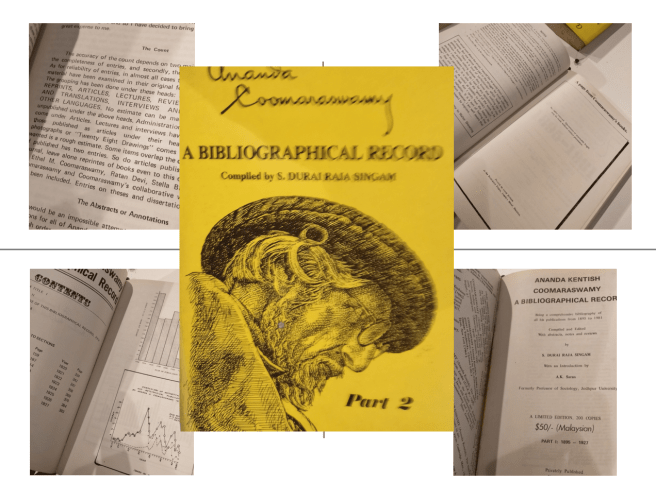
biblio
Event: Tradition as a Measure of the Contemporary Dialog Session
Speakers: Niranjan Rajah, Dr. Simon Soon, and audience!
Date: 17th March 2018
Time:  2 pm to 4.30 pm
Venue: Piyadasa Gallery/ Cultural Centre, Universiti Malaya

Theme: Centered on the lifework of work of Dr. Durai Raja Singam, the session will go on to explore the place of tradition in contemporary Malaysian art and life. Is Art a way of Life? I quote the following from the cover of Durai Raja Singam’s ‘Letters of Ananda Coomaraswamy Vol 5’, 1976 (self published) – “As I wake up each morning I transcribe a letter and as I retire to bed, I copy out another. These are SUBLIME LEAVES I read in the evening of my life”.
Image: https://artklitique.blogspot.ca/2017/12/kl-biennale-ii-gift-of-knowledge.html

Kaala and Caste

As we eagerly await Kaala, Rajinikanth SUPERSTAR’s first movie after his entry into Tamil Nadu politics, it is pertinent to reflect on the messages embedded in this and his last release, Kabali. Both films are the directorial works of PA Rajinth, the rising Kollywood auteur of Dalit origins who has successfully presented critical social messages with mass commercial appeal. Rajinth is vocal on Dalit issues off the screen and here is an important document evidencing his rage and articulating his core message – TAMILS ARE DIVIDED BY CASTE … ADMIT IT!  – It is a message that is steeped deep in Ambedker Blue and, incredulously, one that SUPERSTAR Rajinikanth seems to be taking upon his crisp new political mantle whose own native hue is allegedly a Hindutva Saffron.

BC’s Energy Oroboros 3

800px-Linteau_Musée_Guimet_25974As it is recounted in the Skanda Purana … Kirtimukha or glorious face is what is left of a beast created in the embodiment of Lord Shiva’s rage. In a gesture of containment Shiva ordered it to feed on itself and the Kirtimukha obediently obliged, tail first, leaving only his glorious face.

People pay Hydro

Hydro pays Province

Hydro pays Independants

Peoples pay Hydro

While no where near as the elegant as the beast of Hindu Myth, BC Hydro, the provincial Crown Corporation responsible for electricity, seems to exhibit the same structural properties. Let me explain …  According to an article in Desmogcanada.com  Eoin Finn of the BC Ratepayers Association, notes that BC Hydro is $20 billion in debt and goes on to explain that the corporation has used ‘deferral accounts’ to develop a further $6 billion  of debt that is misrepresented as an asset. All this, according to Finn, gives BC Hydro the worst debt to equity ratio of any public or private utility in North America.

Finn explains how this huge debt was built up over a period of 15 years by the previous Liberal government as it funded itself from BC hydro coffers to the tune of $3 billion regardless of income, or rather debt. They didn’t permit rate increases for electoral reasons. To top it all, they set up a privatization programme, wherein BC Hydro was obliged to buy power from Independant Power Producers (IPP) at rates that would cover the IPP’s expenses and capital costs’ regardless of market realities. It seems that BC Hydro presently buys power at a rate of $93 per megawatt hour and sells it for $88. As such, all we have today of a corporation that has been steadily eating itself for 15 years is its Glorious face – its Kiritimukha!

Image: https://en.wikipedia.org/wiki/Kirtimukha

https://www.desmog.ca/2018/03/02/what-you-need-know-about-bc-hydro-s-financial-mess-and-site-c-dam


Rajini’s Black is Blue!

The boss is back and his colour is Black but it seems a to be a Black tinted with strong hues of Blue. The eagerly awaited trailer for Kaala is out and for me, and most of the 10 million other early viewers, the thrill ain’t gone! SUPERSTAR adulation aside however, there has been a lot of talk about Rajinikanth’s colour in the context of his recent entry into Tamil Nadu politics. The concern has been, as his friend and rival in life, art and now in politics, Kamal Haasan, has put it,  that Rajinikanth’s hue is Saffron. Saffron is the colour of the Hindu nationalist (Hindutva) politics of India’s ruling BJP, with whose values Rajinikanth has shown some affinities.

In my own view the equation of nation state with religion, that Hindutva represents, is a tragic and disastrous misunderstanding and misuse of both religion and nation. Nevertheless, there is still hope that Rajinikanth is not on the Hindutva page and that his colour may not be saffron after all! Kaala is the followup to Rajni Sir’s earlier collaboration with activist director PA Rajinth. Rajinth is a ground breaking mainstream Kollywood director who is of Dalit origins, and who brings Dalit issues to the central forum of contemporary Indian cultural life. In their previous collaboration, Kabali, this dark duo addressed the caste issue both with external references and reflexive dialogue that deconstructs character roles in Tamil cinema.

In the Kaala trailer Black is presented as the colour of class resistance, but the colour of our hero’s the Mumbai ghetto is clearly blue. Blue is the dominant roof colour in an ariel shot of the ghetto. As observed in an Indiaglitz.com commentary,  it is also the colour of the hero’s ghetto flag, the colour of co-star Huma Qureshi’s dress, and also of the drapery that surrounds her in a dance sequence. Blue is the colour associated with the great Indian and Dalit leader B R Ambedkar, who always wore blue suits. Indeed, Blue is the colour of Buddhism and, symbolically speaking, the opposite of the aforementioned Saffron. Blue has become the colour of the Dalit resistance that Ambedkar set into motion at the time of Indian independence. While it must be noted that the hero’s own spouse (one presumes) is seen dressed in a saffron saree, one is not unjustified in hopefully speculating that Rajinikanth’s Black is, indeed, just the darkest shade of Blue.

https://youtu.be/hOe0U6nIrNo