Early Internet Art in Malaysia 8

I had begun my practice as an artist in the late 1980’s with a series of paintings and had moved onto a more self-consciously critical performance/ installation practice when, in 1995, I found the World Wide Web, with its capacities for instantaneous connectivity, hypertextual linking and multimedia convergence. I then transferred my practice to this new medium and between 1996 and 1998 made two web works and La Folie de la Peinture (1998), is the second of these. It is archived in fragments on the Wayback Machine.

At the center of this work was a remediation of a set of installation photographs, linked in such a manner as to represent movement through the space, with the experience of each ‘work’ recast as a multimedia experience (WAV, GIF, MOV and VRML files). The text (hypertext) was an integral part of this web work and in it, I set out some contextualizing ideas. These ideas were also presented within a wider theoretical framework in a paper titled Toward a Universal Theory of Convergence: Transcending the Technocentric View of the Multimedia Revolution presented at INET 1998 in Geneva. These points originally made in 1998 are presented below –

* With the emergence of abstract colour-field painting, the placement of works on the gallery wall became integral to the presentation and, in the light of this transient ‘installation’ aspect of the presentation, photographic documentation began to take on a new significance.

* While the ‘installation shot’ confirms the uniqueness of the ‘site’ of the installation, this photographic documentation leaves its own mass (mechanical reproduction) condition unindexed and has, quite surreptitiously, become the ‘extended’ medium, of installation art.

* As bandwidth increases and multimedia technology goes online, fluidly articulating the remote experience of image, moving image, text and sound in an interactive ‘virtual reality’, it will become increasingly difficult to differentiate between an actual place, person or thing from its image or representation.

* As the representations contained on the multitude of servers on the Internet exist in virtual proximity, ‘here’ and ‘there’ have been brought together in the ‘now’ of fiber optic connectivity. The instantaneous connectivity of computer mediated communication, appears to have eliminated geographical distance and the modern/ postmodern distinction of ‘site’ and ‘non-site’ is no longer be meaningful.

https://web.archive.org/web/19990826231718/http://www.kunstseiten.de/installation/

https://web.archive.org/web/20160103142357/https://www.isoc.org/inet98/proceedings/7c/7c_1.htm

Early Internet Art in Malaysia 7

One of the themes of my work in the 1990’s was a reclamation of the international contemporary art discourse from a national perspective. If postmodernism had displaced the hegemony of international of modernism with a disruptive array of regional, national and marginal discourses. While my own work was clearly located within the ambit of this postmodernist deconstruction, I had become disenchanted with its increasingly oppressive orthodoxy. Postmodernism promised an enabling relativity of signification but, by definition, it denied credence to all sign systems that acknowledged a transcendental signified. While this enabled alternative perspectives to rise over the overbearing horizon of modernism. it conflicted with contemporary approaches, like mine, that were grounded in the traditional world-view. As I worked on the protocols of a post-postmodern rapprochement of the traditional and the contemporary, I knew that my first obligation was to make a gesture of defilement.

In my web work of 1998, La Folie de la Peinture (1998), the ZIP‘ hyperlink took the user through to a photograph of an intervention I made in 1995 at the site of architect Bernard Tchumi’s work at the Parc de la Vilette, Paris. Speaking sculpturally, if the modernist work ‘occupies’ the physically empty, semiotically blank and ideologically neutral ‘non-site’ of the gallery or the urban plan, the postmodern work comes off the walls or blueprint and, arguably, ‘constitutes’ its ‘site’. There is no longer an object in view as the postmodern ‘figure’ becomes part of its own ‘ground.’ If the expansion of sculpture into the ‘site’ specific installation had deconstructed the institutional ‘white cube’ of modern art, the purposeless ‘red cubes’ of Bernard Tchumi’s‘ architectural installation, perversely articulate postmodernism’s negative ontology on a monumental scale. Conceived in collaboration with the progenitor of deconstruction himself, Jacques Derrida, and erected under the reactionary auspices of the French state, Tchumi’s follies epitomize the paradox of the 20th Century avant-garde – the inevitable institutionalization of its negative impulse. In my intervention at the site of this intellectually astute yet politically oblivious folly, I pissed on one of these futile structures and all that it seemed to represent!


https://web.archive.org/web/19990826231718/http://www.kunstseiten.de/installation/

http://tschumi.com/projects/3/

Early Internet Art in Malaysia 6

In 1998, I made my 2nd web art work titled La Folie de la Peinture (The Madness of Painting), fragments of which are archived on the Wayback Machine site. This was a comprehensive, if condensed, articulation of my critique of the movement from modernist abstraction, via conceptualism, to the photographic ontology of postmodern installation and performance art. My own practice had been evolving along this trajectory until, in the mid 1990’s, I found the World Wide Web with its capacities for instantaneous connectivity, hypertextual linking and multimedia convergence. La Folie de la Peinture was featured in the 2nd Multimedia Asia Pacific Festival (MAAP) 1999,: COLLAPSING GEOGRAPHIES online exhibition which was part of the Third Asia Pacific Triennial, Screen Culture and Virtual Triennial program.

The opening image of this navigational work was a direct flatbed scan of a bottle of Cuvée Tradition French wine that we had recently consumed. The two hyperlinked hotspots on the image that took the user through to the rest of the work were a ‘black square’ and the word ‘ZIP‘, references to the endgame in American hard-edged abstraction. Black square took the user through to a set of photographic images, remediated documentation, of an installation made at the Tower House Studios, Goldsmith’s college, London in 1991. These images were linked in such a manner as to enable a simulation of the navigation of the space and the experience of each ‘work’ in the new web ‘space’ as a reinterpretation in multimedia for online viewing. This part of the web work was augmented with physical objects from the original installation and a new desktop VR interface, when La Folie de la Peinture was presented at the Substation, Singapore in 2001 in a two-person show with Joe Lewis titled, Layers … Reality … Memory.

ZIP‘ took the user through to a modified image of a vulgar performative intervention I made in 1995. at the site of Bernard Tchumi’s architectural reification of the deconstructive ethos at the Parc de la Vilette, Paris.

https://web.archive.org/web/19990826231718/http://www.kunstseiten.de/installation/

https://www.maap.org.au/exhibition/maap-1999-collapsing-geographies/

http://tschumi.com/projects/3/


Early Internet Art in Malaysia 5

When the INET (annual Internet Society conference) came to Malaysia in 1997, I presented a paper titled “Art After the Internet: The Impact of the World Wide Web on Global Culture.” In this paper I analyzed how the Internet. was being shaped by various national and transnational forces and how esoteric postmodern theories were turning into everyday sensibilities. I presented examples of how artists were mapping the aesthetic, social, and political contours of the emerging electronic “terrain” as they made critical use of the World Wide Web to construct new arenas for their work.

This paper also set out the framework of Ideas that contextualized my web art work The Failure of Marcel Duchamp/Japanese Fetish Even! which had just launched in 1996. At the heart of this work was the new capacity to mix live (so to speak) images from servers that were geographically dispersed. I explained this extension of the modernist collage into the postmodern medium of jpegs, HTML, hotspots and servers as follows, “One of the artistic consequences of the mass circulation of printed images was the invention of collage. The artist no longer had to hand make an image but could now “cut out” two pre-existing images and combine them to generate another. The production of meaning was achieved by appropriating and recontextualizing found or ready-made material. Far from its esoteric origins as a mode of criticism, recontextualizing has now become the normal way of generating new content. In the popular music industry, the appropriated track or sample has been widely used for a long time and “mixing,” be it live or in the studio, is elevated to a form of art. With the availability of digital image manipulation and high resolution scanning, this approach now prevails even in the most commercial areas of the visual arts. With the development of technology acting as “frames,” the online textual, visual, multimedia “mix” is already happening”. Of note is the fact that Netscape had introduced ‘frames’, which involved the screen being divided into independent, scrollable areas in 1995.

This paper is archived on its entirety on the Wayback Machine.

https://html.com/frames/

https://web.archive.org/web/19970729041144/http://www.isoc.org/inet97/proceedings/G3/G3_1.HTM

https://www.w3.org/People/Raggett/book4/ch02.html

Early Internet Art in Malaysia 4

In the introduction to his profound work on the cinematic image, Signatures of the Visible, Fredric Jameson writes, “The visual is essentially pornographic, which is to say that it has its end in rapt, mindless fascination.” Explicit pornography is thus the acknowledgement of the true nature of the filmic image, a “potentiation” of its call to “stare at the world as though it were a naked body.” There is no doubt in my mind that, from the perspective of the Traditional School (with Coomaraswamy and Guenon as exemplars), that the visual abjection that Jameson attributes to cinema is simply the culmination of what one might refer to as the ‘ocularization’ of human civilization in the course of Humanism, the Enlightenment and Modernism.

Exemplified by the entrenchment of single-point perspective as the representation of reality (indeed as reality itself!) in art of the European Renaissance, this ocularity has permeated all aspects of social, cultural and political life in the mainstream of our civilization. Jameson orients his critique towards the centrality of images in consumerist society, wherein our very sense of being in the world is first and foremost visual. He says, “our society has begun to offer us the world … as … a body, that you can possess visually, and collect the images of.” It is this very photographic and pornographic ontology that Marcel Duchamp had earlier articulated and developed through his oeuvre. In all his work, be it his readymades, the Large Glass and most profoundly, in Etant Donnes, this obscenity, inherent in the image is both indexed and exploited.

This critique of visuality and the nature of the image is the impetus for my own The Failure of Marcel Duchamp/ Japanese Fetish Even! (1996). According to Tyrus Miller, underlying the various senses of Duchamp’s use of the word ‘delay’ in connection of the work The Bride Stripped Bare by her Bachelors, Even is that the glass of the so called ‘ Large Glass’ is a medium in which and through which ‘delay’ is realized and manifested, “by virtue of its material properties of transparency, reflectiveness, and refraction of light, and hence, by implication, the splitting of a present act of seeing into temporally different streams, ranging from maximum to minimum delay in the passage of light.” Indeed, I saw the slow download speeds of the early WWW as a vivification of Duchampian ‘delay.’

Further, like Jameson, I saw that the fight about power and desire had to be brought to that place “between the mastery of the gaze and the illimitable richness of the visual object.” In making The Failure of Marcel Duchamp/ Japanese Fetish Even!, I took my own object to the site of Duchamp’s notorious diorama, Étant Donnés, and made an intervention and a photograph. My image was later digitally composited with a pornographic one appropriated from the internet and offered as an online presentation which was inaccessible without the conscious intention of the viewer. If the viewer chose ‘to proceed,’ this gave rise a slow download of the new image, delayed by the bandwidth of the Internet of the day! The first commercial modem, was introduced in 1962 by AT&T and had a download speed of 300 bits per second. By 1994 speeds had reached at 28.8 kilobits per second and in then 1996 the 56K modem was invented. Very slow in comparison to speeds we are familiar with today. For instance, my provider in Vancouver offers fiberoptic data plans with 75mega bits per second (MBPS), 940mbps and 1500mbps download rates.

Also of note is the fact that in January of 1996, 5 years after Tim Berners-Lee published the first ever website and also the year in which The Failure of Marcel Duchamp/ Japanese Fetish Even! premiered at ISEA, there were, according to one source, only 100,000 websites (unique hostnames) on the World Wide Web (an alternative figure for that year is 257,601 websites). Today (as of August 2021), there are well over 1.5 billion websites. Of these annual numbers, 75% are believed to be inactive sites or parked domains.

https://thecharnelhouse.org/wp-content/uploads/2017/09/Fredric-Jameson-Signatures-of-the-Visible-1992.pdf

https://modernistreviewcouk.wordpress.com/2020/07/03/a-delay-in-glass-marcel-duchamp-the-possible-and-the-aversion-to-deja-vu/

https://whirlpool.net.au/wiki/d_u_m_h

https://www.pingdom.com/blog/the-web-in-1996-1997/

https://www.internetlivestats.com/total-number-of-websites/

Early Internet Art in Malaysia 3

In 1993 I made my first trip to New York. My wife Jane and I were living in London and had bought a Hoover vacuum cleaner. As part of the infamous Hoover promotion of that time we got two free tickets to New York. I had, as an artist from Malaysia practicing in the London art scene, been working with found objects and performative interventions as a means of making a Janus faced engagement with the Modernist canon. I had already identified the ceramic bedpan as the the key readymade in my growing collection of objects – a pastiche and/or parody of the primordial Duchampian readymade. I sourced a plastic version that would be more suitable for travel and planned the performative action. Jane and I left for our holiday with an exciting itinerary that included a visit to the Twin Towers, a Cecil Taylor concert, a William Dafoe one-man theatre performance, a personal tour of the Electronic Arts Intermix archive, a social visit with pioneering avant-garde pianist Margret Leng Tan and an intervention planned in the space of Duchamp’s Étant Donnés installation at the Philadelphia Museum of Art…. The photograph featured in the The Failure of Marcel Duchamp/Japanese Fetish Even!  was taken by Jane as documentation of this intervention.

In 1995 Jane and I moved to Kuching so that I could take up a teaching position at the Faculty of Applied and Creative Arts at the Universiti Malaysia Sarawak (UNIMAS) which had been established in 1992 as the newest University in Malaysia. Its founding coincided with Malaysia’s sophisticated Information and Communication Technologies (ICT) strategy of the 1990s and we had a cutting edge Internet infrastructure and a commensurate technology centered academic programme. I had been practicing my art in the space between material objects, text, image, performance and the physical placement of the work in space. I had found myself developing a critical practice wherein context became part of the work. As I stated in an Interview with Roopesh Sitharan, it was when I joined UNIMAS that “I was introduced to the WWW, and most significantly, I met Hasnul who was already teaching there and in the early stages of developing an art and technology agenda initially envisioned by the visionary artist and theorist Ismail Zain. Hasnul encouraged me to consider the new media and I quickly realized that the new user friendly, ubiquitous, hypertextual, multimedia Internet was a medium that I had been waiting for – more and more my installation works had been yearning for a transcendence of materiality, geography, narrative hegemony and context – and this transcendence is what the WWW appeared to offer, even embody in its very ontology. I made ‘Failure of Marcel Duchamp’ in 1996”.

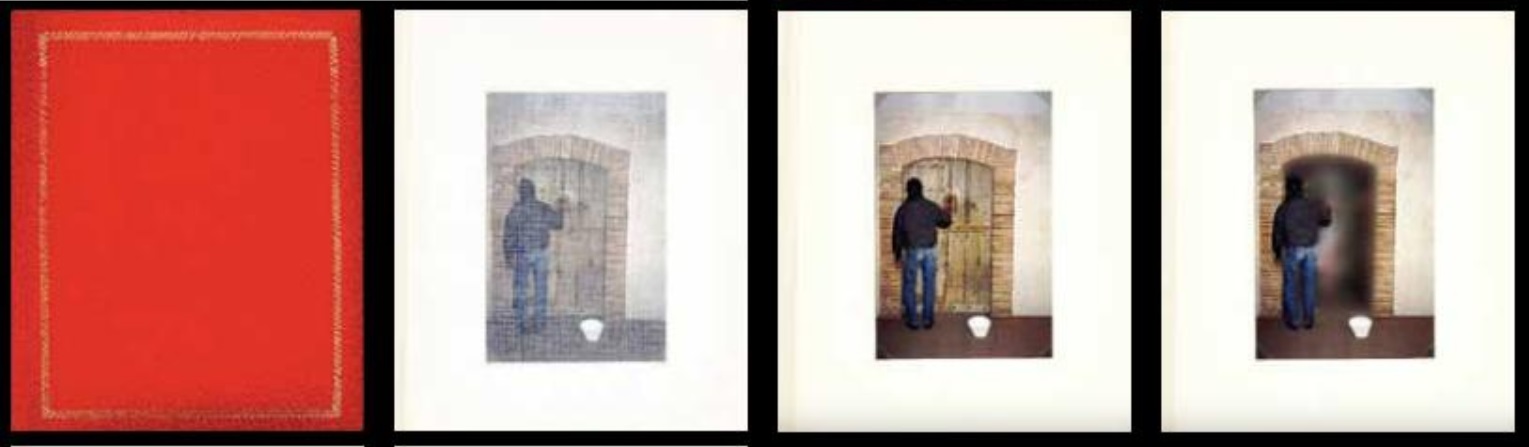
When this web work was presented at Explorasi, the inaugural Faculty of Applied and Creative Arts exhibition at the Petronas Gallery in 1997, I also presented a set of four framed 8.3 x 11.7 inch computer prints (in a single edition). Each print represents one key stage in the interaction of the website. The last print was framed with a frosted section in the glass to veil the pornographic element in the print. This website went offline after some years and was reconstructed and temporarily revived for the Relocations exhibition curated by Roopesh Sitharan for ISEA 2008 in Singapore. It was hosted on the 12 Gallery website during the period of the event. What remains of the work today is just the bare bones as archived without images on the Wayback Machine website. In this light the framed set of prints is the only tangible residue of what is slowly but surely being acknowledged as the first online artwork in Malaysia and Southeast Asia. This print set was exhibited again as part of Rupa Malaysia curated by Reza Piyadasa in 2001.

https://thehustle.co/the-worst-sales-promotion-in-history/

https://www.eai.org/

https://www.margaretlengtan.com/

https://danm.ucsc.edu/sites/default/files/roopeshthesis.pdf

https://issuu.com/mgtfusm/docs/relocations

https://web.archive.org/web/19990219215837/http://www.hgb-leipzig.de/waterfall/

Early Internet Art in Malaysia 2

In 1996 I made a web work titled The Failure of Marcel Duchamp/Japanese Fetish Even! which is the first Internet art work in Malaysia and, as far as I know, also in Southeast Asia. This work was both an admiring tribute and a harsh parody of Marcel Duchamp’s Étant donnés (Given: 1. The Waterfall, 2. The Illuminating Gas) which is installed at the Philadelphia Museum of Art. In this meticulously realized work, Duchamp cleaves from logos, an abyss of eros. I suggest that it represents the culmination of the humanist trajectory in the philosophy of being, as in its presentation, the visual perspective of the ‘eye’ is fused, or confused, with the ‘I’ of the anthropocentric worldview. In this hypostatization of the ontology underpinning photography, sculptural form and visual image are rendered indifferent, arguably heralding the end of the retinal orientation in the art of the West and the birth of conceptual art. Étant donnés is a paragon of visibility, a par ergon of reality, a hyperreality even!

My own work remixed an image appropriated from a Japanese bondage site, an erotic or pornographic element, within the photographic documentation of an intervention I made at the site of the Duchamp installation in 1993. The erotic element would have been unacceptable on Malaysian servers and so was isolated from the rest of the image and located, with the help of media artist Paul Sermon, on a server at the The Hochschule für Grafik und Buchkunst (Academy of Fine Arts) in Leipzig. Part of the aim of the work was to address territoriality and cultural difference in the Internet. The work underscored the fact that information that was then becoming globally accessible is not universally acceptable. Another aim of the work was to reify, in the context of what was in the mid 1990’s, the ‘slow download’ of the Internet, Fredric Jameson proposition that the visual Image is, in Itself, essentially pornographic. With the advent of the mass access to computer mediated communications brought about by the World Wide Web, Duchamp’s delayed image was no longer an esoteric encounter. It was becoming democratically accessible (Given:) as the slow download (The Waterfall?) on a personal illuminated screen (The Illuminating Gas!).

The The Failure of Marcel Duchamp/Japanese Fetish Even! was launched at a poster session at ISEA 1996. That presentation, from which this post has been developed, was titled Locating The Image In An Age Of Electronic Media .

http://isea-archives.org/docs/1996/proceedings/ISEA96_proceedings.pdf


Early Internet Art in Malaysia

I am honored to be featured in a keynote by Associate Professor Hasnul Jamal Saidon at the 6th ICACA (International Conference on Applied & Creative Arts), Faculty of Applied & Creative Arts, UNIMAS, 18 August 2021. Hasnul generously describes the work I did at the Universti Malaysia Sarawak between 1995 and 2002 as a very important legacy with regard to Internet art and online art in Malaysia. He describes me as the pioneer of Internet art in Southeast Asia and the forerunner in the region of critical engagement in the context of the shift from offline to online art. He notes that my The Failure of Marcel Duchamp/ Japanese Fetish Even! (1996) is the first Internet art work in Malaysia and that I curated the first online exhibition in Malaysia at the 4th Ipoh Arts Festival (1999). I am happy to be remembered and would like to return the recognition by noting that Hasnul is himself a pioneering contributor to electronic art in Malaysia through his early forays into video art, video installation art and his own critical and theoretical writings. Beyond our individual contributions, I believe that it is what we achieved together, by way of curating the 1st Electronic Art Show (1997) and the founding of the Eart ASEAN Online (1999) portal, that constitutes a platform for further developments in Malaysian new media art.

Malaysian Indian Artists 2

In his article on Malaysian Indian artists published in the Penang Monthly, Ooi Kok Chuen writes of J. Anu and myself both being of Sri Lankan Tamil descent. This observation, in the context of the question of Malaysian Indianness, raises two concerns pertaining to blood ties, one intimate and familial and the other, public and communal.

The first is a fact – I am proud to note that Anu and I are not only members of the same community, we are of the same family. Anu’s mother Gana, whom I call Acca, is my cousin, and this relationship is celebrated in an image of the Koboi Balik Lagi series of the Koboi Project.

4 Ikatan Pertiwi
4 Ikatan Pertiwi, Koboi Balik Lagi, https://koboibalikkampung.wixsite.com/baliklagi

The second is a question that underpins Ooi’s own pertinent question – ” WHY ARE THERE so few artists of Indian (including Singhalese) descent in Malaysia?.” It is this – Who is Indian in the Malaysian context? As I have noted in a previous post, Ceylonese Tamils in Malaysia have historically tried to preserve a distinct identity from Malaysian Indians. We have our own organization, the Malaysian Ceylonese Congress (MCC), that has been traditionally aligned to Barisan National. Although the MCC is not a registered political party, it had, until 1981, a senator in the Malaysian parliament’s upper house, the Dewan Negara. However, as Suhaini Aznan notes, Malaysians do not recognize the difference between Indians and Ceylonese and in the 2000 census many Ceylonese were counted as Indians. In this light, MIC seems to have invited the Ceylonese to join up with the Indians but, as Aznan notes the Ceylonese declined. He explains, after Datuk Dr N.K.S. Tharmaseelan, president of the MCC, “every race wanted its own identity to survive.”

It is my own opinion that Malaysian Tamils of Ceylonese origin should, to the extent that the Malaysian Indians will accept us, be absorbed into the category and identity of ‘Indian’. It is not a question of renouncing ones Ceylon Tamil background but, rather, of integrating it into the wider Malaysian Indian mosaic. Regardless of my own identification, however, the question remains, “are Ceylonese Tamils included in the category ‘Malaysian Indian’?” The question of Indianness does not stop here. It is clear from Ooi’s placing ‘including Singhalese’ within parenthesis in his question, that even he feels his placement of this other Ceylonese community within the Indian category is questionable. And then there is the question of the Mamak or Indian Muslims – it is unclear if they would all be equally happy with the highlighting of their belonging to the Indian category, as some might be in the process of transferring their identity into the ‘Malay’ category’.

Returning to the first concern, that of family, artist T. Selvaratnam is related to both Anu and myself, but that is a story for another blog post.

https://penangmonthly.com/article/20432/spotlight-on-indian-malaysian-artists?fbclid=IwAR3CB_s6jMPFH2A8P-4UcFwKXz6oUzjwBn7aRXijHkPNp35Aob8d9iE5Gto

https://en.wikipedia.org/wiki/Malaysian_Ceylonese_Congress

https://www.thestar.com.my/opinion/letters/2005/03/27/standing-up-for-the-ceylonese

Malaysian Indian Artists

“WHY ARE THERE so few artists of Indian … descent in Malaysia?” Veteran Malaysian art Journalist Ooi Kok Chuen presents an overview of Malaysian Indian artists in the Penang Monthly which opens by questioning the dearth of Indians in the national canon. He goes on to offer some possible answers that he notes have been ‘bandied about,’ “Economic status, parental / social disapprobation, opportunity, (lack of) role models, patronage, minority syndrome (proportionately smaller population, of only 6.2%), “estranged” Indian-ish themes, and discrimination,” Ooi rightly states no preference amongst these reasons. Nevertheless, while it is difficult to go beyond speculation in this matter, I am glad he has asked the question publically. It is an important one as it points to the undeniable fact that, while a few Malaysian Indians have made significant contributions to the practice and theorization of the visual arts, overall, our numbers are low.

This is something that gave me pause during my years of intense involvement in the Malaysian scene from 1996 to 2002. I gave my support and encouragement to individual artists with a sense of communal allegiance whenever the opportunity came my way, but my own concerns during that period were national and international, and while intra-national questions of race and communalism formed the framework of my practice, I was not community oriented. I often wonder if I could have engaged more actively with my community in those years in terms of promoting and developing the arts.

This personal reflection and recollection, triggered by Ooi’s question, leads to a more fundamental question that lies at the heart of my Malaysian identity. Am I an Indian first or a Malaysian first? An Indian Malaysian or a Malaysian Indian! Of course, an analogous question arises for the other races of our multiethnic nation. Such pondering has even been turned into political capital. Malaysia’s present Prime Minister is reported to have said, back in 2010, “I am a Malay first, I want to say that … But being Malay does not mean that you are not Malaysian.” While the country struggles with the horrors of the recent covid-19 crisis atop an ongoing and now long running political one, the foundations of the nation are being shaken. Will the old Malaysia, whose founding social contract is premised on communalism, survive this crisis in its present form? Will we regress to a more ethnocentric paradigm, or will we emerge from this national trauma with a reformed and refined national agreement? These questions might seem far from the world of Malaysian art but this is where the stream of thoughts that flowed that follows from Ooi’s innocent, perhaps not so innocent question, has brought me – WHY ARE THERE so few artists of Indian … descent in Malaysia?”

https://penangmonthly.com/article/20432/spotlight-on-indian-malaysian-artists?fbclid=IwAR3CB_s6jMPFH2A8P-4UcFwKXz6oUzjwBn7aRXijHkPNp35Aob8d9iE5Gto

https://www.japantimes.co.jp/news/2020/03/01/asia-pacific/politics-diplomacy-asia-pacific/muhyiddin-yassin-malaysia/