Early Internet Art in Malaysia 12

 CyberForum
desktop VR
avatar
virtual reality
Niranjan Rajah pictured during a session as guest at the CyberForum, Art Center College of Design, Pasadena in 2000

One of the highlights of my days as an early Internet artist in Malaysia is being invited as a guest at Michael Heim’s (author of The Metaphysics of Virtual Reality) virtual world Cyberforum as a guest in 2000. Other speaker that year were leaders in the field – Cliff Joslyn, David Weinberger, Howard Bloom, Francis Heylighen, Bruce Damer, William J. Mitchell, Lev Manovich, Carol Gigliotti, Brenda Laurel, Katherine Hayles, and Peter Lunenfeld, so I was really excited at being invited to participate.

Even with my high expectations the session was not a disappointment. Michael’s pioneering Virtual Worlds Theory and Design team began hosting chat interactions in avatar worlds at the end of 1999. with the aim of researching the dynamics of these spaces as sites for the exchange of ideas about digital technology. I was both a speaking subject and an object for observation in this encounter. Among the outcomes of this research for Michael Heim was an important paper about what he calls ‘flow; in virtual world interactions. The paper was titled The Feng Shui of Virtual Reality. I myself gained great insights about web based virtual reality and the nature of immersion. I incorporated a desktop VR representation of the installation, when La Folie de la Peinture (1998) was presented at the Substation, Singapore in a show titled, Layers … Reality … Memory in 2001. I also incorporated these ideas into a paper titled From the Aesthetics of perceptual Objects to the Metaphysics of Interactivity which was presented at the 15th International congress for Aesthetics in Tokyo. This paper won an Asian Scholars Award from the International Aesthetics Association and the Japanese Society for Aesthetics (this paper is not available online).

CyberForum was built in Active Worlds and was accessible using the Eduverse 3D browser. Active Worlds, was an early Virtual Reality community on the web that let users builtd, visit and chat in 3D worlds in millions of square kilometers of virtual territory. The log of my CyberForum session is available on the Wayback Machine.

https://web.archive.org/web/20030224021716/http://www.mheim.com/cyberforum/

https://www.goodreads.com/book/show/1879758.The_Metaphysics_of_Virtual_Reality

https://web.archive.org/web/20030224021716/http://www.mheim.com/cyberforum/

https://web.archive.org/web/20030214114520/http://activeworlds.com/#

https://web.archive.org/web/20040506025007/http://www.mheim.com/cyberforum/html/summer2000/log-S3.html

Early Internet Art in Malaysia 11

Between 1997 and 1998 Dr. Raman Srinivasan of Chennai and I collaborated to build, theorize and install a virtual temple on the Internet. The Temple was built in VRML in Chennai and located on a server in Sarawak. It was presented to the international interactive arts community in a paper titled Sacred Art in a Digital Era: Or the Internet and the Immanent Place in the Heart at the 2nd Consciousness Reframed conference at the University of Wales College in Newport (not available online).

The VRML temple was based on sketches of the Hridayaleeswarar temple, an existing physical structure in Thirunindravur about 20 miles from Chennai. According to the Sthala Purana or founding legend of the temple, it was in fact erected by the great King Kadavaraja based on the proportions of what was initially a virtual temple built in devotional meditation by the sage Poosalar. Some years after our project ended and the website was taken down, I returned to the VRML model to make a 3D print of its central Icon, Lord Shiva Nadaraja. This image was sent to Chennai from Vancouver where it was consecrated by Srinivasan’s father and used in domestic worship.

At the heart of this project was the integration of the traditional and the technological relationships of the real to the virtual. There was first, in the sthala purana, a movement from myth to physical architecture and then, in our VRLM/Internet project, from the actual architecture to the virtual model and, finally moving from the VRML model to the physical 3D print. This work was grounded in the belief that as the World Wide Web makes the Internet globally accessible, it must become a medium for the living sacred traditions of the world.

I went on to develop a framework for the rapprochement of digital technology and sacred tradition in papers like the following –


http://www.immersence.com/publications/1999/1999-NRajah-full.html

https://web.archive.org/web/20030106042915/http://www.uoc.edu/artnodes/eng/art/rianan0302/rianan0302.html

.

Early Internet Art in Malaysia 10


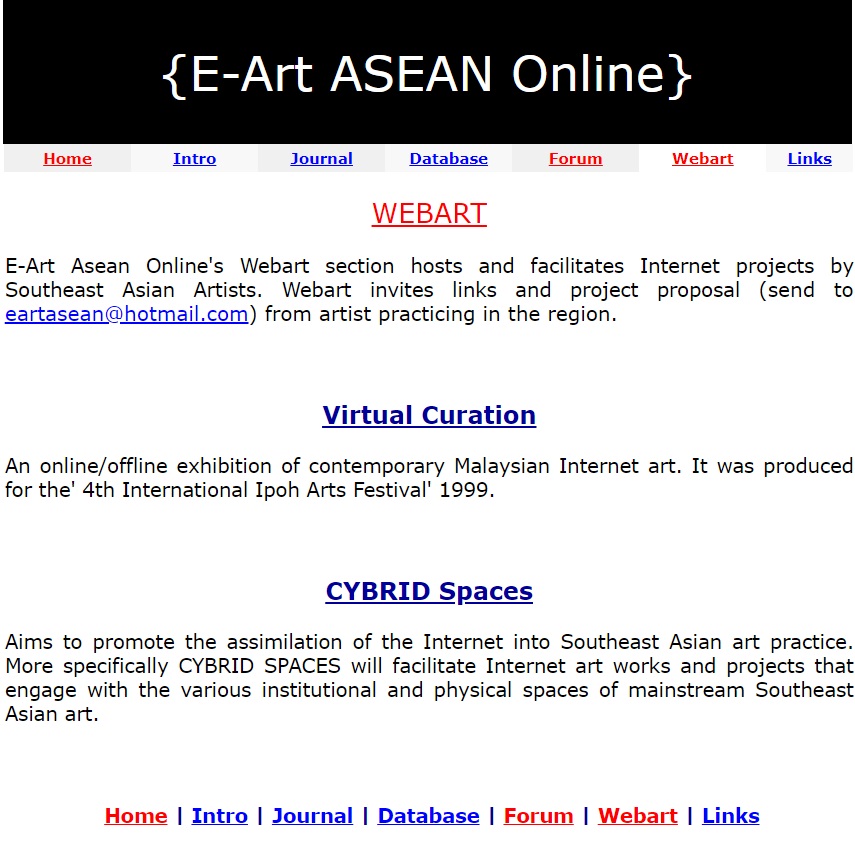
In 1999 Hasnul Jamal Saidon and I founded the pioneering Eart ASEAN Online portal which, as the text on the homepage used to say, was an “interactive resource for electronic art in Southeast Asia. This site consists of a comprehensive Database of new media art including profiles of artists and samples of artworks, a Journal dealing with the historical development of electronic art in South East Asia, theoretical and critical issues related to the use of electronic media in the visual arts as well as reviews and analysis of electronic artworks, a Forum for online discussion as well as Links to related websites worldwide and a space for developing and hosting Webart by Southeast Asian Artists.”

The Webart  section of Eart ASEAN set out a criteria for web art and a theory of how online art works might be integrated within the physical infrastructure of offline world. Integrating Peter Anders notion of cybrid space, which involves the complete coalescence of the virtual and the real, and Jochaim Blank’s problematization of the presentation of net projects in physical space, I outlined a curatorial agenda for our own ‘Cybrid Spaces.’ The call for submissions read – “CYBRID SPACES aims to promote the assimilation of the Internet into Southeast Asian art practice. More specifically CYBRID SPACES will facilitate Internet art works and projects that engage with the various institutional and physical spaces of mainstream Southeast Asian art. CYBRID SPACES will work with artists (offline and online) in the region bridging communication gaps in the arts infrastructure of the region. CYBRID SPACES invites projects proposals (send to eartasean@hotmail.com) from artist practicing in the region”.

This first presentation under this rubric was a set of web works that explored this new ontology. These were all works, that featured in the Virtual Curation exhibition at the Ipoh Arts Festival and they were linked via the curatorial essay I wrote for that event. This was the inaugural presentation of CYBRID SPACES and many of the works, particularly Ting Ting Hook’s Tortoise Zone, exemplified the proposed agenda. Sadly, there were no further presentations in this section as, having given it our all for a couple of years, both Hasnul and I moved on to other things.

It must be said, in this regard, that the Eart ASEAN Online portal was clearly ‘ahead of its time.’ This was both, the measure of its success and the cause of its ultimate failure. The project may have arrived at a time when the Malaysian electronic art scene was too well rooted in the analog realm to envisage the benefits of virtual community (this was well before the advent of social media) and dissemination. Also, it seems that the majority of those becoming involved in the new media were more in tune with industry and, although we had incorporated the the applied dimension of the arts into our programme and welcomed them, we could not induce much participation. Most significantly we had set out the geopolitical framework of ASEAN for the project and most of the states involved – Indonesia, Malaysia, Philippines, Singapore and Thailand, Brunei Darussalam, Viet Nam, Lao PDR and Myanmar and Cambodia would take some years before gaining the Internet infrastructure and capacity to participate. Nevertheless, Eart ASEAN laid out the theoretical framework and exemplified the social networking and platform development any such endeavor would have to involve, even today.

https://web.archive.org/web/20011115023154/http://free.freespeech.org/eartasean/index.html

https://kathryn23.wordpress.com/2010/10/26/cybrids/

https://web.archive.org/web/20021231121635/http://free.freespeech.org/eartasean/html/webart/cybrid.html

https://web.archive.org/web/20020103051608/http://free.freespeech.org/eartasean/html/webart/virtualcuration.html

https://web.archive.org/web/20120305183403/http://www.fortunecity.com/westwood/gucci/369/index.html

Early Internet Art in Malaysia 9

Tortoise_Zone” by Ting Ting Hook.

In 1999, I curated the first exhibition of online artworks in Malaysia for the ‘4th International Ipoh Arts Festival.’ The artists in the show were all students and faculty from the Faculti Seni Gunaan dan Kreatif (FSGK), Universiti Malaysia Sarawak (UNIMAS). Indeed, between 1995 and 2000 Hasnul Jamal Saidon and I had worked to established FSGK as a leading new media hub in Southeast Asia. My own art work during this time was web-based and our students were encouraged to explore and integrate this newly accessible interface to the Internet into their art works. The exhibition in Ipoh presented an array of computers each featuring one web art work, in an effort to integrate the private online experience into the more public offline space.

The show included Prasembah 2000: An Antologi La…! by Hasnul and Rainmaker by John Hii, both of which are not available on the Internet archive. There are two works for which fragments are still available on the Archive. Below are sections from my curatorial statement for the show

In Tortoise_Zone by Ting Ting Hook explores the relationship between interior and exterior in human consciousness in terms of the notion of ‘place’. Using the conventions of painting and installation art as points of departure for an Internet work, he invokes a slightly hallucinatory mode as the viewers disembodied impressions of a virtual place impinge on his or her encounter with an analogous physical site. The differences between the outdoor site in Kuching, Sarawak, and the online interactive domain increase with time, as the intense tropical climate rapidly takes its toll. Eventually the physical place is left as a residue of an event, a ‘marked site’, a scar even! While the virtual site, remains unweathered and unchanged in perpetuity. Documentation of the real site was uploaded to the website as the event progressed.

Modernism withdrew from painting the function of representing visual reality and gave it instead the role of constructing a pure aesthetic order. Painting became the “high” art form of an initiated intellectual elite. Each artist was considered a genius and each painting a unique object of aesthetic veneration. Mondrian represents the epitome of modernist aesthetic obsession and intellectual alienation. “Mondrian in Action! by Ling Sew Woei deconstructs this great icon in a simple online engagement with the “viewer.” “Composition with Red, Yellow and Blue” is extended into the third dimension and rendered interactive in VRML. As we pan, rotate and zoom in and out of the now sculptural copy, we overcome the passivity with which we would have approached the original. Indeed, we are able to manipulate the image from whatever remote location we happen to occupy. The “PLEASE DO NOT TOUCH” of modern painting is undermined in the ‘PLEASE INTERACT’ connectivity of the Internet.

Another early UNIMAS student work, for which fragments are available in the Internet Archive, was not included in the Ipoh show. It was however included in my INET 1998 paper presentation in Geneva and is described below –

My 12 Friends: Representation Less Reflection” by Tham Chee Chong uses the of the Internet to present images of boxes whose contents index the personalities of his friends. Initially the friends were invited to put something of theirs, something of themselves even, in the boxes. These were then marked with the names of the friends and installed in a grid in a public space in the community to which the friends belong. The shift from intimacy to the public sphere and then on to the anonymity of the Internet is an abstraction of sorts — from the meaningful to a situation in which reflection would yield no meaningful result. We are left with signifiers for personality without specific referents. Tham uses some of the particularities of the interface to engage the viewer in a playful movement from box to box that yields no conclusive result.

https://web.archive.org/web/20120305183403/http://www.fortunecity.com/westwood/gucci/369/index.html

https://web.archive.org/web/20001008024520/http://www.geocities.com:80/Paris/Bistro/6268/index.htm

https://web.archive.org/web/19991206164911/http://members.xoom.com/yellowchair/allboxes/12boxes/cover.htm

https://web.archive.org/web/20010418041908/http://www.freespeech.org/eartasean/html/webart/virtualcuration.html

https://web.archive.org/web/20160103142357/https://www.isoc.org/inet98/proceedings/7c/7c_1.htm