The Koboi Returns 2023 – 17

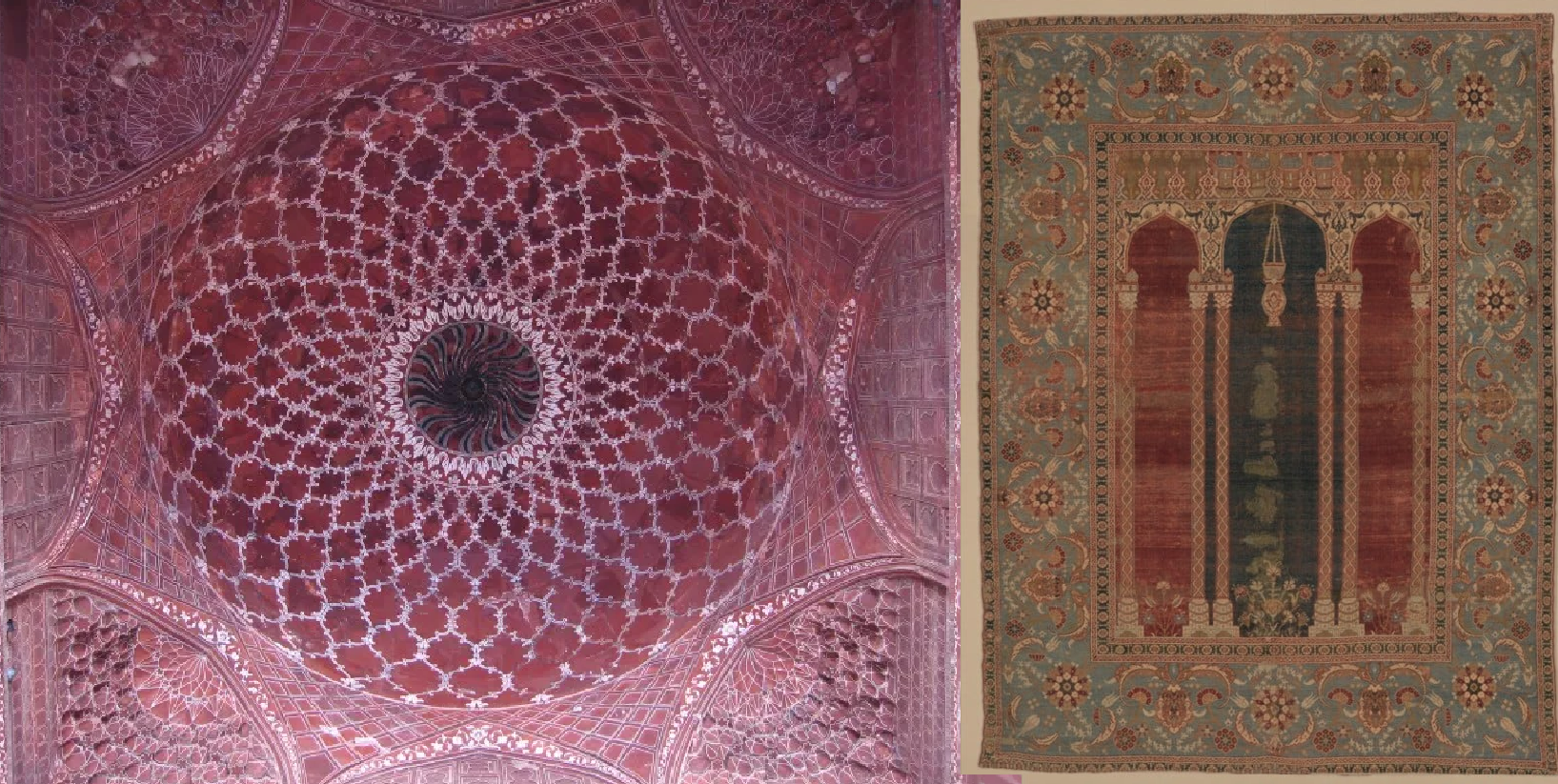
The Shajarat al-Tûba  (Tree of Bliss) and the Olive Tree are arguably, central features, albeit indirectly, of Islamic art and architecture. The patterns on the interior of many Mosque domes, like that of the Taj Mahal mosque, have been interpreted as the Tree of Bliss. Remember this is an inverted tree that grows downwards with its roots in the primum mobile giving great theophanic significance to gazing up the centre of the dome from below. Then, there is the Mirab, or directional niche of the mosque, which marks the Qibla or orientation towards the Kaaba. This is always a concave or negative space, that is kept empty of all content other than its decorative surface. It is the way it recieves and reflects light, that is central to its design and to its meaning. It could be said, with reference to the Holy Koran, that that the light that is articulated in the Mirab and in Mosque architecture in general, is the embodiment of the light of the oil of the olive tree, a tree that is neither of the east nor of the west (so centrally located with regaed to the sun, that it is facing the sun in all directions, and in passing time) and whose oil glows forth of itself. Glass lamps are a significant feature in Mosque architecture and, with this in mind, it must be noted that, in the the design of the Islamic prayer rug, there is sometimes a coalesence the motifs – niche, plant and lamp.

Image: https://ibnarabi360.wordpress.com/2012/01/07/%D8%B2-%D9%A1/ / https://www.dailyartmagazine.com/art-of-mihrab/

https://islamqa.info/en/answers/1920/trees-mentioned-in-the-quraan-and-sunnah

https://smarthistory.org/a-glass-lamp-illuminating-sultan-hassans-mosque-and-madrasa/

https://islamqa.info/en/answers/1920/trees-mentioned-in-the-quraan-and-sunnah
The Koboi Returns 2023 – 16

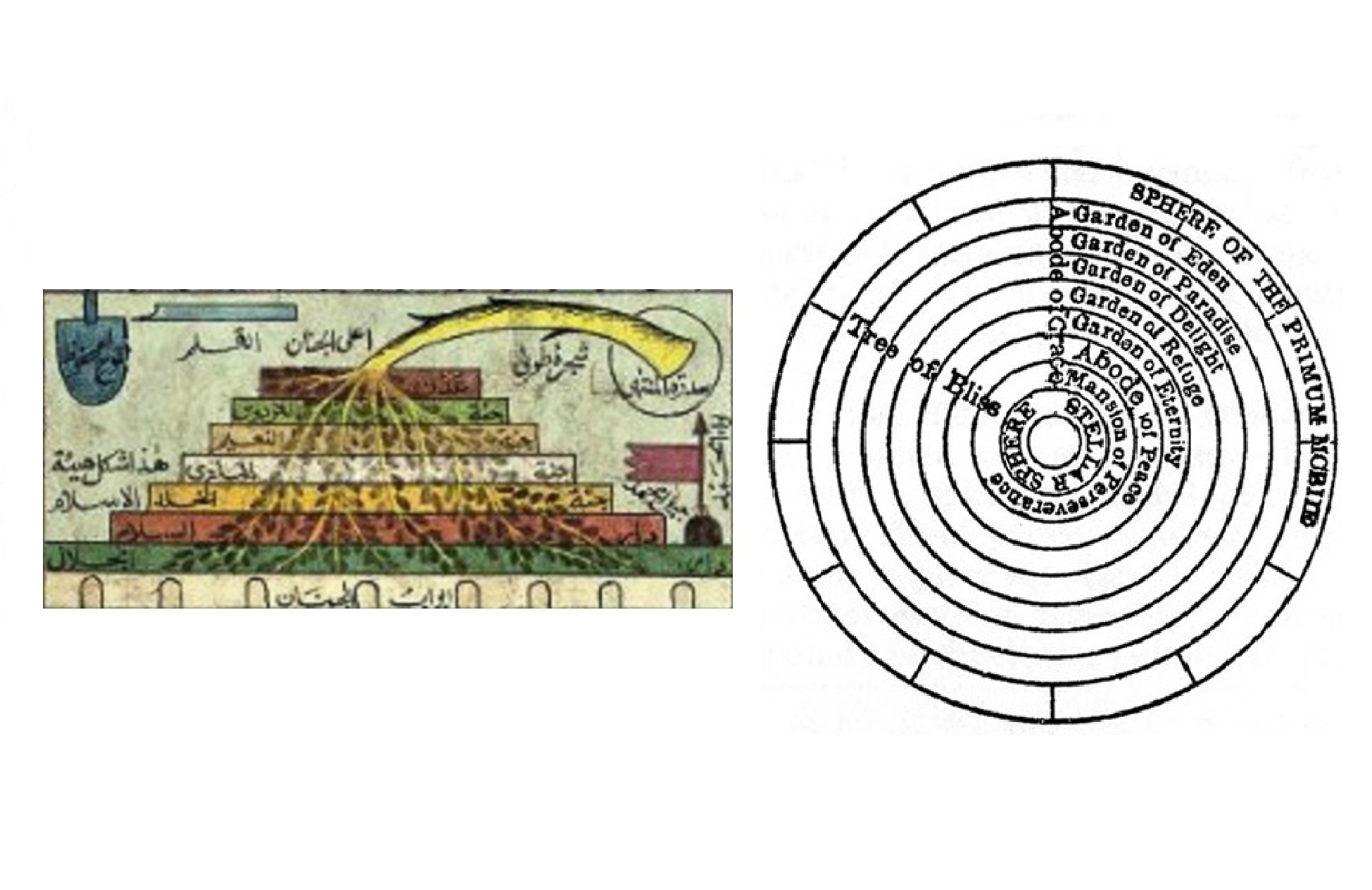
The Shajarat al-Tûba, or the Tree of Bliss is described in the hadîth as giving such shade that “a rider could travel for a hundred years without crossing it.” Ibn Arabî places this tree at the centre of a cosmology, inverted and rooted in the the primum mobile, where sits the Throne of Allah. The Tree of Bliss is thus, “rooted in the ground of Being and fed by the water of Essence.” The sphere of Earth is at the centre of the concentric cosmos, followed by the stellar sphere of the physical cosmos, and then various heavens. Beyond the Seventh Paradise, that of Eden, is the primum mobile. The Tree of Bliss is rooted in this Abode of Allah, with its trunk rising through Eden and spanning the levels of Paradise. While the Shajarat al-Tûba is not mentioned in the Holy Koran, its ontological significance might be understood in terms of the metaphysics of the Olive Tree which is mentioned. The Olive Tree stands “neither of the East nor West” and its “oil would almost glow forth (of itself) though no fire touched it.” In geometric terms, this tree seems to mark a centre and, in causal terms, an origin. The oil iof this tree is the source and being of earthly light, just as Allâh is the light of all that is the heavens and on the earth.

https://magictransistor.tumblr.com/post/121976939786/ottoman-diagram-of-heaven-and-hell-caucasus

https://islamqa.info/en/answers/1920/trees-mentioned-in-the-quraan-and-sunnah

http://www.studiesincomparativereligion.com/public/articles/The_Tree_Symbol_in_Islam-by_Noble_Ross_Reat.aspx#_ftnref71

The Koboi Returns 2023 -15

The Pohon Beringin represents the three levels to the Malay cosmos, with fishes, serpents, or crocodiles at the bottom level representing the lower Waterworld; land animals like monkeys or elephants in the middle level representing the earth; birds at the top level representing the Skyworld. This tripartite division maps on to 5. Kayangan (Skyworld), 1 Dunia (earth) and 6 Dasar Laut (Waterworld) of the more complex Malay Cosmology as laid out by Md. Salleh Yaspar. In this syncretic premodern Malay Cosmology that integrates all previous ontologies with that of Islam, 5. Kayangan is consonant with Syurga and 6 Dasar Laut with Neraka, above and below the 1 Dunia, respectively.

This structure arguably underpins the story of Haji Batu whose ship went down while crossing the fearsome Pusat Tasek, as he was journeying to perform the Haj, Haji Batu clung to the Pokok Pauh Janggi and drew himself up on 7 nails that he drove into the tree. When he reached the top, he attached himself to the Burong Roc (Garuda) and flew Westward on his Journey to Mecca. (see Walter William Skeat’s Malay Magic). The climbing up the 7 nails can be seen as being an analogy for rising from the seven realms of Hell (the 7 nails could equally represent the seven levels of Heaven of course, or both (seven is a number of multilayered cosmological and soteriological significance) and the flight of the Burong Roc, for an ascent into the Skyworld.

In fact, in the sufi understanding of being, which is based on the Quranic Jihad al-nafs (battle agains the self), there are seven nafs or states of desire through which the adept must rise. The lowest state is Nafsi Ammara, a manifestation of the animal soul in man.  In Nafsi Lawwama man hears the voice of his conscience and tries to resist carnal desires. Nafsi Mulhima is when man receives direct instructions from his Lord. In Nafsi Mutmainna, man is freed of self-indulgence and finds peace and tranquility in a state of piety and obedience to the Lord. Nafsi Radiyya is when man accepts all that happens without any resentment or pain, and when good and bad become equal to him. In Nafsi Mardiyya man assumes the Divine Attributes, leaving behind the material realm, and finally, in Nafsi Safiyya, man reaches the purity of perfect harmony.

https://ejournal.um.edu.my/index.php/MJPVA/article/view/13970/9368

http://www.gutenberg.org/files/47873/47873-h/47873-h.htm

https://sufipathoflove.com/seven-levels-of-being/

The Koboi Returns 2023 – 14

This diagram can be seen as a representation of the metaphysics and the physics of the traditional Malay cosmos. The Pokok Pauh Janggi is the axis mundi of the 1 Dunia (world) connecting the depths of the 6 Dasar Laut (Underworld) to the heights if the 5. Kayangan (Skyworld). Its location at the 2 Pusat Tasik Pauh Janggi puts it directly above the ‘Underworld’. In the tale of Haji Batu, the drew 7 nails that the Haji drove into the tree to make his way up might be a reference to the 7 levels of Hell as understood in Islam. His passage to from the top of the Pokok Pauh Janggi to Mecca by clinging to the mythical Burong Roc (Garuda) might equally signify his ascent towards the Heavens.

If the Pokok Pauh Janggi anchors the metaphysical model of the Malay cosmos, the physics of this world is represented by Giant crab that lives at its base. This crab blocks the opening of the drain of the waters at the bottom of the Pusat Tasek (whirlpool or navel of the seas) and it is the daily movements of this crab, that cause the oceans to rise and fall cyclically, giving us both the currents and the tides.  (see Walter William Skeat’s Malay Magic).

The above diagram combines the outlines of two Kelantan Wayang Kulit puppets (Pokok Pauh Janggi and giant crab) collected by Walter William Skeat in the late 19th Century, with an adaptation of a diagram of the Malay Cosmos by Md. Salleh Yaspar in Malaysian World View edited by Mohd Taib Osman.


https://www.gutenberg.org/files/47873/47873-h/47873-h.htm

https://books.google.com.my/books?id=-AR-V3ymAzoC&pg=PA274&lpg=PA274&dq=mohd+taib+osman+pusat+tasik&source=bl&ots=Ck_2ts5cvN&sig=ACfU3U189ige7-t0nqKA3yKcLDIurDnuoQ&hl=en&sa=X&ved=2ahUKEwi688zh_sDmAhVT8XMBHaXlC1QQ6AEwAXoECAwQAQ#v=onepage&q=mohd%20taib%20osman%20pusat%20tasik&f=false