Tahi Besi Menjadi Pagar

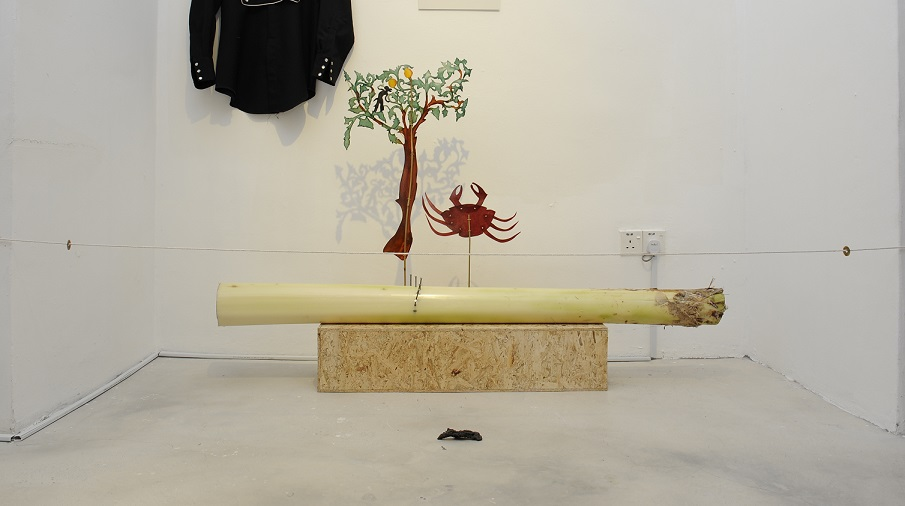
In the gallery presentation of the puppets from the Pokok Pauh Janggi performance at Kapallorek Artspace in Bandar Seri Iskandar, Perak, I used a mineral deposit known as tahi besi or ‘iron waste’ – ‘iron shit’ in a more direct translation!. (In fact I was told that the piece I aquired was called tahi pelangi or rainbow shit due to its vivid metallic colouration). I aquired it from a vendor at the Lata Iskandar waterfall on the old Tapah road. It was explained to me that the local Semai and Malay people used it as a protective medium to ‘fence’ or protect themselves and their premises from the intrusion of unwanted entities from the sprit world. The Pokok Pauh Janggi installation features the Koboi Balik Lagi series of photographs and runs from 5th Aug – 30th Sept 2023 at the Kapallorek Artspace in Bandar Seri Iskandar, Perak.

http://mistik707corner.blogspot.com/2010/12/tahi-besi.html#

https://en.wikipedia.org/wiki/Semai_people

https://www.kapallorek.com/my/

Tahi Besi Menjadi Pagar 2

Soalan: Boleh tak tahi besi kita buat berobat nak pagar rumah, guna ayat Koran?

Jawapan: Boleh buat Tahi Besi buat pagar, tetapi pagar kawat itulah! (Hah, pasal dia besi … buat kawat 🙂 )
Yang tak boleh nya, tahi besi itu yang kita jaga rumah kita. Tak Boleh! Dan kalau Al Koran dengan selawat … boleh. Faham? Aaa!

The above extract.from a ceramah by Ustaz Azhar Idrus evidences a persistant syncreticism in the quotidian practice of Islam amongst the Malays of the peninsular. The Bahasa transcription is my best translation of the Ustaz’s loghat Kelate. I would appreciate corrections. Please send to nrajah@sfu.ca

The Pokok Pauh Janggi installation runs from 5th Aug – 30th Sept 2023 at the Kapallorek Artspace in Bandar Seri Iskandar, Perak.

http://mistik707corner.blogspot.com/2010/12/tahi-besi.html#

https://www.kapallorek.com/my/

Jampi Upacara Pokok Pauh Janggi


MEMANGGIL SEMANGAT
Aku minta’ ampun kapada kramat yang memegang tanah disini!

Aku minta’ ampun kapada sagala Hantu Tinggi!

Aku minta’ ampun juga kapada sagala Jambalang Wayang!

MEMBUKA PANGGONG
Hei Jin Tanah, Hantu Tinggi,
Hoi Jembalang Wayang ! Dato’ jangan membisakan,
Aku tahu asal ‘kau jadi : Dato jangan membe’ngkakkan :
Bintang Timor asal ‘kau mula jadi. 
Biar sagala makhluk suka permainan kita,
Berkat Dato’ Batara Guru Menyaksikannya.

MEMBUANG BADI
O Si Lanang, Si Lambaun,
Si Ketor, Si Becheh, orang yang berampat,
Ambil kembali bahagian-kau dari rusa ini!

O Mentala Guru
Asa sabulan, dua sabulan,Tiga sabulan, ampat sabulan,
Lima sabulan, anam sabulan,
Tujoh sabulan, malam di-angkau,
Siang di-aku.
Sa’ekor aku bawa balik,
Sa’ekor aku tinggalkan!

MENGAMBIL ISYARAT
Mata, telinga, mulut, hidong,kaki, tangan, bulu, hati, jantong, limpa, tandok.

MENGHIDUPKAN PATONG POKOK PAUH JANGGI
Hei Toh Mambang Puteh, Toh Mambang Hitam
Yang diam di bulan dan matahari
Melempahkan sakalian ‘alam asal-nya pawang,
Menyampeikan sakalian hajat-ku,
Melakukan sagala kahandak-ku,
Hidulaplah Pokok Pauh Janggi!

MENGHIDUPKAN PATONG KETAM GERGASI

Al-salam ‘aleikum !
Hei sahabat-ku Mambang Tali Harus,
Yang berulang ka pusat tasek Pauh Janggi,
Sampeikan-lah pesan-ku ini,
Bangunkan Jambalang Ketam Gergasi!

Diubahsuai daripda catatan Walter William Skeat dalam bukunya Malay Magic.

http://www.gutenberg.org/files/47873/47873-h/47873-h.htm

Pokok Pauh Janggi

EXTENDED TILL 8TH OCT 2023

In December 2019, The Koboi Project presented Dari Pusat Tasek at the Percha Artspace, Lumut, Perak. This presentation was realized as an installation in the gallery accompanied by a performance in the public space of the Lumut waterfront. Dari Pusat Tasek addressed salient themes of contemporary Malaysian society while also engaging with the forms and meanings of traditional Malay ritual and folklore. Documentary images of this earlier Percha Artspace performance forms the content of the Panji Pauh Ulung photographic series of the Koboi Project. The Koboi now returns to Malaysia again, to present Pokok Pauh Janggi, a related performance and exhibition at Kapallorek Artspace, Bandar Iskandar, Bota, Perak. The exhibition features the Koboi Balik Lagi series of photographs and runs from 5th Aug – 30th Sept 2023. OPENING EVENTS on 5TH AUG: Performance 6pm, Reception 8pm, Artist Talk 9pm.

The Koboi Returns 2023 – 17

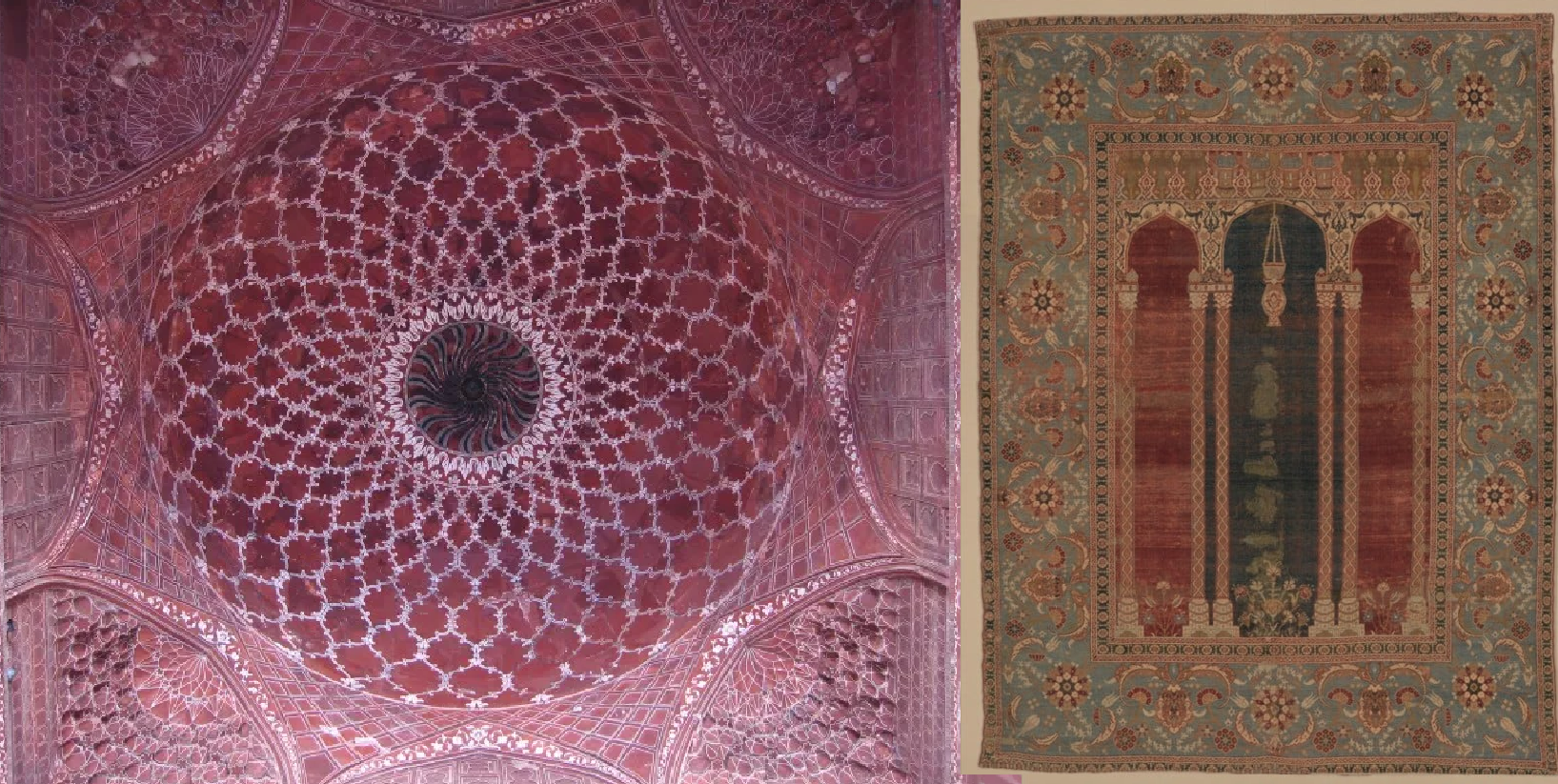
The Shajarat al-Tûba  (Tree of Bliss) and the Olive Tree are arguably, central features, albeit indirectly, of Islamic art and architecture. The patterns on the interior of many Mosque domes, like that of the Taj Mahal mosque, have been interpreted as the Tree of Bliss. Remember this is an inverted tree that grows downwards with its roots in the primum mobile giving great theophanic significance to gazing up the centre of the dome from below. Then, there is the Mirab, or directional niche of the mosque, which marks the Qibla or orientation towards the Kaaba. This is always a concave or negative space, that is kept empty of all content other than its decorative surface. It is the way it recieves and reflects light, that is central to its design and to its meaning. It could be said, with reference to the Holy Koran, that that the light that is articulated in the Mirab and in Mosque architecture in general, is the embodiment of the light of the oil of the olive tree, a tree that is neither of the east nor of the west (so centrally located with regaed to the sun, that it is facing the sun in all directions, and in passing time) and whose oil glows forth of itself. Glass lamps are a significant feature in Mosque architecture and, with this in mind, it must be noted that, in the the design of the Islamic prayer rug, there is sometimes a coalesence the motifs – niche, plant and lamp.

Image: https://ibnarabi360.wordpress.com/2012/01/07/%D8%B2-%D9%A1/ / https://www.dailyartmagazine.com/art-of-mihrab/

https://islamqa.info/en/answers/1920/trees-mentioned-in-the-quraan-and-sunnah

https://smarthistory.org/a-glass-lamp-illuminating-sultan-hassans-mosque-and-madrasa/

https://islamqa.info/en/answers/1920/trees-mentioned-in-the-quraan-and-sunnah

The Koboi Returns 2023 – 16

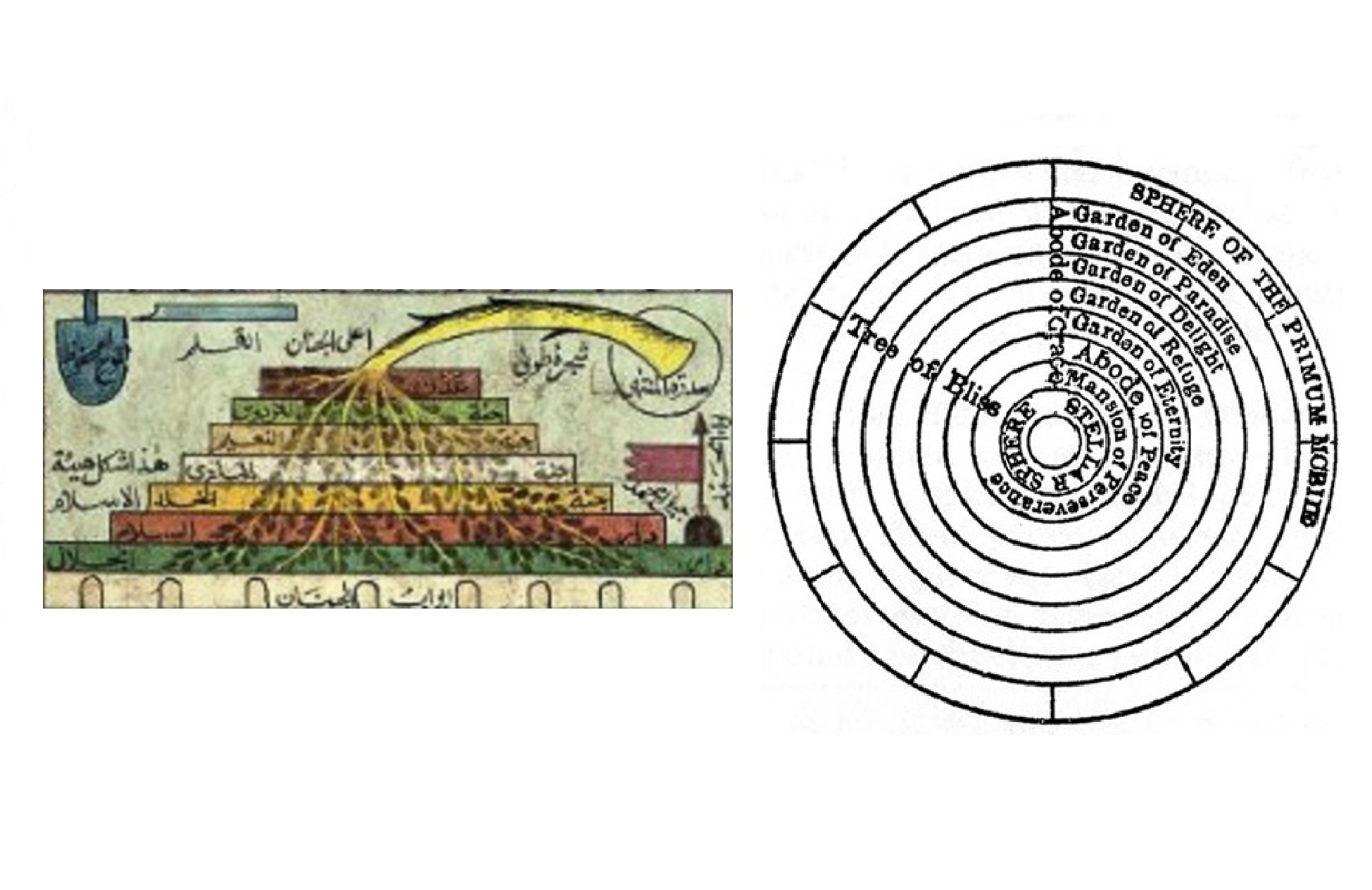
The Shajarat al-Tûba, or the Tree of Bliss is described in the hadîth as giving such shade that “a rider could travel for a hundred years without crossing it.” Ibn Arabî places this tree at the centre of a cosmology, inverted and rooted in the the primum mobile, where sits the Throne of Allah. The Tree of Bliss is thus, “rooted in the ground of Being and fed by the water of Essence.” The sphere of Earth is at the centre of the concentric cosmos, followed by the stellar sphere of the physical cosmos, and then various heavens. Beyond the Seventh Paradise, that of Eden, is the primum mobile. The Tree of Bliss is rooted in this Abode of Allah, with its trunk rising through Eden and spanning the levels of Paradise. While the Shajarat al-Tûba is not mentioned in the Holy Koran, its ontological significance might be understood in terms of the metaphysics of the Olive Tree which is mentioned. The Olive Tree stands “neither of the East nor West” and its “oil would almost glow forth (of itself) though no fire touched it.” In geometric terms, this tree seems to mark a centre and, in causal terms, an origin. The oil iof this tree is the source and being of earthly light, just as Allâh is the light of all that is the heavens and on the earth.

https://magictransistor.tumblr.com/post/121976939786/ottoman-diagram-of-heaven-and-hell-caucasus

https://islamqa.info/en/answers/1920/trees-mentioned-in-the-quraan-and-sunnah

http://www.studiesincomparativereligion.com/public/articles/The_Tree_Symbol_in_Islam-by_Noble_Ross_Reat.aspx#_ftnref71

The Koboi Returns 2023 -15

The Pohon Beringin represents the three levels to the Malay cosmos, with fishes, serpents, or crocodiles at the bottom level representing the lower Waterworld; land animals like monkeys or elephants in the middle level representing the earth; birds at the top level representing the Skyworld. This tripartite division maps on to 5. Kayangan (Skyworld), 1 Dunia (earth) and 6 Dasar Laut (Waterworld) of the more complex Malay Cosmology as laid out by Md. Salleh Yaspar. In this syncretic premodern Malay Cosmology that integrates all previous ontologies with that of Islam, 5. Kayangan is consonant with Syurga and 6 Dasar Laut with Neraka, above and below the 1 Dunia, respectively.

This structure arguably underpins the story of Haji Batu whose ship went down while crossing the fearsome Pusat Tasek, as he was journeying to perform the Haj, Haji Batu clung to the Pokok Pauh Janggi and drew himself up on 7 nails that he drove into the tree. When he reached the top, he attached himself to the Burong Roc (Garuda) and flew Westward on his Journey to Mecca. (see Walter William Skeat’s Malay Magic). The climbing up the 7 nails can be seen as being an analogy for rising from the seven realms of Hell (the 7 nails could equally represent the seven levels of Heaven of course, or both (seven is a number of multilayered cosmological and soteriological significance) and the flight of the Burong Roc, for an ascent into the Skyworld.

In fact, in the sufi understanding of being, which is based on the Quranic Jihad al-nafs (battle agains the self), there are seven nafs or states of desire through which the adept must rise. The lowest state is Nafsi Ammara, a manifestation of the animal soul in man.  In Nafsi Lawwama man hears the voice of his conscience and tries to resist carnal desires. Nafsi Mulhima is when man receives direct instructions from his Lord. In Nafsi Mutmainna, man is freed of self-indulgence and finds peace and tranquility in a state of piety and obedience to the Lord. Nafsi Radiyya is when man accepts all that happens without any resentment or pain, and when good and bad become equal to him. In Nafsi Mardiyya man assumes the Divine Attributes, leaving behind the material realm, and finally, in Nafsi Safiyya, man reaches the purity of perfect harmony.

https://ejournal.um.edu.my/index.php/MJPVA/article/view/13970/9368

http://www.gutenberg.org/files/47873/47873-h/47873-h.htm

https://sufipathoflove.com/seven-levels-of-being/

The Koboi Returns 2023 – 14

This diagram can be seen as a representation of the metaphysics and the physics of the traditional Malay cosmos. The Pokok Pauh Janggi is the axis mundi of the 1 Dunia (world) connecting the depths of the 6 Dasar Laut (Underworld) to the heights if the 5. Kayangan (Skyworld). Its location at the 2 Pusat Tasik Pauh Janggi puts it directly above the ‘Underworld’. In the tale of Haji Batu, the drew 7 nails that the Haji drove into the tree to make his way up might be a reference to the 7 levels of Hell as understood in Islam. His passage to from the top of the Pokok Pauh Janggi to Mecca by clinging to the mythical Burong Roc (Garuda) might equally signify his ascent towards the Heavens.

If the Pokok Pauh Janggi anchors the metaphysical model of the Malay cosmos, the physics of this world is represented by Giant crab that lives at its base. This crab blocks the opening of the drain of the waters at the bottom of the Pusat Tasek (whirlpool or navel of the seas) and it is the daily movements of this crab, that cause the oceans to rise and fall cyclically, giving us both the currents and the tides.  (see Walter William Skeat’s Malay Magic).

The above diagram combines the outlines of two Kelantan Wayang Kulit puppets (Pokok Pauh Janggi and giant crab) collected by Walter William Skeat in the late 19th Century, with an adaptation of a diagram of the Malay Cosmos by Md. Salleh Yaspar in Malaysian World View edited by Mohd Taib Osman.


https://www.gutenberg.org/files/47873/47873-h/47873-h.htm

https://books.google.com.my/books?id=-AR-V3ymAzoC&pg=PA274&lpg=PA274&dq=mohd+taib+osman+pusat+tasik&source=bl&ots=Ck_2ts5cvN&sig=ACfU3U189ige7-t0nqKA3yKcLDIurDnuoQ&hl=en&sa=X&ved=2ahUKEwi688zh_sDmAhVT8XMBHaXlC1QQ6AEwAXoECAwQAQ#v=onepage&q=mohd%20taib%20osman%20pusat%20tasik&f=false


The Koboi Returns 2023 -13

According to Malay folklore, far out in in the deep ocean somewhere, there is said to be a momentus whirlpool, known as Pusat Tasik, that swirls down to the depths, draining the waters into the earth. Rooted to the ocean floor at this nexus, is the fabulous Pokok Pauh Janggi that reaches up to the heavens. In the Selangor Malay tale of Haji Batu, a man, journeying to perform the Haj, had to cross the fearsome Pusat Tasek (Siapa terjatuh atau tergelincir, tersuruplah ia ke dalam pusar. Tempat menanti segala mara bahaya. Tempat duduk menantinya Nenek Sepit Pentala Naga di Laut Buih Gelombang Tujuh. Kalau si lemah yang sampai, maka hilang ghaiblah ia di mulut Raja Naga yang maha bisa). As Haji Batu’s ship went down, he clung to the Pokok Pauh Janggi in the middle of the swirl of the Pusat Tasek, and following instructions he had received in a dream, drew himself up on 7 nails that he drove into the tree. When he reached the top, he found the nest of the mythical gigantic Burong Roc (Garuda) that lived there.  He waited therein and when the Roc returned, he attached himself to the bird and flew Westward on his Journey to Mecca. (see Walter William Skeat’s Malay Magic). The above diagram presents the outline of a Pokok Pauh Janggi Wayang Kulit puppet collected by Walter William Skeat from a Tok Dalang from Kelantan in the late 19th Century. Could the figure in the tree possibly be this Haji Batu about to be attach himself to the Burong Roc, or could it be the great bird itself (note the aquline features of the figure’s head)? Perhaps it is a composite figure combining the two entities?

http://www.gutenberg.org/files/47873/47873-h/47873-h.htm

The Koboi Returns 2023 – 12

The Pohon Beringin puppet of Kelantan Wayang Kulit is closely related to the Gunungan puppet from the Javanese Wayang, which as Fiona Wong E Chiong and Ghulam-Sarwar Yousof explain, is used by the Dalang to bring a whole cosmos of gods, demons, humans and other creatures to life for the time of the performance. While this magical function is understated in the Kelantan tradition, the Pohon Beringin puppet is used to mark the opening and closing of the performance. The Pohon Beringin is a microcosm of the universe, with a central tree motif surrounded by flora and fauna, sky, water, flame, and mountain motifs. There are three levels to this cosmos, with fishes, serpents, or crocodiles at the bottom level representing the lower Waterworld; land animals like monkeys or elephants in the middle level representing the earth; birds at the top level representing the Skyworld. The Pohon Beringian is associated with the universal Tree of Life motif, which, in Islam, is called the Tree of Immortality or šajaratu l-ḫuld . If in Christianity, there are 2 trees in the garden of Eden – the tree of the knowledge of good and evil the fruit of which God forbade to Adam and Eve , in Islam, there is only one tree, the šajaratu l-ḫuldat located at the centre of the Garden of Eden.

.Image: Pohon Beringin puppet/Persian Sarouk Farahan Tree of Life Rug, Late 19th Century 

https://ejournal.um.edu.my/index.php/MJPVA/article/view/13970/9368

http://catholic.cafe/2020/02/04/what-is-the-tree-of-life-and-why-was-it-guarded-by-the-cherubim/

https://nazmiyalantiquerugs.com/antique-persian-fine-sarouk-farahan-tree-of-life-rug-48624/