In the Malay cosmology, 5. Kayangan is located above the Pokok Pauh Janggi which rises through the2.Pusat Tasik Pauh Janggi, which is directly above the 6 Dasar Laut or ‘underworld’. The downward spiral of the Pusat Tasek and the upward thrust of the enormous Pokok Pauh Janggi both pass through the 1. Dunia, combining to create the axis mundi of the Malay cosmos. In the Islamic cosmos (see Jachimowicz) the force of creation moved down from the Throne of God, through the planetary spheres to the sublunary realm where its moment stirs the elements into becoming the manifest world. A line of force is drawn from the highest heaven down to the sublunary region echoing the axial function and dynamics of the Pokok Pauh Janggi.
Image: Diagram of the physical cosmos from Jachimowicz, Edith (1975). Islamic Cosmology/ The Malay Cosmos diagram is adapted after Md. Salleh Yaspar in Malaysian World View edited by Mohd Taib Osman.
In the Malay cosmology, 5. Kayangan is located above the Pokok Pauh Janggi which rises through the2.Pusat Tasik Pauh Janggi, which is directly above the 6 Dasar Laut or ‘underworld’. In the Islamic cosmology, in the uppermost realm of Heaven, there is the Toba tree, “whose shade a rider could travel for a hundred years without crossing it.” Down below, in the realm of the seven hells, the Zaqqum tree rises out of the Hellfire with fruit-stalks like the heads of devils. Then there is the Sidrat al-Muntahā, which marks the boundary between the seven realms of paradise and the three realms of the domain of God. There is also the Tree of Immortality in the Garden of Eden which plays a significant role in Man’s descent into the world to experience the difficulties of life and death, by whose difference, the nature of paradise can be understiood. There is also the the Olive Tree that stands in no place, or every place. According to the Holy Koran, it stands “neither of the East nor West.” It’s oil is the source and being of earthly light.
I would like to suggest that the Pokok Pauh Janggi can be seen as a single tree that serves similar functions to the various Holy Trees of Islam. Anker Rentse offers an insight into the syncretic assimilation of the local Malay Cosmology with the Islamic one. “Shurga, Heaven, is on the top of Pauh Janggi, and Nuraka, Hell, is down below its roots. A gigantic hole between the roots causes the ocean water to disappear into hell’s big boiling-pot, kawah nufaka, whence the whirl-pool. Underneath the pot burns everlasting fire. A dragon guards the hole, the gate to hell (pintu nuraka) with its body in order to prevent the ocean from running dry.
Image: Eighteenth century Ottoman diagram from the Causus/ The Malay Cosmos diagram is adapted after Md. Salleh Yaspar in Malaysian World View edited by Mohd Taib Osman.
Rentse, Anker. “NOTES ON MALAY BELIEFS.” Journal of the Malayan Branch of the Royal Asiatic Society 11, no. 2 (117) (1933): 245–51. http://www.jstor.org/stable/41559822.
According to Edith Jachimowiczhe, Islamic cosmology echoew the geocentricity of the Aristotalian/ Ptolemaic Cosmos. The space between the surface of the earth and the sphere of the Moon is known as the sub-lunary region. It is the realm of the elements, of minerals, plants, and animals, and of generation and corruption. In addition to the eight Ptolemaic spheres (Moon or falak al-kamar, Mercury or falak al-utarid, Venus or falak al- zuhra, Sun or falak al- shams, Mars or falak al-Mirrikh, Jupiter or falak al-Mushtari, Saturn or falak al-Zuhal, Fixed Stars or falak al-burudj), the Islamic cosmos has a ninth Sphere, the Sphere of Spheres or falak al-aflak. This astronomical (physical) model of the cosmos is integrated with a theological (metaphysical) cosmology.
In the explaining the relationship of the structure of the Islamic cosmos to the process of the primordial Creation, Jachimowiczhe cites theTasawwurat of Nasir al-Din Tusi, in which it is said that the creative force “reached the Throne of God, from the Throne reached the pedestal and, from the Pedestal again, descended to the sphere of Saturn and became attached to it. Again, it descended further, from one sphere to the other, until it reached the sphere of the moon. Then the exaltations and the rays of the stars, by the force of that energy and through the mediation of the sphere of the moon, fell upon the elements. This was certainly the cause which stirred the elements …” A line of force is drawn from the highest heaven down to the sublunary region and, given the notion of the ‘stirring’ of the elements, we might impute a turning movement to this force. In my own imagination, this line of force echoes the axial function and dynamics of the Pokok Pauh Janggi which links Dasar laut to Kayangan in the Malay cosmos.
Image: Jachimowicz, Edith (1975). Islamic Cosmology. In Carmen Blacker, Michael Loewe & J. Martin Plumley (eds.), Ancient Cosmologies. Allen & Unwin.
The Sidrat al-Muntahā or the Lote Tree of the Utmost Boundary, is mentioned in the Qur’an and Hadith in the context of the Holy Prophet’s ascent (Mi’raj) to receive the Islamic revelation. According to Edith Jachimowicz this tree marks the boundary between the outermost of the seven realms of paradise (astronomical Heaven) with the first of the three realms of God (theological Heaven). It is a boundary that no angel and no man other than the Holy Prophet has crossed.
While there is no direct connection or association between the Sidrat al-Muntahā of the Islamic revelation and the Pokok Pauh Janggi of the Alam Melayu, there is a clear coincidence of placement within their respective cosmologies. If the Sidrat al-Muntahā is directly below the highest heavens, the Pokok Pauh Janggi is rooted at the threshold of underworld, directly above the Dasar Laut ’. Both trees seem to stand on a cosmic axis, perhaps with differing emphasis on cosmogonic (literal structure of the universe) and escathalogical (allegory of the soul’s final journey at the end of time) aspects of existance.
Jachimowicz, Edith (1975). Islamic Cosmology. In Carmen Blacker, Michael Loewe & J. Martin Plumley (eds.), Ancient Cosmologies. Allen & Unwin.
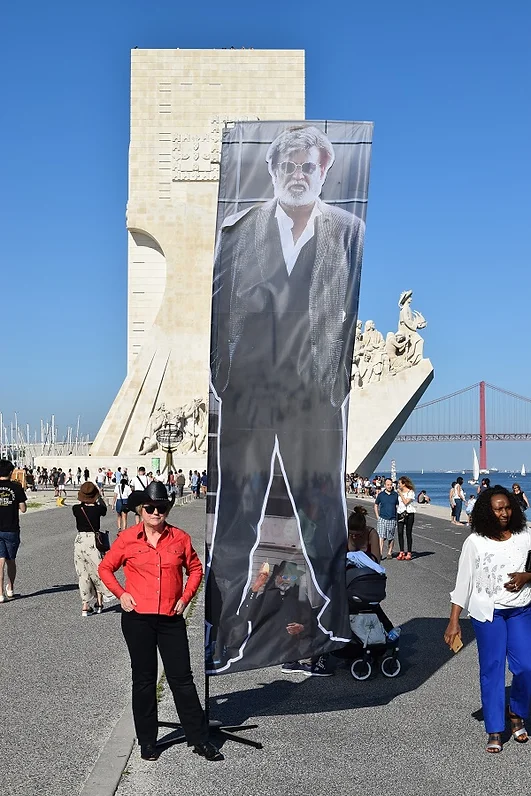
Cowboys signing autographs at the Cloverdale Rodeo and County Fair. Well, it’s bulls and blood, it’s dust and mud It’s the roar of a Sunday crowd It’s the white in his knuckles, the gold in the buckle He’ll win the next go ’round It’s boots and chaps, it’s cowboy hats It’s spurs and latigo It’s the ropes and the reins, and the joy and the pain And they call the thing rodeo
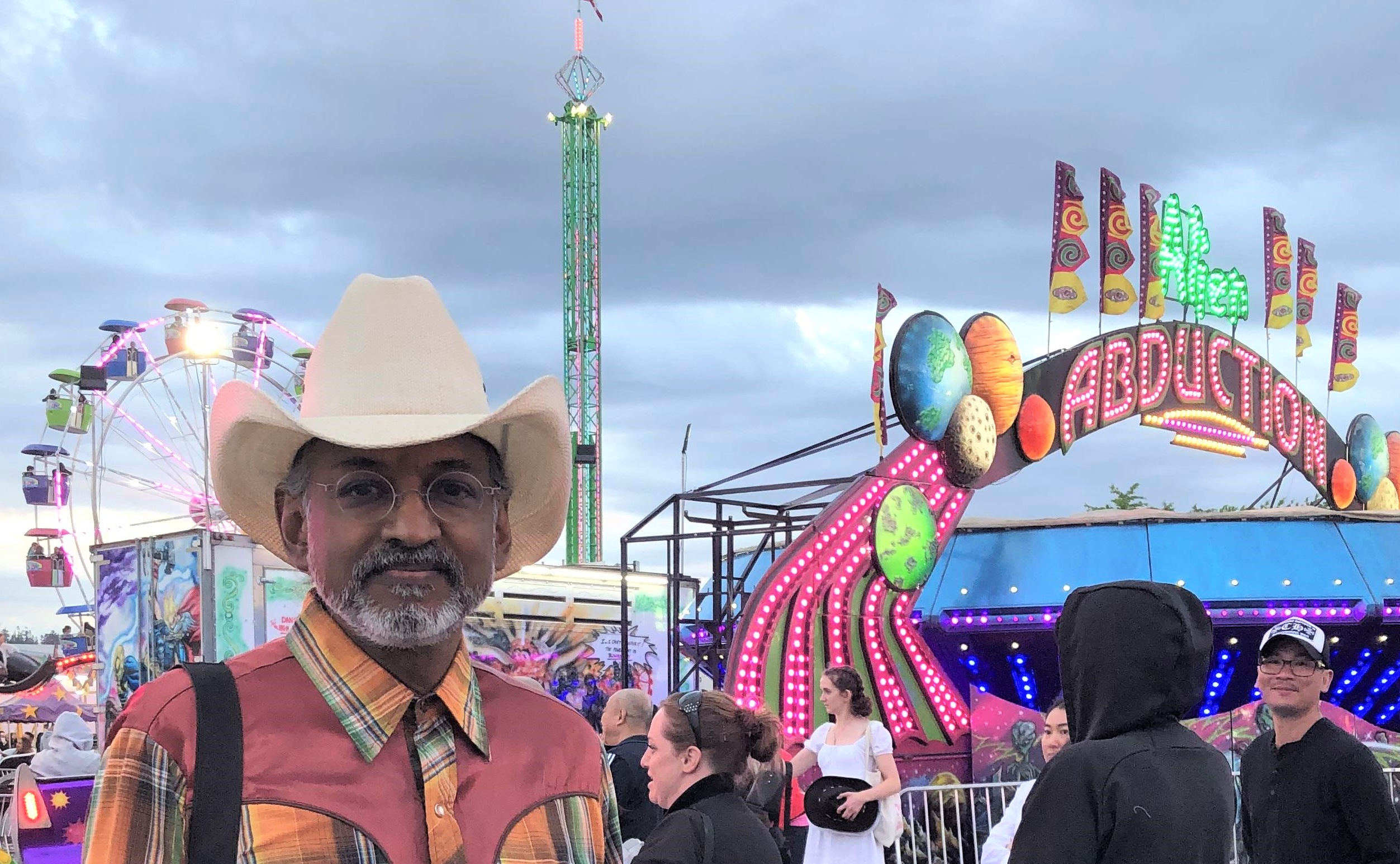
The Koboi Project centres on the question of identity and its relationship to authenticity. I dress as a cowboy, both in performance situations and in my private life. Indeed, I am very comfortable with this eccentricity of mine, so much so that, in some ways, I feel that I am a cowboy, albeit an urban cowboy who has never ridden a horse and has very little to do with cows. As a vegetarian, I do not even eat them. In my daily life, you could say it is my style. When I perform in Southeast Asia it stands for my return from the West. But what happens to the authenticity of my persona when I venture into real cowboy country.
Recently, at the Cloverdale Rodeo, I gained some insight into the nature of my Koboi persona and even the nature of cowboy persona itself. At the heart of the rodeo is the image of the pesky, spunky cowboy prevailing over the ornery Bronco, kicking and bucking to get him off its back. In my observation at Cloverdale, however, there seemed to be a little bit of a disconnect. Indeed, the horses buck violently, and the Cowboys hang on valiantly and skillfully, but are the horses bucking to get the cowboys off or are they bucking for some other reason? There is, in this context, a debate about the use of spurs and the application of pressure around the horse’s belly with what is called a flank strap. Some say the strap brings pain that causes the bucking and others that it merely gives form to the buck.
The BC SPCA says that the flank strap “applies pressure on their sensitive underbelly, causing discomfort. The rider also uses … spurs, to cause discomfort which leads to more bucking. While bucking is a natural behaviour of these animals, in rodeo it is a behaviour rooted in discomfort, not in play.” In other words, it is not as it appears, that the horse is bucking to get the rider off, but as a response to the discomfort caused by the flank strap. The cowboy’s art of hanging on is incidental or secondary to the main action. Proponents of rodeo however, counter with the argument that the horse bucks because it is in its nature and breeding to do so, and that the “flank strap alters the bucking action of the horse by encouraging him to kick out straighter and higher with his hind legs, thus making himself harder to ride. The flank strap stacks the odds in favor of the horse. It cannot make him buck.” With regard to the spurs, they insist that they are required to be blunt and spinning and that they also put the odds in favor of the horse, as the forward position of the feet required to spur the horse in the shoulders makes it much harder for the cowboy to stay on.
Even within the proponents’ terms, it can not be denied that there is a sense that the bucking is being induced and conditioned independently of the horse’s impulse to get the rider off its back. The horse is just bucking independantly and the rider holds in an illusion of relationship. The question of cruelty aside, the rodeo cowboy’s ride is a performance, and not unlike my own Koboi performance, an artifice or fiction of sorts.
Having lived in Vancouver, so close to Western Canada’s cowboy country, and having been a cowboy of sorts myself, since 2013, it is of note that the Cloverdale Rodeo and County Fair 2023 is ‘my first rodeo’. Jane and I were given VIP tickets to the Stetson Suite by Dave from the Rockin Cowboy, where I have acquired much of my Western gear since the start of the Koboi Project. In fact, Dave had invited me before but I have always, evaded his kind invitation due to my concerns about animal welfare. You see, I am a vegetarian Cowboy. Yes, an oxymoron! This time, however, I accepted. After a decade of being the Koboi, I wanted to be able to use the expression – this aint my first rodeo, meaningfully! While I did feel concerned for the animals involved, not to mention the cowboys being bucked about, I can’t say I did not enjoy myself. Thanks Cowboy Dave!
The Malay and Javanese word ‘kayangan‘ is synonymous with adnan, eden, firdaus, janah, nirwana, surga, indraloka, kedewaan, keindraan, suargaloka, suralaya, surgaloka and paradiso. In Malay cosmology, 5. Kayangan is inhabited by Dewa, Perman. This ‘skyworld’ is located directly above the Pokok Pauh Janggi which rises through the Pusat Tasik . This 2 Pusat Tasik Pauh Janggi is, in turn, directly above the 6 Dasar Laut which can be seen as the ‘underworld’. The combined downward spiral of the Pusat Tasek and the upward thrust of the enormous Pokok Pauh Janggi both pass through the 1 Dunia, combining to create the axis mundi of the Malay cosmos.
Anker Rentse explains, from ethnographic notes that seem to have been made in Ulu Kelantan“Shurga, Heaven, is on the top of Pauh Janggi, and Nuraka, Hell, is down below its roots. A gigantic hole between the roots causes the ocean water to disappear into hell’s big boiling-pot, kawah nufaka, whence the whirl-pool. Underneath the pot burns everlasting fire. A dragon guards the hole, the gate to hell (pintu nuraka) with its body in order to prevent the ocean from running dry. In Pusat Tasek an account is kept of the good and the bad deeds of every human being in the world. The accountant in Heaven is Ka’ Tebir, and in Hell, Kiraman. The last one is said to be so busy on occasions, that he gets angry, throws his pen on the floor and declares, Ini sekarang sudah chukup!”
The diagram is adapted after Md. Salleh Yaspar in Malaysian World View edited by Mohd Taib Osman.
Rentse, Anker. “NOTES ON MALAY BELIEFS.” Journal of the Malayan Branch of the Royal Asiatic Society 11, no. 2 (117) (1933): 245–51. http://www.jstor.org/stable/41559822.





 The Koboi Project

You must be logged in to post a comment.