Early Internet Art in Malaysia 3

In 1993 I made my first trip to New York. My wife Jane and I were living in London and had bought a Hoover vacuum cleaner. As part of the infamous Hoover promotion of that time we got two free tickets to New York. I had, as an artist from Malaysia practicing in the London art scene, been working with found objects and performative interventions as a means of making a Janus faced engagement with the Modernist canon. I had already identified the ceramic bedpan as the the key readymade in my growing collection of objects – a pastiche and/or parody of the primordial Duchampian readymade. I sourced a plastic version that would be more suitable for travel and planned the performative action. Jane and I left for our holiday with an exciting itinerary that included a visit to the Twin Towers, a Cecil Taylor concert, a William Dafoe one-man theatre performance, a personal tour of the Electronic Arts Intermix archive, a social visit with pioneering avant-garde pianist Margret Leng Tan and an intervention planned in the space of Duchamp’s Étant Donnés installation at the Philadelphia Museum of Art…. The photograph featured in the The Failure of Marcel Duchamp/Japanese Fetish Even!  was taken by Jane as documentation of this intervention.

In 1995 Jane and I moved to Kuching so that I could take up a teaching position at the Faculty of Applied and Creative Arts at the Universiti Malaysia Sarawak (UNIMAS) which had been established in 1992 as the newest University in Malaysia. Its founding coincided with Malaysia’s sophisticated Information and Communication Technologies (ICT) strategy of the 1990s and we had a cutting edge Internet infrastructure and a commensurate technology centered academic programme. I had been practicing my art in the space between material objects, text, image, performance and the physical placement of the work in space. I had found myself developing a critical practice wherein context became part of the work. As I stated in an Interview with Roopesh Sitharan, it was when I joined UNIMAS that “I was introduced to the WWW, and most significantly, I met Hasnul who was already teaching there and in the early stages of developing an art and technology agenda initially envisioned by the visionary artist and theorist Ismail Zain. Hasnul encouraged me to consider the new media and I quickly realized that the new user friendly, ubiquitous, hypertextual, multimedia Internet was a medium that I had been waiting for – more and more my installation works had been yearning for a transcendence of materiality, geography, narrative hegemony and context – and this transcendence is what the WWW appeared to offer, even embody in its very ontology. I made ‘Failure of Marcel Duchamp’ in 1996”.

When this web work was presented at Explorasi, the inaugural Faculty of Applied and Creative Arts exhibition at the Petronas Gallery in 1997, I also presented a set of four framed 8.3 x 11.7 inch computer prints (in a single edition). Each print represents one key stage in the interaction of the website. The last print was framed with a frosted section in the glass to veil the pornographic element in the print. This website went offline after some years and was reconstructed and temporarily revived for the Relocations exhibition curated by Roopesh Sitharan for ISEA 2008 in Singapore. It was hosted on the 12 Gallery website during the period of the event. What remains of the work today is just the bare bones as archived without images on the Wayback Machine website. In this light the framed set of prints is the only tangible residue of what is slowly but surely being acknowledged as the first online artwork in Malaysia and Southeast Asia. This print set was exhibited again as part of Rupa Malaysia curated by Reza Piyadasa in 2001.

https://thehustle.co/the-worst-sales-promotion-in-history/

https://www.eai.org/

https://www.margaretlengtan.com/

https://danm.ucsc.edu/sites/default/files/roopeshthesis.pdf

https://issuu.com/mgtfusm/docs/relocations

https://web.archive.org/web/19990219215837/http://www.hgb-leipzig.de/waterfall/

Early Internet Art in Malaysia 2

In 1996 I made a web work titled The Failure of Marcel Duchamp/Japanese Fetish Even! which is the first Internet art work in Malaysia and, as far as I know, also in Southeast Asia. This work was both an admiring tribute and a harsh parody of Marcel Duchamp’s Étant donnés (Given: 1. The Waterfall, 2. The Illuminating Gas) which is installed at the Philadelphia Museum of Art. In this meticulously realized work, Duchamp cleaves from logos, an abyss of eros. I suggest that it represents the culmination of the humanist trajectory in the philosophy of being, as in its presentation, the visual perspective of the ‘eye’ is fused, or confused, with the ‘I’ of the anthropocentric worldview. In this hypostatization of the ontology underpinning photography, sculptural form and visual image are rendered indifferent, arguably heralding the end of the retinal orientation in the art of the West and the birth of conceptual art. Étant donnés is a paragon of visibility, a par ergon of reality, a hyperreality even!

My own work remixed an image appropriated from a Japanese bondage site, an erotic or pornographic element, within the photographic documentation of an intervention I made at the site of the Duchamp installation in 1993. The erotic element would have been unacceptable on Malaysian servers and so was isolated from the rest of the image and located, with the help of media artist Paul Sermon, on a server at the The Hochschule für Grafik und Buchkunst (Academy of Fine Arts) in Leipzig. Part of the aim of the work was to address territoriality and cultural difference in the Internet. The work underscored the fact that information that was then becoming globally accessible is not universally acceptable. Another aim of the work was to reify, in the context of what was in the mid 1990’s, the ‘slow download’ of the Internet, Fredric Jameson proposition that the visual Image is, in Itself, essentially pornographic. With the advent of the mass access to computer mediated communications brought about by the World Wide Web, Duchamp’s delayed image was no longer an esoteric encounter. It was becoming democratically accessible (Given:) as the slow download (The Waterfall?) on a personal illuminated screen (The Illuminating Gas!).

The The Failure of Marcel Duchamp/Japanese Fetish Even! was launched at a poster session at ISEA 1996. That presentation, from which this post has been developed, was titled Locating The Image In An Age Of Electronic Media .

http://isea-archives.org/docs/1996/proceedings/ISEA96_proceedings.pdf


Early Internet Art in Malaysia

I am honored to be featured in a keynote by Associate Professor Hasnul Jamal Saidon at the 6th ICACA (International Conference on Applied & Creative Arts), Faculty of Applied & Creative Arts, UNIMAS, 18 August 2021. Hasnul generously describes the work I did at the Universti Malaysia Sarawak between 1995 and 2002 as a very important legacy with regard to Internet art and online art in Malaysia. He describes me as the pioneer of Internet art in Southeast Asia and the forerunner in the region of critical engagement in the context of the shift from offline to online art. He notes that my The Failure of Marcel Duchamp/ Japanese Fetish Even! (1996) is the first Internet art work in Malaysia and that I curated the first online exhibition in Malaysia at the 4th Ipoh Arts Festival (1999). I am happy to be remembered and would like to return the recognition by noting that Hasnul is himself a pioneering contributor to electronic art in Malaysia through his early forays into video art, video installation art and his own critical and theoretical writings. Beyond our individual contributions, I believe that it is what we achieved together, by way of curating the 1st Electronic Art Show (1997) and the founding of the Eart ASEAN Online (1999) portal, that constitutes a platform for further developments in Malaysian new media art.

Malaysian Indian Artists 2

In his article on Malaysian Indian artists published in the Penang Monthly, Ooi Kok Chuen writes of J. Anu and myself both being of Sri Lankan Tamil descent. This observation, in the context of the question of Malaysian Indianness, raises two concerns pertaining to blood ties, one intimate and familial and the other, public and communal.

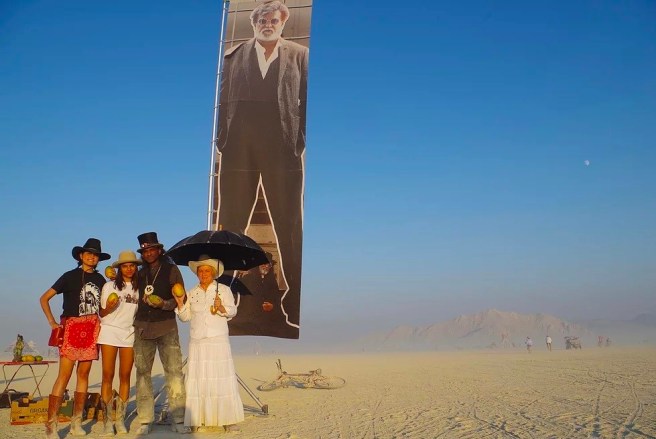
The first is a fact – I am proud to note that Anu and I are not only members of the same community, we are of the same family. Anu’s mother Gana, whom I call Acca, is my cousin, and this relationship is celebrated in an image of the Koboi Balik Lagi series of the Koboi Project.

4 Ikatan Pertiwi
4 Ikatan Pertiwi, Koboi Balik Lagi, https://koboibalikkampung.wixsite.com/baliklagi

The second is a question that underpins Ooi’s own pertinent question – ” WHY ARE THERE so few artists of Indian (including Singhalese) descent in Malaysia?.” It is this – Who is Indian in the Malaysian context? As I have noted in a previous post, Ceylonese Tamils in Malaysia have historically tried to preserve a distinct identity from Malaysian Indians. We have our own organization, the Malaysian Ceylonese Congress (MCC), that has been traditionally aligned to Barisan National. Although the MCC is not a registered political party, it had, until 1981, a senator in the Malaysian parliament’s upper house, the Dewan Negara. However, as Suhaini Aznan notes, Malaysians do not recognize the difference between Indians and Ceylonese and in the 2000 census many Ceylonese were counted as Indians. In this light, MIC seems to have invited the Ceylonese to join up with the Indians but, as Aznan notes the Ceylonese declined. He explains, after Datuk Dr N.K.S. Tharmaseelan, president of the MCC, “every race wanted its own identity to survive.”

It is my own opinion that Malaysian Tamils of Ceylonese origin should, to the extent that the Malaysian Indians will accept us, be absorbed into the category and identity of ‘Indian’. It is not a question of renouncing ones Ceylon Tamil background but, rather, of integrating it into the wider Malaysian Indian mosaic. Regardless of my own identification, however, the question remains, “are Ceylonese Tamils included in the category ‘Malaysian Indian’?” The question of Indianness does not stop here. It is clear from Ooi’s placing ‘including Singhalese’ within parenthesis in his question, that even he feels his placement of this other Ceylonese community within the Indian category is questionable. And then there is the question of the Mamak or Indian Muslims – it is unclear if they would all be equally happy with the highlighting of their belonging to the Indian category, as some might be in the process of transferring their identity into the ‘Malay’ category’.

Returning to the first concern, that of family, artist T. Selvaratnam is related to both Anu and myself, but that is a story for another blog post.

https://penangmonthly.com/article/20432/spotlight-on-indian-malaysian-artists?fbclid=IwAR3CB_s6jMPFH2A8P-4UcFwKXz6oUzjwBn7aRXijHkPNp35Aob8d9iE5Gto

https://en.wikipedia.org/wiki/Malaysian_Ceylonese_Congress

https://www.thestar.com.my/opinion/letters/2005/03/27/standing-up-for-the-ceylonese

Malaysian Indian Artists

“WHY ARE THERE so few artists of Indian … descent in Malaysia?” Veteran Malaysian art Journalist Ooi Kok Chuen presents an overview of Malaysian Indian artists in the Penang Monthly which opens by questioning the dearth of Indians in the national canon. He goes on to offer some possible answers that he notes have been ‘bandied about,’ “Economic status, parental / social disapprobation, opportunity, (lack of) role models, patronage, minority syndrome (proportionately smaller population, of only 6.2%), “estranged” Indian-ish themes, and discrimination,” Ooi rightly states no preference amongst these reasons. Nevertheless, while it is difficult to go beyond speculation in this matter, I am glad he has asked the question publically. It is an important one as it points to the undeniable fact that, while a few Malaysian Indians have made significant contributions to the practice and theorization of the visual arts, overall, our numbers are low.

This is something that gave me pause during my years of intense involvement in the Malaysian scene from 1996 to 2002. I gave my support and encouragement to individual artists with a sense of communal allegiance whenever the opportunity came my way, but my own concerns during that period were national and international, and while intra-national questions of race and communalism formed the framework of my practice, I was not community oriented. I often wonder if I could have engaged more actively with my community in those years in terms of promoting and developing the arts.

This personal reflection and recollection, triggered by Ooi’s question, leads to a more fundamental question that lies at the heart of my Malaysian identity. Am I an Indian first or a Malaysian first? An Indian Malaysian or a Malaysian Indian! Of course, an analogous question arises for the other races of our multiethnic nation. Such pondering has even been turned into political capital. Malaysia’s present Prime Minister is reported to have said, back in 2010, “I am a Malay first, I want to say that … But being Malay does not mean that you are not Malaysian.” While the country struggles with the horrors of the recent covid-19 crisis atop an ongoing and now long running political one, the foundations of the nation are being shaken. Will the old Malaysia, whose founding social contract is premised on communalism, survive this crisis in its present form? Will we regress to a more ethnocentric paradigm, or will we emerge from this national trauma with a reformed and refined national agreement? These questions might seem far from the world of Malaysian art but this is where the stream of thoughts that flowed that follows from Ooi’s innocent, perhaps not so innocent question, has brought me – WHY ARE THERE so few artists of Indian … descent in Malaysia?”

https://penangmonthly.com/article/20432/spotlight-on-indian-malaysian-artists?fbclid=IwAR3CB_s6jMPFH2A8P-4UcFwKXz6oUzjwBn7aRXijHkPNp35Aob8d9iE5Gto

https://www.japantimes.co.jp/news/2020/03/01/asia-pacific/politics-diplomacy-asia-pacific/muhyiddin-yassin-malaysia/

Godspeed Dear Jason 3

koboi

In this, the last of 3 posts remembering Jason Avery, I want to reflect on Jason’s role in bringing me within the fold of the Burning Man community in terms of my own growing awareness of the Festival.

In the late 1990’s I was based at the Universiti Malaysia Sarawak and was very much part of the global Internet art scene. Once, I was in Los Angeles for a conference and I met Mark Pesce who was a progenitor of desktop VR (Mark had been among those who spearheaded the standardization of 3D on the Web). As we socialized one evening, I was surprised to find him espousing the virtues of what sounded to me like a neo-pagan gathering in the desert. This was the first time I had heard of the Burning Man festival (Mark would, in 2003, pen a stinging critique of the cultification of the festival … but that is another story).

Some years later, in 2006 – 07, as faculty at the School of Interactive Arts and Technology, Simon Fraser University, Canada, I supervised an MA dissertation titled ‘The return of the gift society: Traditional relations of exchange and trust in contemporary technological society’. My student, Efrat Ben-Yehuda was a burner and, as I helped her frame her thesis in terms of traditional and technological discourses, I learned about the lived experience of the festival. I was enthralled but still not drawn towards participating in the event .

Then, as outlined in my previous post, following my reunion with Jason in 2017, I was educated, encouraged, entreated, enlisted and eventually enabled to come to the festival, bringing along both my art and my family. Just as an artist must be able to visualize the work in order to realize it, a community builder must imagine the society he or she wants to bring into fruition. Jason was just such a builder. He envisioned how my art would align with the festival and, beyond my own wildest imaginings, he saw how joining [The Camp With No Name] as a family would would be a rewarding experience for us. Jason enabled both a wonderful family experience as well as the production of the Anugraham series of the Koboi Project.

‘Anugraham’ means ‘grace’ and this work celebrates the gifting ethos that informs the Burning Man Festival, the sense of giving as receiving, that Jason knew so well.

https://en.wikipedia.org/wiki/Mark_Pesce

http://tripzine.com/listing.php?id=mcburners

https://sfu-primo.hosted.exlibrisgroup.com/primo-explore/fulldisplay?docid=01SFUL_ALMA21160741050003611&context=L&vid=SFUL&lang=en_US&tab=default_tab&query=any,contains,the%20return%20of%20the%20gift%20society

https://www.facebook.com/groups/340397416356816/posts/444141185982438/

Godspeed Dear Jason 2

A Dusty Prayer for Jason

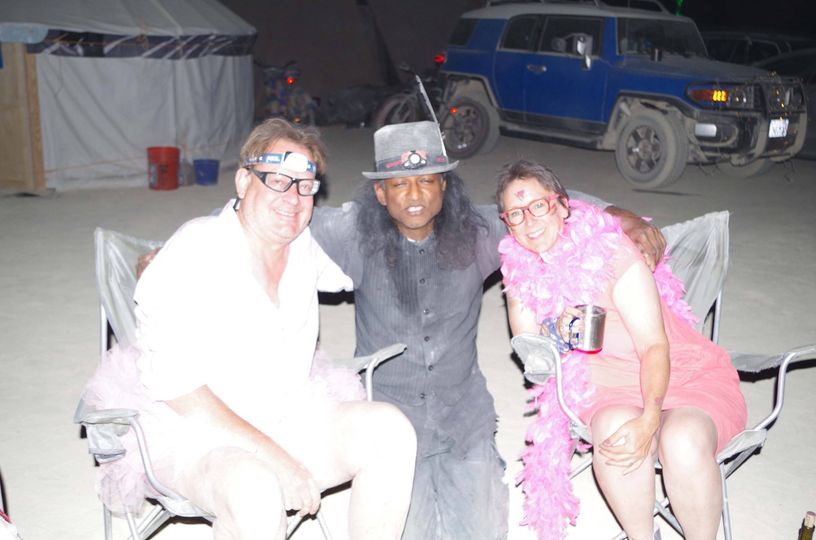
At the end of Burning Man 2017, as my family and I were about to leave Black Rock City, Jason gave me his treasured Top Hat, history, memories and all! Such giving seemed to come easily to Jason. I think he was saying thank you for bringing the koboi project to [The Camp with No Name]. I protested as I knew its history and the memories it held for him and anyhow it was really I who needed to thank Jason for making the Anugraham series of the Koboi Project possible. Still, in the spirit of receiving and with the delight of possessing the thing itself … I accepted graciously. Although I have since dressed the hat to my own liking, I have not actually seen fit to wear it. Now that Jason is gone, it seems right to bring it out and set it on our alter, to light a lamp and to offer a dusty prayer.

Rest in peace Jason.

https://www.facebook.com/photo?fbid=10159498815678762&set=a.10151721175903762

Godspeed Dear Jason

With Jason Avery and Vicky Byers-Brown, Black Rock City, 2017

In the last few days there have been posts on Facebook about the passing of Jason Avery. Jason was a friend I made at Oakham School in the UK in the 1979, over 40 years ago. I was 17 years old when we met there and we were together for the 2 years of 6th form. Jason was a day boy and I was a boarder. We did not spend much time together but I remember some deep and sensitive conversations. Years later, in early 2017 we connected again, after a 37 year hiatus, and this lead to my bringing the Koboi Project to Burning Man that year. At the heart of this reunion was a wonderful act of generosity from Jason … he spent so much time and energy drawing me in to the idea of bringing my art to the desert, and did so much to support me and my family during the Festival. He encouraged and enabled us to perform the Anugraham series of the Koboi Project.

God spede dear Jason. I have no doubt you will prosper in heaven. I will end this post with words, your own words, that reflect what Jane, Tara and Durga and I experienced of your person – “The one thing from my first burn many years ago. Gifting. The gifting culture has stayed with me now for many years. It’s simple. But it’s hard too!! To gift with no expectation of return … is beautiful. But what is hard, is to receive that gift … and accepting that you have no requirement to return”.

https://koboibalikkampung.wixsite.com/anugraham

https://www.grammarphobia.com/blog/2014/01/godspeed.html

https://www.facebook.com/groups/340397416356816/posts/444141185982438/

The Situation in Palestine

Michael Walker and the British communist commentator Ash Sarkar discuss Israel’s ongoing bombardment of Gaza in terms of Western geopolitical interests. They deconstruct the blatant media bias in covering the conflict, which they set in the context of Israel’s ongoing settler colonialism and apartheid. The critique is centered on Omar Badder’s analysis and questioning of the entry point for Western media reporting, which is as follows –

  1. Status quo: occupation/ apartheid is violence against Palestinians
  2. Then Israel escalates through evictions/beatings/ shootings
  3. Then some Palestinians respond w/violence.
  4. Then Israel “responds” w/massacres

“If you start reporting at #3. you are misleading your audience”