According to the CBC, 6 people were arrested by the RCMP on Feb 06, 2020 pursuant to an injunction against those blocking construction of the Coastal GasLink pipeline on Wet’suwet’en territory in northern B.C. Wet’suwet’en Nation hereditary Chief Na’Moks is reported to have said, “They came in with armed forces to remove peaceful people that are doing the right thing at the right time for the right reasons. We’re protecting the land, the air, the water. Our rights and title, our authority as hereditary chiefs. And we’re exercising our jurisdiction … We’ve never ceded nor surrendered our lands. We’ve never signed a treaty. We are the law of the land, we are free people and I will go to my territories.”
The injunction which was issued by the BC Supreme Court, and the consequent arrests, seem to be at odds with Bill 41 of the BC legislature which embraces the UN Declaration on the Rights of Indigenous Peoples, and which, as summarized by West Coast Environmental Law, “requires the government to prepare an implementation and action plan in consultation and cooperation with Indigenous people” Most significantly, this act also seems to recognize the authority of Indigenous governing bodies, like the hereditary chiefs that Chief Na’Moks refers to above, which stand outside the ambit of the Indian Act.
Grand Chief Stewart Phillip, president of the Union of British Columbia Indian Chiefs, is reported to have said “It’s an absolute outrage and deeply frustrating that the RCMP is acting in the capacity of a goon squad on behalf of business and industry”. This is where Malaysia’s premier Crown corporation PETRONAS is implicated as one of the corporations with a significant interest in seeing the pipeline implemented, with investments at both ends of it (upstream and down.)
This interview with Najwa Shihab is my favourite of those given by Dr M in recent years. Whether you like him or not, you can not deny that Mahathir’s clarity and incisiveness are beyond compare … see how simply he explains the mechanics and ethos of his political alignment with Anwar, subtly indexing the political realities of the the post victory scenario,” … kita perlu bersatu untuk jatuhkan Najib dan itu sudah tercapai”. (minute 16:05) Indeed, regardless of second tier electoral promises, the primary aim of the initial alignment has been achieved, and the central promise delivered. With Najib’s fall, a new evaluation must be made of the alignment, to ascertain if the need to continue is mutual … perfectly natural, perhaps even ethical in the realm of politics!
“You’ve waited 20 years, extending six months doesn’t actually matter,” Anwar is reported to have told Reuters, expressing confidence that the Pakatan Harapan coalition allies would stand behind him, as they have stood behind Mahathir.
“If there’s a request to go back to parliament, of course it can be done, but PH has the majority right now. Even those who are not in PH, some would support the PM of the day. I also have been given that assurance. They support Mahathir as the PM, and they will continue to support me when I assume the premiership.”
One scene from the Pa Ranjith/ Rajinikanth film Kaala (2018) that resonates deeply is that in which the villainous Hari Dada’s (Nana Patekar) granddaughter asks him “Who is Kaala dada?” and he answers pensively, “Ravan … Ravan.”(second 0.37 in trailer) In this moment the films palpable Dravidian ethos is emblazoned upon the screen narrative, eliminating all possibility of a misreading. For those who are unfamiliar with the political history of Tamil Nadu, the central tenet of the Dravidian self-respect movement that informs the political parties that have governed the state since 1967 is that of the a North/ South (or Aryan/ Dravidian or Brahmin/Non-brahmin) divide. In symbolic terms, this dichotomy has been articulated in a deconstruction of the Hindu religion, particularly in the desecration one of its sacred narratives, that of the Ramayana. Those who subscribe to the Dravidian ethos, identify with Rama’s nemesis Ravana or as Nana Patekar refers to him, ‘Ravan’.
This identification of Ravana with the hero Kaala, and with the SUPERSTAR, clearly advances director Pa Ranjith’s well known brand of Dalit activistivism. This film is a vehicle for his message about the ancient dispossession of Dravidian peoples in an Aryan conquest and the consequent oppression of casteism in contemporary India. If the film can be said to echo its director’s politics what can be said of its resonance with that of his star, his SUPERSTAR, Rajinikanth, who is in the runup to an entry into Tamil Nadu politics? Rajinikanth is himself a signifier of the Dravidian ethos in that he was the first dark skinned (the North/ South dichotomy presents as the light skin/ dark skin complex of the Tamil people) leading man in Tamil cinema. It has long been known that Rajinikanth is not a stalwart of Dravidianism as the movement is atheistic whereas he is invested in Hindu spirituality. Further he has explicitly announced a platform of spiritual politics and has regularly aligned himself with the policies of the federal BJP, while at the same time working hard to eschew over-identification with the Hindutva branding of the BJP.
Indeed, Rajinikanth seems to have tried to keep his potential alignments open for the coming assembly polls in Tamil Nadu in 2021. In a recent statement however he seems to have burned all bridges with the hard-core Dravidian parties by raising the spectre of an anti-superstition rally from 1971 in which the founder and light of the Dravidian social reform movement, E.V. Ramasamy Periyar, is said to have desecrated icons of Rama and Sita. In the ensuing decades, the Dravidian movement has regressed to an accomodation with Hindu theism, and paradoxically Periyar has himself come to be venerated as an icon of sorts. In this light, Rajinikanth’s indexing of this controversial event, compounded by his refusal to apologise in the aftermath, has resulted in what, I suggest, is an unbridgeable chasm between his spiritual politics and secular Dravidianism. Most significantly, it might have soured the potential alignment with his friend and staunchly secular political co-aspirant Kamal Haasan who seems to have reached out to him recently.
It has even been suggested that Rajinikanth’s speech was ‘scripted’ by the BJP. Frontline magazine has reported that former head of the Tamil Department of the University of Madras , V. Arasu, has said: “Why should Rajinikanth broach an incident that was half a century old and long forgotten? The D.K., too, over a period of time has toned down its anti-god rhetoric significantly. Hence, the actor’s casual remark on a revered social reformer needs strong convincing. Periyar stands for rationalism and social justice. The anti-god doctrine was just one among many themes of his social reform campaign. Besides, recalling an event that was mired in legal and political controversies at that time has no relevance now. By raking up this issue, Rajini has willingly fallen into the hands of those who are out to exploit the name and fame he has earned as an actor.” This brings us back to the question of what can be said of Kaala’s resonance with the politics Rajinikanth. It is with regret that I must note that if the question to be answered here is, “Who is Rajinikanth dada?”, given the accumulation of the SUPERSTAR’s statements to date, I find myself having to say, no less pensively than Hari Dada, “Hanuman Ji … Hanuman Ji”
In response to an earlier post in this series which referred to Bruce Lee’s ‘Lost Interview’, my friend, veteran Malaysian journalist and art writer Ooi Kok Chuen commented, “Bruce Lee is much misunderstood after all these years where he is seen as a supreme martial arts fighter. … his cult brand of Chinese martial art is more than stunning physical manoeuvres. It’s a philosophy, a discipline of the highest order, and on top of it all, a way of life.” Indeed, this philosophy/discipline was embodied in what I would call a post-traditional fighting system that Bruce called Jeet Kune Do. The Jeet Kune Do system seems to acknowledge the plurality of traditional forms while unifying then in a praxis.
In the interview Bruce Lee explains this praxis in terms of the relationships between martial arts, acting and life, “… all types of knowledge mean self-knowledge … [my students] want to learn to express themselves through some movement, be it anger, be it determination or whatsoever … to show … in combative form, the art of expressing the human body … it might sound too philosophical, but its unacting acting, or acting unacting. I mean, here is the natural instinct, and here is control. You are to combine the two in harmony … The ideal is unnatural naturalness or natural unnaturalness … ultimately, martial art means honestly expressing yourself …You have to keep your reflexes, so that when you want it, it’s there! When you want to move, you are moving. And when you move, you are determined to move …”
Another friend Hugo Moss, co-founder of Michael Chekhov Brasil responded to the same post by noting that Bruce lee’s praxis echoes that of Michael Chekhov (1891-1955), a Russian actor, director and teacher whose approach to actor training, rehearsal and performance continues to inspire artists around the world. Hugo notes that Chekhov posits the same “polarity of being in controlling and releasing yourself 100% free in the moment. It’s the creative process of meaningfully living ‘the tangible/material world’, ‘the cosmos/possible’ and ‘oneself’ in equal measure/harmony. … yes there’s a polarity … In the creative act there is part of it which is a “doing” in the traditional sense, but then there is a “getting out of the way” and allowing the creative moment to flow … [and] that flow [is] this threefold consciousness – ‘Material World’ + ‘Cosmos & Imagination & the possible’ + ‘Self’, [with] our gesture unifying the first two.”
In the light of the profundity of Bruce Lee’s contribution, Tarantino’s project seems frivolous at best and at worst, a folie.
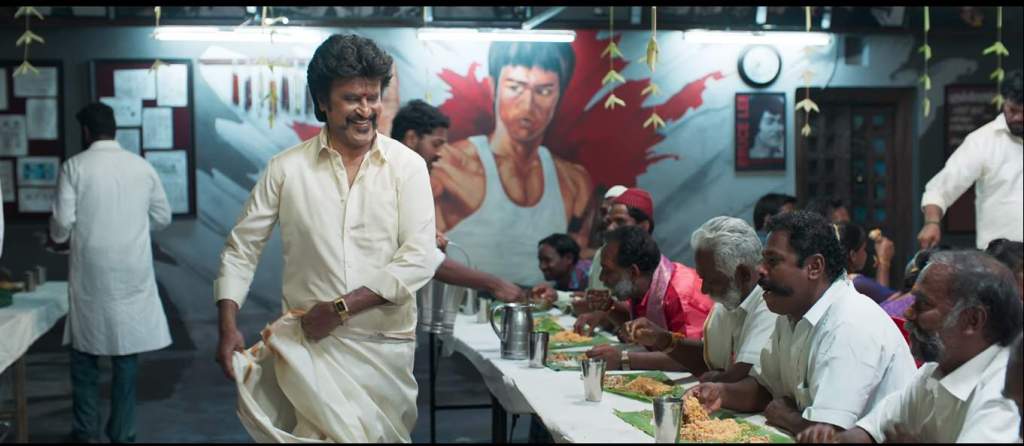
Another film from 2019 (other than Quentin Tarantino’s Once Upon a Time in Hollywood) that makes reference to Bruce Lee is the Tamil-language action film titled Petta directed by Karthik Subbaraj and starring the septuagenarian (well, he will be in December) SUPERSTAR of Indian cinema, Rajinikanth. In one flashback scene Rajinikanth, is seen sporting an old-school Indian moustache, wearing a traditional veshti and striding along a row tables with seated guests enjoying a banana-leaf meal. It is a wedding scene and the people are feasting in some kind of community hall on the rear wall of which is painted, rather incongruously, a mural of Bruce Lee!
It is interesting to note that Rajinikanth movies are just as referential as Quentin Tarantino’s oeuvre, albeit with less pretension. If Tarantino’s referential play indexes the worlds of Hollywood and Spaghetti Westerns, Rajinikanth films refer even more reflexively to the realm of Rajinikanth movies (over 160 released to date), generating SUPERSTAR tropes that transcend specific films. Further, Indian cinema is, as a whole, filled with instances of pastiche, parody, piracy and praise – ranging from reverential remakes across the many indigenous language cinemas, to shameless ripoffs of Hollywood.
One reviewer of Petta explains just such a scene from the film, “In one moment Rajini actually takes out a nunchuck and starts doing fancy moves with it. I imagine a 10-year-old Karthik Subbaraj [who is so much younger than his leading man] watching Bruce Lee’s Enter the Dragon and thinking, ‘imagine how cool it would be if my Thalaivar did that?!’ and then writing it down on a piece of paper with a crayon. It’s kinda ridiculous, but that about sums up the fun, bizarre and complete Rajini mania world that is Petta.” This tribute to the Martial Arts master and first crossover Asian superstar in the global movie industry reflects the place he holds in the esteem and imagination of the populations of many Asian nations.
It is in the light of this place of honour that I suggest that Tarantino’s degrading portrayal is an egregious maligning not only of a man but also that of an icon which is esteemed by a wide global community. Bruce Lee is much more to us than just a great martial arts master and the first Asian cross-over movie superstar and … you know, although I loved Pulp Fiction, somehow, I could never get into the martial arts oriented Kill Bill set … now I understand why … Once Upon a Time in Hollywood seems to have revealed much more about Tarantino than it has about Bruce Lee.
Please watch this interview from The Pierre Berton Show! It was recorded in 1971, lost for several years, and eventually rediscovered and aired in 1994 as ‘The Lost Interview’. I will not interpret or mediate for Bruce Lee, as I feel that his personality and ethos are quite palpable in his speech. I will only say that, for me, this interview reveals Quentin Tarantino’s take on Bruce Lee in his utterly reactionary film, Once Upon a Time in Hollywood, as being misinformed or capricious at best and racist at its worst!
Incredibly, this film has been chosen by both the American Film Institute and the National Board of Review as one of the top ten films of the year, it won Best Motion Picture – Musical or Comedy at the Golden Globe Awards and that it is up for Best Picture and Best Director at the Academy Awards as well as the British Academy Film Awards. I have to say that such wide ranging accolades for this film and this director, must reflect the underlying ignorance, indifference and ethnocentricity … racism even, of the industry as a whole.
I have loved Quentin Tarantino for his Reservoir Dogs and for Pulp Fiction and I have forgiven him for many a tedious and pretentious flic on the podium of these two groundbreaking works. More significantly, I have given him, and his celluloid surrogate Samuel L Jackson, licence to skate thin ice with regard to the ‘N word’. I gave this M_ _ _ _ _ R F _ _ _ _ _ R license on the basis that his oeuvre was A _ T; because rigid political correctness is tedious and damaging to culture, and even to the justice it purports to prompte; because I believed that Quentin’s ‘heart’ was in the right place on the questions of race in America; and most of all because ‘perhaps I did not get it yet’ but that ‘maybe I would on the next viewing’! Now, after viewing the jaded and reactionary Once Upon a Time in Hollywood (just once is all I could possibly bear!), I have clarity, and a correction to make – I was wrong! Quentin was wrong, QUENTIN IS WRONG! … Hey Academy of Motion Picture Arts … Dont give the C _ _ _ _ _ R an Oscar! It will only confirm your ensconcement in that quintessential, or should I say Quentinessential Americana of racism! … Kabali Da!
In a post titled Indian Vote: Entha Kabali? made before the Malaysian federal election in 2018, I wrote, . … “Whatever happens in the voting, it looks like it is indeed going to be close and, perhaps, the Indian vote is going to be important.” Further, I asked, ” … does the opposition look like they will treat us any different [from Barisan]? Just look at how they made unholy exaggerations and unfulfillable promises on the Stateless Indians issue … should they not be shown that the Indian vote, just like the vote of the other communities, has to be earned?” While I was skeptical about the outcome for Indians, I did, as indicated in my post titled Kabali Da!, cast my lot with the new Malaysia promised by the Pakatan Harapan opposition led by Dr Mahathir Mohamad.
Well, it came to pass that Mahathir and Harapan did win and, in the 2 years since, many have become disillusioned and dissatisfied with New Malaysia for their many unfulfilled promises. One such promise pertains to the Indian statelessness problem. Indeed, in this matter Harapan has been deeply disappointing. They promised a complete solution within 100 days, but their re-branded ‘Indian affairs’ body, the Malaysian Indian Transformation Unit (MITRA) has not solved the this problem as yet. As far as I can ascertain, the last statement issued by the minister responsible states that MITRA was still working “to outline a comprehensive solution to the stateless issue, in line with the PH government’s manifesto promise”.
Since then another issue has arisen to affect the Indian community at an equally deep symbolic level – the spate of LTTE related arrests and charges. I have discussed the apparent pervisity of these arrests and detentions under SOSMA of 12 Indians including 2 government MPs previously in this series (beginning with On Being a Malaysian Tamil 1) and the question I explore here is how one might understand the implications for the Harappan government visa vis the Indian vote. The perceived involvement of government, even if it is misplaced, will surely be detrimental to their ability to garner Indian votes in the next general elections
In principle the police act independently of the Attorney General’s Chambers and the Judiciary and the government is distant from the decisions of all these bodies. While the judiciary is independent by virtue of the separation of powers expected in Malaysia’s Westminster based legal system, the police and the AG’s chambers are extensions of the executive. They too, however, are expected to act independently of executive interference and without improper collusion with one another. If all is running as it should be in our nation’s governance, no blame can be laid at the feet of the Harappan government for these LTTE arrests, detentions, changes and for the eventual judicial outcomes, whatever they might turn out to be. However, the history of the relationships concerned in Malaysia is such that it will be very difficult for the people to believe in the integrity of the system, even if it were true.
There is no question that the majority of Malaysian Tamils, like most of their fellows throughout the world support the Elam struggle, regardless of their misgivings about the terror tactics of the LTTE. Certainly, most of us feel there was an equal amount of state terror being deployed by the Sri Lankan government in this conflict and that the Terrorist organization designation applied to the LTTE, however justified it might be, is ultimately a political assignation. Indeed, the evidence for this suggestion is the fact that the Tigers were not so designated in Malaysia till 2014, years after the war ended and all acts or terror had ceased. Given this fact and the fact that our Malaysian institutions of state are known for being questionably interdependent, it is going to be difficult for Harapan to win the hearts of the Indian community and, of course, this may have a bearing on their votes in the next elections.
The Coastal Gaslink pipeline infrastructure that will connect the PETRONAS’ North Montney gas fields to the LNG Canada export terminal on BC’s West Coast must pass through Wet’suwet’en territory and the Wet’suwet’en are objecting and resisting on the basis of Aboriginal title. In Delgamuukw v. British Columbia (1977) the Supreme Court of Canada court defined Aboriginal title as Indigenous peoples’ exclusive right to the land, and affirmed that such title is recognized as an “existing aboriginal right” in s.35 of the Constitution Act, 1982. The Canadian Encyclopedia notes however that, such rights as are recognized and affirmed are, however, not absolute and that Government regulation can infringe upon these if it meets the test of justification under s. 35(1).
Economic development through agriculture, mining, forestry and hydroelectric power, as well as the related building of infrastructure and settlement of foreign populations, are held to be valid legislative objectives that satisfy the justification requirement. These legislative objectives are, nevertheless, subject to accommodation of the aboriginal peoples’ interests in accordance with the honour and good faith of the Crown. Such accommodation of “aboriginal title” entails notifying and consulting aboriginal peoples with respect to the development of the affected territory, as well as providing fair compensation.





 The Koboi Project
You must be logged in to post a comment.