Silting Up the Settlement 1

silt

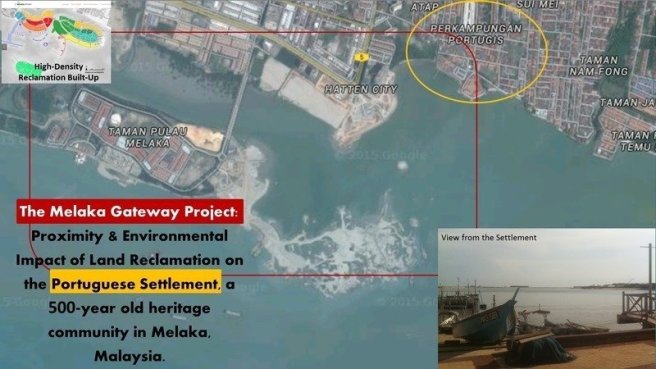
In 2016, President of the Malacca Portuguese-Eurasian Association, Micheal Singho, described the fate of his community in the face of the ongoing Gateway development.

Here is what he wrote in the New Straits Times on October 2, 2016 –

“RECENTLY, there have been reports on China’s RM30 billion boost to the Melaka Gateway project with a signing of a memorandum of understanding.

The approval of the project will snuff the life out of the Portuguese Settlement by depriving it of its life, spirit and culture-sustaining sea.

The Melaka Gateway development will rob the settlement of the open sea and replace it with a waterway that will turn it into a silt-filled, polluted, stinky and dead swamp if the design contours are not altered to studied specifications in the 1997 macro-Environmental Impact Assessment (EIA) report.

Is this morally right and responsible?

Even the basic 750m distance is not adhered to, with portions of the design coming as close as 250m to the settlement.

The project, coupled with the Pulau Melaka project, increases the level of siltation as it does not allow adequate flushing, and impedes vital current flows and tidal movements.

Even the channel between the two man-made islands is narrow and ineffective.

The project is still without a Social Impact Assessment report. Fishermen, whose income are affected, have not been compensated. These violations resulted in a stop-work order issued by the Department of Environment in March last year.

At the last meeting with government agencies and the developer, representatives of the Portuguese-Eurasian community forwarded a proposal that adhered to the tenets of the 1997 macro-EIA report and called for the channel to be a functional waterway free of pollution.

They are still waiting for a response.

MCA president Datuk Seri Liow Tiong Lai, who is also transport minister, has voiced his support and interest in the project.

But, will this come at the cost of a living, profound and contributing legacy falling victim to development?

Liow must recall how the Chinese fought for the preservation of Bukit Cina, a place that provided sanctuary for their dead.

The sea is our Bukit Cina, but with a little difference, as it sustains the living.

Nothing should be allowed to rob whatever is left of the sea and the seafront of the Portuguese Settlement. There are other options that will spare the settlement.”

Image: https://www.change.org/p/unesco-the-federal-government-of-malaysia-the-state-government-of-melaka-please-step-in-to-protect-and-sustain-the-well-being-the-environment-and-the-heritage-culture-of-the-portuguese-settlement-at-ujong-pasir-in-the-state-of-melaka-malaysia-as-i

https://www.nst.com.my/news/2016/10/177480/protect-portuguese-settlement
Kristang Protest

coffin

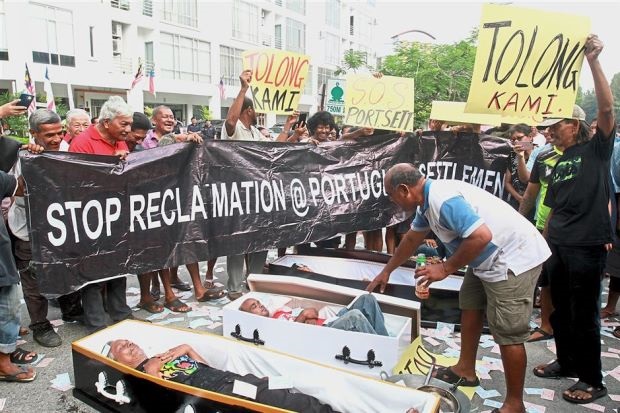
The Melaka Portuguese community staged a coffin protest at the Melaka Gateway site office on the 17th May 2018. Melaka Gateway is a gargantuan land reclamation and development project that is a part of China’s One Belt One Road initiative. It will include a deep-sea port that is being built by Chinese companies in a joint venture with Malaysia’s own KAJ Development Sdn Bhd’s (KAJD). According to a report in the STAR newspaper, the Chairperson of the Portuguese Village Community Management Council, Jacinta Lazaroo, alleged that the developer failed to comply with the macro EIA (Environmental Impact Assessment) report of 1998. This non-compliance seems to have resulted in severe silting which has affected the livelihoods of the members of this largely fishing community. The STAR also reported that according to Melaka Gateway’s developer, Hasbullah Zakaria, KAJD Maning Director, the company had not received any memorandum of protest nor any demand for compensation from the community.

Image: https://www.thestar.com.my/news/nation/2018/07/18/coffin-protest-by-melaka-portuguese-community-was-a-desperate-survival-call/


Nations Ban Fracking

irelandWhile the province of British Columbia endorses extensive fracking activities in the course of its LNG industry, environmental and health & safety concerns are being acknowledged by a growing number of national governments around the world. In June 2017 the Irish parliament passed legislation that outlaws this resource extraction technique. According to  EcoWatch. Ireland follows France, Germany and Bulgaria in legislating against fracking.  Tony McLoughlin, who introduced the legislation as a private member’s bill is reported to have said, “If fracking was allowed to take place in Ireland and Northern Ireland it would pose significant threats to the air, water and the health and safety of individuals and communities here. Fracking must be seen as a serious public health and environmental concern for Ireland”. Either he is wrong or the province of British Columbia is is well down the wrong track!
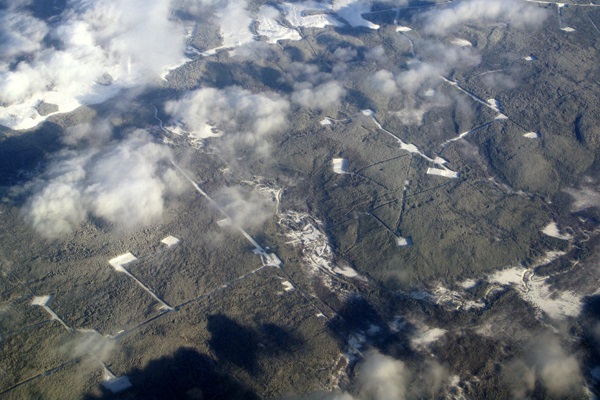
Image: https://www.irishnews.com/news/2017/06/30/news/outright-ban-on-fracking-in-ireland-should-be-implemented-in-the-north-1071027/
https://www.ecowatch.com/ireland-ban-fracking-2450255362.html

Fracking in BC

viewRoads and fracking drill pads slice up the scenery in northeastern BC (2013)
In June 2018, Centre forCPA-BC Resource Policy Analyst Ben Parfitt made a presentation to British Columbia’s Scientific Hydraulic Fracturing Review Panel in the context of rising provincial LNG industry and attendant concerns about general health and safety, and specifically the well being of Indigenous Peoples and communities.

Parfitt’s presentation included the following findings:

  • at least 92 dams were built in northeast BC without the companies that built them first obtaining the required licences and authorizations.
  • a large number of drilled and fracked gas wells in one remote operating area in northeast BC leaked methane gas, potentially contaminating groundwater.
  • increased water use at more fracking sites means more earthquakes.
  • contrary to the Province’s adoption and implementation of the United Nations Declaration on the Rights of Indigenous Peoples, the fracking operations in BC have taken place without the “free, prior and informed consent” of First Nations.

Imafe: https://thetyee.ca/News/2013/06/07/Northern-BC-Transition-Fuel/

https://www.policyalternatives.ca/publications/reports/ccpa-bc-presentation-scientific-hydraulic-fracturing-review-panel

Kaza Nunteng Porta

monument resize
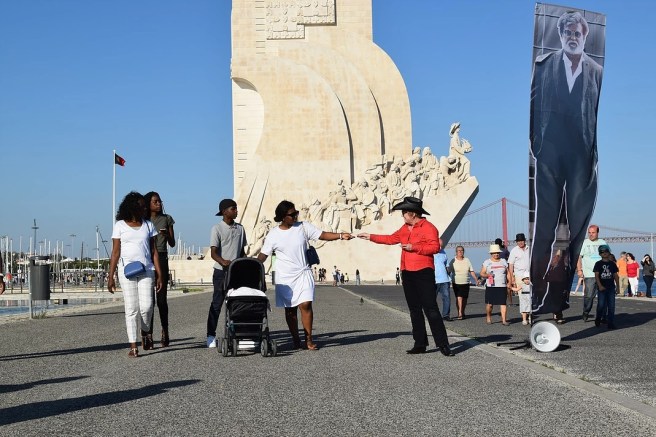
‘Kaza Nunteng Porta’ is Kristang (Melaka Portugese) for ‘House Without a Door’. It is the title of the latest Koboi Project series shot in Belem, Lisboa. This series addresses notions imperialism, globalization, migration, miscegenation and tourism in the course of my expansive Koboi Narrative. In impromptu photo-performances that took place at the Alfonso De Albuquerque Monument and the Discoveries Monument in Belem, Lisbon on 7th and 8th July 2018 respectively, I recast two important Portuguese memorials to discovery and ascendancy in an allegory of diasporic identity. In the course of each performance I raised my Pazaham Neeyappa banner with its image of Tamil movie SUPERSTAR Rajinikanth and played audio clips on a megaphone. The audio included Fausto’s A Guerra é a Guerra and Soundararajan & Janaki’s Ulagam Ulagam and a rendition of Jingkli Nona on the cello by Tara Rajah. I also played verses from the Malay pantun (poem) Kalau Roboh Kota Melaka and the lyrics of Ulagam Ulagam spoken in Portuguese by Hugo Moss. At the heart of each street intervention was the convivial engagement with the passers-by. Cards presenting the state flag of Melaka  were handed out.

Portuguese/ Malay Fusion

Jinkli Nona sung with Kristang and Malay verse  … How beautiful is the hybridity of traditions in Malaysia and the world! From Branyo to Joget and back again!

Jinkli nona, jinkli nona; yo kereh kazah
kaza nunteng porta nona; klai logu pasah?
Teng kantu teng; kantu teng falah nunteng
amor, minya amor; amor minya korasang

Puluh lapan dan I jauh ketengah
Gunung Lah daik bercabang Tiga
Hancur lah badan I dikandung tanah
Budi yang baik dikenang juga

Tek Kayu Tek Pucuk Pisang bunga Ramping


PETRONAS Confirms!

flag

On July 13 2018, LNG Canada formally welcomed PETRONAS as their  fifth Joint Venture participant. According to Energycity.ca  “Petronas is now an official partner in the consortium that is proposing to build a $40 billion liquified natural gas export terminal in Kitimat”. Petronas subsidiary Progress Energy will take a 25 percent stake in the LNG Canada development, which is still subject to regulatory approvals. Shell will lead the consortium with a 40% stake. The other partners are  PetroChina, Mitsubishi Corp. and Kogas Canada. As I noted in a previous post there are implications for national, trans-national relationships and intra-national relations. This investment will be closely aligned with the Coastal GasLink pipeline that TransCanada is building to transport the natural gas from Dawson Creek to Kitimat. Some members of the Wet’suwet’en nation of Canada have built a healing camp in the path of the pipeline. To acknowledge the changing scenarios in Malaysia and in BC I have changed the colours that brand this blog.

https://www.facebook.com/LNGCanada/photos/a.412970468894663.1073741827.412705752254468/911746075683764/?type=3&theater

https://www.energeticcity.ca/2018/07/petronas-now-officially-a-partner-in-lng-canada/

http://www.coastalgaslink.com/


Portfolio Review

potfolio review

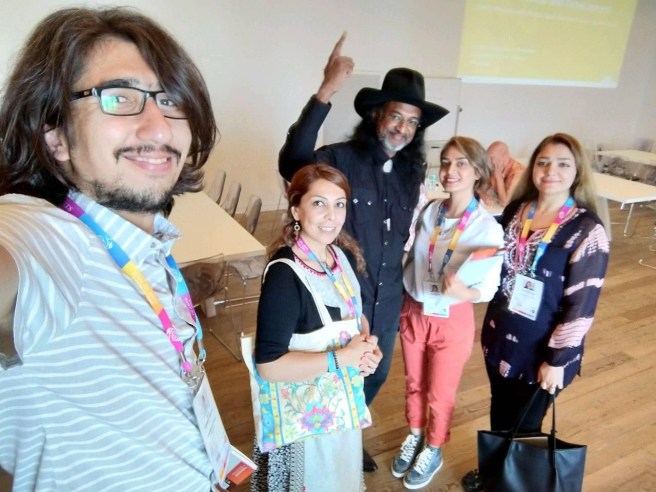
As faculty of the International Art Gallery of the Ismaili Diamond Jubilee Arts Festival in Lisbon, July 2018, I did two Portfolio review sessions. The photo above was taken after we ran well overtime in one of these sessions. The participants were  Fashion Designer Maryam GH, Carpet designer Ilnaz Ataei, painter Nasim Ataollahi and astro photographer Danyal Ghanbary.

Image: https://www.facebook.com/photo.php?fbid=1528643907239561&set=pob.100002819003124&type=3&theater

International Art Gallery

art gallery
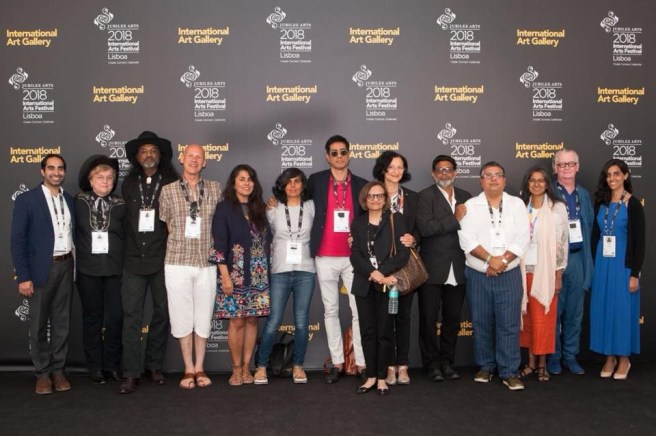
The International Art Gallery ran an extensive visual arts programme as a part of the Ismaili Diamond Jubilee Arts Festival at the Portugal Pavilion in Lisbon in July 2018. The faculty comprised: In the photo – Niranjan Rajah, Christian Bernard Singer, Rozemin Keshvani, Zarina Bhimji, Amin Gulgee, Zainub Verjee, Sara Diamond, Shaheen Merali, Narendra Pachkhede, Bryan Mulvihill; Other Faculty – Karim Jabbari, Faisal Devji, Pedro Gadanho, joão Ludovice, Yasmin Jiwani, Ilyas Kassam.

Image: https://www.facebook.com/photo.php?fbid=10217078897550493&set=a.1084585840769.2015094.1410069828&type=3&theater

Performance Masterclass

vexillationOr perhaps ‘Post Photo-conceptual Performance’ … a tag I have been developing to locate my practice at the junction of photography and performance. While the tag needs much refinement, I think the praxis itself seems now, after 5 years of the Koboi Project, to be reasonably developed. I had the privilege of delivering a Masterclass in Performance Art as Faculty at the International Ismaili Diamond Jubilee Arts Festival in Lisbon, which ran from the 5-9 July 2018.
See https://koboibalikkampung.wixsite.com/nuntengporta/masterclass

In this class, I shared my preparations for two impromptu photo-performances that took place at the Alfonso De Albuquerque Monument and the Discoveries Monument in Belem on 7th and 8th July 2018, respectively. I took the workshop participants, who were amateur and professional artists from the global Ismaili diaspora through my preparations for the two street interventions. They participated in my search for a meaningful action. We began the class within the designated presentation space and finished outside absorbing the architecture Portugal Pavilion and the masterclass itself into the spectacle and symbol of the event. In the light of his exercise and the images it produced, I have clarified for myself the stations of my process and have articulated them in a set of 12 words and images.