Before the The 40th British Columbia general elections in 2013, the Provincial Liberals made projections and promises on the basis of the massive LNG investments. They won that election and as early as 2014 they claimed Promise Made, Promise Kept. The linchpin in this scheme is the massive investment by PETRONAS on Lelu island. While I believe the Liberals are committed to their model of resource driven development for the province, this may be collateral to the main use of such promises – winning votes in elections. So while it looks more and more remote that the investment will materialize in the near future, what may matter more to the Liberals than whether it actually happens, is whether the promise of imminent investment is still electoral capital for the next elections in May 2017.
LNG Bluff 1: The Feds
I would like to attempt to elucidate, by speculation, the subtitles and contradictions of intention and action involved in the Lelu island proposal. The Federal Liberals have approved the the project but still maintain their stance on emission reduction and carbon tax. Could it be, that they are betting on a PETRONAS pull out due to the combination of global LNG market conditions, and the ongoing court challenges by the native and environmental stakeholders. In this way, they can be seen to be moving forward into their term in office without upsetting the BC provincial government and the influential resource sector in the run up to the provincial elections, and yet, ultimately, escape the wrath of the environmentalists and the native peoples as the specter of this massive LNG plant defiling the pristine west coast dissipates of its own accord!
Koboi Performance

In my 1st Metonymic Mango performance, I made an offering to Murugan and Ganesha in remembrance of their mythic race around the universe. In the 2nd Performance, my accomplice Singapore Biennale curator and cowboy John Tung, extended the signification of the mango, by narrating a Tekka Market tale of desire and denial. This time, on 20th January, I will perform again to complete the cycle.
Chief Yahaan Speaks
Video published on October 2015
On October 13, 2016 I emailed Chief Yahaan of the Gitwilgyoots tribe of the Lax Kw’alaams , and leader of the Lelu Island occupation, a question. I had spoken to him by phone before but had only had minimal email communications. This recent email contact took place before the federal government approved the environmental review for the project. We were in the midst of reports and rumours that PETRONAS might consider moving their LNG plant further north, to a location with less potential for direct harm to the salmon ecology. I put it like this, “Chief, … I am wondering about your own perspective on moving the plant off the island, to the North somewhere as rumoured … is this an acceptable compromise for you and your people, or is it still a NO!… as it just shifts the burden to another area and another community”. His answer was as follows, “I would like to see environmental areas protected and this particular project goes against that … what I would like to see is more tech work done on the emissions from the plant”. The Chief,makes it clear that beyond the potential of specific damage to the Flora Banks estuary, there is the potential for a more general damage to the environment that needs to be evaluated properly. He seems to be indicating an openness to research on emissions. He seems to be asking for more science, which brings me to the question of the integrity of the science being applied and the possibility that the knowledge currently in play is the product of a scary science.
Yellow

Scary Science
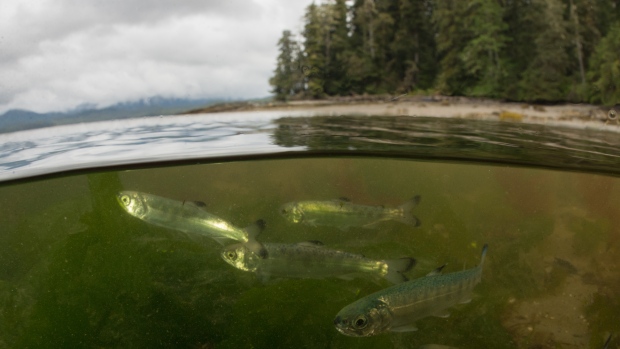
The federal government’s conditional approval of the Petronas-led LNG project on Flora Banks, Lelu island was based in part on an environmental assessment that determined a terminal and suspension bridge across one side of Flora Bank would not harm fish stocks. According to Bruce Cheadle of The Canadian Press, pioneer sediment transport and sedimentation dynamics geologist Dr. Patrick McLaren has alleged that project contractors altered, manipulated and ignored data in an effort to prove the viability of their project. He is reported to have said, “I feel I could easily go to court in terms of what constitutes scientific fraud ” and “The concepts through all their work have the characteristics of scientific fraud.” While they have defended their scientists findings, neither the project owners, nor the relevant government agencies has responded directly to a set of technical modelling questions that have been put forward in connection with the above allegations. Several First Nations and environmental groups have filed legal challenges against the project. One of these is based directly on a claim that the environmental assessment was flawed. The point here is that, while opinions among stakeholders on this project and this land may rightly be divided, the science upon which their opinions must rely has the obligation to be accountable, meticulous and transparent.
http://www.northernsentinel.com/national/400186021.html
Mango Performance
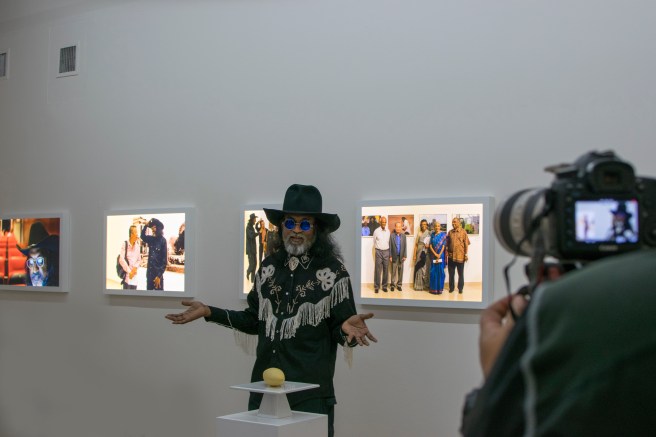 It was a happy return for the Koboi, when on the 28th October 2016, I presented my Koboi Balik Lagi performance as a Biennale artist at the Singapore Art Museum. This is where I had cut my teeth as a Southeast Asian theorist and as a curator in the 1990s. Compared to my previous appearances at this venue, my mango myth presentation was a bit more of an enactment and less of an exposition. Still, for me, there is little difference between the two modes of performance. In fact, in the oral, tradition all speech acts are performative. In the mindful recounting of myth, the diegesis is inherently mimetic. The world is enacted in the telling and within this enactment, stirs the moment of its its very creation. Such are the workings of the oral tradition … the universal sacred tradition. Indeed, as Ananda Coomaraswamy has explained, ‘a myth is always true’.
The Installation
 The lighting of the Koboi Balik Lagi installation was completed just prior to the official opening of the Singapore Biennale on the 26th of October. Deference to the eventual reception and judgment of the work aside, I am deeply satisfied with its realization in this installation. I would like to thank all those who made this installation and the performance series possible, especially my photographers Durga Rajah and Zuraini Anuar who shot Kedualan Si Koboi and Koboi Balik Lagi respectively; my curators Nur Hanim Khairuddin and Louis Ho; my project manager Anisah Aidid; my printers Bill Boutin and Roy Ng of ABC Photo, my framer Michael Batty of Fine Art Framing Services, as well as Dave Lawr of Rockin Cowboy, Monet at Salon 6 Twelve and Ray at Durga Interiors. I would like to thank the Koboi’s inner circle of cowboys and girls on the long drive to market, Roopesh Sitharan, Stuart Kennedy, Tara Rajah, Durga Rajah and Jane Frankish. Last but by no means least, I would like to thank my accomplice in red and Singapore Art Museums own in-house cowboy and assistant curator John Tung.
Natives support LNG

In the interest of balance I would like to summarize support among Native communities for Lelu Island related LNG developments. According to Gordon Hoekstra in April 2016 Pacific NorthWest LNG had signed impact-benefit agreements or term sheets with the Metlakatla, Kitselas, Kitsumkalum and Gitxaala First Nations. Even opposition from the Lax Kw’alaams who have lead the occupation of Lelu Island is not unanimous. Earlier this year Mayor, John Helin, offered conditional support for the project in a letter to the Canadian Environmental Assessment Agency. Further, according to the provincial government, 16 of 19 First Nations that must be consulted along the Prince Rupert Gas Transmission project route have benefit agreements. Hoekstra notes that B.C. Aboriginal Relations and Reconciliation Minister John Rustad has issued a written statement explaining the high level of support from First Nations in terms of the belief that the LNG sector can be developed in an environmentally sustainable manner and contribute positively to their communities.
http://vancouversun.com/business/energy/first-nation-support-for-pacific-northwest-lng-growing
Installing the Icon
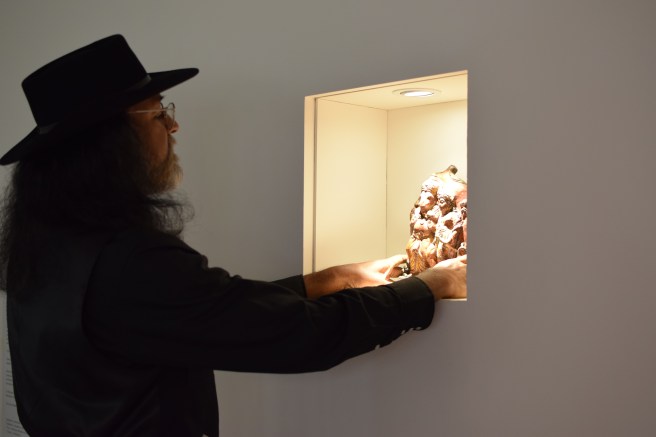 An auspicious moment in the run-up to the opening of the Singapore Biennale 2016 – on the morning of the 25th of October I placed the mango icon in its niche at the site of my Koboi Balik Lagi installation. With this placement I acknowledge the liminality of this object and engage with its complex ontology as a museum artifact, a readymade art object and as a living sacred icon. Since the turn of the 20th century, international modernism and global postmodernism have assimilated, subsumed, displaced and secularized traditional symbols. As contemporary art works proliferate in the global arenas of our present era, artists present local forms and subjects dressed for international consumption. The Koboi Project takes a post-traditional approach, emphasizing idiomatic expression, vernacular social and historical knowledge and living sacred forms, in the hope that the Koboi might be grounded in the local while he attempts to gain credence and currency within the mainstream of cultural production.
 The Koboi Project
You must be logged in to post a comment.