Godspeed Dear Jason 3

koboi

In this, the last of 3 posts remembering Jason Avery, I want to reflect on Jason’s role in bringing me within the fold of the Burning Man community in terms of my own growing awareness of the Festival.

In the late 1990’s I was based at the Universiti Malaysia Sarawak and was very much part of the global Internet art scene. Once, I was in Los Angeles for a conference and I met Mark Pesce who was a progenitor of desktop VR (Mark had been among those who spearheaded the standardization of 3D on the Web). As we socialized one evening, I was surprised to find him espousing the virtues of what sounded to me like a neo-pagan gathering in the desert. This was the first time I had heard of the Burning Man festival (Mark would, in 2003, pen a stinging critique of the cultification of the festival … but that is another story).

Some years later, in 2006 – 07, as faculty at the School of Interactive Arts and Technology, Simon Fraser University, Canada, I supervised an MA dissertation titled ‘The return of the gift society: Traditional relations of exchange and trust in contemporary technological society’. My student, Efrat Ben-Yehuda was a burner and, as I helped her frame her thesis in terms of traditional and technological discourses, I learned about the lived experience of the festival. I was enthralled but still not drawn towards participating in the event .

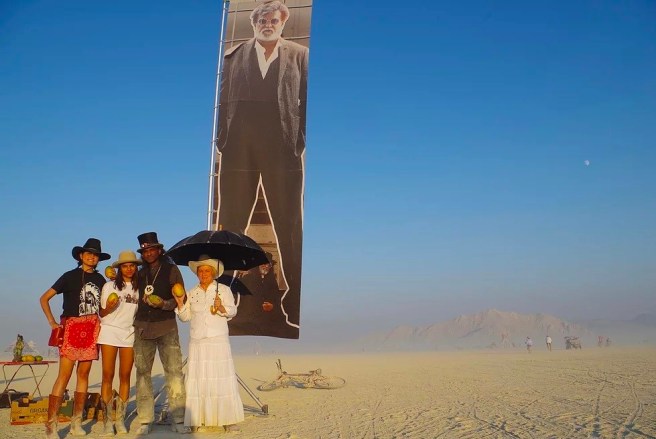
Then, as outlined in my previous post, following my reunion with Jason in 2017, I was educated, encouraged, entreated, enlisted and eventually enabled to come to the festival, bringing along both my art and my family. Just as an artist must be able to visualize the work in order to realize it, a community builder must imagine the society he or she wants to bring into fruition. Jason was just such a builder. He envisioned how my art would align with the festival and, beyond my own wildest imaginings, he saw how joining [The Camp With No Name] as a family would would be a rewarding experience for us. Jason enabled both a wonderful family experience as well as the production of the Anugraham series of the Koboi Project.

‘Anugraham’ means ‘grace’ and this work celebrates the gifting ethos that informs the Burning Man Festival, the sense of giving as receiving, that Jason knew so well.

https://en.wikipedia.org/wiki/Mark_Pesce

http://tripzine.com/listing.php?id=mcburners

https://sfu-primo.hosted.exlibrisgroup.com/primo-explore/fulldisplay?docid=01SFUL_ALMA21160741050003611&context=L&vid=SFUL&lang=en_US&tab=default_tab&query=any,contains,the%20return%20of%20the%20gift%20society

https://www.facebook.com/groups/340397416356816/posts/444141185982438/

Valayan Katti

3 abdul


The following is extracted and translated from a post titled AL-KESAH KOBOI BALIK KAMPUNG (28th MArch 2018) on Kebun JiwasHalus’ Blog – Yesterday we went to Merlimau, Melaka. Our guide was Azizan Paiman. The mission was a photo-shoot for the latest Koboi Balik Kampung series by Niranjan Rajah. Niranjan’s Koboi series plays on the problematics of a cosmopolitan identity in the context of contemporary trans-national mobility. Niranjan has taken the photo-conceptual Koboi Project everywhere, the Singapore Biennale, the Burning Man Festival and the KL Biennale. For the photo-shoot in Merlimau, Niranjan continued his discourse, this time with ‘me’ and ‘Melaka traditional house’ as ‘texts’ in his image. The traditional Melaka house refers to my teacher Ismail Zain’s digital collage dot matrix print entitled ‘Al-Kesah’ (1988). This work remains one of Ismail Zain’s most enduring intellectual legacies. “Al-Kesah” features a traditional Malay house as the backdrop for JR Ewing’s family photo (from the popular TV series of the early 80’s, Dallas). Pak Mail touches on the ‘modernization’ of the village landscape – in the context of globalization (or globa-lu-kasi, globalisasau, also gooblelibasi) connecting the impact of mass media and internationalist architecture in a semiotic and inter-textual play.

Hasnul asked me – Whats the term you use for my role in your photo bro? Am reflecting on koboi for my blog now.

I sent hasnul a hasty answer that is included in his post, and now take the opportunity to correct and elaborate on my reply – The Image (which is yet to be finalized and is not the one above) is being developed around the Tamil term valayan katti, which means pengikat dawai or person who ties wire. This is a term which, according to the ostentatiously  named author Sheikh Moinudeen Chisti Syed Abdul Kadir (is this a pen name for some other person of mischievous intent?), was “invented by Tamil estate workers but which became widely used by most Tamils including Indian Muslims to describe Malays”. In his rather informative , if controversial, posting about Malaysian Mamak or Indian Muslim identity the suspiciously illusive Sheikh Moinudeen explains, “…’valayan‘ means wire. ‘Katti‘ means to tie something. So ‘valayan katti means ‘a person who ties a wire’”. He continues, “In the early days of the rubber industry, the British tried to get the Malays to tap the rubber trees. However the native Malays had problems tapping the rubber tree in the proper manner and ended up injuring the tree, reducing the output of rubber. The British had better luck getting the trees properly tapped with the Tamils from India. Malays were then delegated the simpler job of using wire (valayan) to tie (katti) the little latex cups to the rubber tree. Hence the name valayan katti“. While this etymology is corroborated in various other online sources this term and its origins needs further confirmation.

Regardless of my doubts about the veracity of this reading of the term … it allows me to continue the approach I developed in my Telinga Keling (2000) in which I attempt to deconstruct and even to reconstruct a derogatory term that speaks to the depths of our national psyche. You (Hasnul) as a Malay are nominally the valayan-katti in my image. Then again, in electronic art days at UNIMAS,  we were both Valayan Katti – your wire carried the electronic video signal and mine, the new internet data. This brings me to the Ismail Zain reference of this image. You are his student and in a sense his heir … and me too … indirectly … Indeed, I think I can claim to be the valayan katti of Malaysian Internet art. Bringing this allegorical play into the present … despite a decade and a half of separation, given your Gemabelas and my Anugraham, we are somehow still connected or WIRED … working independently yet synchronously with tradition, compassion, physics and metaphysics. Indeed, now our network is metaphysical.

Image: http://hasnulsaidon.blogspot.ca/2018/03/al-kesah-koboi-balik-kampung.html

https://www.malaysia-today.net/2008/03/05/kimma-kurma-and-karma/

https://www.facebook.com/Gemabelas2017/

https://koboibalikkampung.wixsite.com/anugraham