The Koboi Returns 2023 – 16

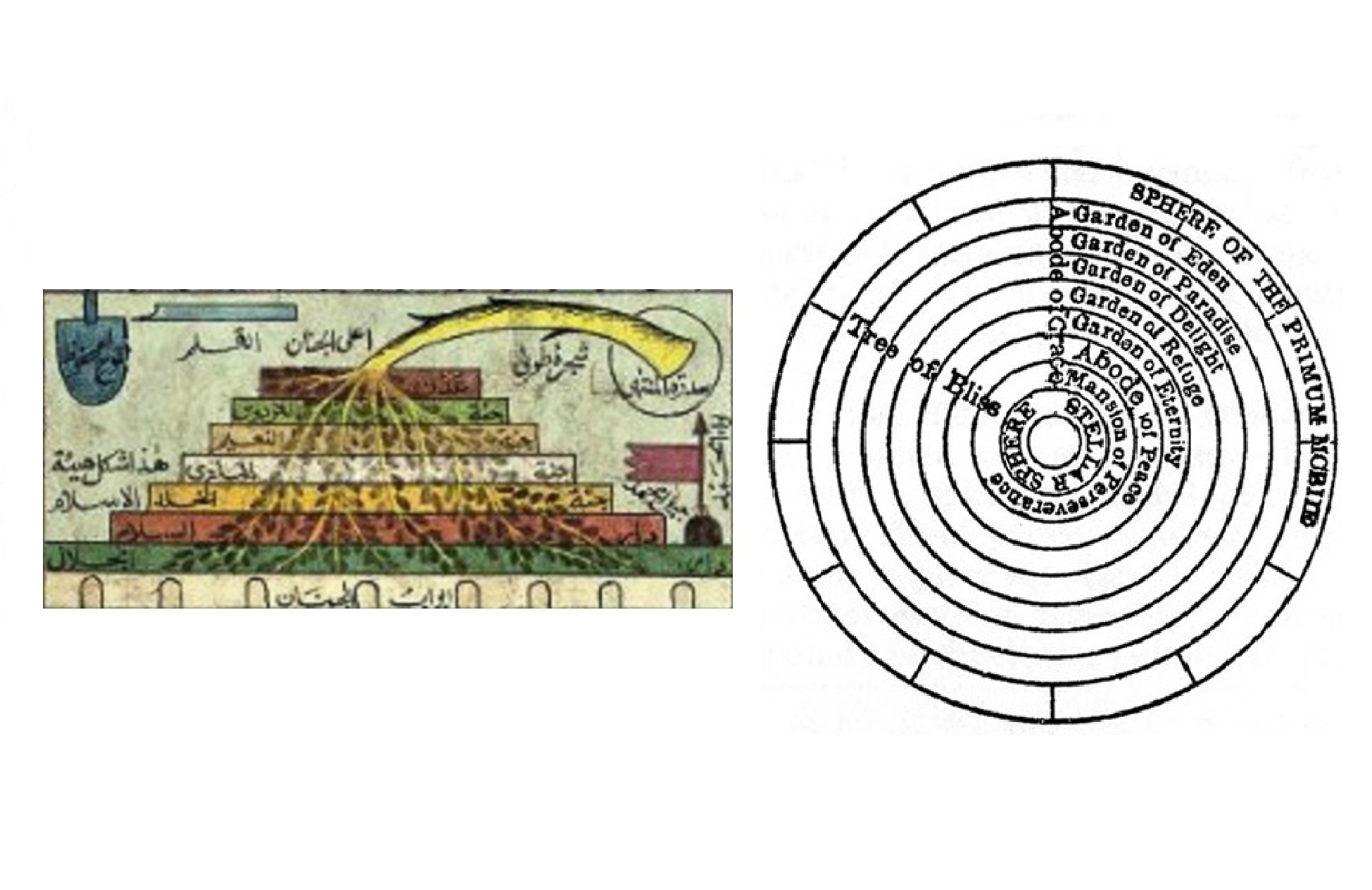
The Shajarat al-Tûba, or the Tree of Bliss is described in the hadîth as giving such shade that “a rider could travel for a hundred years without crossing it.” Ibn Arabî places this tree at the centre of a cosmology, inverted and rooted in the the primum mobile, where sits the Throne of Allah. The Tree of Bliss is thus, “rooted in the ground of Being and fed by the water of Essence.” The sphere of Earth is at the centre of the concentric cosmos, followed by the stellar sphere of the physical cosmos, and then various heavens. Beyond the Seventh Paradise, that of Eden, is the primum mobile. The Tree of Bliss is rooted in this Abode of Allah, with its trunk rising through Eden and spanning the levels of Paradise. While the Shajarat al-Tûba is not mentioned in the Holy Koran, its ontological significance might be understood in terms of the metaphysics of the Olive Tree which is mentioned. The Olive Tree stands “neither of the East nor West” and its “oil would almost glow forth (of itself) though no fire touched it.” In geometric terms, this tree seems to mark a centre and, in causal terms, an origin. The oil iof this tree is the source and being of earthly light, just as Allâh is the light of all that is the heavens and on the earth.

https://magictransistor.tumblr.com/post/121976939786/ottoman-diagram-of-heaven-and-hell-caucasus

https://islamqa.info/en/answers/1920/trees-mentioned-in-the-quraan-and-sunnah

http://www.studiesincomparativereligion.com/public/articles/The_Tree_Symbol_in_Islam-by_Noble_Ross_Reat.aspx#_ftnref71

The Koboi Returns 2023 – 12

The Pohon Beringin puppet of Kelantan Wayang Kulit is closely related to the Gunungan puppet from the Javanese Wayang, which as Fiona Wong E Chiong and Ghulam-Sarwar Yousof explain, is used by the Dalang to bring a whole cosmos of gods, demons, humans and other creatures to life for the time of the performance. While this magical function is understated in the Kelantan tradition, the Pohon Beringin puppet is used to mark the opening and closing of the performance. The Pohon Beringin is a microcosm of the universe, with a central tree motif surrounded by flora and fauna, sky, water, flame, and mountain motifs. There are three levels to this cosmos, with fishes, serpents, or crocodiles at the bottom level representing the lower Waterworld; land animals like monkeys or elephants in the middle level representing the earth; birds at the top level representing the Skyworld. The Pohon Beringian is associated with the universal Tree of Life motif, which, in Islam, is called the Tree of Immortality or šajaratu l-ḫuld . If in Christianity, there are 2 trees in the garden of Eden – the tree of the knowledge of good and evil the fruit of which God forbade to Adam and Eve , in Islam, there is only one tree, the šajaratu l-ḫuldat located at the centre of the Garden of Eden.

.Image: Pohon Beringin puppet/Persian Sarouk Farahan Tree of Life Rug, Late 19th Century 

https://ejournal.um.edu.my/index.php/MJPVA/article/view/13970/9368

http://catholic.cafe/2020/02/04/what-is-the-tree-of-life-and-why-was-it-guarded-by-the-cherubim/

https://nazmiyalantiquerugs.com/antique-persian-fine-sarouk-farahan-tree-of-life-rug-48624/

The Koboi Returns 2023 – 8

According to Edith Jachimowiczhe, Islamic cosmology echoew the geocentricity of the Aristotalian/ Ptolemaic Cosmos.  The space between the surface of the earth and the sphere of the Moon is known as the sub-lunary region. It is the realm of the elements, of minerals, plants, and animals, and of generation and corruption. In addition to the eight Ptolemaic spheres (Moon or falak al-kamar, Mercury or falak al-utarid,  Venus or falak al- zuhra, Sun or falak al- shams, Mars or falak al-Mirrikh, Jupiter or falak al-Mushtari, Saturn or falak al-Zuhal,  Fixed Stars or falak al-burudj), the Islamic cosmos has a ninth Sphere, the Sphere of Spheres or falak al-aflak. This astronomical (physical) model of the cosmos is integrated with a theological (metaphysical) cosmology.

In the explaining the relationship of the structure of the Islamic cosmos to the process of the primordial Creation, Jachimowiczhe cites theTasawwurat of Nasir al-Din Tusi, in which it is said that the creative force “reached the Throne of God, from the Throne reached the pedestal and, from the Pedestal again, descended to the sphere of Saturn and became attached to it. Again, it descended further, from one sphere to the other, until it reached the sphere of the moon. Then the exaltations and the rays of the stars, by the force of that energy and through the mediation of the sphere of the moon, fell upon the elements. This was certainly the cause which stirred the elements …” A line of force is drawn from the highest heaven down to the sublunary region and, given the notion of the ‘stirring’ of the elements, we might impute a turning movement to this force. In my own imagination, this line of force echoes the axial function and dynamics of the Pokok Pauh Janggi which links Dasar laut to Kayangan in the Malay cosmos.

Image: Jachimowicz, Edith (1975). Islamic Cosmology. In Carmen Blacker, Michael Loewe & J. Martin Plumley (eds.), Ancient Cosmologies. Allen & Unwin.


Dari Pusat Tasek 27

Taib Osman
Diagram by Niranjan Rajah combining the Malayy ontologies as described by Md. Salleh Yaspar and Anker Rentse.

According to Taib Osman, in the Malay cosmology, 1. Dunia is inhabited by Man, animals, plants, objects, spirits; 2. Pusat Tasik Pauh Janggi is inhabited by Nagas, Jins, Garudas; 3. Kayangan is inhabited by Dewa, Perman; 4. Dasar Laut is inhabited by Raja Lebis. Further, according to Anker Rentse, Syurga sits above the Pokok Pauh Janggi, while Neraka lies below it. It is from below the Dasar Laut, from hell’s boiling-pot or the kawah nufaka, that rises the swirl of the Pusat Tasek. A gigantic hole between the roots causes the ocean water to disappear into the boiling-pot. A dragon guards this hole that serves as the pintu Neraka. Its body also blocks the hole, preventing the ocean from running dry. In the Pusat Tasek an account is kept of the good and the bad deeds of every human being in the world.

https://www-jstor-org.proxy.lib.sfu.ca/stable/41559847

Dari Pusat Tasek 2

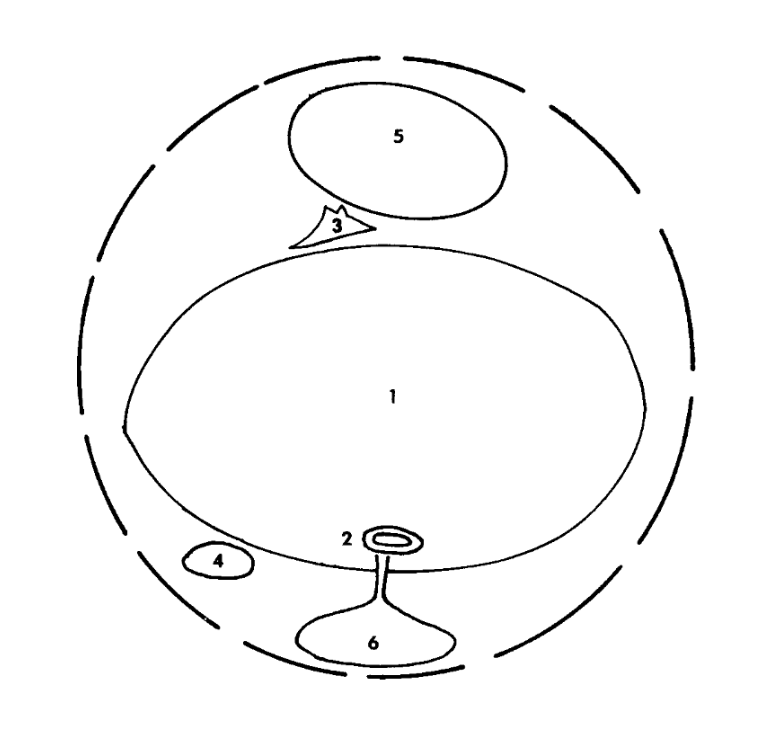
1. Dunia; 2. Pusat Tasik Pauh Janggi; 3. Padang Jauh dan Puncak Gunung; 4. Pulau Buah; 5. Kayangan; 6. Dasar Laut.  Diagram by Md. Salleh Yaspar in Malaysian world-view by Taib Osman

The Koboi Project exhibition and performance titled Dari Pusat Tasek will open at the Percha Art Space in Lumut on 25th Dec 2019. There will be an impromptu street performance, carried out as part of this exhibition, based on the malay myth of the ‘navel of the seas’ or the pusat tasik pauh janggi. The combined downward spiral of the Pusat Tasek and the upward thrust of the enormous Pokok Pauh Janggi combine to create an axis of the world, one that analogous with the Tiang Seri of the traditional Malay House. In the Malay Ontology or cosmos – 1. Dunia is inhabited by Man, animals, plants, objects, spirits; 2. Pusat Tasik Pauh Janggi is inhabited by Nagas, Jins, Garudas; 3. Padang Jauh dan Puncak Gunung is inhabited by Giants, jins; 4. Pulau Buah is inhabited by Ancestral spirits; 5. Kayangan is inhabited by Dewa, Perman; 6. Dasar Laut is inhabited by Raja Lebis. 

The Pusat Tasik Pauh Janggi appears to exemplify more general Southeast Asian structural and relational principles in which – 1. The Navel of the Seas drains the waters of the world; 2. A submarine tree or world pillar at the navel links the human realm to both the underworld and the skyworld; 3. There are mythic creatures dwelling at the navel of the seas at the base of the tree or pillar; 4. The ebb and flow of tides are due to the movements of the creature blocking the drain at the navel; 5; The ocean currents are due to water flowing in and out of the drain at the navel; 6. Earthquakes are caused by creature at navel of the sea shaking the world pillar; 7. There are relationship between these flows to the movement of the Sun and Moon and events like eclipses; 8. Rising sea levels and flooding are associated with the navel of the sea.

http://sambali.blogspot.com/2008/04/kuroshio-current-and-navel-of-sea.html