At the height of the performance (see performance notes) the Koboi invokes the spirit of the Pokok Pauh Janggi. He raises the puppet , waves it about, showing only back, and saying-
Hei Toh Mambang Puteh, Toh Mambang Hitam Yang diam di bulan dan matahari Melempahkan sakalian ‘alam asal-nya pawang, Menyampeikan sakalian hajat-ku, Melakukan sagala kahandak-ku, Hidulaplah Pokok Pauh Janggi!
Hey White Ghost, Black Ghost Who dwell in the moon and the sun Bestow all ‘the world of the magician,’ Deliver all my desires, Do all my bidding, Come alive Pauh Janggi Tree!
Koboi turns the puppet around to show color, sets it in the banana stem.
Having covered his head with the black cloth, Koboi presented the new deerskin puppets, unpigmented side facing the audience. He then put them down and performed a ritual (see performance notes) to dispel malicious entities (Badi) from the deer hide. He uttered a spell,
O Si Lanang, Si Lambaun, Si Ketor, Si Becheh, orang yang berampat, Ambil kembali bahagian-kau dari rusa ini!
O Lanang, the Lambaun, The Ketor, the Becheh, the four of you, Take back your part of this deer!
Koboi then took cuttings of deer hide (waste from the fabrication of the puppets) from the muslin cloth and, one by one, gave the signs of deer to the audience, calling them out by name —
He put each fragment on the banana leaf. When all eleven signs had been presented and thier material signifiers deposited on the leaf, Koboi folded the leaf, deposited it in the earth-filled basket, and uttered,
O Mentala Guru Asa (menaruh harapan) sabulan, dua sabulan, Tiga sabulan, ampat sabulan, Lima sabulan, anam sabulan, Tujoh sabulan, malam di-angkau, Siang di-aku. Sa’ekor aku bawa balik, Sa’ekor aku tinggalkan!
O Mentala (Batara) Guru Hoping (desiring, hunting) for a month, two months, Three months, four months, Five months, six months, Seven months, the night is yours, The day is mine. One deer I take, One I leave behind!
Finally, he sprinkled water and flowers onto the basket.
It began to drizz;e (gerimis) over the performance area at around this moment. Later we learnt from observers that it had only rained in the Kapallorek Artspace area and not the surrounding area. This was particu;arly notable as there had been a drought over the previous weeks.
In the Pokok Pauh Janggi Performance, the panggung was designed to echo the traditional Balinese set-up for daylight puppet display known as Wayang Lemah. Also the seating followed the traditional arrangement when the pawang or bomoh joins the dalangto conduct the upacara membuka panggung. At the heart of this performance was thepresentationand initiation of two long forgotten Kelantanese pupppets – the Pokok Pauh Janggi and the Ketam Gergasi. I exorcized the bad spirits from the deer hide (membuang badi rusa) and invoked the spirit of each puppet (memanggil jambalang patung).
This ceremony (upacara) involved the presence of two other more familiar puppets – Pak Dogol who is black and Wak Long who has a red counternance.During the performance, the Koboi wore his habitual black koboi outfit and sat on the side of Pak Dogol. The Koboi’s collaborator, Sang Nabil Utama, wore red baju and kain batik and sat with Wak Long. In the course of the performance the I exchanged my Western hat for a songkok, alluding to the fourth question of the previous post in this series – Sejauh manakah seseorang warga tanah Melayu sezaman boleh masuk Melayu tanpa masuk Islam?
The panggung (theatre/stage) for the Pokok Pauh Janggi performance was denoted by a tikar sengkuang (seashore pandan mat) and 2 cushions to mark the positions of the ersatz Dalang (puppet master) and the Pawang (shaman). The traditional Wayang Kulit batang pisang (banana stem) constituted the ibu pertiwi (mother earth) of the panggung and at each end of this ‘ground’ was inserted a bamboo rod, stating the vertical plane and marking the left and right boundaries of the proscenium. Wayang Kulit normally takes place in the dark so the shadows of the puppets can be starkly delineated on the kelir (screen), which is the ultimate site or interface of the performance. The Pokok Pauh Janggi performance was not, however, the presentation of a shadow play but, rather, the sharing of the sacred or magical upacara (rites) of Malay Wayang Kulit. The performance took place just before dusk, while there was still enough light for the buang badi rusa (dispelling of the mischief of the deer) and the invocation of the jambalang wayang (spirit of the puppets) could be observed by the audience. There could of course be no screen, and this led to practical problems with regard to support for the puppets and focusing the space of the performance.
To help delineate the proscenium and to order the space of the ritual, some devices were borrowed from the Balinese Wayang Lemah which also traditionally takes place in daylight without the mediation of a screen. In the presentation of Wayang Lemah, an intertwined cord of three threads known as the tukelan is tied across the vertical posts of the proscenium. The taught, straight tukelan signifies akasa (sky) and dharma (righteousness). At either end of the tukelan is strung an Uang Kepeng (pierced Chinese coin) that was the medium of exchange in the traditional Balinese economy, and which is said to symbolize balance between the Bhuana Agung (macrocosm) and Bhuana Alit (microcosm). While the incorporation of these elements of Wayang Lemah constitutes a deviation from the Kelantan tradition, it was apropos to the mechanics, optics, and metaphysics of the daylight performance of Pokok Pauh Janggi and, most importantly, it brought a broader Nusantara perspective to the proceedings.
Thanks to my friend and Vancouver based Tok Dalang Mark Parlett for guiding me towards the realization of this important aspect of the Pokok Pauh Janggi performance.
Pokok Pauh Janggi performance and installation by Niranjan Rajah runs from 5th Aug – 30th Sept 2023.
According to Malay folklore, far out in in the deep ocean somewhere, there is said to be a momentus whirlpool, known as Pusat Tasik, that swirls down to the depths, draining the waters into the earth. Rooted to the ocean floor at this nexus, is the fabulous Pokok Pauh Janggi that reaches up to the heavens. In the Selangor Malay tale of Haji Batu, a man, journeying to perform the Haj, had to cross the fearsome Pusat Tasek (Siapa terjatuh atau tergelincir, tersuruplah ia ke dalam pusar. Tempat menanti segala mara bahaya. Tempat duduk menantinya Nenek Sepit Pentala Naga di Laut Buih Gelombang Tujuh. Kalau si lemah yang sampai, maka hilang ghaiblah ia di mulut Raja Naga yang maha bisa). As Haji Batu’s ship went down, he clung to the Pokok Pauh Janggi in the middle of the swirl of the Pusat Tasek, and following instructions he had received in a dream, drew himself up on 7 nails that he drove into the tree. When he reached the top, he found the nest of the mythical gigantic Burong Roc (Garuda) that lived there. He waited therein and when the Roc returned, he attached himself to the bird and flew Westward on his Journey to Mecca. (see Walter William Skeat’s Malay Magic). The above diagram presents the outline of a Pokok Pauh Janggi Wayang Kulit puppet collected by Walter William Skeatfrom a Tok Dalang from Kelantan in the late 19th Century. Could the figure in the tree possibly be this Haji Batu about to be attach himself to the Burong Roc, or could it be the great bird itself (note the aquline features of the figure’s head)? Perhaps it is a composite figure combining the two entities?
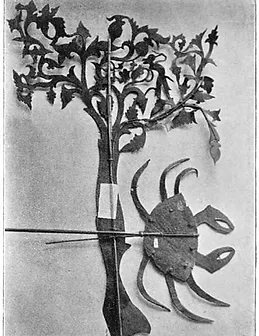
According to Malay folklore, in the far depths of the ocean, there is a great whirlpool known as the ‘Pusat Tasek’ or the ‘navel of the seas’. At the centre of this whirlpool, there is an enormous tree known as the Pokok Pauh Janggi. This place, identified in Malay Cosmology as the Pusat Tasik Pauh Janggi, is inhabited by Nagas, Jins, Garudas and other such creatures. One of these creatures sits on the ocean floor, at the base of the tree blocking a gigantic opening at the root of the tree. This opening leads further down to the nether world of the Dasar Laut inhabited by Raja Lebis. Further, according to Anker Rentse, it is from the Dasar Laut, that the swirl of the Pusat Tasek rises in the course of ocean water draining down the opening. In some versions of this cosmology, a dragon guards this hole and its body also blocks the hole, preventing the ocean from running dry. In other accounts it is not a dragon but a giant crab that holds the waters up. It is the daily movements of this crab, unblocking and reblocking the hole, that cause the movement of the waters that we humans experience as currents and tides. The above Kelantan Wayang Kulit puppets of the Pokok Pauh Janggi and the giant crab were collected by Walter William Skeatfrom a Tok Dalang in the late 19th Century. They index the likelyhood that the Wayang repertoire was once replete with representations of indegenous Nusantara myths and ideas that have since been abandoned.


 The Koboi Project
You must be logged in to post a comment.