Who or what is the Cakravartin? (Spiritual Authority and Temporal Power in the Indian Theory of Government)

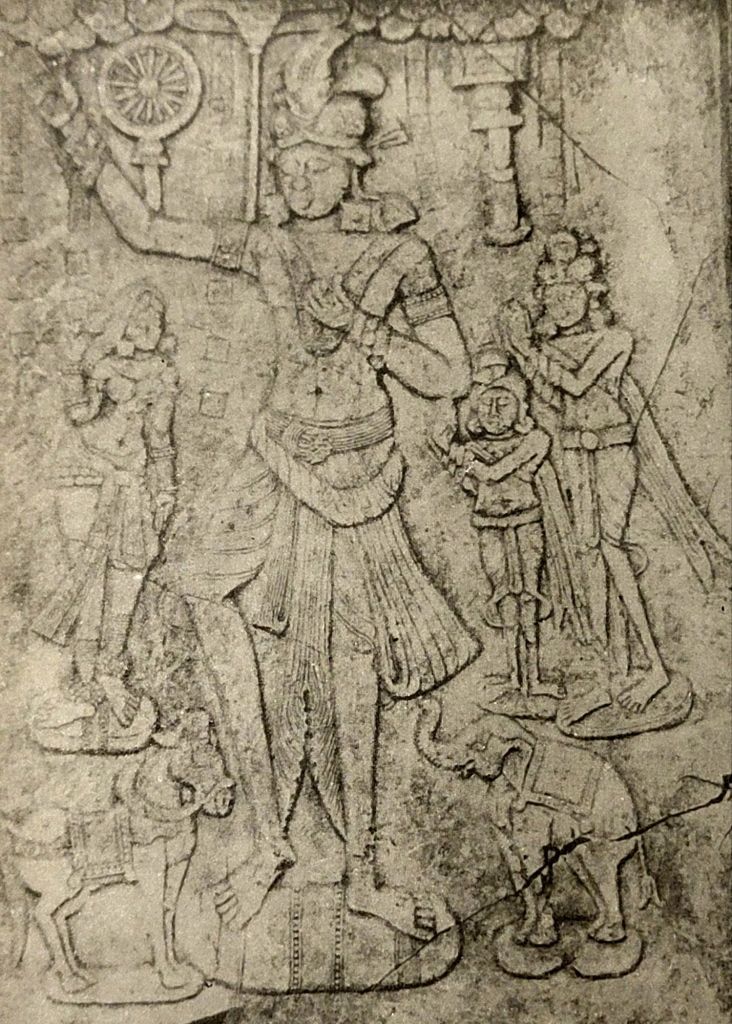
Fig 1. The Circulation of the Shower of Wealth: a Caktavartin with the umbrella of Dominion and the Seven Treasures. Jagayyapeta, 2nd century B.C. (After Coomaraswamy)

I have been slow to begin my series on Ananda Kentish Coomaraswamy’s Spiritual Authority and Temporal Power in the Indian Theory of Government,1 but here is the first installment. It is, arguably, the most complex and integrative of Coomaraswamy’s three most profound texts, the other two being Hinduism and Buddhism and Time and Eternity. I have been reading and rereading Time and Eternity slowly for the best part of 25 years but have only recently begun studying Hinduism and Buddhism and Spiritual Authority and Temporal Power in the Indian Theory of Government. It has not been easy work without proficiency in Sanskrit, Latin and a host of other languages that would render a comprehension of Coomaraswamy’s uncompromising work more complete. Nevertheless, I have taken it upon myself to attempt this task, and share my reflections on this text, as limited as they might be. I am particularly interested in understanding contemporary governance in its light.

I will begin with six  contextualizing themes: 1) Post traditionalism, 2) the relationship of Traditionalism with Fascism, 3) the precedence of Rene Guenon’s Spiritual Authority and Temporal Power,2 4) the implied validation of varna or the caste system, 5) the implied gender hierarchy, and 6) the image of the Cakravartin. In this, the first post in the series, I will deal with the image of the Cakravartin, which, as the frontispiece, is quite literally, the opening of the book. This image is captioned, “The Circulation of the Shower of Wealth: a Cakravartin with the umbrella of Dominion and the Seven Treasures. Jagayyapeta, 2nd century B.C.”

The Cakravartin expresses the Indic ideal of the Universal Monarch and was developed as an icon in the Andhra region during the Buddhist era. The concept was defined and perpetuated in the Brahmanical Kautilya Arthasastra. As John M. Rosenfield notes in The Dynastic Arts of the Kushans, “In the relief carvings of Amaravati and Nagarjunikonda the Cakravartin is usually shown surrounded by the seven emblems of his supremacy: the great discus of unimpeded conquest [cakra], the state elephant on which the king can ride to the very ends of the earth and back in one day, his equally remarkable charger, the octagonal gem which is so luminous that it can light the path of his army by night, the all-wise finance minister, the beautiful consort who is the very embodiment of his prosperity, and his prime minister (or the crown prince). These seven attributes of his dignity, the sapta ratna, come supernaturally to the king when he has attained a requisite degree of virtue.”3 The number and variety of the “jewels” or ratnas varies, sometimes including householder, general, and chariot, with the source being referred to, but there are usually seven and the symbolism is consistent.

As Coomaraswamy notes, according to traditional doctrine, not just Indian but universal doctrine, the life and fertility of the realm depends upon the King.4 If the King fails to fulfil his duty, by way of ritual and metaphysical sacrifice, the wealth and bounty that falls from the sky as rain will cease. This is what the Cakravartin icon symbolizes. The image ties the actions of the King to the fate of the land in a perpetual circulation of gifts – the Gods confer their bounty and the King presents his sacrifice. Coomaraswamy translates and interprets verses from the Satapatha Brahmana on the relationship between the Shower of Wealth and the Cakravartin thus, “its [the Shower of Wealth] self or body (atman) is the sky, the cloud its udder, lightning its teat, the shower the shower (the rain); from the sky it comes to the cow (i.e. from the Sky as archetypal cow to the earthly cow … ), its self or body is the cow … its shower the shower (of milk); and from the cow it comes to the Sacrificer. He [the Cakravartin] (in turn) is the self or the body, his arm its udder, the offering ladle its teat, the shower the shower (of ghi). From the Sacrificer to the Gods: from the Gods to the Cow; from the cow to the Sacrificer; thus circulates this perpetual neverending food of the Gods.” 5

Coomaraswamy specifically addresses the Cakravartin as represented in sculptural reliefs. in Amaravati (similar to the frontispiece which is from Jagayyapeta) He explains that the image shows the Cakravartin raising his right hand up to the clouds (signifying his sacrifice), and that from the sky, a shower of coins is falling (signifying the bounty).6 The image, as a whole, signifies the circulation of wealth, produced and perpetuated by the ritual (outward) and metaphysical (inward) righteousness of the Universal Monarch – the Cakravartin.

  1. Ananda K. Coomaraswamy, Spiritual Authority and Temporal Power in the Indian Theory of Government  (Munshiram Manoharlal Publishers, 1978),
  2. Rene Guenon, Spiritual Authority and Temporal Power (Sophia Perennis, 2001).
  3. John M. Rosenfield, The Dynastic Arts of the Kushans (University of California Press, 1967), 175.
  4. Ananda K. Coomaraswamy, Spiritual Authority, 68.
  5. Ananda K. Coomaraswamy, Spiritual Authority, 68.
  6. Ananda K. Coomaraswamy, Spiritual Authority, 69.

Applying the Sri Lanka Genocide Model in Gaza 3

As I have said in previous posts (see Applying the Sri Lanka Genocide Model in Gaza and applying the Sri Lanka Genocide Model in Gaza 2), I am having a sense of deja vu as I follow the recent events in Gaza. I am brought back to the state of psychic shock that I found myself in early 2009 as the short-lived Tamil nation of Elam came to its crushing end. In this post, I will outline the history of the formation of the de-facto Tamil state.

The island of Sri Lanka gained independence from the British in 1948 with the majority Sinhalese taking the reins of a unitary state which incorporated ancestral Tamil areas in the North and the East. After decades of discrimination and futile non-violent resistance, some Tamils organized to take up arms to wage a violent struggle. Indeed, in 1972 Velupillai Prabhakaran and others formed the Tamil New Tigers (TNT). In 1976, the TNT became the Liberation Tigers of Tamil Eelam (LTTE) under the leadership of Prabhakaran. In July 1983 the LTTE killed 13 Sri Lankan soldiers in an action in the Jaffna peninsula, and this led to race riots in Colombo in which hundreds of Tamils were killed and thousands more were displaced. This was the start of a full-fledged guerrilla war referred to as the “First Eelam War.”

In 1987 India brokered the Indo-Lanka Peace Accord and deployed peacekeeping troops in Northern Sri Lanka to enforce it. When the LTTE refused to disarm, a full-scale war between the LTTE and India. After incurring heavy losses, the Indian troops withdrew in 1990 and the Tigers took control of large sections of northern Sri Lanka, and the fighting resumed between them and Sri Lankan troops. This was the beginning of the “Second Eelam War” which ended in a truce in 1995, with the LTTE controlling one-third of all Sri Lankan territory and two-thirds of the island’s coastline.

The “Third Elam War” began with the breakdown of the short-lived truce in April 1995 and a brutal 6 year war ensued across the North and East of the island. It was during this war, that the United States declared that the LTTE was a terrorist organisation. This US declaration was made in 1997. It was followed a British declaration in 2001 and other nations then followed suit. This “third Elam war” ended in 2001 when a ceasefire was instituted through a Memorandum of Understanding which was formalized in the 2002 Ceasefire Agreement, made under the auspices of Norwegian mediation.

From 1984 onwards the LTTE set up a functioning government in the territory under their control. They ran a sophisticated administration comprising a judicial system, a civil police force, Human Rights organizations, health and education systems, a Bank, as well as radio and Television stations Periods of Sri Lankan military occupation not withstanding, this de-facto Tamil state was fully functional and was recognized by many global institutions; notably, the World Bank’s Sri Lanka representative made the following statement in 2005, ‘Given the fact that there is an officially recognized LTTE-controlled area, a kind of unofficial state, and since it is a party to the ceasefire agreement with the Government, the LTTE has the status of a legitimate stakeholder’

Note: This WordPress post was originally headed by the image of a Tamil Elam flag. I re-posted it on Facebook and was warned about posting offensive material and my re-post was blocked. In this context, it is important to understand that, the Tamil Elam flag (above) is different from the LTTE flag (the LTTE is a proscribed organization). For a detailed explanation please see Applying the Sri Lanka Genocide Model in Gaza 4.

Images: https://naimnikmat.blogspot.com/2019/10/siapa-ltte-dan-mengapa-ltte-ni-tiba.html
https://koboiproject.com/wp-content/uploads/2023/11/78545-save_20191011_122638.jpg

The cronology presented above has been compiled from the following three articles:
https://www.reuters.com/article/us-srilanka-war-timeline-sb-idUSTRE54F16620090518/
https://www.wionews.com/photos/a-timeline-to-tamil-tigers-37-year-marathon-struggle-against-lankan-army-for-separate-state-219592
https://en.wikipedia.org/wiki/Tamil_Eelam#cite_note-sunday-42

https://academic.oup.com/isq/article/61/2/337/3078982?login=false

https://www.tandfonline.com/doi/abs/10.1080/01436590600850434

https://www.tamilguardian.com/content/tamil-eelam-flags-fly-high-canada-and-uk

Desi on the Moon

A rat done bit my brother Nandi,
(with Desi on the moon),
His face and arms began to swell …

The irony of India’s successful landing on the moon is underscored by its chasmic income inequality which persists despite, or perhaps because of, massive economic growth in recent years. This inequality, combined with India’s ascendant politics of Hindutva, its entrenched indignities of caste, expansive inner-city slums, and yawning rural/ urban divide, brings to mind Gill Scott-Heron’s scathing critique of the American space progamme, made in 1970, soon after Neil Armstrong set foot on the moon in 1969.

A rat done bit my sister Nell.
(with Whitey on the moon)
Her face and arms began to swell.
(and Whitey’s on the moon)
I can’t pay no doctor bill.
(but Whitey’s on the moon)
Ten years from now I’ll be paying still.
(while Whitey’s on the moon)

Image: https://torontosun.com/news/world/indias-moon-rover-completes-its-walk-scientists-analyzing-data-looking-for-signs-of-frozen-water

https://thegeopolitics.com/income-inequality-in-india/

https://www.theatlantic.com/technology/archive/2011/05/gil-scott-herons-poem-whitey-on-the-moon/239622/

K is for Kisona 3

In this post I will begin to unpack the meaning, possible meanings rather, of Bersatu Pasir Puteh division vice chairman Borhanuddin Che Rahim statement on social media, made with reference to Kisona Selvaduray, in the context of her recent defeat in the Sudirman Cup semi-final match in Finland. “BAM kutip india (keling) dlm mana lah jd pemain utama Malaysia” or “Which estate did BAM (The Badminton Association of Malaysia) fund this indian (keling) and make her Malaysia’s main player”.

As I noted in the previous post, my instinctive response is the same as that of most Malaysians. Surely, this statement is a racial slur. Still, given the immediate apology and resignation of the perpetrator, I now have some doubts as to the meaning of his text and as to his intention as well. To satisfy myself and to do justice to the accused, I will attempt interrogate the statement in terms of its semiotics in order to determine if indeed the statement is racist and if so, what exactly constitutes its racism. If it is not racist, I will ask if it is, nevertheless, a slur of some sort, and again how it achieves its harm. In doing this, I will unpack the syntax, semantics, and pragmatics of this utterance –

BAM kutip india (keling) dlm estate mana lah jd pemain utama Malaysia

  1. I will begin with some definitions. ‘Syntax’, is way in which the words are put together to form the offending phrase, ‘Semantics’ involves the meaning of words used independent of the context and ‘pragmatics’ is the meaning of the statement in relation to the context of its utterance. Pragmatics helps us approach the meaning as intended or implied by the speaker.

  2. The obvious trigger word here is ‘keling’ and while it is clearly used in a derogatory manner as exemplified and evidenced by the infamous ‘Keling Babi” video, the word is deeply complex both in its etymology and in its current usage. It is in fact a mainstay of Malay idiomatic expression (Please see my exhaustive Keling Lexicon). In semantic terms, to define ‘keling’ as having a racist denotation, or even a necessary connotation of racism, would mean denying the benign etymology of the word. At the very least it would mean that the contemporary negative connotations (which one can in fact see even in the older idiomatic expressions of the lexicon), have displaced other more neutral denotations of Indian origins and Indianness.

  3. Further, in this question of usage, there is a clear geographical diversity in the understanding the word. I have come to understand anecdotally, that the word is used freely by Malays in Kelantan, under the impression that it is not a slur and that Indians do not take it as one. I am yet to gain any insight about the Kelate Indian communities position in this matter but I consider my Malay informers astute, sensitive and reliable. If indeed this is the position in Kelantan, the explanation given by Borhanuddin Che Rahim stands corroborated. He states in his apology, “Saya tidak berniat menghina kaum India dengan panggilan tersebut, ia sebaliknya bahasa percakapan di Kelantan yang merujuk kepada orang India”.

  4. There is also syntactical indication that the use of the term might not be as a slur. It is used, not instead of ‘India’ but, as an ancillary to ‘india,’ and it is set within brackets, as if to indicate that it is an adjective modifying the noun. If the word ‘india’ is being explained by the more Kelate appellation of ‘keling’, or if ‘india’ is being qualified – indicating which type of ‘india,’ ‘keling’ or perhaps ‘mamak’, then there arises the possibility that no racial slur arises in the use of the word, at least not from the perspective of intention.

To be continued in the following post …

https://www.badmintoncentral.com/forums/index.php?threads/s-kisona.183894/

https://www.differencebetween.com/difference-between-semantics-and-vs-pragmatics/

https://www.dailymotion.com/video/x2urrs8

https://www.utusan.com.my/terkini/2021/10/saya-minta-maaf-tidak-ada-niat-hina-kaum-india/

Keling Pariah 4

Pa. Ranjith is the director I admire the most in mainstream Tamil Cinema. His ability to infuse this commercial medium with the messaging of an ascendant Dalit consciousness, as he did in Kabali and Kaala, while maintaining box-office success, is astounding. Ranjith is a fearless activist and provocateur. Ranjith hails from a cheri (ghetto) in Karalapakkam, Tamil Nadu and, according to wikipedia, he is from the Paraiyar community.

Pariah has become a slur and a derisive word in English and in Malay and Indians get upset and enraged when they hear this word. Why? Well, this name comes from the cast order that is Indian and Hindu. Attitudes towards it reflect the worst racial prejudice that is innate to Indian culture. The Pariyar are a community that is categorized as outside of the Brahmanical social order. While I deplore the use of the name of this community as a slur in English and Malay, I suggest that it is more important that Indians stop flinching when they hear this word, as that reaction comes from their own racist impulse.

https://www.firstpost.com/india/india-and-the-indian-i-hope-my-daughter-inherits-a-country-unbound-by-caste-lingustic-strictures-writes-pa-ranjith-6839771.html

https://en.wikipedia.org/wiki/Paraiyar

It’s Time to be Clear 2

So what is Fascism? In The Anatomy of Fascism, Robert Paxton defines fascism as “a form of political behavior marked by obsessive preoccupation with community decline, humiliation, or victimhood and by compensatory cults of unity, energy, and purity, in which a mass-based party of committed nationalist militants, working in uneasy but effective collaboration with traditional elites, abandons democratic liberties and pursues with redemptive violence and without ethical or legal restraints goals of internal cleansing and external expansion.”

While there is no doubt that Donald Trump and by implication the Republican Party have been flirting with White Supremacy, and thereby bringing the USA within the ambit of Paxton’s definition, as a Malaysian Tamil who has lived in the UK, I can not but think of the analogous forces that have given us Brexit, Ketuanan Melayu and Hindutva.

Further, as an immigrant to Canada and as a resident of British Columbia, I struggle to disentangle my new, welcoming and multicultural home from its White Supremacist provenance, and I wonder about the future.

http://libcom.org/files/Robert%20O.%20Paxton-The%20Anatomy%20of%20Fascism%20%20-Knopf%20(2004).pdf

https://www.mtholyoke.edu/courses/rschwart/hist151/Paxton_Fascism/Paxton%20Anatomy%20of%20Fascism%20Chap8.pdf

PETRONAS’ Pipeline Interest 3

On 13, 2020, it was reported on the UNIST’OT’EN website that, in what would be an escalation of the conflict over CGL pipeline, the RCMP (Police) have set up an “exclusion zone” at 27km and are blocking media, Wet’suwet’en people, and food from getting up to their territory. The report claims that this is a violation of the Wet’suwet’en’s human rights, of Wet’suwet’en law, and of their constitutionally protected rights as Indigenous people. The report also highlights the fact that the ‘last time RCMP set up an ‘exclusion zone,’ they had authorized lethal force against unarmed people.”

I am observing these developments as a Malaysian resident of British Columbia and I cant help thinking of our own Malaysian indignation at the Indian state’s mistreatment of Kashmiris with curfews and media black outs. Malaysians must be made aware that our premier Crown Corporation stands to benefit from these apparently analogous acts of the Canadian state. As I have noted before Malaysia’s PETRONAS’ investment in Kitimat is totally dependant on this CGL pipeline which will transport natural gas from PETRONAS’ own North Montney fields. So once again, the interests of the exemplary Malaysian bumiputera (indigenous) led enterprise is contrary to the those of a group of indigenous people from British Columbia.

http://unistoten.camp/jan13/

https://economictimes.indiatimes.com/news/international/world-news/malaysian-pm-says-india-invaded-occupied-kashmir-at-unga/articleshow/71362388.cms

Rajinikanth Glows Saffron

After a meeting of Indian Prime Minister Narendra Modi’s cabinet, Home Minister Amit Shah announced  the abrogation of Article 370 of the Indian Constitution ending the special status and relative autonomy for Jammu and Kashmir and the division of the territory into two. While his friend and fellow traveller in movie stardom and in politics, Kamal Haasan has criticized this BJP policy as an assault on democracy, Rajinikanth has, sadly, approved. Taking the spiritual allegory of the Mahabharata, quite literal, to the contemporary battlefield, the fledgling politician is reported to have said that Modi and Amit Shah were like Krishna and Arjuna

In my own view, this is an epic political fail for Thalaiva. I was, from some of his earlier pronouncements on religious and cast politics, envisioning a more humanistic and inclusive application of the traditional Hindu ethos in contemporary Indian Politics. Indeed Rajinikanth should be wary that he does not become a ‘wooden’ politician, particularly in the sense of becoming the Trojan horse that secrets BJP’s RSS/Arya Samaj saffron remix into the black atheist heart of the Dravida polity. Such an autocratic gesture from this second term Hindutva government bodes ill for the diversity that has characterized Indian politics since independence in 1947.

As far as Thalaiva’s entry into Tamil Nadu politics is concerned, I had hopes that Thalaiva would usher in a fresh spiritually motivated universalism to the tired atheist and ethnocentric Dravidianism that has shaped the modern state. I regret to note that, as his star glows with an increasingly saffron hue, my hope of Thalaiva becoming an exemplary post-traditional politician is fast reducing to just another fan-boy’s fantasy! Come on La … Thalaiva!!!

https://www.ndtv.com/india-news/article-370-kamal-haasan-shreds-kashmir-move-says-extremely-regressive-autocratic-2080709

https://www.news18.com/news/politics/rajinikanth-keeps-promise-of-spiritual-politics-bars-members-of-religious-caste-outfits-from-joining-forum-1862425.html

https://economictimes.indiatimes.com/news/politics-and-nation/rajinikanth-hails-amit-shah-for-kashmir-initiative/articleshow/70628240.cms?utm_source=contentofinterest&utm_medium=text&utm_campaign=cppst

https://caravanmagazine.in/politics/rss-attempt-takeover-arya-samaj-english

Continue reading “Rajinikanth Glows Saffron”