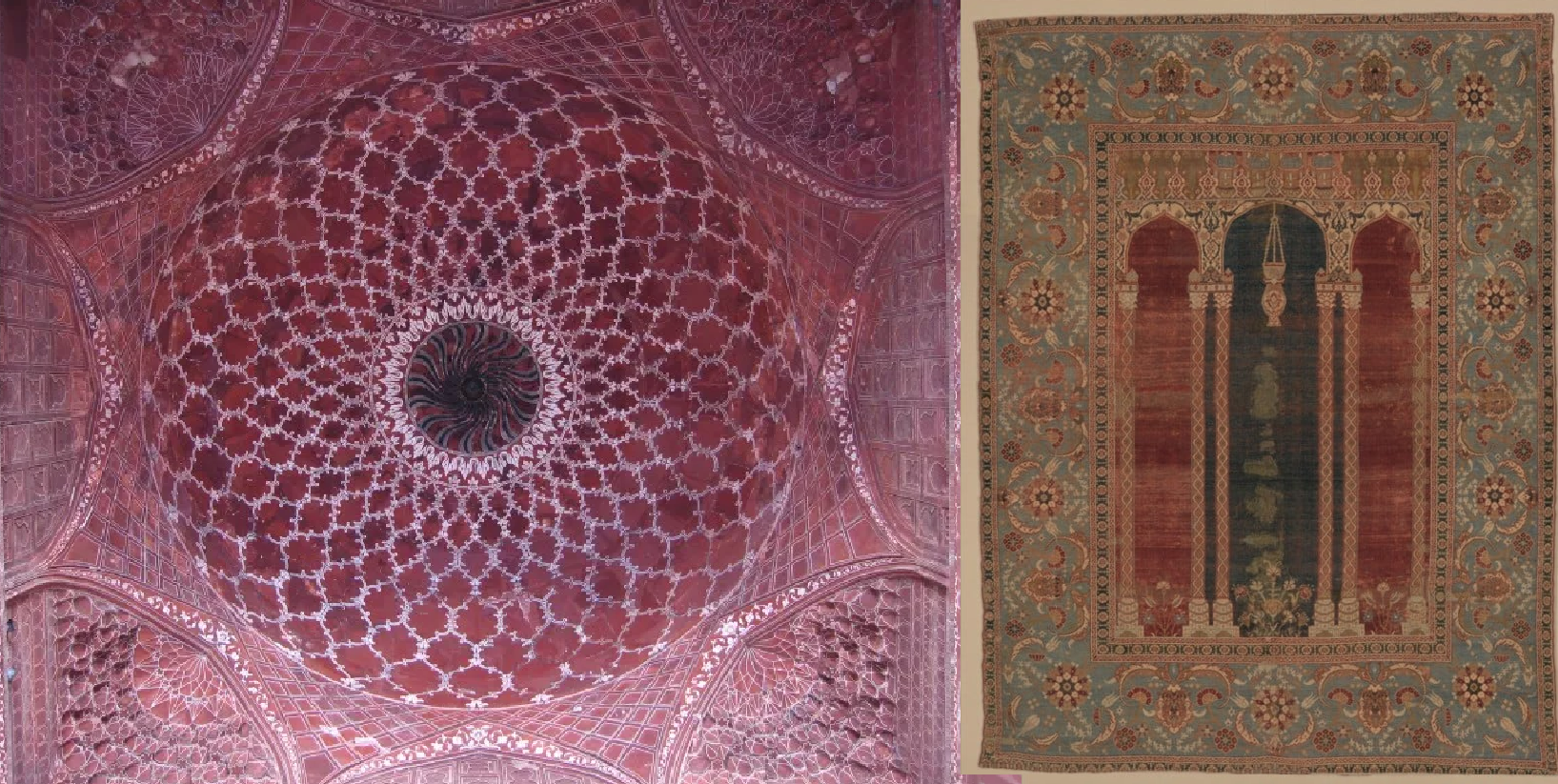
The Shajarat al-Tûba (Tree of Bliss) and the Olive Tree are arguably, central features, albeit indirectly, of Islamic art and architecture. The patterns on the interior of many Mosque domes, like that of the Taj Mahal mosque, have been interpreted as the Tree of Bliss. Remember this is an inverted tree that grows downwards with its roots in the primum mobile giving great theophanic significance to gazing up the centre of the dome from below. Then, there is the Mirab, or directional niche of the mosque, which marks the Qibla or orientation towards the Kaaba. This is always a concave or negative space, that is kept empty of all content other than its decorative surface. It is the way it recieves and reflects light, that is central to its design and to its meaning. It could be said, with reference to the Holy Koran, that that the light that is articulated in the Mirab and in Mosque architecture in general, is the embodiment of the light of the oil of the olive tree, a tree that is neither of the east nor of the west (so centrally located with regaed to the sun, that it is facing the sun in all directions, and in passing time) and whose oil glows forth of itself. Glass lamps are a significant feature in Mosque architecture and, with this in mind, it must be noted that, in the the design of the Islamic prayer rug, there is sometimes a coalesence the motifs – niche, plant and lamp.
Image: https://ibnarabi360.wordpress.com/2012/01/07/%D8%B2-%D9%A1/ / https://www.dailyartmagazine.com/art-of-mihrab/
https://islamqa.info/en/answers/1920/trees-mentioned-in-the-quraan-and-sunnah
https://smarthistory.org/a-glass-lamp-illuminating-sultan-hassans-mosque-and-madrasa/
https://islamqa.info/en/answers/1920/trees-mentioned-in-the-quraan-and-sunnah
 The Koboi Project
You must be logged in to post a comment.