Jin Tanah

The first propitiation of this performance (see notes) was to the spirits of the earth (jin tanah, also called hantu tanah, hulubalang or jambalang tanah), specifically the land (bumi)  where the performance takes place. Soil from the ground below was gathered and placed in a woven basket and brought up to the roof of the Kapallorek Artspace, where the performance took place. A lighted candle was placed in this basket of soil while the following was uttered,

Aku minta’ ampun kapada kramat yang memegang tanah disini!
I beg forgiveness from the sacred spirits that hold this land!

This appeasement of spirits was performed wholeheartedly (dengan bersungguh sungguh) as magic (in terms of its metaphysical or spirtiual dimension), but not without an awareness some socio-political implications. The propitiation sets up a hierarchy of asspciation with the land – first there are the spirits (kramat) of the land, then the people who recognize and propitiate these spirits, and only then the others. In other words, first kramat yang memegang tanah disini!, then the orang Pribumi yang mengakui keunggulan Kramat tanah, and only after, the non-indegenous (orang baru datang or pendatang) who do not know (mengenali) the kramat .

An interesting implication of this model of primacy is that, as the Malays lose their connection with the Semangat of their land in the course of modernization (due to both Islamic modernism and secular modernity), they too get alienated from the land and lose their place in the hierarchy. Conversely, the pendatang who becomes attuned to this Semangat might, arguably, rise up. I belioeve that this aspect of the performance discretely problematizes the notion of the bumiputera that informs the Malaysian social contract.
Pak Dogol and Wak Long

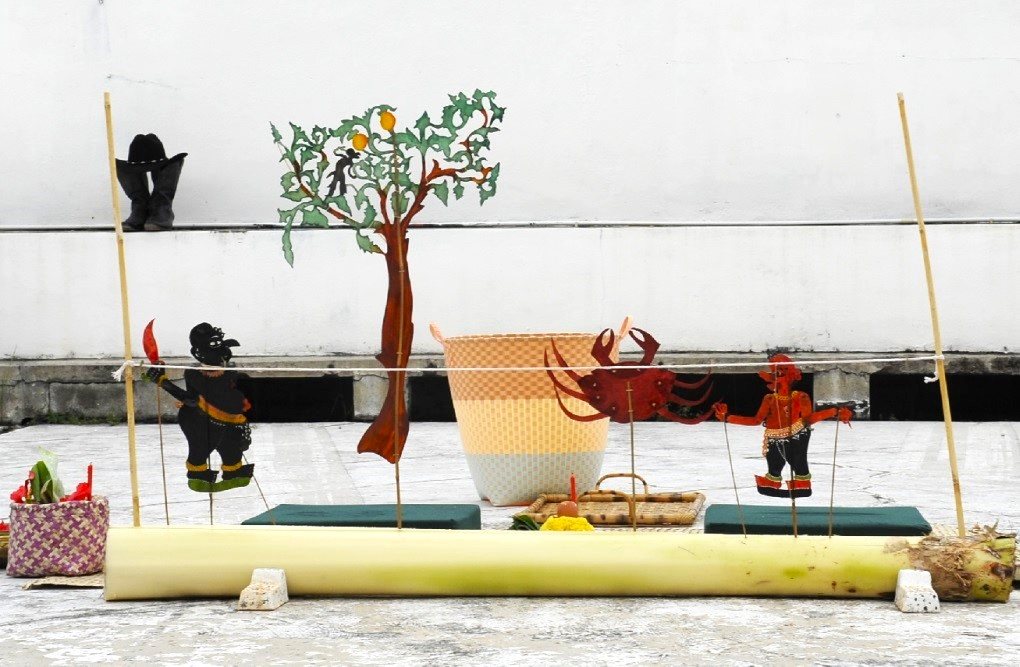
In my Pokok Pauh Janggi performance at Kapallorek Artspace, I presented a Pak Dogol puppet and a Wak long puppet, both of which I collected in Kota Baru, Kelantan over 20 years ago. In Kelantanese Wayang Kulit, or Wayang SIam as it was referred to locally, Pak Dogol is a minder or caregiver of Sri Rama. He presents as black, bald (botak), old, pot bellied man with a protruding belly button (pusat perut), an pronounced nipple (tetek), large buttocks and a large nose. He holds a machete (golok). In fact he is Dewa Sang Yang Tunggal, a supreme demigod (dewa) who descended to earth (dunia) from the heavenly realm (kayangan) with this unsightly appearance (wajah) as a disguise, in order to find his son. Pak Dogol is the principal peran (humourous figure) in Wayang Siam. He is ritually speaking, the most important of all Wayang Siam characters. This puppet is considered to be magical and possessing of a sometimes sinister spirit (keramat) that resides in tree stumps (tunggul Kayu mati). The puppet is stored wrapped a yellow cloth, signifying the a regal status of its character. Pak Dogol is always the first to receive praise and offerings (puja) in the course of the upacara buka panggung (blessing of the stage) ritual.

Wak Long, who is Pak Dogol’s companion, was created out of the former’s spirit and dirt from his body. He, like Pak Dogol, is a peran, only, he is funnier than his friend. Wak Long presents as a Red figure with a distinctive topknot. He does not hold a weapon. Both characters do not appear in the Ramayana which forms the narrative basis of Wayang Siam. Pak Dogol and Wak long are indigenous to Nusantara, analogous to Semar in Wayang Kulit Jawa. At the heart of my own performance was the presentation and initiation of two other long forgotten puppets. – Pokok Pauh Janggi and Ketam Gergasi puppet. I exorcized the bad spirits from the deer hide (membuang badi rusa) and invoked the spirit of each puppet (memanggil jambalang patung). Both of these puppets were made following designs from late 19th Century examples collected and photographed by Walter William Skeat. They too are rooted in Malay folklore and metaphysics and are not found in the Ramayana or the Mahabharata, the great epics that form the core of the culture of what some have called Greater India. As these puppets made their return to the panggung, I felt that it was important to have Pak Dogol and Wak long, present to bear witness to the proceedings.

See: Wayang Kulit Kelantan: A Study of Characterization and Puppets, Article in Asian Theatre Journal · April 2017

https://muzium.kelantan.gov.my/index.php/en/warisan/wayang-kulit/watak-watak-utama/pak-dogol

https://utusantv.com/2023/03/21/kisah-keramat-pok-dogol-nampak-tunggul-kayu-jangan-dekat-jangan-kencing/

https://www.gutenberg.org/files/47873/47873-h/47873-h.htm