Rajinikanth as Signifier

rajini
On December 31st 2017 SUPERSTAR Rajinikanth confirmed his entry into Tamil Nadu Politics by announcing that he would launch a new political party before the next assembly election in the state. Growing up as a Tamil in Malaysia in the 1970’s, although I was not a film fan, I was aware of Rajnikanth’s significance as an identity pioneer. Up till his arrival on the scene, the dark skinned  audiences of Tamil cinema had perversely preferred their leading men pale-faced and all powdered up. Rajnikanth had changed all that and gone on to become the biggest box office draw in Indian cinema. Later in my life, as my children were growing up in Kuching, Sarawak far from my parents and any significant Tamil influences, I went looking for Tamil media to fill the lack. I found a copy of Rajnikanth’s 1995 release, Muthu at the local night-market and to my delight, my girls loved it. What’s more, I found that I loved Muthu too.

On a visit to Tokyo at around this time, I was greeted by a billboard image of Rajinikanth. ‘Muthu’ or ‘Dancing Maharaja’ as the film was titled for its Japanese release, had become a box-office sensation in Japan. This was a rare example of an idiomatic local cultural product becoming a cross-over success without any mitigation of its sharp flavors. To the contrary, Japanese fans now learn Tamil to follow their SUPERSTAR in his own idiom. Against the grain of an era of global marketing and dochakuka in which the global products are varied, adapted and ‘localized’ for specific markets, Rajinikanth appears to have successfully projected an untempered idiomatic expression into a culturally distinct market and milieu. I recognized in this phenomena a signifier for the antithesis of the homogenization that was taking hold in the all global arenas, including that of contemporary art.
https://www.ndtv.com/tamil-nadu-news/tamil-superstar-rajinikanth-announces-his-entry-in-politics-top-10-quotes-1794021

http://koboibalikkampung.wixsite.com/kedualan

Truth on the Playa

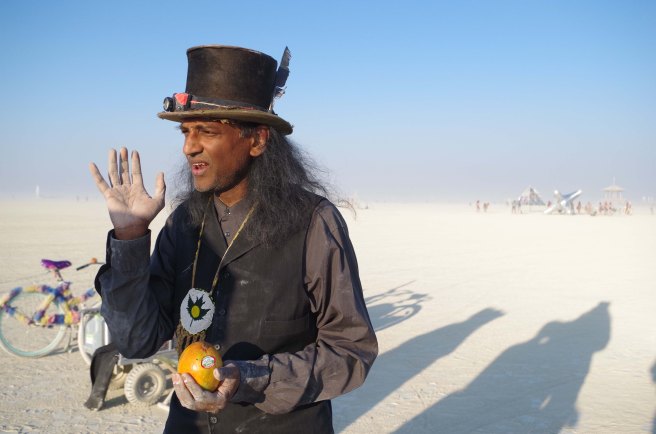
mango of truthThe mango also appears in an episode in the Oriya  poet Sarala’s rendition of the Mahabaratha where, the now mature and more worldly, Lord Krishna performs a miracle with the fruit. He materializes a ripe mango from a seed, while the fruit is out of season and then, turns it to ashes, thereby revealing both the illusory nature of reality (maya) and the complexities that underlie the idea of truth (satyam) itself.

As it is written in the Mahabaratha … Nine years pass after the Pandavas go into the forest having lost their kingdom in a game of dice. Duryodhana the leader of the Kauravas sends Gouramukha to locate  the Pandavas. Gouramukha would find them by posing as a sage and asking for the gift of a ripe mango out of season. Only the Pandavas, aided by their ally Lord Krishna, could produce such a miraculous mango. When Yudhisthir, the lead Pandava, came upon Gouramukha in the forest disguised as a sage, he asked with great humility what food he would accept as an offering. The false sage said he would accept only a ripe mango. As expected, the  needy Yudistihira asked Krishna for help. Krishna was, of course, able to oblige but an out of season mango was a ‘mango of truth’ and that it could only be produced if each of the Pandava brothers and their common wife Draupadi spoke their innermost truth.

Krishna called for a dry mango seed and breathed the potential of life into it. One after another the Pandavas each spoke their truth – Yudhisthira said he was a man of integrity and that he intended to fight to get back his kingdom … a shoot emerged from the seed; Bhima said he was a man of greed and he would kill anyone who insulted his mace … the plant grew into a tree; Arjuna said that he was brave and pure and that he was unbeatable in battle as long as he held his divine bow … the tree blossomed gloriously; Nakula said he was a man of conscience and that he was loyal to Yudhisthira  … small unripe fruits appeared;  Sahadeva said that he had the knowledge of the past, the present and the future but that he would not volunteer unsolicited advice to anyone … the mangoes grew to full size. Finally it was Draupadi ’s turn and she said that although the five Pandavas equal as her husbands, she had the greatest affection for Arjuna. The other brothers were hurt and angered but the mangoes were ripened by this truth.

Gauramukha swiftly departed to give Duryodhana the news that the Pandavas were indeed alive in the forest but Krishna intervened disguised as a Brahmin. Pretending to be surprised at the sight of a ripe mango in autumn, he suggests that it can not be ‘a real mango’ as a mango ripening in autumn was an anathema to the nature of things. ‘Truth’ could not produce such a mango. When Gouramukha protested, Krishna said that he would like to utter some truths as a test of this mango of truth. He said he had seen that a stone was floating on water, and a lotus was blooming on a mountaintop. The moon rose in the day and the sun arose at night. He continued in this manner and in no time the mango was burnt to ashes.

By Krishna’s ‘lies’ the falsehood of the ‘mango of truth’ ripened out of season was revealed and it was destroyed. Krishna symbolically destroys the very possibility of absolute truths in the relativistic flux of maya (our everyday reality), which is sustained by ambiguity. All things that one takes to be true are mere illusion – false mangoes of truth that reveal their falsehood beside Krishna’s apparent lies, which are at a deeper level, Krishna’s truths.

http://saralamahabharat.blogspot.ca/2008/06/story-of-mango-of-truth.html

Not the Chief!

4 Tunai itu Raja

Image: 7 Cash is King, copyright by Niranjan Rajah. Preparatory image for photographic work developed from an original illustration by Gord Hill.

With the 150th birthday of Canada approaching this weekend and with the various recent Department of Justice filings of charges in the United States implicating Malaysian  crown business practices, it seems apt to reflect on the relations of my two nations. The cogent event here is the looming but contested arrival of Malaysian Oil and Gas giant PETRONAS on Lelu island in the Canadian province of British Columbia. This meeting of hegemonies takes place on land that is technically unceded and therefore under the authority of traditional Chieftains of the indigenous peoples of the land in Question. Two such groups , the Gitanyow of the Gitxsan nation and the Gitwilgyoots of the Tshimshian nation, have filed  lawsuits and are seeking a judicial review of the Federal Government’s approval of the Petronas led LNG project on the basis of inadequate consultation with their respective authorities. Lelu island lies within traditional Gitwilgyoots territory.

In a counter measure the elected Lax Kw’alaams Band band council in northern British Columbia, and PETRONAS subsidiary, Pacific NorthWest LNG, made representations at the Federal court earlier in the present month of June 2017, seeking to deny the ancestral authority of Simogyet Yahaan, of the Gitwilgyoots Tribe of the Tsimshian peoples. In other words the purported hereditary chief’s standing is being questioned by the elected chiefs. As an immigrant to these shores from Malaysia,  a nation that is embroiled in the mother of all financial and political controversies, I find it both tragic and ironic that this attempted usurpation is being carried out by the natives themselves, under the auspices of the exemplar of Malaysian corporate prowess.

http://www.cnbc.com/2017/06/16/us-acts-to-seize-assets-allegedly-looted-from-malaysia-fund-1mdb.html