Major General G. D. Bakshi, is a retired Indian army officer of great distinction and a prolific military analyst. In a 4th March interview he suggests that, despite Western media cheerleading of the Ukrainian resistance, Putin is steadily achieving his stated objective of demilitarising Ukraine and that, most likely, he has no intention of capturing and holding much territory in Western Ukraine. He suggests that the main objectives are Eastern and Southern Ukrainian nuclear plants (Chernobyl, Zaporizhzhia, etc.), Southern Ukrainian seaports (Mariupol, Odesa, etc.), and Eastern land that will give Russia a land corridor to the Crimean Peninsula. He even speculates that the assault on Kyiv might even be a deception operation, a distraction that has enabled them to make swift progress on their true objectives. He believes, however, that they will devastate Kyiv in due course.
Tag: Kyiv
Ukraine: Tatlin’s Constructivist Tower
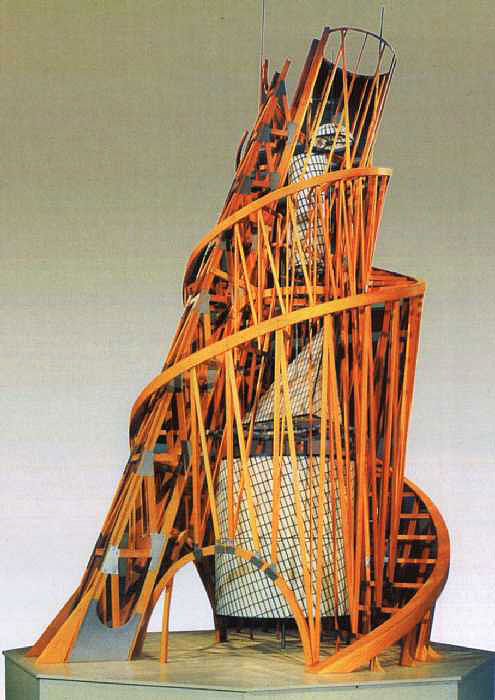
Soviet Constructivism was on the avant-garde of the Bolshevik Revolution that burst upon Russia in 1917. At the heart of this movement, was the question of the imbrication of art as a part of proletariat life. Constructivism eschewed the elitist concerns of the academy and the museum, in order to embrace the technologies and the process of the Industry.
In 1920 Vladimir Tatlin presented the exemplary Constructivist work, A Monument to the Third International, or, as it is best known today, Tatlin’s Tower. This hybrid of art, architecture and communication design, was meant to be used as a propaganda platform that would drive the spread of the Communist revolution across the world. Although it was never built, this design had a profound impact on the revolutionary art of the Soviet Union and on the international modern art that followed.
Although Vladimir Tatlin was born in Moscow, he grew up in Kharkiv. He studied art at the Kharkov Arts School and then become a merchant sea cadet at Odessa. Having established himself as a leader of the Moscow avant-garde, Tatlin moved to Kyiv in 1925, to become chair of the theater, film, and photography department of the Kyiv State Art Institute. During this time he established connections with Mykhailo Semenko and the Nova Generatsiia futurist group in Kharkiv.
Image: https://humphries346.wordpress.com/2015/02/16/soviet-constructivism/
https://en.wikipedia.org/wiki/Vladimir_Tatlin
http://www.encyclopediaofukraine.com/display.asp?linkpath=pages%5CT%5CA%5CTatlinVladimir.htm
Ukraine: Dziga (Vertov) Means Top in Ukrainian
Cinema pioneer Denis Kaufman’s family was Jewish and hailed from Bialystok in what was once Russia, but is today a part of Poland. Kaufman is known to us by his pseudonym, Dziga Vertov, which he seems to have started using as early as the year 1915. According to an entry in momoscope, “Vertov” is a neologism extrapolated from the Russian verb vertit’sia, to spin, and Dziga is the Ukrainian word for a top, This new name carried connotations of the dynamism of the age. Another aspect of this name change is that it was typical of Russophilic Jewish youth of the revolutionary period.
In the light of today’s crisis and conflict on Ukraine, it is significant that being Russophile does not preclude the pairing of Russian and Ukrainian words in the coining of a pseudonym. In fact, much of Vertov’s seminal ‘Man with a Movie.’ Camera was shot in Ukraine. Here is how this seminal work of modernist filmmaking is described in the Telescope International film database, “A man wanders around Moscow, Kharkov, Kiev, and Odessa with a camera slung over his shoulder, documenting urban life with dazzling invention. There are few films that better enable the viewer to feel and understand the power of editing than this towering achievement in cinema.”
 The Koboi Project
You must be logged in to post a comment.