The Advance of Maleficence

The Massacre of the Innocents (detail) is one of a 36 paintings on 4 panels, the majority of which are by Fra Angelico, in the Museo di San Marco, Florence. This extensive series includes another painting addressing the Lex Amoris doctrine of Saint Thomas Aquinas, which arguably sets the theme for the series as a whole. This doctrine is articulated in the inscription on this painting, “Christ did not come to me to destroy the old laws of the patriarchs, but to renew and complete them with a new Law of Love.” Perhaps, the Massacre of the Innocents, underscores by antithesis, the essential New Testament principle of love.

In this primordial image of slaughter, a group of soldiers is represented impassively working its way across the scene, effortlessly slitting the throats of babes in the arms of their desperate mothers who, despite their bodily resistance, are soon to be completely overwhelmed. Viewed abstractly, a solid mass of darkness advances from left to right with strong momentum and at a steady pace, portending the imminent extinguishment of all light and color in the image. In the latest reprise of this archetypal act of inhumanity, 8,663 Gazan children have been slaughtered (UpdatedDecember 19) in an equally malefic military movement, a movement that Norman Finkelstein might describe, after Israeli sources, as ‘mowing the lawn.

See also:

Grace in the Face of Suffering

Netanyahu channels King Herod!

Le Massacre des Innocents

Witness to Slaughter

Image: https://scottdodge.blogspot.com/2010/12/feast-of-holy-innocents-martyrs.html

http://www.travelingintuscany.com/art/fraangelico/armadiodegliargenti.htm

https://fraangelicoinstitute.com/2018/05/27/fra-angelico-and-the-armadio-degli-argenti-part-3-of-the-heaven-on-earth-exhibition/

https://www.aljazeera.com/news/longform/2023/10/9/israel-hamas-war-in-maps-and-charts-live-tracker

https://www.normanfinkelstein.com/norman-finkelstein-israel-mowing-the-lawn-in-gaza/

The Appearance of a Fact ataupun Batu Kasih Piyadasa, circa 2007

This work is what I call a ‘deep readymade’, by which I mean there is a gesture or configuration by another actor being interpreted or articulated in the work. A deep readymade is thus differentiated from a simple readymade, in that there is a juxtaposition of components done by someone other than the artist. The primary component of this work is a carved wooden Ganesha which was once in my late mother’s possession. When my mother was alive, this Ganesha used to sit on the wall, above her prayer altar and would receive flowers in the course of her daily worship. It is an item she and my father brought back from one of their trips to India and Sri Lanka. While my father was born in Seremban, Malaysia, my mother, myself, and my sister Shyamala were born in Jaffna, Sri Lanka. We are Jaffna Tamils and Sri Lanka is in some sense our homeland.

The second component of this deep readymade, is the white stone, a large, well-worn pebble that was picked up on a Sri Lankan beach by the renowned Malaysian artist Reza Piyadasa on his first trip (date uncertain but a book that I believe was presented at the same time is autographed and dated 1995) to Sri Lanka (his own ancestral homeland) and brought back for my mother. The late Reza Piyadasa was a Sinhalese Malaysian and the stone was a deeply meaningful exchange of a piece of Sri Lankan earth (bumi) between two Malaysians, one Sinhalese, the other a Tamil – two people whose communities were at war in their homeland. As Malaysians, however, these two people were at peace with each other, falling together in the shared category of ‘Malaysian Indian’. My mother placed this stone, which was so lovingly brought for her by Piyadasa, at the feet of Lord Ganesha and it has remained there ever since. Beyond this complex image of the interplay of race and nationality in human relations, there is, embodied in this readymade, the personal relationship between Piyadasa and my mother. Piya had lost his own parents relatively early in life and, somehow, he formed a close attachment to my parents. They were his guests when he received the prestigious Prince Claus Award in 1998, and later, in 2007, he called them to his hospital bedside when he was close to the moment of his passing.

In titling this piece ‘The Appearance of a Fact ataupun Batu Kasih Piyadasa’, I pay a tribute to the striking conceptualism of Pia’s early output, while offering a way through its solipsistic reflexivity. In a piece titled ‘A Fact Has No Appearance’, 1977, Pia created an ouroboros-like liaison between form and concept. The piece consisted of a box, part painted, part bare wood, a painted ovoid form, probably made of plaster, and the stenciled text A FACT HAS NO APPEARANCE. It is indeed true that a fact is immaterial and, as such, has no appearance; even while an appearance, which is material, is, indubitably, a fact! In my readymade, we have a material configuration that presents, in its appearance, a simple fact – the fact of love.

The Appearence of a Fact ataupun Batu Kasih Piyadasa, circa 2007 is on display in the Pokok Pauh Janggi exhibition which runs from 5th Aug – 30th Sept 2023 at the Kapallorek Artspace in Bandar Seri Iskandar, Perak

Dari Pusat Tasik 17

Bak Pauh Dilayang

Layangan di langit yang tinggi,
melayang di cahaya mentari;
Kertasnya berkilat kuning kemasan,
walaupun tidak ditandakan tangan.

Pemimpin massa sama gadis tercinta,
tarikan berdasarkan wajah di mata;
Pipinya cantik bak pauh dilayang,
pepatah samakan hasrat dan wayang.

Biar wajahnya cerah kuning kemerahan,
barulah hati pengundi tertawan
dan ditahan


Love on the Playa

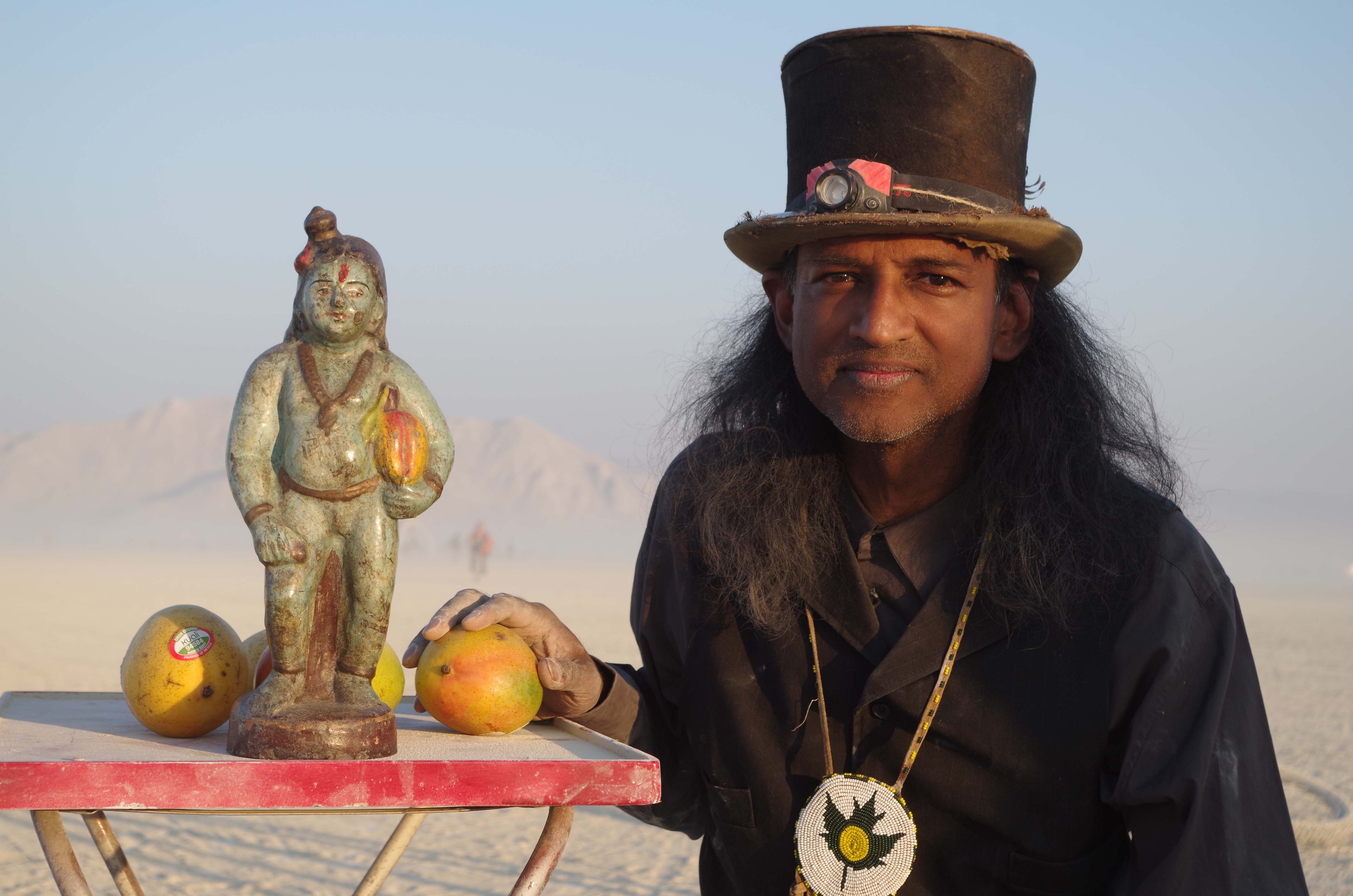
fruitseller​In the myth of Krishna and the fruit seller, an old hawker woman selflessly satisfies the god child’s desire for her ripe and aromatic produce, even though he seems to offer her practically nothing in return. In folk representations of this allegory of desire (kama) and devotion (bakthi), such as the terracotta icon described above, the sublime mango often stands, metonymically, for the cornucopia of fruit in the old woman’s basket, which in turn represents the desires and delectations of the material life.

This kama is redolent, or indeed ripe, with soteriological promise in that it can be transmuted into the bakthi of a selfless offering to the Lord. To return to the story … One day a fruit seller came to Vrindavan, the village that is young Krishna’s abode. She was a simple woman, old and poor. Little Krishna heard her call and he ran out to her with a handful of grains to trade for his favorite mango. As he was running, the grains fell out between his little fingers and as he made his offer to the fruit seller, there were hardly any left in his hands.

The poor old lady was, however, so charmed by Krishna’s  beauty that she freely gave him all the fruits he desired. On the way home she noticed the basket was heavy and when she arrived she found that the lord had filled it up with celestial jewels. Thus it is shown how love (bakthi) of the greater self (Brahman), recognized metonymically in the more tangible beauty of the young Lord Krishna has great soteriological effect. It is this salvation by selfless giving  that is both the theme and the message of the myth of Krishna and the fruit seller.

http://radhanathswamiyatras.com/articles/vrindavan-articles/radhanath-swami-on-krishnas-mercy-to-fruit-vendor

Indians on the Playa

playa

So we did it! My fellows at The Camp With No Name, my family and I – we realized the image I had visualized for Cowboys and Indians at Burning Man. We did one performance on the evening of the 31st August at camp where I presented the Krishna icon, the Thalaivar banner, and the Indian Cowboy image and 40 perfectly ripe mangoes. I told Krishna stories of love and truth to the gathering. Tara played an improvisation on the melody of Joe Ely’s Indian Cowboy on the Cello and Jane read her Poems on the Megaphone. Durga took photographs for future editions of the Koboi Project. The next day on the 1st September, Jane, Tara, Durga, Lucas, Guy, Saren and I took Cowboys and Indians onto the playa. This time we distributed 80 mangoes and interacted with burners as they came by on the their vehicles, their bikes and on foot. We shared love and truth … and mangoes till the sun went down on the Playa.

Cowboys and Indians

8a4215_690fe1b560114dbabbae780c529c73af-mv2

The Koboi and family are off to Burning Man festival 2017 in Black Rock City, Nevada. This year’s theme for projects at Burning Man is Radical Ritual, and I propose to present a special edition of Cowboys and Indians. In keeping with the theme, this work will exemplify how, even traditional rituals are constantly being revivified and radicalized. This presentation consists of two images – Pazham Neeyappa and Indian Cowboy, as well as the Mango of Truth performance which will be carried out at the  [The Camp with No Name] on the Black Rock City Playa.