Al-salam ‘aleikum! Hei sahabat-ku Mambang Tali Harus, Yang berulang ka pusat tasek Pauh Janggi, Sampeikan-lah pesan-ku ini, Bangunkan Jambalang Ketam Gergasi!
Peace be upon you! Hey my friend the Spirit of the currents (water), Who tos-and-fros to the pusat tasek Pauh Janggi, Realize this request of mine, Raise the Giant Crab!
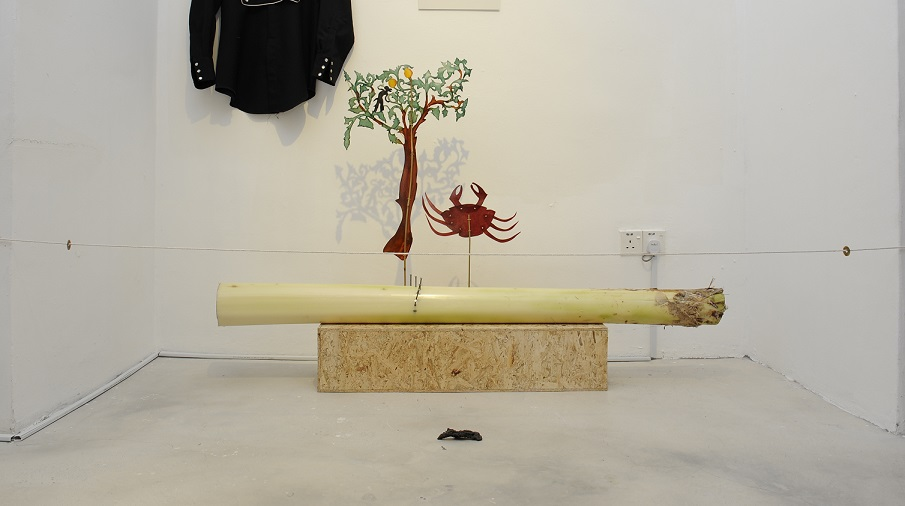
Sang Nabil Utama turns crab around to show color and pierces it into the banana stem.
Having covered his head with the black cloth, Koboi presented the new deerskin puppets, unpigmented side facing the audience. He then put them down and performed a ritual (see performance notes) to dispel malicious entities (Badi) from the deer hide. He uttered a spell,
O Si Lanang, Si Lambaun, Si Ketor, Si Becheh, orang yang berampat, Ambil kembali bahagian-kau dari rusa ini!
O Lanang, the Lambaun, The Ketor, the Becheh, the four of you, Take back your part of this deer!
Koboi then took cuttings of deer hide (waste from the fabrication of the puppets) from the muslin cloth and, one by one, gave the signs of deer to the audience, calling them out by name —
He put each fragment on the banana leaf. When all eleven signs had been presented and thier material signifiers deposited on the leaf, Koboi folded the leaf, deposited it in the earth-filled basket, and uttered,
O Mentala Guru Asa (menaruh harapan) sabulan, dua sabulan, Tiga sabulan, ampat sabulan, Lima sabulan, anam sabulan, Tujoh sabulan, malam di-angkau, Siang di-aku. Sa’ekor aku bawa balik, Sa’ekor aku tinggalkan!
O Mentala (Batara) Guru Hoping (desiring, hunting) for a month, two months, Three months, four months, Five months, six months, Seven months, the night is yours, The day is mine. One deer I take, One I leave behind!
Finally, he sprinkled water and flowers onto the basket.
It began to drizz;e (gerimis) over the performance area at around this moment. Later we learnt from observers that it had only rained in the Kapallorek Artspace area and not the surrounding area. This was particu;arly notable as there had been a drought over the previous weeks.
Having called (memanggil) the spirits, Koboi performed a ritual consecration of the stage (upacara membuka panggung) by raising the plate up and towards the audience and uttering,
Hei Jin Tanah, Hantu Tinggi, Hoi Jembalang Wayang ! Dato’ jangan membisakan, Aku tahu asal ‘kau jadi : Dato jangan membe’ngkakkan : Bintang Timor asal ‘kau mula jadi. Biar sagala makhluk suka permainan kita, Berkat Dato’ Batara Guru Menyaksikannya.
Among the spirits propitiated in the Pokok Pauh Janggi performance were the Jambalang Wayang (spirits of the stage). An offering consisting of nasi pulut kuning (glutinous rice), daun sireh (betel leaf), and a soft-boiled egg was presented on an old ceramic plate. At the start of the performance, the egg was broken open, the offering was brought to the panggung on a tray and placed to the rear of the performance area, between the two cushions. Koboi lit a red candle and placed in the glutinous rice offering (nasi pulut kuning) while crying out,
Aku minta’ ampun juga kapada sagala Jambalang Wayang! I ask forgiveness from the spirits of the Wayang!
The Koboi performances involve integrating themes that arise from the location of the event with the abiding themes of the Koboi Project – 1) the persona of the black hat cowboy, 2) the giant SUPERSTAR banner , and 3) the ritual offering. The SUPERSTAR banner brings a sense of scale, both immediate physical size and the more expansive sense of mass media projection. The first SUPERSTAR banner carried a representation of inimitable Kollywood giant Rajinikanth. It was initially raised at the Burning Man Festival 2017, and later presented in Tokyo 2018, Bangkok 2018, and Lisbon 2018 & 2019. For the Dari Pusat Tasek performance at Percha Artspace, Lumut, Perak in December 2019, the image of Rajinikanth was replaced by that of Malaysian political colossus, Anwar Ibrahim. This Anwar Banner was raised again at Kapallorek Artspace, Bandar Seri Iskandar, Perak in August 2023.
Bandar Seri Iskandar is a new university town, a recent development in an older area known as Bota. ‘Bota‘ derives from the Sanskrit bhūta (demon) and refers to a local ‘giant’. According to folklore, once upon a time, giants inhabited this area and the old place names of the surrounding areas – Bota Kanan, Bota Kiri and Ekor Bota, stem from layering the image of a fallen giant over a landscape shaped by the Perak river. If one were to understand this physical territory in terms of the ontology of the traditional Malay cosmos, one might see it as being contiguous with the area known as Padang Jauh dan Puncak Gunung.
With both SUPERSTARS and Botas in mind, a propitiation was made, at the start of the Pokok Pauh Janggi performance (see notes) to all the Hantu Tinggi. Struggling against the wind that arose at this time, I lit a red candle at the near the massive Gergasi Bota mural on the Kapallorek building, while calling out, . Aku minta’ ampun kapada sagala Hantu Tinggi! I ask forgiveness of all Tall Ghosts (Giants)!
At this very moment, the SUPERSTAR banner, that had been previously raised, collapsed in a sudden gust of wind, as if to indicate the Hantu Tinggi did not quite approve! Having raised the banner again, and having secured it properly this time, I placed the lighted candle at its foot.
The first propitiation of this performance (see notes) was to the spirits of the earth (jintanah, also called hantu tanah, hulubalang or jambalang tanah), specifically the land (bumi) where the performance takes place. Soil from the ground below was gathered and placed in a woven basket and brought up to the roof of the Kapallorek Artspace, where the performance took place. A lighted candle was placed in this basket of soil while the following was uttered,
Aku minta’ ampun kapada kramat yang memegang tanah disini! I beg forgiveness from the sacred spirits that hold this land!
This appeasement of spirits was performed wholeheartedly (dengan bersungguh sungguh) as magic (in terms of its metaphysical or spirtiual dimension), but not without an awareness some socio-political implications. The propitiation sets up a hierarchy of asspciation with the land – first there are the spirits (kramat) of the land, then the people who recognize and propitiate these spirits, and only then the others. In other words, first kramat yang memegang tanah disini!, then the orang Pribumi yang mengakui keunggulan Kramat tanah, and only after, the non-indegenous (orang barudatang or pendatang) who do not know (mengenali) the kramat .
An interesting implication of this model of primacy is that, as the Malays lose their connection with the Semangat of their land in the course of modernization (due to both Islamic modernism and secular modernity), they too get alienated from the land and lose their place in the hierarchy. Conversely, the pendatang who becomes attuned to this Semangat might, arguably, rise up. I belioeve that this aspect of the performance discretely problematizes the notion of the bumiputera that informs the Malaysian social contract.
In the gallery presentation of the puppets from the Pokok Pauh Janggi performance at Kapallorek Artspace in Bandar Seri Iskandar, Perak, I used a mineral deposit known as tahi besi or ‘iron waste’ – ‘iron shit’ in a more direct translation!. (In fact I was told that the piece I aquired was called tahi pelangi or rainbow shit due to its vivid metallic colouration). I aquired it from a vendor at the Lata Iskandar waterfall on the old Tapah road. It was explained to me that the local Semai and Malay people used it as a protective medium to ‘fence’ or protect themselves and their premises from the intrusion of unwanted entities from the sprit world. The Pokok Pauh Janggi installation features the Koboi Balik Lagi series of photographs and runs from 5th Aug – 30th Sept 2023 at the Kapallorek Artspace in Bandar Seri Iskandar, Perak.
Soalan: Boleh tak tahi besi kita buat berobat nak pagar rumah, guna ayat Koran?
Jawapan: Boleh buat Tahi Besi buat pagar, tetapi pagar kawat itulah! (Hah, pasal dia besi … buat kawat 🙂 ) Yang tak boleh nya, tahi besi itu yang kita jaga rumah kita. Tak Boleh! Dan kalau Al Koran dengan selawat … boleh. Faham? Aaa!
The above extract.from a ceramah by Ustaz Azhar Idrus evidences a persistant syncreticism in the quotidian practice of Islam amongst the Malays of the peninsular. The Bahasa transcription is my best translation of the Ustaz’s loghat Kelate. I would appreciate corrections. Please send to nrajah@sfu.ca
The Pokok Pauh Janggi installation runs from 5th Aug – 30th Sept 2023 at the Kapallorek Artspace in Bandar Seri Iskandar, Perak.
In making my black jelly offering to Phra Rahu I learnt a Kata Bucha or (Gatha Pooja in Sanskrit.) Kata is the Thai term for an Incantation or Prayer used instrumentally in worship, veneration, invocation and magic. I learnt the Kata Prha Rahu Kam Duang to recite as part of my offering to Rahu from Ajarn Spencer’s online teaching. Phra Hanuman, presented by Jariya Laoriendee, is watching the ritual offering of Suriyan (the Sun) to Phra Rahu . Of course it in the tussle for the Sun (which the young Hanuman thought was a mango) with Rahu that Hanuman got his name – Broken Jaw!


 In making my black jelly offering to Phra Rahu I learnt a Kata Bucha or (Gatha Pooja in Sanskrit.) Kata is the Thai term for an Incantation or Prayer used instrumentally in worship, veneration, invocation and magic. I learnt the
  The Koboi Project
You must be logged in to post a comment.