This centrepiece from a 19th Century Malay wedding showing fabulous birds and dragons. As the dragons face-off in the lake, the birds occupy the tree-tops. Walter Skeat, who collected this piece at the end of the 19th Century, notes three types of bird – the Roc (of Middle Eastern origin) which he equates with Garuda (Lord Vishnu’s vehicle), Jintayu (or Jadayu from the Ramayana) and the Walimana which he equates with the Harpy (of Greek mythology). This display evidences how the, now less familliar, Burung Roc was once an integral part of Malay folklore and material culture.
According to Malay folklore, far out in in the deep ocean somewhere, there is said to be a momentus whirlpool, known as Pusat Tasik, that swirls down to the depths, draining the waters into the earth. Rooted to the ocean floor at this nexus, is the fabulous Pokok Pauh Janggi that reaches up to the heavens. In the Selangor Malay tale of Haji Batu, a man, journeying to perform the Haj, had to cross the fearsome Pusat Tasek (Siapa terjatuh atau tergelincir, tersuruplah ia ke dalam pusar. Tempat menanti segala mara bahaya. Tempat duduk menantinya Nenek Sepit Pentala Naga di Laut Buih Gelombang Tujuh. Kalau si lemah yang sampai, maka hilang ghaiblah ia di mulut Raja Naga yang maha bisa). As Haji Batu’s ship went down, he clung to the Pokok Pauh Janggi in the middle of the swirl of the Pusat Tasek, and following instructions he had received in a dream, drew himself up on 7 nails that he drove into the tree. When he reached the top, he found the nest of the mythical gigantic Burong Roc (Garuda) that lived there. He waited therein and when the Roc returned, he attached himself to the bird and flew Westward on his Journey to Mecca. (see Walter William Skeat’s Malay Magic). The above diagram presents the outline of a Pokok Pauh Janggi Wayang Kulit puppet collected by Walter William Skeatfrom a Tok Dalang from Kelantan in the late 19th Century. Could the figure in the tree possibly be this Haji Batu about to be attach himself to the Burong Roc, or could it be the great bird itself (note the aquline features of the figure’s head)? Perhaps it is a composite figure combining the two entities?
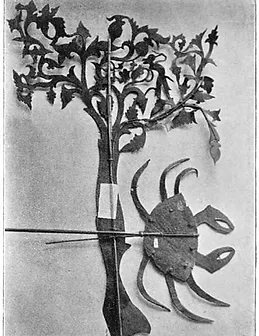
According to Malay folklore, in the far depths of the ocean, there is a great whirlpool known as the ‘Pusat Tasek’ or the ‘navel of the seas’. At the centre of this whirlpool, there is an enormous tree known as the Pokok Pauh Janggi. This place, identified in Malay Cosmology as the Pusat Tasik Pauh Janggi, is inhabited by Nagas, Jins, Garudas and other such creatures. One of these creatures sits on the ocean floor, at the base of the tree blocking a gigantic opening at the root of the tree. This opening leads further down to the nether world of the Dasar Laut inhabited by Raja Lebis. Further, according to Anker Rentse, it is from the Dasar Laut, that the swirl of the Pusat Tasek rises in the course of ocean water draining down the opening. In some versions of this cosmology, a dragon guards this hole and its body also blocks the hole, preventing the ocean from running dry. In other accounts it is not a dragon but a giant crab that holds the waters up. It is the daily movements of this crab, unblocking and reblocking the hole, that cause the movement of the waters that we humans experience as currents and tides. The above Kelantan Wayang Kulit puppets of the Pokok Pauh Janggi and the giant crab were collected by Walter William Skeatfrom a Tok Dalang in the late 19th Century. They index the likelyhood that the Wayang repertoire was once replete with representations of indegenous Nusantara myths and ideas that have since been abandoned.


 The Koboi Project
You must be logged in to post a comment.