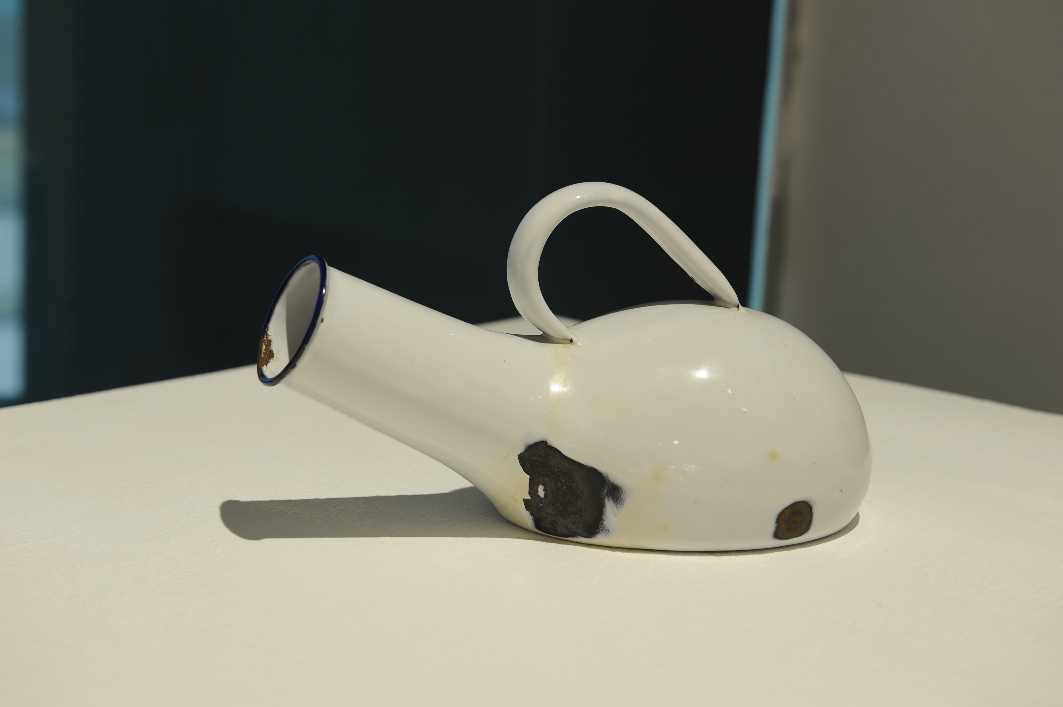
Air Abang Salleh, circa 2013

This readymade or found object alludes to that infamous incident at the Dewan Bahasa dan Pustaka in 1974, when Reza Piyadasa and Sulaiman Esa’s seminal Mystical Reality exhibition received a drenching (literally ) criticism from the enfant terrible of the Kuala Lumpur literary scene, Salleh ben Joned. While Salleh himself writes of the “simple act of unzipping my trousers and zipping up my mouth” he was undoubtedly itching (to use another bodily metaphor) to explain his position. In an open letter titled Kencing dan kesenian: surat dari Salleh Ben Joned untuk Piyadasa,published in 1975 in the Dewan Sastra, he responded to Piyadasa’s challenge to give the rationale for his uncouth (kurang ajar) gesture of pissing on the Mystical Reality manifesto in the corner of the exhibition space during the opening.

At the heart (perhaps this is the wrong bodily metaphor) of Salleh Joned’s gesture there seems to have been a critique of what he saw as Mystical Reality’s confusion of the relationship between art and life. Here is what he says “Piya! Piya! You want art, but how confused you are about what art is. You want reality, but how innocent you are about reality. Reality? Just remember the rainbow arc of my piss, the fountain of life affirms and celebrates the unity of reality: the vulgar and the refined, the bawdy and the spiritual, the concrete and the transcendent, the stinking and the mystical, the profane and the sacred.” The intrepid and insightful art collector, Pakhruddin Sulaiman, has given us a record of Piyada’s own response to being on the receiving end of this savage lesson in the Zen of art. He writes, “Rupa-rupanya, menurut Piyadasa, wujud seorang “mahaguru” Zen yang telah berjaya “mengajar” mereka berdua (yang masih “greenhorn” dalam falsafah Zen pada waktu itu) secukup-cukupnya tentang apa itu Zen sehingga serangan “mahaguru” itu tidak terbantah oleh mereka.”

My own gesture of presenting this enamel urinal along with the title “Air Abang Salleh” pays homage to Salleh Joned’s masterful deconstruction of the salient pretension of Modern Art – the interchangeability of art and life. There is also, however, in the respectful honorific “Abang” of my title, a gentle critique, much more in keeping with Malay decorum (adab), of Salleh Joned’s own pretensions to radicality. He has after all, in spite of all his ill-mannered and uncouth anti-traditional posturings, which many of his contemporaries found most offensive, been lifted up, out of the 1970’s Kuala Lumpur underground, and assimilated into the canon of modern Malaysian culture.

See Also:
Who is Niranjan Rajah?
La Folie

Air Abang Salleh, circa 2013 is on display in the Pokok Pauh Janggi exhibition which runs from 5th Aug – 30th Sept 2023 at the Kapallorek Artspace in Bandar Seri Iskandar, Perak.

https://sallehbenjoned.blogspot.com/2016/02/the-art-of-pissing.html

http://sentapmalaysia.blogspot.com/2008/09/piyadasa-obor-yang-telah-padam.html

Early Internet Art in Malaysia 8

I had begun my practice as an artist in the late 1980’s with a series of paintings and had moved onto a more self-consciously critical performance/ installation practice when, in 1995, I found the World Wide Web, with its capacities for instantaneous connectivity, hypertextual linking and multimedia convergence. I then transferred my practice to this new medium and between 1996 and 1998 made two web works and La Folie de la Peinture (1998), is the second of these. It is archived in fragments on the Wayback Machine.

At the center of this work was a remediation of a set of installation photographs, linked in such a manner as to represent movement through the space, with the experience of each ‘work’ recast as a multimedia experience (WAV, GIF, MOV and VRML files). The text (hypertext) was an integral part of this web work and in it, I set out some contextualizing ideas. These ideas were also presented within a wider theoretical framework in a paper titled Toward a Universal Theory of Convergence: Transcending the Technocentric View of the Multimedia Revolution presented at INET 1998 in Geneva. These points originally made in 1998 are presented below –

* With the emergence of abstract colour-field painting, the placement of works on the gallery wall became integral to the presentation and, in the light of this transient ‘installation’ aspect of the presentation, photographic documentation began to take on a new significance.

* While the ‘installation shot’ confirms the uniqueness of the ‘site’ of the installation, this photographic documentation leaves its own mass (mechanical reproduction) condition unindexed and has, quite surreptitiously, become the ‘extended’ medium, of installation art.

* As bandwidth increases and multimedia technology goes online, fluidly articulating the remote experience of image, moving image, text and sound in an interactive ‘virtual reality’, it will become increasingly difficult to differentiate between an actual place, person or thing from its image or representation.

* As the representations contained on the multitude of servers on the Internet exist in virtual proximity, ‘here’ and ‘there’ have been brought together in the ‘now’ of fiber optic connectivity. The instantaneous connectivity of computer mediated communication, appears to have eliminated geographical distance and the modern/ postmodern distinction of ‘site’ and ‘non-site’ is no longer be meaningful.

https://web.archive.org/web/19990826231718/http://www.kunstseiten.de/installation/

https://web.archive.org/web/20160103142357/https://www.isoc.org/inet98/proceedings/7c/7c_1.htm

Early Internet Art in Malaysia 7

One of the themes of my work in the 1990’s was a reclamation of the international contemporary art discourse from a national perspective. If postmodernism had displaced the hegemony of international of modernism with a disruptive array of regional, national and marginal discourses. While my own work was clearly located within the ambit of this postmodernist deconstruction, I had become disenchanted with its increasingly oppressive orthodoxy. Postmodernism promised an enabling relativity of signification but, by definition, it denied credence to all sign systems that acknowledged a transcendental signified. While this enabled alternative perspectives to rise over the overbearing horizon of modernism. it conflicted with contemporary approaches, like mine, that were grounded in the traditional world-view. As I worked on the protocols of a post-postmodern rapprochement of the traditional and the contemporary, I knew that my first obligation was to make a gesture of defilement.

In my web work of 1998, La Folie de la Peinture (1998), the ZIP‘ hyperlink took the user through to a photograph of an intervention I made in 1995 at the site of architect Bernard Tchumi’s work at the Parc de la Vilette, Paris. Speaking sculpturally, if the modernist work ‘occupies’ the physically empty, semiotically blank and ideologically neutral ‘non-site’ of the gallery or the urban plan, the postmodern work comes off the walls or blueprint and, arguably, ‘constitutes’ its ‘site’. There is no longer an object in view as the postmodern ‘figure’ becomes part of its own ‘ground.’ If the expansion of sculpture into the ‘site’ specific installation had deconstructed the institutional ‘white cube’ of modern art, the purposeless ‘red cubes’ of Bernard Tchumi’s‘ architectural installation, perversely articulate postmodernism’s negative ontology on a monumental scale. Conceived in collaboration with the progenitor of deconstruction himself, Jacques Derrida, and erected under the reactionary auspices of the French state, Tchumi’s follies epitomize the paradox of the 20th Century avant-garde – the inevitable institutionalization of its negative impulse. In my intervention at the site of this intellectually astute yet politically oblivious folly, I pissed on one of these futile structures and all that it seemed to represent!


https://web.archive.org/web/19990826231718/http://www.kunstseiten.de/installation/

http://tschumi.com/projects/3/

Early Internet Art in Malaysia 6

In 1998, I made my 2nd web art work titled La Folie de la Peinture (The Madness of Painting), fragments of which are archived on the Wayback Machine site. This was a comprehensive, if condensed, articulation of my critique of the movement from modernist abstraction, via conceptualism, to the photographic ontology of postmodern installation and performance art. My own practice had been evolving along this trajectory until, in the mid 1990’s, I found the World Wide Web with its capacities for instantaneous connectivity, hypertextual linking and multimedia convergence. La Folie de la Peinture was featured in the 2nd Multimedia Asia Pacific Festival (MAAP) 1999,: COLLAPSING GEOGRAPHIES online exhibition which was part of the Third Asia Pacific Triennial, Screen Culture and Virtual Triennial program.

The opening image of this navigational work was a direct flatbed scan of a bottle of Cuvée Tradition French wine that we had recently consumed. The two hyperlinked hotspots on the image that took the user through to the rest of the work were a ‘black square’ and the word ‘ZIP‘, references to the endgame in American hard-edged abstraction. Black square took the user through to a set of photographic images, remediated documentation, of an installation made at the Tower House Studios, Goldsmith’s college, London in 1991. These images were linked in such a manner as to enable a simulation of the navigation of the space and the experience of each ‘work’ in the new web ‘space’ as a reinterpretation in multimedia for online viewing. This part of the web work was augmented with physical objects from the original installation and a new desktop VR interface, when La Folie de la Peinture was presented at the Substation, Singapore in 2001 in a two-person show with Joe Lewis titled, Layers … Reality … Memory.

ZIP‘ took the user through to a modified image of a vulgar performative intervention I made in 1995. at the site of Bernard Tchumi’s architectural reification of the deconstructive ethos at the Parc de la Vilette, Paris.

https://web.archive.org/web/19990826231718/http://www.kunstseiten.de/installation/

https://www.maap.org.au/exhibition/maap-1999-collapsing-geographies/

http://tschumi.com/projects/3/


It’s Time to be Clear 5

In an essay titled Ur Fascism, Umberto Eco lists 14 Fascistic characteristics. This essay appeared in the June 22, 1995 issue of the New York Review. I have taken the liberty of encapsulating Eco’s explanation of these characteristics as follows –
1. A penchant for traditionalism
2. The rejection of modernism
3. The cult of action
4. A prohibition of disagreement
5. A fear of difference
6. An appeal to the middle class
7. A belief in conspiracy theories
8. A feeling of humiliation
9. The glorification of war
10. A contempt for weakness
11. The cult of heroism
12. The cult of machismo
13. A charismatic populism
14. A stupefaction of language

It is instructive to compare, contrast and combine this list with Robert Paxton’s List from his The Anatomy of Fascism which I present in my post titled It’s Time to be Clear 3. It is imperative, given the unprecedented storming of Capitol Hill by Trump supporters, that Americans and, indeed, people of all nations consider their national polity in these terms. As we move deeper into the 21st Century, many other exemplars of democracy, albeit of less consequence on the world stage than the USA, will fare just as badly, if measured against these criteria.

For Americans, I suggest that this means more than seeking retribution from the Donald. While I do not doubt that he is culpable, I feel that such simplistic scapegoating, belies the true nature of American exceptionalism, of the bipartisan dialectic of its military-industrial project: War on Crime – Globalization – War on Terror – Yes, we Can! – Make America Great Again! The Republican Party will want to purge the memory of their willing Trumpian engagement from the record and the Democrats will want to foreground this entanglement for political advantage, but all this will distract us from their reciprocal complicity in their nation descent from democracy into oligarchy and authoritarianism.

https://www.nybooks.com/articles/1995/06/22/ur-fascism/?lp_txn_id=1012119

14 Post-Tradition

Keling Maya: Post-traditional Media, Malaysian Cyberspace and Me, presented at the Aliran Semasa Symposium, 2013, at the National Art Gallery, Kuala Lumpur.

In a paper titled Beyond Art History* presented at the Singapore Art Museum in 1995, I called for an approach to contemporary art in Southeast Asia that went beyond the historical approaches of chronology, stylistics and teleology. Given the persistence of traditional and sacred art forms, in the face of the disruptions and displacements of colonialism, I suggested that the study of contemporary art in the region should emphasize metaphysical and social approaches over conventional art history. Then, in Vancouver, I convened the New Forms Festival conferences of 2004 and 2005 which addressed,the relationship between culture and technology in local and global contexts. These conferences were premised on a post-traditional media theory which is represented in the diagram diagram above and outlined in the text that follows.

As the 19th Century became the 20th, it seemed that the pre-modern or traditional world was being erased and replaced by the modernity. The birth and passage of this modernist view are represented in the timeline above as the Modern Worldview. Then, there was the arrival of the Postmodern Worldview, in which modernism was deconstructed, decentered and retrospectively devalued. This moment is marked, after architectural historian Charles Jencks, by the demolition of the Pruitt-Igoe complex in 1972. Postmodern fragmentation and reorientation was accelerated by the arrival of the ubiquitous and instantaneous communications of the World Wide Web.

The sociologist Anthony Giddens challenges the view that postmodernism constitutes a break from the modernism in his assertion that is is simply a tertiary development of modernism. He suggests that ‘postmodern’ is a misnomer for ‘late modern’ and posits that both categories are properly subsumed in his Post-traditional Worldview (1). While I concur with Giddens’ conflation of the postmodern and the modern, I reject his truppeting of the ‘end of tradition.’ I also oppose his characterization of tradition as being merely superstition and irrationality, something that modern society is fortunate to be released from. In my own Post-traditional Worldview (2), there is a more nuanced understanding of the ‘modern moment.’ For me, it the start of an era in which it is no longer possible to hold an insular and self-satisfied view of one’s own tradition. My ‘post-tradition’ indexes a plurality of traditions that are cognisant of each other.

I suggest that this new self-aware and relativistic sense of tradition emerged due to the sudden acceleration in the exposure of traditional peoples to the material cultures of others around the turn of the century. This heightened awareness of others occurred in the context of the integrative communication flows of colonial economies, as well as the emerging representational technology of the Cinematographie. This new post-traditional condition was first hidden behind the edifice of the modernism/ postmodernism complex. I argue that it took the startling events of 9/11 to reveal this reality, retrospectively, and the present theory is presented as part of the effort to share this vision. The destruction of the Twin Towers at the dawning of the 21st Century, marks the convulsive realization that the hubris of modernism had been just that, a Western imperialist gloss on a vibrant, even violent, post-traditional world. Indeed, a plurality of traditions have survived modernism and have re-surfaced, rhizome-like, as an array of neo-traditionalisms and fundamentalisms, reducing the once transcendent modernism to being just another tradition in the mix.

This post-traditional theory was first presented in an unpublished paper presented at the New Forms Festival conference in 2004. A summary appears in the Convener’s introduction** to the conference programme. It offers a transhistorical or ahistorical framework within which to integrate traditional, particularly sacred, paradigms with the contemporary discourses around representational and communications technologies.

* Niranjan Rajah, “Towards a Southeast Asian Paradigm: From Distinct National Modernisms to an Integrated Regional Arena for Art,” 36 Ideas from Asia: Contemporary South-East Asian Art. (Singapore: ASEAN COCI [Singapore Art Museum], 2002), 26–37.

**Niranjan Rajah, “Convener’s Passe-Partout: Developing Discursive Protocols for Media Arts in Post-Traditional Scenario” (Vancouver: New Forms Media Society, 2004), 22.


0 Performance
1 Keling Maya
2 Cyberspace
3 Model
4 Heterotopia
5 Rajinikanth
6 Heroes
7 Telinga Keling
8 Keling Babi
9 Duchamp
10 MGG Pillai
12 Praxis
13 Dochakuka
15 Philosophia Perennis

Post Traditional Praxis 2

rememberingThe dialog session titled Tradition as a Measure of the Contemporary: Towards a Post Traditional Praxis in Malaysian Art, takes place on 17th March 2018 from 2 pm to 4.30 pm at the Piyadasa Gallery/ Cultural Centre, Universiti Malaya.  Presenting the lifework of work of Dr. Durai Raja Singam, the session will go on to explore the place of tradition in contemporary Malaysian art and life. To what extent do contemporary art and theory engage with the forms and values of tradition. Are traditional forms meaningfully conceived in isolation from the theories of modernism and postmodernism. Given our national culture and life, wherein diverse religious paradigms coexist, we need approaches that art that unpack and explore the deeper meanings of tradition and as a contemporary or a post-traditional practice. This dialogue is a part of my installation at the Piyadasa Gallery titled The Gift of Knowledge  Installation Commemorating the Person and Work of Durai Raja Singam (1904-1995) which is a part of  ALAMI BELAS – KL BIENNALE 2017, Bali Seni Visual Negara.

Image: https://artklitique.blogspot.ca/2017/12/kl-biennale-ii-gift-of-knowledge.html