Apa sebenarnya kemampuan sesuatu kejadian seni itu, dan apakah kewajipan seniman yang menguruskannya? What are the affordances of an art event, and what are the obligations of the artist in managing these?
In the late 1990’s Hasnul and continued the work of the late Ismail Zain in laying the theoretical and the practical ground for new media in Malaysian art. We did this as we worked together at the Faculty of Applied and Creative Arts, Universiti Malaysia Sarawak over a period of about 5 or 6 years. While we have exhibited together in Relocations 2008 in Singapore, curated by Roopesh Sitharan, and shared the occasional speaking platform, we have not worked together since. We have, in fact, barely kept in touch kept in touch in the conventional sense but somehow, we are completely connected in the core of our beliefs in terms of the purpose of art, the meaning of art and of the role of the artist in society.
‘Traces, Legacies, and Futures’ is a live-streamed conversation on electronic art between Hasnul Jamal Saidon and Niranjan Rajah, mediated by Ropesh Sitharan. The event is hoisted online by Muzium & Galeri Tuanku Fauziah, Unverslti Sains Malaysia.
Synopsis: The practice of art is contextual in that it is responsive to, or critical of, the time in which it is performed. Especially a work of art that invites us to foresee the possibilities to come, akin to a message that tries to teach (some say warn) future generations. In this sense, an artist is not someone who mimics the ordinary for a palatable outreach, but who is ready and willing to use their talents to challenge norms and shift perceptions. This casual conversation with Hasnul and Niranjan probes such significant efforts of ‘shifting’ in their art practice – what we have come to refer to as ‘new media art’ today. It will address the diversity and the various trajectories in their practice that have substantially contributed to the ongoing conversations about art, culture and technology in our lives today. Indeed, it is hoped this conversation on past ideas, expressions and arguments by them will help preserve their legacy and launch critical inquiry into the future of electronic art in Malaysia as these ideas find their way to the relevant institutions.
‘Traces, Legacies, and Futures’ is a live-streamed conversation on electronic art between Hasnul Jamal Saidon and Niranjan Rajah, mediated by Ropesh Sitharan.
Apa ‘kuasa’ yg mampu mencairkan ego sambil menyatukan ‘hati’ semua manusia? What power can melt the ego while uniting the heart of all human beings? (Hasnul J Saidon)
Synopsis: The practice of art is contextual in that it is responsive to, or critical of, the time in which it is performed. Especially a work of art that invites us to foresee the possibilities to come, akin to a message that tries to teach (some say warn) future generations. In this sense, an artist is not someone who mimics the ordinary for a palatable outreach, but who is ready and willing to use their talents to challenge norms and shift perceptions. This casual conversation with Hasnul and Niranjan probes such significant efforts of ‘shifting’ in their art practice – what we have come to refer to as ‘new media art’ today. It will address the diversity and the various trajectories in their practice that have substantially contributed to the ongoing conversations about art, culture and technology in our lives today. Indeed, it is hoped this conversation on past ideas, expressions and arguments by them will help preserve their legacy and launch critical inquiry into the future of electronic art in Malaysia as these ideas find their way to the relevant institutions.
One of the highlights of my days as an early Internet artist in Malaysia is being invited as a guest at Michael Heim’s (author of The Metaphysics of Virtual Reality) virtual world Cyberforum as a guest in 2000. Other speaker that year were leaders in the field – Cliff Joslyn, David Weinberger, Howard Bloom, Francis … Continue readingEarly Internet Art in Malaysia 12
Between 1997 and 1998 Dr. Raman Srinivasan of Chennai and I collaborated to build, theorize and install a virtual temple on the Internet. The Temple was built in VRML in Chennai and located on a server in Sarawak. It was presented to the international interactive arts community in a paper titled Sacred Art in a … Continue readingEarly Internet Art in Malaysia 11
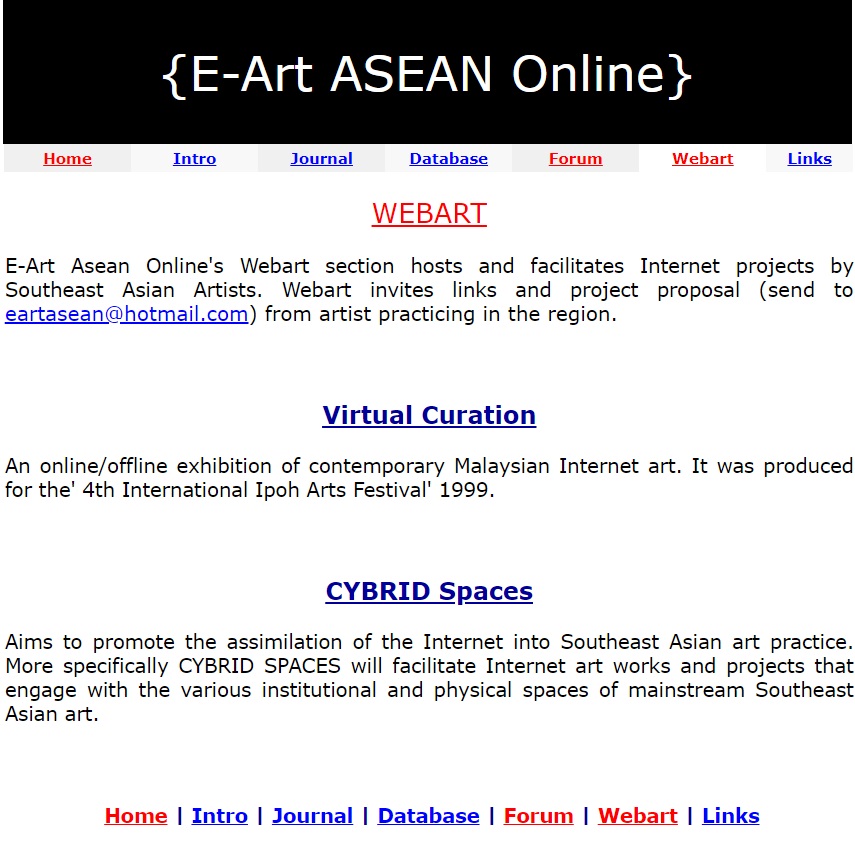
In 1999 Hasnul Jamal Saidon and I founded the pioneering Eart ASEAN Online portal which, as the text on the homepage used to say, was an “interactive resource for electronic art in Southeast Asia. This site consists of a comprehensive Database of new media art including profiles of artists and samples of artworks, a Journal dealing with the historical … Continue readingEarly Internet Art in Malaysia 10
In 1999, I curated the first exhibition of online artworks in Malaysia for the ‘4th International Ipoh Arts Festival.’ The artists in the show were all students and faculty from the Faculti Seni Gunaan dan Kreatif (FSGK), Universiti Malaysia Sarawak (UNIMAS). Indeed, between 1995 and 2000 Hasnul Jamal Saidon and I had worked to established … Continue readingEarly Internet Art in Malaysia 9
I had begun my practice as an artist in the late 1980’s with a series of paintings and had moved onto a more self-consciously critical performance/ installation practice when, in 1995, I found the World Wide Web, with its capacities for instantaneous connectivity, hypertextual linking and multimedia convergence. I then transferred my practice to this … Continue readingEarly Internet Art in Malaysia 8
One of the themes of my work in the 1990’s was a reclamation of the international contemporary art discourse from a national perspective. If postmodernism had displaced the hegemony of international of modernism with a disruptive array of regional, national and marginal discourses. While my own work was clearly located within the ambit of this … Continue readingEarly Internet Art in Malaysia 7
In 1998, I made my 2nd web art work titled La Folie de la Peinture (The Madness of Painting), fragments of which are archived on the Wayback Machine site. This was a comprehensive, if condensed, articulation of my critique of the movement from modernist abstraction, via conceptualism, to the photographic ontology of postmodern installation and … Continue readingEarly Internet Art in Malaysia 6
When the INET (annual Internet Society conference) came to Malaysia in 1997, I presented a paper titled “Art After the Internet: The Impact of the World Wide Web on Global Culture.” In this paper I analyzed how the Internet. was being shaped by various national and transnational forces and how esoteric postmodern theories were turning … Continue readingEarly Internet Art in Malaysia 5
In the introduction to his profound work on the cinematic image, Signatures of the Visible, Fredric Jameson writes, “The visual is essentially pornographic, which is to say that it has its end in rapt, mindless fascination.” Explicit pornography is thus the acknowledgement of the true nature of the filmic image, a “potentiation” of its call … Continue readingEarly Internet Art in Malaysia 4
In 1993 I made my first trip to New York. My wife Jane and I were living in London and had bought a Hoover vacuum cleaner. As part of the infamously disastrous (for Hoover) promotion of the time we got two free tickets to New York. I had, as an artist from Malaysia practicing in …
In 1996 I made a web work titled The Failure of Marcel Duchamp/Japanese Fetish Even! which is the first Internet art work in Malaysia and, as far as I know, also in Southeast Asia. This work was both an admiring tribute and a harsh parody of Marcel Duchamp’s Étant donnés (Given: 1. The Waterfall, 2. The … Continue reading
In 1999 Hasnul Jamal Saidon and I founded the pioneering Eart ASEAN Online portal which, as the text on the homepage used to say, was an “interactive resource for electronic art in Southeast Asia. This site consists of a comprehensive Database of new media art including profiles of artists and samples of artworks, a Journal dealing with the historical development of electronic art in South East Asia, theoretical and critical issues related to the use of electronic media in the visual arts as well as reviews and analysis of electronic artworks, a Forum for online discussion as well as Links to related websites worldwide and a space for developing and hosting Webart by Southeast Asian Artists.”
The Webart section of Eart ASEAN set out a criteria for web art and a theory of how online art works might be integrated within the physical infrastructure of offline world. Integrating Peter Anders notion of cybrid space, which involves the complete coalescence of the virtual and the real, and Jochaim Blank’s problematization of the presentation of net projects in physical space, I outlined a curatorial agenda for our own ‘Cybrid Spaces.’ The call for submissions read – “CYBRID SPACES aims to promote the assimilation of the Internet into Southeast Asian art practice. More specifically CYBRID SPACES will facilitate Internet art works and projects that engage with the various institutional and physical spaces of mainstream Southeast Asian art. CYBRID SPACES will work with artists (offline and online) in the region bridging communication gaps in the arts infrastructure of the region. CYBRID SPACES invites projects proposals (send to eartasean@hotmail.com) from artist practicing in the region”.
This first presentation under this rubric was a set of web works that explored this new ontology. These were all works, that featured in the Virtual Curation exhibition at the Ipoh Arts Festival and they were linked via the curatorial essay I wrote for that event. This was the inaugural presentation of CYBRID SPACES and many of the works, particularly Ting Ting Hook’s Tortoise Zone, exemplified the proposed agenda. Sadly, there were no further presentations in this section as, having given it our all for a couple of years, both Hasnul and I moved on to other things.
It must be said, in this regard, that the Eart ASEAN Online portal was clearly ‘ahead of its time.’ This was both, the measure of its success and the cause of its ultimate failure. The project may have arrived at a time when the Malaysian electronic art scene was too well rooted in the analog realm to envisage the benefits of virtual community (this was well before the advent of social media) and dissemination. Also, it seems that the majority of those becoming involved in the new media were more in tune with industry and, although we had incorporated the the applied dimension of the arts into our programme and welcomed them, we could not induce much participation. Most significantly we had set out the geopolitical framework of ASEAN for the project and most of the states involved – Indonesia, Malaysia, Philippines, Singapore and Thailand, Brunei Darussalam, Viet Nam, Lao PDR and Myanmar and Cambodia would take some years before gaining the Internet infrastructure and capacity to participate. Nevertheless, Eart ASEAN laid out the theoretical framework and exemplified the social networking and platform development any such endeavor would have to involve, even today.
I had begun my practice as an artist in the late 1980’s with a series of paintings and had moved onto a more self-consciously critical performance/ installation practice when, in 1995, I found the World Wide Web, with its capacities for instantaneous connectivity, hypertextual linking and multimedia convergence. I then transferred my practice to this new medium and between 1996 and 1998 made two web works and La Folie de la Peinture (1998), is the second of these. It is archived in fragments on the Wayback Machine.
At the center of this work was a remediation of a set of installation photographs, linked in such a manner as to represent movement through the space, with the experience of each ‘work’ recast as a multimedia experience (WAV, GIF, MOV and VRML files). The text (hypertext) was an integral part of this web work and in it, I set out some contextualizing ideas. These ideas were also presented within a wider theoretical framework in a paper titled Toward a Universal Theory of Convergence: Transcending the Technocentric View of the Multimedia Revolution presented at INET 1998 in Geneva. These points originally made in 1998 are presented below –
* With the emergence of abstract colour-field painting, the placement of works on the gallery wall became integral to the presentation and, in the light of this transient ‘installation’ aspect of the presentation, photographic documentation began to take on a new significance.
* While the ‘installation shot’ confirms the uniqueness of the ‘site’ of the installation, this photographic documentation leaves its own mass (mechanical reproduction) condition unindexed and has, quite surreptitiously, become the ‘extended’ medium, of installation art.
* As bandwidth increases and multimedia technology goes online, fluidly articulating the remote experience of image, moving image, text and sound in an interactive ‘virtual reality’, it will become increasingly difficult to differentiate between an actual place, person or thing from its image or representation.
* As the representations contained on the multitude of servers on the Internet exist in virtual proximity, ‘here’ and ‘there’ have been brought together in the ‘now’ of fiber optic connectivity. The instantaneous connectivity of computer mediated communication, appears to have eliminated geographical distance and the modern/ postmodern distinction of ‘site’ and ‘non-site’ is no longer be meaningful.
I am honored to be featured in a keynote by Associate Professor Hasnul Jamal Saidon at the 6th ICACA (International Conference on Applied & Creative Arts), Faculty of Applied & Creative Arts, UNIMAS, 18 August 2021. Hasnul generously describes the work I did at the Universti Malaysia Sarawak between 1995 and 2002 as a very important legacy with regard to Internet art and online art in Malaysia. He describes me as the pioneer of Internet art in Southeast Asia and the forerunner in the region of critical engagement in the context of the shift from offline to online art. He notes that my The Failure of Marcel Duchamp/ Japanese Fetish Even! (1996) is the first Internet art work in Malaysia and that I curated the first online exhibition in Malaysia at the 4th Ipoh Arts Festival (1999). I am happy to be remembered and would like to return the recognition by noting that Hasnul is himself a pioneering contributor to electronic art in Malaysia through his early forays into video art, video installation art and his own critical and theoretical writings. Beyond our individual contributions, I believe that it is what we achieved together, by way of curating the 1st Electronic Art Show (1997) and the founding of the Eart ASEAN Online (1999) portal, that constitutes a platform for further developments in Malaysian new media art.



 The Koboi Project
You must be logged in to post a comment.