Tok Dalang Cina

Eyo Hock Seng is a Kelantanese Wayang Kulit Dalang who has been practicing his craft for over 40 years. Today he is one of eight or nine wayang kulit Dalangs who are performing today. Not only is he a Chinese master of this Malay
art form, but he might also even be credited for keeping the form alive in Kelantan for 30 years during which the PAS State government had banned Wayang Kulit in Kelantan. He tells of how he was one of eighteen Dalangs in the State
when they all called to a meeting with the late Tok Guru Nik Aziz (Menteri Besar of Kelantan from 1990 to 2013 and Spiritual Leader of PAS until his death in 2015) in 1999. As Hock Seng recalls, when they were asked to perform
for Tok Guru, they did so with all the traditional ritual accouterments, including spells and glutinous rice offerings. The result of which is that Wayang Kuilt was banned, due to its unIslamic elements (Animist, Hindu/Buddhist).

In fact the Kelantan state government officially banned cultural performances like Mak Yong and Wayang Kulit under
the Entertainment\ and Entertainment Premises Enactment 1998. The Dalangs had to migrate to other states in order to continue their art and many gave up altogether. Eyo Hock Seng was the only one permitted to continue the practice as he was not a Muslim but he was restricted to presenting his Wayang in the Chinese and Siamese districts. During this time Eyo Hock Seng grew in stature as a performer and gained an international reputation. It was only in 2019 that the ban was lifted, with the proviso that there were no unIslamic elements of worship in the performances. Hock Seng laments that there were not many of the old Dalangs left who could return to the practice after the passage
of twenty years, as many had given up altogether and had sold their puppets and musical instruments during the ban.

The following questions relating to this episode in the history of Kelantanese Wayang Kulit inform my own Pokok Pauh Janggi performance (see notes)
1. To what extent can Malay culture be isolated from its pre-Islamic roots?
2. To what extent can the elements of pre-Islamic Malay culture be accepted within contemporary Malay Islam?
3. To what extent does contemporary Malay culture remain contigious with the wider spirit of the Archipelago?
4. To what extent can a contemporary citizen of Malay lands be assimilated to Malayness without being a Muslim?
5. Can only non-Malay/Non-Muslims perform and preserve Malay traditions that are presently considered unIslamic?

The first three questions pertain to the essence of Malay culture. The fourth and fifth question reflect on the significance of non-Malay/ non-Muslims performing, identifying with and preserving Malay cultural forms, Thes last questions index the prospect of an integrative, integral even, Malaysian identity.

https://worldofbuzz.com/un-official-wants-kelantan-to-lift-ban-against-traditional-art-like-mak-yong-wayang-kulit/

https://www.malaymail.com/news/malaysia/2019/09/25/kelantan-lifts-mak-yong-ban-after-two-decades-but-insists-performances-must/1794202

Pak Dogol and Wak Long 2

1. Sejauh manakah budaya Melayu boleh diasingkan daripada akar-umbi pra Islamnya?
2. Sejauh manakah unsur-unsur budaya Melayu pra Islam boleh diterima oleh Islam Melayu sezaman?
3. Sejauh manakah budaya Melayu sezaman berkesinambungan dengan semangat Nusantara yang mengandunginya?

4. Sejauh manakah seseorang warga tanah Melayu sezaman boleh masuk Melayu tanpa masuk Islam?
5. Hanya orang bukan Melayu/Bukan Islam kah, yang mampu mengamal dan memelihara tradisi Melayu yang kini dianggap menentang hukum Islam?

Inilah hanya lima diantara banyak soalan yang tersirat didalam persembahan Pokok Pauh Janggi dan perbincangangan yang mengelilinginya. Soalan satu hingga tiga adalah berkenaan dengan isi atau pati budaya Melayu. Soalan keempat mempertikaikan peranaan saya sendiri sebagai orang bukan Melayu yang menerima dan mempersembahkan budaya ini.

1. To what extent can Malay culture be isolated from its pre-Islamic roots?
2. To what extent can the elements of pre Islamic Malay culture be accepted within contemporary Malay Islam?
3. To what extent does contemporary Malay culture remain contigious with the wider spirit of the Archipelago?
4. To what extent can a contemporary citizen of Malay lands be assimilated to Malayness without being a Muslim?
5. Can only non-Malay/Non-Muslims perform and preserve Malay traditions that are presently considered unIslamic?

These are just five of the many questions implicit in the Pokok Pauh Janggi performance and the discussion surrounding it. Questions one to three are about the content or essence of Malay culture. The fourth and fifth questions reflects on my own role as a non-Malay performing and identifying with these forms. In reflecting on the first three questions, albeit at a tangent, I suggest that Pak Dogol and Wak Long are pesonifications of the indigenous spirit (semangat) in the face of the Hindu/Buddhist ethos of Wayang Kulit. Hindu deities like Dewa Sinar Matahari (Surya), Dewa Sinar Bulan (Chandra), Siti Andang Dewi, (Lakshmi) and Dewa Berembun (Vishnu) are present in the narrative but have no puppets. Bentara Guru (Shiva) and Bentara Narada are the only two Hindu gods that appear as puppets. The highest god of the Wayang Kulit heaven (kayangan) is, however, Dewa Sang Yang Tunggal, who is not a Hindu deity but is, instead, derived from the Javanese Wayang Kulit tradition. Dewa Sang Yang Tunggal also does not have a distinct puppet but his earthly manifestation, Pak Dogol, does. As does Wak Long, who is said to have been created out of Pak Dogol’s spirit combined with dirt from his body. (See Wayang Kulit Kelantan: A Study of Characterization and Puppets)

Arguably, Pak Dogol and Wak Long are intermediaries, interlocutors, and interpreters, in the integration of Animistic and Hindu/Buddhist elements into the syncretic Islamic culture that characterizes the Malay Archipelago. According to Barbara S. Wright, one dalang held that the originator of the shadow play was the Angel Azizin, who first became Nenek Haji Mula, then became Dewa Sang Yang Tunggal who finally descended from heaven (kayangan) to the world (dunia) bearing the Wayang Kulit in the form of Pak Dogol. According to another dalang, Haji Mula gave the shadow play to the Prophet Mohammad, who gave it to Sang Yang Tunggal, who gave it to Betara Guru,.who gave it to Dewa Narada, who gave it to Wak Long. In yet another more involved version, “Haji Mula preceded Adam in Gods creation and when he was asked to bow down to Adam he refused. Allah refused to let him live under his sky and thus he fell into the sea and lay on a rock in the sea for forty years, unable to wash the dirt from his body. From the resulting bodily dirt he created a companion for himself, Wak Long, of course. Eventually, Allah relented and sent Haji Mula down to earth in Kelantan as the ugly Pak Dogol. He simultaneously descended as Semar in Jawa and in Epong inThailand (This is the Kelantan Malay undrestanding, not necessarily consonant with views in Jawa or Thailand). Allah gave Haji Mula a mission – to forcefully remind the forgetful about his grace. These origin myths of Wayang Kulit Kelantan, attest to the assimilative and proselytizing roles that Pak Dogol and Wak Long have played within the Islamic culture of the Malay Peninsula.

… and what of the fourth and fifth questions? … Well, that is a story for another post or two!

https://www.researchgate.net/publication/313848278_Wayang_Kulit_Kelantan_A_Study_of_Chara cterization_and_Puppets

https://www-jstor-org.proxy.lib.sfu.ca/stable/1178141?seq=6

Tahi Besi Menjadi Pagar 2

Soalan: Boleh tak tahi besi kita buat berobat nak pagar rumah, guna ayat Koran?

Jawapan: Boleh buat Tahi Besi buat pagar, tetapi pagar kawat itulah! (Hah, pasal dia besi … buat kawat 🙂 )
Yang tak boleh nya, tahi besi itu yang kita jaga rumah kita. Tak Boleh! Dan kalau Al Koran dengan selawat … boleh. Faham? Aaa!

The above extract.from a ceramah by Ustaz Azhar Idrus evidences a persistant syncreticism in the quotidian practice of Islam amongst the Malays of the peninsular. The Bahasa transcription is my best translation of the Ustaz’s loghat Kelate. I would appreciate corrections. Please send to nrajah@sfu.ca

The Pokok Pauh Janggi installation runs from 5th Aug – 30th Sept 2023 at the Kapallorek Artspace in Bandar Seri Iskandar, Perak.

http://mistik707corner.blogspot.com/2010/12/tahi-besi.html#

https://www.kapallorek.com/my/

RIP Jeganathan Ramachandran 2

In reflecting on my engagement with the art of Jeganathan Ramachandran, I clearly recall including his paintings in the exhibition I curated for the Balai Seni Lukis Negara in 2002 titled Bara Hati Bahang Jiwa. The exhibition was premised on the need to reconsider the established narrative on Expressionism in Malaysian art from the perspective of a post-colonial recovery. Skirting the pitfalls of essentialism and nationalism, I pitched the reconfiguration in terms of ethnic, ethnographic, regional and national considerations. I identified the underpinnings of a Malay approach to ‘expressionism’ and presented the representative artists this within a boarder national overview, placing the dominant Malay idiom within the wider pool of contemporary Malaysian expressions.

While my thesis was couched in the aesthetic and emotional proclivities of the Malays, I included Chinese and Indians artists even though they disrupted my neat Nusantara schematization which emphasized indigenous psychology and culture (amok, latah, adat and adab). I decided that I would try negotiate the essentially Malay aesthetics of my curatorial theme with the overarching multiethnic realities of the nation. The Indian and Chinese artists did not fit in neatly within my theme and, In this regard, I must acknowledge that, as a whole, Bara Hati Bahang Jiwa was somewhat unresolved, perhaps it was unresolvable by definition … as unresolvable as the idea of the Malaysian nation itself!

Given that I was going to include an Indian artist in the mix, regardless of the goodness of fit, I needed to identify an artist whose work exemplified and encapsulated contemporary Malaysian Indian expression on its own terms … Who would it be? ….. Jeganathan Ramachandran had been making his presence felt in the contemporary scene since the mid 1990’s, with his powerful figurative paintings. Having studied sculpture, woodcarving and painting from a traditional perspective, Jeganathan had been developing a direct and personal mode of expression that was nevertheless steeped in traditional Indian philosophy, psychology and science. I saw in his work the complete Malaysian Indian expression – religious, spiritual, mythical, metaphysical and, most importantly, social.

In a note sent to me in the course of our communication after the ASEAN Art Awards 1996 Jega had said, “I have always believed that art is not just a decorative medium but a powerful tool of expression and the deeper I looked within the Indian art context I saw the vast symbolic expressions that exist within the ‘rigid style’… Then I started painting in a narrative form much like the old times. Nearly every painting of mine had a story and every symbol I applied, new and old, further enhanced the story. During this time my involvement in spiritualism introduced me to many wondrous expressions and their visual impressions upon my mind took on new shapes and I started depicting them in my paintings.” Just as the Malay artists I had selected seemed to carry their particular traditions and psyche into the contemporary idiom of ‘Expressionism, Jega brought forth a deeply Indian expressiveness.

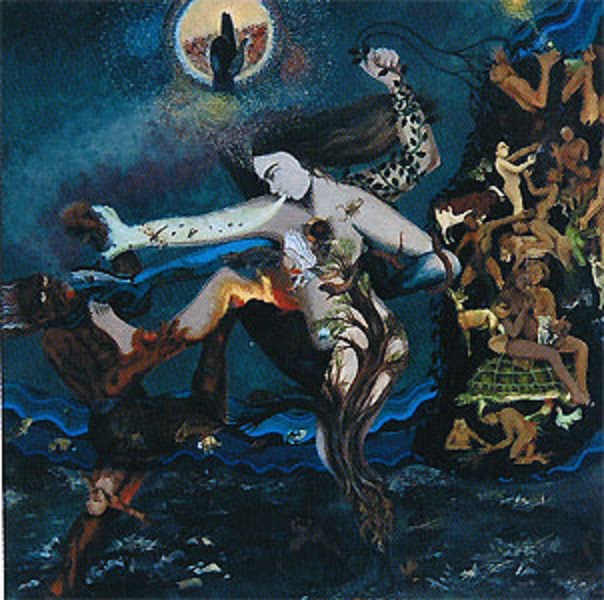
I included 4 of Jega’s works in Bara Hati Bahang Jiwa – ‘Invocation’ (2001) and ‘1 Tree = 40 Life Forms’ (2001) reflect this quest for a spiritual expression, with different degrees of reference to aspects of lived experience. ‘The House Slave’ (2001) is a response to the suffering of a friend in an abusive situation and a reflection on the plight of women caught within Indian social norms. Pictured above is the most expansive of the 4 works, both in scale and in thematic. It is titled ‘Fallout in the Garden of Life’ (1998). The artist has said “Kali is nature and she is fighting everything unnatural which has created imbalance on earth and all the people in the boat- like thing, that Noah’s Ark (my version). My belief is that nature will always protect those who are natural and the five hands represent the five elements (pancha butham). And notice the tree, that’s where it all starts.”

Rest in Peace Jega – Kali Kali Mahakali!

The above is a modified extract from my essay ‘Expression and Expressionism in Contemporary Malaysian Art’ published in 2002.

Reference:
Rajah, Bara Hati Bahang Jiwa: Expression and Expressionism in Contemporary Malaysian Art, Kuala Lumpur: Balai Seni Lukis Negara, 2002.

Image: http://www.sgm.org.my/en/?cur=page/page&id=154&title=Why_Art?_A_Public_Lecture_by_Zanita_Anuar