In this late career engraving by Dutch painter Johannes Stradanus (1523-1605) commerating Ferdinand Maggellen’s discovery of the passage around the globe, there is a representation of the ‘Roc.’ In his essay analysing this complex collection of realistic, emblematical, and mythological representations, Rudolph Wittkover makes two references that locate the abode of the creature in what must be the South China Sea. He notes that Maggellen’s companion and chronicler, Antonio Pigafetta, locates its home in the “Chinese Seas”. Indeed, as the ship in the illustration, is coming out of the Magellen Straits and facing the open Pacific Ocean, the South China Sea might be located in the North Westerly direction from whence the Roc could be interpreted as approaching the scene. Wittkover also cites the Maghrebi explorer and scholar, Ibn Batuta, who tells how, again, in the Chinese Seas, a massive form that he and his fellows thought was a flying mountain, turned out to be the Roc. These accounts tie in with the notion that the Roc nests in the Pokok Pauh Janggi at the center of the Pusat Tasek, located somewhere in the South China Sea.
This centrepiece from a 19th Century Malay wedding showing fabulous birds and dragons. As the dragons face-off in the lake, the birds occupy the tree-tops. Walter Skeat, who collected this piece at the end of the 19th Century, notes three types of bird – the Roc (of Middle Eastern origin) which he equates with Garuda (Lord Vishnu’s vehicle), Jintayu (or Jadayu from the Ramayana) and the Walimana which he equates with the Harpy (of Greek mythology). This display evidences how the, now less familliar, Burung Roc was once an integral part of Malay folklore and material culture.
In Islamic cosmography, heaven is often represented directly above the earth, the centre of which is marked by the Ka’ba. Represented below the earth, but in fact surrounding it, is Mount Qaf, a boundary world of jins and spirits, and further down lie the seven levels of hell. As represented in the Ottoman image on the left (above), the Sacred trees of Islam – the Shajarat al-Tûba, and the Zaqqum tree, form a direct vertical line from the uppermost realm of Heaven, down to the gate of the Seven Hells, just as the Pokok Pauh Janggi does in the Malay cosmology, connecting Kayangan to Dasar Laut. This lining-up of various sacred trees of Islamic cosmography might represent the intended indexing of an underlying cosmology, or it may simly be due to the limitations of 2-dimensional graphical ontology, but in any event, it an artifact of Islamic cosmographic representation. Other trees not represented in this Ottoman diagram, but that could also, hypothetically, be placed in line include the Sidrat al-Muntahā or Lote Tree of the Utmost Boundary (which marks the boundary between the astronomical and the theological Heavens), the šajaratu l-ḫuldor Tree of Immortality (which is the Tree at the centre of the Garden of Eden which Allah forbade to Adam and Eve) and the Olive Tree, whose centre is located everywhere (tawhid). In Middle Eastern mythology, the Mountains of Qaf are also the abode of the giant bird, the Roc. In Nusantara folklore the Burong Roc nests on the top of the pokok Pauh Janggi, co-locating the ring of the Mountains of Qaf to the base of the Pokok Pauh Janggi one will find the enterance to the cavern that leads down to the Dasar Laut.
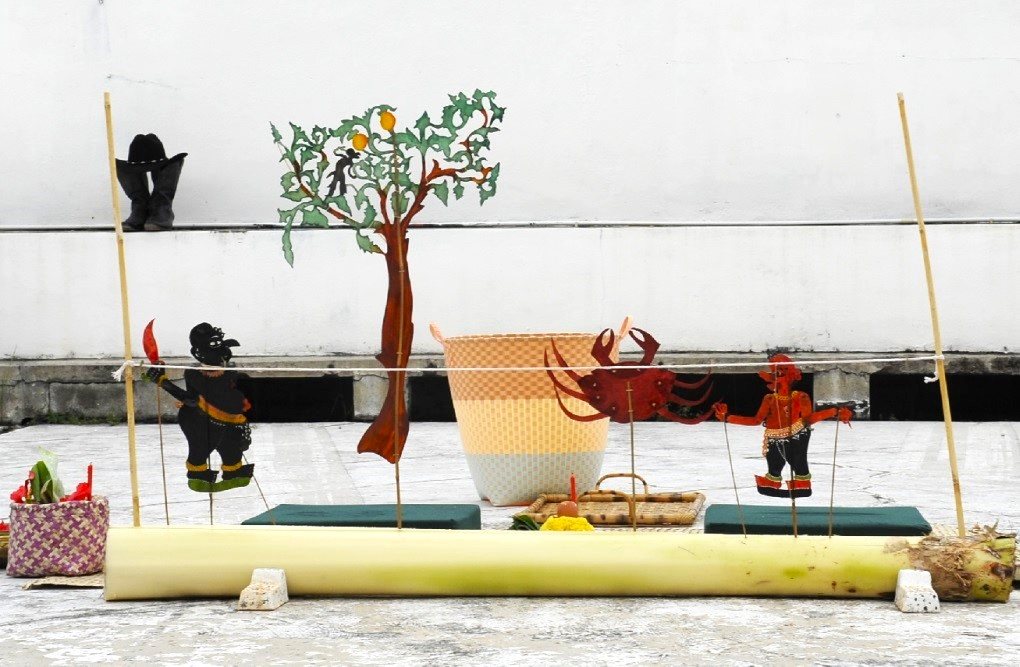
In the Pokok Pauh Janggi Performance, the panggung was designed to echo the traditional Balinese set-up for daylight puppet display known as Wayang Lemah. Also the seating followed the traditional arrangement when the pawang or bomoh joins the dalangto conduct the upacara membuka panggung. At the heart of this performance was thepresentationand initiation of two long forgotten Kelantanese pupppets – the Pokok Pauh Janggi and the Ketam Gergasi. I exorcized the bad spirits from the deer hide (membuang badi rusa) and invoked the spirit of each puppet (memanggil jambalang patung).
This ceremony (upacara) involved the presence of two other more familiar puppets – Pak Dogol who is black and Wak Long who has a red counternance.During the performance, the Koboi wore his habitual black koboi outfit and sat on the side of Pak Dogol. The Koboi’s collaborator, Sang Nabil Utama, wore red baju and kain batik and sat with Wak Long. In the course of the performance the I exchanged my Western hat for a songkok, alluding to the fourth question of the previous post in this series – Sejauh manakah seseorang warga tanah Melayu sezaman boleh masuk Melayu tanpa masuk Islam?
1. Sejauh manakah budaya Melayu boleh diasingkan daripada akar-umbi pra Islamnya? 2. Sejauh manakah unsur-unsur budaya Melayu pra Islam boleh diterima oleh Islam Melayu sezaman? 3. Sejauh manakah budaya Melayu sezaman berkesinambungan dengan semangat Nusantara yang mengandunginya? 4. Sejauh manakah seseorang warga tanah Melayu sezaman boleh masuk Melayu tanpa masuk Islam? 5. Hanya orang bukan Melayu/Bukan Islam kah, yang mampu mengamal dan memelihara tradisi Melayu yang kini dianggap menentang hukum Islam?
Inilah hanya lima diantara banyak soalan yang tersirat didalam persembahan Pokok Pauh Janggi dan perbincangangan yang mengelilinginya. Soalan satu hingga tiga adalah berkenaan dengan isi atau pati budayaMelayu. Soalan keempat mempertikaikan peranaan saya sendiri sebagai orang bukan Melayu yang menerima dan mempersembahkan budaya ini.
1. To what extent can Malay culture be isolated from its pre-Islamic roots? 2. To what extent can the elements of pre Islamic Malay culture be accepted within contemporary Malay Islam? 3. To what extent does contemporary Malay culture remain contigious with the wider spirit of the Archipelago? 4. To what extent can a contemporary citizen of Malay lands be assimilated to Malayness without being a Muslim? 5. Can only non-Malay/Non-Muslims perform and preserve Malay traditions that are presently considered unIslamic?
These are just five of the many questions implicit in the Pokok Pauh Janggi performance and the discussion surrounding it. Questions one to three are about the content or essence of Malay culture. The fourth and fifth questions reflects on my own role as a non-Malay performing and identifying with these forms. In reflecting on the first three questions, albeit at a tangent, I suggest that Pak Dogol and Wak Long are pesonifications of the indigenous spirit (semangat) in the face of the Hindu/Buddhist ethos of Wayang Kulit. Hindu deities like Dewa Sinar Matahari (Surya), Dewa Sinar Bulan (Chandra), Siti Andang Dewi, (Lakshmi) and Dewa Berembun (Vishnu) are present in the narrative but have no puppets. Bentara Guru (Shiva) and Bentara Narada are the only two Hindu gods that appear as puppets. The highest god of the Wayang Kulit heaven (kayangan) is, however, Dewa Sang Yang Tunggal, who is not a Hindu deity but is, instead, derived from the Javanese Wayang Kulit tradition. Dewa Sang Yang Tunggal also does not have a distinct puppet but his earthly manifestation, Pak Dogol, does. As does Wak Long, who is said to have been created out of Pak Dogol’s spirit combined with dirt from his body. (See Wayang Kulit Kelantan: A Study of Characterization and Puppets)
Arguably, Pak Dogol and Wak Long are intermediaries, interlocutors, and interpreters, in the integration of Animistic and Hindu/Buddhist elements into the syncretic Islamic culture that characterizes the Malay Archipelago. According to Barbara S. Wright, one dalang held that the originator of the shadow play was the Angel Azizin, who first became Nenek Haji Mula, then became Dewa Sang Yang Tunggal who finally descended from heaven (kayangan) to the world (dunia) bearing the Wayang Kulit in the form of Pak Dogol. According to another dalang, Haji Mula gave the shadow play to the Prophet Mohammad, who gave it to Sang Yang Tunggal, who gave it to Betara Guru,.who gave it to Dewa Narada, who gave it to Wak Long. In yet another more involved version, “Haji Mula preceded Adam in Gods creation and when he was asked to bow down to Adam he refused. Allah refused to let him live under his sky and thus he fell into the sea and lay on a rock in the sea for forty years, unable to wash the dirt from his body. From the resulting bodily dirt he created a companion for himself, Wak Long, of course. Eventually, Allah relented and sent Haji Mula down to earth in Kelantan as the ugly Pak Dogol. He simultaneously descended as Semar in Jawa and in Epong inThailand (This is the Kelantan Malay undrestanding, not necessarily consonant with views in Jawa or Thailand). Allah gave Haji Mula a mission – to forcefully remind the forgetful about his grace. These origin myths of Wayang Kulit Kelantan, attest to the assimilative and proselytizing roles that Pak Dogol and Wak Long have played within the Islamic culture of the Malay Peninsula.
In my Pokok Pauh Janggi performance at Kapallorek Artspace, I presented a Pak Dogol puppet and a Wak long puppet, both of which I collected in Kota Baru, Kelantan over 20 years ago. In Kelantanese Wayang Kulit, or Wayang SIam as it was referred to locally, Pak Dogol is a minder or caregiver of Sri Rama. He presents as black, bald (botak), old, pot bellied man with a protruding belly button (pusat perut), an pronounced nipple (tetek), large buttocks and a large nose. He holds a machete (golok). In fact he is Dewa Sang Yang Tunggal, a supreme demigod (dewa) who descended to earth (dunia) from the heavenly realm (kayangan) with this unsightly appearance (wajah) as a disguise, in order to find his son. Pak Dogol is the principal peran (humourous figure) in Wayang Siam. He is ritually speaking, the most important of all Wayang Siam characters. This puppet is considered to be magical and possessing of a sometimes sinister spirit (keramat) that resides in tree stumps (tunggul Kayu mati). The puppet is stored wrapped a yellow cloth, signifying the a regal status of its character. Pak Dogol is always the first to receive praise and offerings (puja) in the course of the upacara buka panggung (blessing of the stage) ritual.
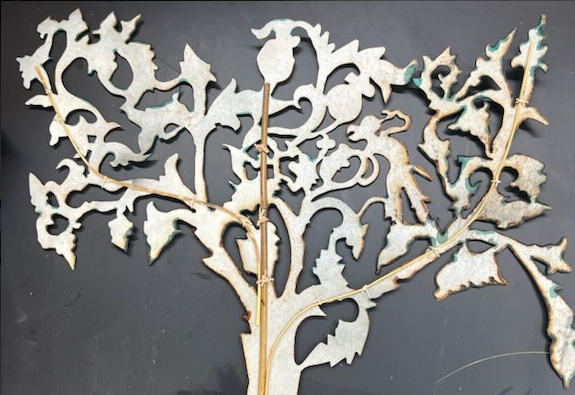
Wak Long, who isPak Dogol’s companion, was created out of the former’s spirit and dirt from his body. He, like Pak Dogol, is a peran, only, he is funnier than his friend.Wak Long presents as a Red figure with a distinctive topknot. He does not hold a weapon. Both characters do not appear in the Ramayana which forms the narrative basis of Wayang Siam. Pak Dogol and Wak long are indigenous to Nusantara, analogous to Semar in Wayang Kulit Jawa. At the heart of my own performance was thepresentationand initiation of two other long forgotten puppets. – Pokok Pauh Janggi and Ketam Gergasi puppet. I exorcized the bad spirits from the deer hide (membuang badi rusa) and invoked the spirit of each puppet (memanggil jambalang patung). Both of these puppets were made following designs from late 19th Century examples collected and photographed by Walter William Skeat. They too are rooted in Malay folklore and metaphysics and are not found in the Ramayana or the Mahabharata, the great epics that form the core of the culture of what some have called Greater India. As these puppets made their return to the panggung, I felt that it was important to have Pak Dogol and Wak long, present to bear witness to the proceedings.
The puppets were made by Greta Burley from deer hide using a laser cutter. It was decided that the Pokok Pauh Janggi should be 27.5″ in height, (69cm) and the Ketam Gergasi would be scaled proportionately based on the original photograph. A key issue in determining the size of the puppets was the dimension of the largest art portfolio that would conform to the 62in dimension limit for checked baggage on international flights. Greta first I cut a small shape out of the deer hide to determine the nature and extent of the cut. She found a setting that worked fairly well although the laser did burn some of the material around the edges. Colour was applied using leather dyes.
Pokok Pauh Janggi exhibition by Niranjan Rajah runs from 5th Aug – 30th Sept 2023.





 The Koboi Project
You must be logged in to post a comment.