A Post-Traditional Polity?

superstabbbr

As Rajinikanth invests his SUPERSTAR capital in the Tamil Nadu political arena, there is a lot of speculation about his future allegiances and alignments. For those, who like me lament the rise of Hindu Nationalism in Indian politics, the concern is that the waning post-independence secularism in Tamil Nadu politics will finally be dissolved in an alliance between our Thalaivar and Narendra Modhi’s Bharatiya Janata Party (BJP). In his speech announcing his entry into politics, Rajnikanth is reported to have said, “We have to create a spiritual politics with no caste and religion barrier. My cornerstones would be honesty, transparency, secularity and spiritual politics. Spiritual politics according to me means fair and just politics.” This statement seems wide open in its possible interpretations. Rajnikanth could indeed end up being , wittingly or otherwise, a Trojan Horse bearing Hindutva cadres into the hitherto atheistic milieu of Tamil Nadu politics. On the other hand, it is possible that his statement carries within it the promise of a new post-atheistic post-traditional  polity – one that sets the Tamil peoples inherent sacral tendencies within a trans-communal and multi-religious ethos. It might seem be too much to ask of a mere movie star, but in the story of Tamil Nadu there have been no leaders as powerful as Annadurai, MGR, Karunanithi and Jayalalitha …..movie people all!

http://www.news18.com/news/politics/in-land-of-dravidian-rationalism-rajinikanth-unleashes-his-spiritual-politics-1619191.html

http://www.firstpost.com/entertainment/are-rajinikanth-kamal-haasan-getting-ready-to-dip-into-tamil-nadus-murky-politics-3998027.html

Rajinikanth as Signifier

rajini
On December 31st 2017 SUPERSTAR Rajinikanth confirmed his entry into Tamil Nadu Politics by announcing that he would launch a new political party before the next assembly election in the state. Growing up as a Tamil in Malaysia in the 1970’s, although I was not a film fan, I was aware of Rajnikanth’s significance as an identity pioneer. Up till his arrival on the scene, the dark skinned  audiences of Tamil cinema had perversely preferred their leading men pale-faced and all powdered up. Rajnikanth had changed all that and gone on to become the biggest box office draw in Indian cinema. Later in my life, as my children were growing up in Kuching, Sarawak far from my parents and any significant Tamil influences, I went looking for Tamil media to fill the lack. I found a copy of Rajnikanth’s 1995 release, Muthu at the local night-market and to my delight, my girls loved it. What’s more, I found that I loved Muthu too.

On a visit to Tokyo at around this time, I was greeted by a billboard image of Rajinikanth. ‘Muthu’ or ‘Dancing Maharaja’ as the film was titled for its Japanese release, had become a box-office sensation in Japan. This was a rare example of an idiomatic local cultural product becoming a cross-over success without any mitigation of its sharp flavors. To the contrary, Japanese fans now learn Tamil to follow their SUPERSTAR in his own idiom. Against the grain of an era of global marketing and dochakuka in which the global products are varied, adapted and ‘localized’ for specific markets, Rajinikanth appears to have successfully projected an untempered idiomatic expression into a culturally distinct market and milieu. I recognized in this phenomena a signifier for the antithesis of the homogenization that was taking hold in the all global arenas, including that of contemporary art.

https://www.ndtv.com/tamil-nadu-news/tamil-superstar-rajinikanth-announces-his-entry-in-politics-top-10-quotes-1794021

http://koboibalikkampung.wixsite.com/kedualan

Light on the Playa

truthOnce upon a time, an eternity ago, in their heavenly abode on Mount Kailash, Lord Shiva, Mother Parvathy and their children Ganesha and Muruga were all together in a moment of family bliss. The Sage Naradha, who is notorious in Hindu mythology, for creating dissension among the Gods, paid them a visit. Holding a mango in his hand, Naradha addressed the boys, “Lord Ganesha, Lord Muruga, this is the mango of knowledge or enlightenment (nyanam) . It is sweeter than amirtham or the divine nectar, elixir of immortality. It must not, however, be shared or divided. It must be consumed whole, by one person of course!” Shiva and Parvathy were perturbed by this divisiveness, but nevertheless Lord Shiva set the boys a challenge, “This mango, this Nyana Pazaham (fruit of enlightenment), goes to the person who is the fastest in circumnavigating the world.”​

Knowing he must win, Muruga bestrode his glorious vahanam (mount), the peacock, and flew swiftly round the world. The ungainly Ganesha, God of Wisdom, thought for a moment before setting off. Ganesha pondered on his own gait and girth, and on his modest vahanam – the homely mouse, and asked his parents a question, “AmmaAppa, is it not true that the parents are the world for a child?” “Yes”, the puzzled but glowing parents replied. Ganesha continued, “Is it not true that the whole universe is but a reflection or manifestation of your Lordly selves?” “Well, yes of course, it is!” It was the only possible reply. Ganesha simply circumambulated Shiva and Parvathy, his father and mother, his whole world – the whole world!

Sure enough Ganesha won the mango. When Muruga came flying back expecting to win, he saw Ganesha with the prize. Feeling cheated by his parents, he flew into a rage and pierced Ganesha in the belly with his vel (spear) a symbolic attribute of the Lord Murugan (This unusual variation of the myth comes via my mother and grandmother). Disenchanted, he abandoned his family and discarded all his jewels and princely clothes. He left his abode in Heaven and went south to stand on Mount Palani in his loin cloth. To this day he stands there as a youth, as Palani Aandi or the Mendicant of Palani, a form of the Lord, dear to the hearts of the Shaivites of South India and the diaspora.

Indians on the Playa

playa

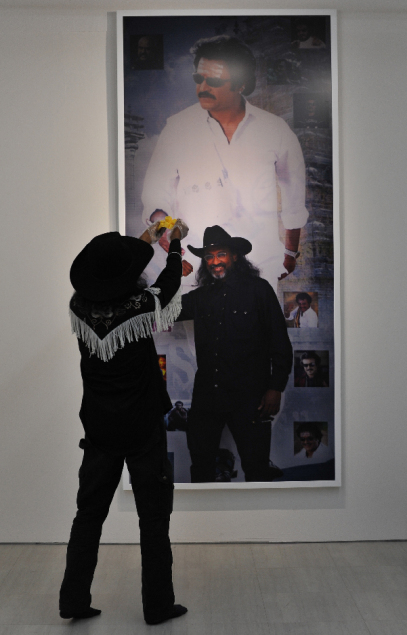
So we did it! My fellows at The Camp With No Name, my family and I – we realized the image I had visualized for Cowboys and Indians at Burning Man. We did one performance on the evening of the 31st August at camp where I presented the Krishna icon, the Thalaivar banner, and the Indian Cowboy image and 40 perfectly ripe mangoes. I told Krishna stories of love and truth to the gathering. Tara played an improvisation on the melody of Joe Ely’s Indian Cowboy on the Cello and Jane read her Poems on the Megaphone. Durga took photographs for future editions of the Koboi Project. The next day on the 1st September, Jane, Tara, Durga, Lucas, Guy, Saren and I took Cowboys and Indians onto the playa. This time we distributed 80 mangoes and interacted with burners as they came by on the their vehicles, their bikes and on foot. We shared love and truth … and mangoes till the sun went down on the Playa.

Cowboys and Indians

8a4215_690fe1b560114dbabbae780c529c73af-mv2

The Koboi and family are off to Burning Man festival 2017 in Black Rock City, Nevada. This year’s theme for projects at Burning Man is Radical Ritual, and I propose to present a special edition of Cowboys and Indians. In keeping with the theme, this work will exemplify how, even traditional rituals are constantly being revivified and radicalized. This presentation consists of two images – Pazham Neeyappa and Indian Cowboy, as well as the Mango of Truth performance which will be carried out at the  [The Camp with No Name] on the Black Rock City Playa.