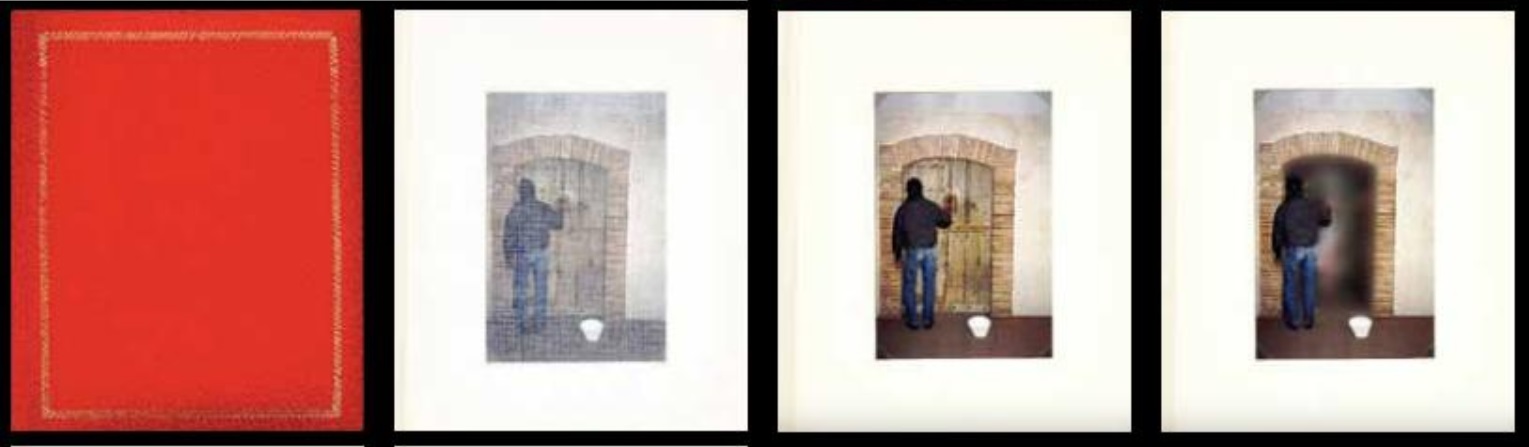
When the INET (annual Internet Society conference) came to Malaysia in 1997, I presented a paper titled “Art After the Internet: The Impact of the World Wide Web on Global Culture.” In this paper I analyzed how the Internet. was being shaped by various national and transnational forces and how esoteric postmodern theories were turning into everyday sensibilities. I presented examples of how artists were mapping the aesthetic, social, and political contours of the emerging electronic “terrain” as they made critical use of the World Wide Web to construct new arenas for their work.
This paper also set out the framework of Ideas that contextualized my web art work The Failure of Marcel Duchamp/Japanese Fetish Even! which had just launched in 1996. At the heart of this work was the new capacity to mix live (so to speak) images from servers that were geographically dispersed. I explained this extension of the modernist collage into the postmodern medium of jpegs, HTML, hotspots and servers as follows, “One of the artistic consequences of the mass circulation of printed images was the invention of collage. The artist no longer had to hand make an image but could now “cut out” two pre-existing images and combine them to generate another. The production of meaning was achieved by appropriating and recontextualizing found or ready-made material. Far from its esoteric origins as a mode of criticism, recontextualizing has now become the normal way of generating new content. In the popular music industry, the appropriated track or sample has been widely used for a long time and “mixing,” be it live or in the studio, is elevated to a form of art. With the availability of digital image manipulation and high resolution scanning, this approach now prevails even in the most commercial areas of the visual arts. With the development of technology acting as “frames,” the online textual, visual, multimedia “mix” is already happening”. Of note is the fact that Netscape had introduced ‘frames’, which involved the screen being divided into independent, scrollable areas in 1995.
This paper is archived on its entirety on the Wayback Machine.
https://web.archive.org/web/19970729041144/http://www.isoc.org/inet97/proceedings/G3/G3_1.HTM
https://www.w3.org/People/Raggett/book4/ch02.html


 The Koboi Project
You must be logged in to post a comment.