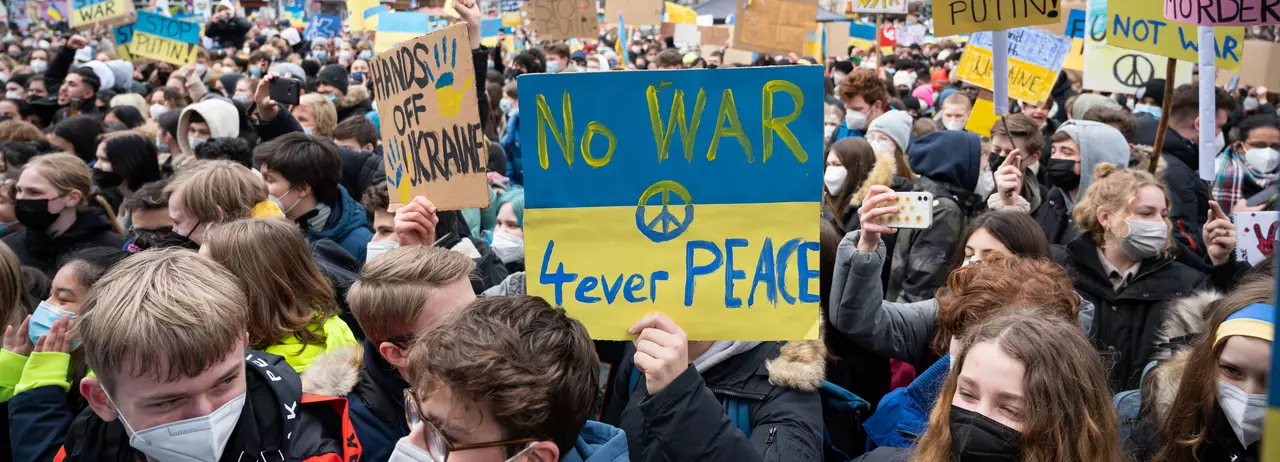
Ukraine: A Path for Peace

Now that the Russian invasion has come to pass and fighting has deepened, the possibility for peace in Ukraine can not be premised on ideals but must be based on compromise. Anatol Lieven, Professor at Georgetown University School of Foreign Service, Qatar; visiting professor in the War Studies Department of King’s College London; and a senior fellow of the New America Foundation in Washington DC, suggests that such a compromise is necessary to save Ukraine from destruction and loss of life, as well as to preserve Ukrainian sovereignty. A prolongation of the war will likely mean that large areas will be permanently lost to Russia, particularly the land linking Crimea to Russia.

Lieven suggests the terms of a possible peace –

  1. Russian forces should withdraw from all the areas occupied since the invasion began.
  2. Ukraine should sign a treaty of neutrality
  3. Russia should guarantee the sovereignty and territorial integrity of Ukraine.
  4. Ukraine should be precluded from NATO membership.
  5. Ukraine must recognize the administrative integrity of the Donbas separatist republics.
  6. Ukraine must recognize Crimea as a part of Russia.
  7. The West should lift all the sanctions imposed on Russia.
  8. Ukraine should be allowed to emerge as a Western-style democracy.
  9. Ukraine should receive a very large Western aid package for reconstruction.

Now according to Calum Roche, Russia has expressed a willingness to end the war on the following terms –

  1. No NATO membership and a neutral position.
  2. Russian should be the second official language of Ukraine, with laws prohibiting it abolished.
  3. Recognise Crimea as Russian territory.
  4. Recognise the independence of Donetsk and Lugansk.
  5. Demilitarisation of Ukraine and abandonment of weapons that could be a threat to the Kremlin.
  6. Banning of ultra-nationalist parties and organisations in Ukraine.

While it has been underplayed by the mainstream media in the West, this Russian peace proposal is close to Lieven’s suggestion as outlined above. Russia’s terms seem to constitute a reasonable (in realpolitik terms, not in terms of what is fair or just) set of demands given Russia’s overwhelming might and the West’s proven unwillingness to engage Russia directly. Can Ukraine keep fighting the Russians alone? What can Ukraine gain by pursuing this asymmetrical fight? In their valiant resistance thus far, Ukrainians have amassed much capital with which to negotiate. The Russians may have bitten off more than they can handle and be ready to compromise. On the other hand, a long and continued resistance will likely mean that larger areas will fall to Russia, not to mention devastation and loss of life.

Peace is an urgent necessity for Ukraine and Ukrainians! It seems, however, that Russia’s condition 5. might mitigate against NATO and the USA’s ascendency, and condition 6. might threaten the powerful ultra-nationalist forces that are aligned with Ukrainian state. Will these realities diminish the Ukrainian leadership’s capacity to make the compromises needed to arrive at a speedy cessation of fighting?

Image: https://www.commondreams.org/views/2022/03/04/what-path-negotiated-peace-ukraine

https://www.msn.com/en-us/news/world/putin-s-six-demands-to-end-russia-s-invasion-of-ukraine/ar-AAV5oMx?ocid=

Ukraine: Chomsky’s view

In an interview recorded on 10 Jan 2022, Chomsky unpacks the crisis that has sinse led to the Russian invasion of Ukraine. He echoes John Mearsheimer’s vie wanout the necessary neutrality of Ukraine with regard to NATO-Russian relations. He decribes the decision by the USA in 2008, taken against the wishes of France and Germany, to invite Ukraine to enter NATO as being utterely unacceptable to any Russian leader (ie this is not a question of Putin’s megalomania). Like Mearsheimer, Chomsky implicates the expansion of NATO contrary to gurantees given to the Soviet Union at the time of the unification of Germany as an significant cause of the present crisis.

He also suggests that the implementation of the Minsk 2 agreement (2015) which would establish the neutrality of Ukraine, as a possible way forward. However, as Duncan Allan notes, “Minsk-2 supports mutually exclusive views of sovereignty: either Ukraine is sovereign (Ukraine’s interpretation), or it is not (Russia’s interpretation)” he calls this “the Minsk conundrum”.

https://www.chathamhouse.org/2020/05/minsk-conundrum-western-policy-and-russias-war-eastern-ukraine-0/minsk-2-agreement

Silting-up the Settlement 3

gatewayAccording to FMT Dr Mahathir Mohamad has in the past described the Melaka Gateway port project as a sign that Najib’s former government was ceding sovereignty to China for short-term political gains. In an interview with South China Morning Post (SCMP) in March 2017, Mahathir is reported to have said, “We already have enough ports and the necessary infrastructure to attract tourists. This [Melaka Gateway] is unnecessary.” Indeed, while the economics of the port is questionable, there is no doubt of the strategic importance of the Malacca Straits to China.

As he questions Beijing’s true motive for this 10 Billion Dollar investment, which includes a deep-sea port,  Thomas Maresca writes in USA Today, “Neighboring Singapore has long had a close defense relationship with the United States, which has deployed naval combat ships there since 2013. Analysts see China’s closer economic ties with Malaysia as an opportunity to strengthen its own maritime footprint in a crucial region”. Maresca cites Johan Saravanamuthu of the S. Rajaratnam School of International Studies at Nanyang Technological University, “There’s the argument that China is not getting favorable treatment from Singapore, so why not try Malaysia? …. With the Malacca Strait on one side and the South China Sea on the other, Malaysia is quite crucial.”

Given that the work on the Gateway Project had already caused severe silting in the Melaka Portuguese Settlement and that the demise of this community goes against all logic in the context of heritage and tourism, I hope the new State and Federal governments hear the people’s protestations. Now that Mahathir has successfully displaced Najib, and is seated as Malaysia’s Prime Minister once again, will he follow through with actions that show us that he was not speaking simply to undermine Najib?

Image: http://www.eurasianbusinessbriefing.com/malaysia-looks-strait-malacca-slice-silk-route-action/melaka-gateway/

http://www.freemalaysiatoday.com/category/nation/2017/04/16/chinas-port-project-in-malacca-under-scrutiny/

https://www.usatoday.com/story/news/world/2017/07/05/melaka-malaysia-china-project/423027001/