Applying the Sri Lanka Genocide Model in Gaza 6

WARNING: DO NOT PROCEED TO THE VIDEO ABOVE IF YOU ARE UNDER 18 YEARS OF AGE
THIS IS AN EXTREMELY DISTURBING DOCUMENTARY WITH VIDEO AND PHOTOGRAPHIC EVIDENCE OF DEATH, INJURY, SEXUAL VIOLENCE, TORTURE, AND MURDER. PLEASE PROCEED TO THE VIDEO ABOVE ONLY AFTER REFLECTING ON THE POSSIBLE IMPACT ON YOUR EMOTIONAL WELL-BEING.

Following the establishment of the de-facto Tamil state in the North and East of the island, the LTTE and the Sri Lankan government maintained a tenuous ceasefire from 2001 to 2006. Between 2004 and 2005, the tsunami hit eastern Sri Lanka, the LTTE Eastern wing broke away from the Northern Command, weakening the Tamil Tigers hold on their territory. In late 2006, large-scale fighting resumed, and by May the LTTE was finally defeated ending the de-facto state of Tamil Elam. The last months of this bloody three-decade-long war are the subject of a deeply disturbing documentary titled No Fire Zone: The Killing Fields of Sri Lanka.

With the resumption of hostilities in Gaza, the seemingly deliberate targeting of civilians by the Israeli Defence Forces, and the scale of the casualties recorded thus far, there is good reason to remember such precedents as the Sri Lankan Genocide evidenced in the video above and to call for an end to the Israeli action. Israeli journalist Yuval Abraham, reports how the Israeli Defence Force’s extensive use of Artificial Intelligence programmes that treat high-rise buildings as “power targets” with large civilian casualties, has turned it into a “mass assassination factory.” Between October 7th and December 3rd, there have been 15,207 killed of which 6,150 are children.

The cronology presented above has been compiled from the following three articles:
https://www.reuters.com/article/us-srilanka-war-timeline-sb-idUSTRE54F16620090518/
https://www.wionews.com/photos/a-timeline-to-tamil-tigers-37-year-marathon-struggle-against-lankan-army-for-separate-state-219592
https://en.wikipedia.org/wiki/Tamil_Eelam#cite_note-sunday-42

https://nofirezone.org/

https://www.aljazeera.com/news/longform/2023/10/9/israel-hamas-war-in-maps-and-

https://www.972mag.com/mass-assassination-factory-israel-calculated-bombing-gaza/

Applying the Sri Lanka Genocide Model in Gaza 5

According to Peter Adams of the BBC, an estimated 2.2 million people are now crammed into the southern two-thirds of the Gaza Strip. Conditions are dire, with many ill, injured, and traumatized by the indiscriminate Israeli bombing campaign, in the name of eviscerating Hamas. This terrible situation has been exacerbated by winter rains and flooding. Further, Adams notes that Israeli authorities have been urging these desperate Gazans to move into an even smaller “safe area” called al-Mawasi on the coast, near the Egyptian border. Al-Mawasi is estimated to be only about 2.5km wide by 4km (2.5 miles) long. In a sinister but wholly predictable development, the IDF’s Arabic social media is reported to have messaged that al-Mawasi would provide “the appropriate conditions to protect your loved ones.” In light of Israel’s promise to resume its assault on Hamas at the end of the present ceasefire, the implication that other than this tiny sliver of land, the rest of Gaza is unsafe, raises the terrifying spectre of an impending massacre. (Update : The Ceasefire ended on the 30th Nov and Isreal has indeed resumed its assault with a vengance).

I am a Jaffna Tamil and, this relentless heading and corralling of the population of Gaza into progressively smaller ‘safe areas’, brings memories of my people being forced into that narrow seaside strip in Mullivaikkal in the Mullaitivu District, towards the end of the Fourth Elam War in 2009. This area was declared a “no fire zone” to protect civilians during this final battle in the Government of Sri Lanka’s relentless war to eradicate the Liberation Tigers of Tamil Elam (LTTE). However, in the aftermath of this battle the Government is accused of indiscriminately, even deliberately, shelling this “safe zone” and the LTTE, in turn, of using the desperate civilians as human shields. The UN has estimated a civilian death toll of 40,000 in the last days of this war but a UN internal inquiry has acknowledged that the number that up to 70,000 deaths were possible. However, when World Bank spreadsheets for 2010 are set against Statistical Handbook Numbers for 2007, the difference suggests that 101,748 people are unaccounted for in the Mullaitivu District.

I fear that Israel might be on the way to applying the Sri Lanka Genocide Model as a solution to the conflict in Gaza. As of December 4th, (UPDATED), 15,523 have been killed, 41,316 injured and 6,800 are missing. Of the 15,000 who have been killed so far, 6,600 children and 4,300 are women. Israeli attacks are as follows. Those of us who live in nations that continue to stand with Israel regardless of the illegality and the inhumanity of its actions must impress upon our leaders that, regardless of how Israel’s negotiations develop vis-a-vis Hamas (Update : The Ceasefire ended on the 30th Nov and Isreal has indeed resumed its assault with a vengance), this genocide must not continue. What happened at the end of the Elam War should not be allowed to happen in Gaza.

Image: https://www.bbc.com/news/world-middle-east-67518819

Image: https://mandalaprojects.com/ice/ice-cases/lanka-climate.htm

https://www.huffingtonpost.co.uk/frances-harrison/one-hundred-thousand-peop_b_2306136.html

https://abcnews.go.com/International/wireStory/live-updates-temporary-cease-fire-expires-israel-hamas-105297622

https://www.aljazeera.com/news/longform/2023/10/9/israel-hamas-war-in-maps-and-charts-live-tracker

Applying the Sri Lanka Genocide Model in Gaza 4

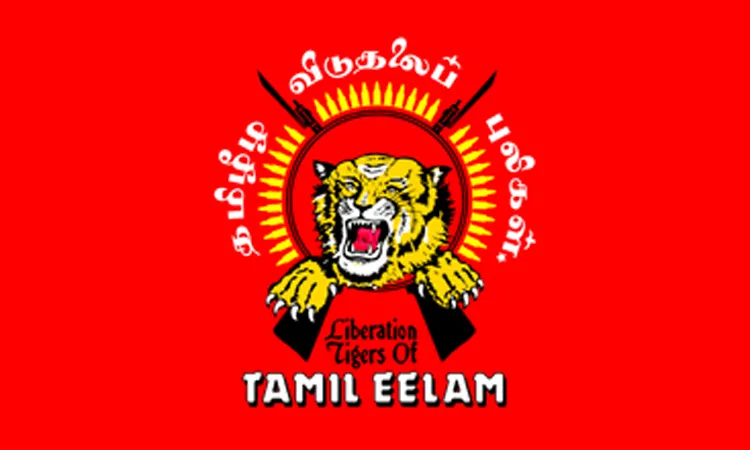
A significant aspect of the Sri Lanka Genocide model (for an explanation of this term, see Applying the Sri Lanka Genocide Model in Gaza 2) is the suppression of news and expression in the media. I will go into the similarities of censorship in the wars in Sri Lanka and in Gaza later but, in the present post, I would like to address a suppression I have just experienced on Facebook. My previous WordPress post, titled Applying the Sri Lanka Genocide Model in Gaza 3, was originally headed by the image of a Tamil Elam flag. This is very similar to the LTTE flag but it is not the same; the difference being in inscriptions in Tamil and English. This difference is explained clearly on Tamilnation.org as follows, “The Tiger symbol of Liberation Tigers of Tamileelam (LTTE) created in 1977, was designated as the National Flag of Tamileelam in 1990 differentiating it from the LTTE’s emblem by leaving out the letters inscribing the movement’s name. The Restructure site explains further, “Yes, the Liberation Tigers of Tamil Eelam created and use the Tamil Eelam flag. It makes sense since they support the Tamil Eelam. However, not everyone who supports the Tamil Eelam supports the Liberation Tigers of Tamil Eelam. The Liberation Tigers of Eelam supporters are a proper subset of Tamil Eelam supporters.”

When I re-posted my WordPress post on on Facebook, I received a warning about posting offensive material, and my post was blocked. I have also had many Facebook privileges removed for a period of one month as some kind of penalty. In this context, it is important to note that, while the LTTE is a proscribed organization and that it would be reasonable for their flag to be prohibited on Facebook, the Tamil Elam flag is different from the LTTE flag, and its display is permitted in many nations around the world that have prohibited the LTTE. Canada, where I reside, is a case in point, as here it is not only legal but also promoted by representatives of different levels of Canadian government.

The scene pictured above is of the Tamil Eelam National Flag Day being celebrated in Brampton Ontario in Nov 2023. Brampton Mayor Patrick Broey, who officiated at the ceremony at the town hall where the Tamil Eelam flags were flown, said, “Today and every day, we celebrate the resilience of the Tamil community and the contributions that Canadian Tamils have made in enriching our communities in Brampton and across the country. We will never forget the atrocities and human rights abuses of the Tamil genocide. We celebrate the resilience of the Tamil community.” Other government representatives who made statements of support on this Tamil Eelam National Flag Day include,  Shaun Collier, Mayor of Ajax;  Jagmeet Singh, Leader of the New Democratic Party (NDP); Ruby Sahota, Member of Parliament for Brampton North; David West, Mayor of the City of Richmond Hill; Iqra Khalid, Member of Parliament for Mississauga-Erin Mills; Shaun Chen, Member of Parliament for Scarborough North; Shafqat Ali, Member of Parliament Brampton Centre: Logan Kanapathi, Member of Provincial Parliament for Markham-Thornhill; and Elizabeth Roy, Mayor of the City of Whitby.

Image: https://www.tamilguardian.com/content/tamil-eelam-flags-fly-high-canada-and-uk

Image: https://www.reddit.com/media?url=https%3A%2F%2Fi.redd.it%2Fzjmyfgv6buu51.png

Image: https://i1.wp.com/www.errimalai.com/wp-content/uploads/2015/05/ltte-flag-1.jpg

https://tamilnation.org/tamileelam/defacto/flag.htm

https://restructure.wordpress.com/2009/05/15/tamil-eelam-flag-versus-tamil-tiger-flag/

|https://www.cbc.ca/news/canada/toronto/tamil-flags-flown-at-protest-legal-toronto

https://www.tgte-homeland.org/2023/11/18/tamil-eelam-national-flag-day-to-be-observed-around-the-world-on-november-21st-tgte/

Applying the Sri Lanka Genocide Model in Gaza 3

As I have said in previous posts (see Applying the Sri Lanka Genocide Model in Gaza and applying the Sri Lanka Genocide Model in Gaza 2), I am having a sense of deja vu as I follow the recent events in Gaza. I am brought back to the state of psychic shock that I found myself in early 2009 as the short-lived Tamil nation of Elam came to its crushing end. In this post, I will outline the history of the formation of the de-facto Tamil state.

The island of Sri Lanka gained independence from the British in 1948 with the majority Sinhalese taking the reins of a unitary state which incorporated ancestral Tamil areas in the North and the East. After decades of discrimination and futile non-violent resistance, some Tamils organized to take up arms to wage a violent struggle. Indeed, in 1972 Velupillai Prabhakaran and others formed the Tamil New Tigers (TNT). In 1976, the TNT became the Liberation Tigers of Tamil Eelam (LTTE) under the leadership of Prabhakaran. In July 1983 the LTTE killed 13 Sri Lankan soldiers in an action in the Jaffna peninsula, and this led to race riots in Colombo in which hundreds of Tamils were killed and thousands more were displaced. This was the start of a full-fledged guerrilla war referred to as the “First Eelam War.”

In 1987 India brokered the Indo-Lanka Peace Accord and deployed peacekeeping troops in Northern Sri Lanka to enforce it. When the LTTE refused to disarm, a full-scale war between the LTTE and India. After incurring heavy losses, the Indian troops withdrew in 1990 and the Tigers took control of large sections of northern Sri Lanka, and the fighting resumed between them and Sri Lankan troops. This was the beginning of the “Second Eelam War” which ended in a truce in 1995, with the LTTE controlling one-third of all Sri Lankan territory and two-thirds of the island’s coastline.

The “Third Elam War” began with the breakdown of the short-lived truce in April 1995 and a brutal 6 year war ensued across the North and East of the island. It was during this war, that the United States declared that the LTTE was a terrorist organisation. This US declaration was made in 1997. It was followed a British declaration in 2001 and other nations then followed suit. This “third Elam war” ended in 2001 when a ceasefire was instituted through a Memorandum of Understanding which was formalized in the 2002 Ceasefire Agreement, made under the auspices of Norwegian mediation.

From 1984 onwards the LTTE set up a functioning government in the territory under their control. They ran a sophisticated administration comprising a judicial system, a civil police force, Human Rights organizations, health and education systems, a Bank, as well as radio and Television stations Periods of Sri Lankan military occupation not withstanding, this de-facto Tamil state was fully functional and was recognized by many global institutions; notably, the World Bank’s Sri Lanka representative made the following statement in 2005, ‘Given the fact that there is an officially recognized LTTE-controlled area, a kind of unofficial state, and since it is a party to the ceasefire agreement with the Government, the LTTE has the status of a legitimate stakeholder’

Note: This WordPress post was originally headed by the image of a Tamil Elam flag. I re-posted it on Facebook and was warned about posting offensive material and my re-post was blocked. In this context, it is important to understand that, the Tamil Elam flag (above) is different from the LTTE flag (the LTTE is a proscribed organization). For a detailed explanation please see Applying the Sri Lanka Genocide Model in Gaza 4.

Images: https://naimnikmat.blogspot.com/2019/10/siapa-ltte-dan-mengapa-ltte-ni-tiba.html
https://koboiproject.com/wp-content/uploads/2023/11/78545-save_20191011_122638.jpg

The cronology presented above has been compiled from the following three articles:
https://www.reuters.com/article/us-srilanka-war-timeline-sb-idUSTRE54F16620090518/
https://www.wionews.com/photos/a-timeline-to-tamil-tigers-37-year-marathon-struggle-against-lankan-army-for-separate-state-219592
https://en.wikipedia.org/wiki/Tamil_Eelam#cite_note-sunday-42

https://academic.oup.com/isq/article/61/2/337/3078982?login=false

https://www.tandfonline.com/doi/abs/10.1080/01436590600850434

https://www.tamilguardian.com/content/tamil-eelam-flags-fly-high-canada-and-uk

Applying the Sri Lanka Genocide Model in Gaza

I am a Malaysian who was born in Jaffna and although I identify unequivocally as a Malaysian, I recognize the Tamil struggle for justice and self-determination in their ancestral lands in the north and the east of the Island of Sri Lanka. After decades of non-violent struggle for justice was met with intransigence by the Sinhalese hegemons of the Sri Lankan state, the Liberation Tigers of Tamil Elam (LTTE) emerged to wage an armed struggle for an independent Tamil state. Through a brutal conflict that ensued, the LTTE succeeded in setting up a defacto Tamil state. I have observed this violent Elam struggle which has involved terror and counterterror, from afar. I have felt its pain vicariously, through my mother’s responses to the experiences of her family. The LTTE reign ended in 2009 when their organization was completely destroyed by the Sri Lankan Army (SLA). In the crushing final battle of this War, it is estimated that between 20,000 and 100,000 Tamil civilians were massacred with impunity by the Sri Lankan Army. As I have followed the ongoing Israeli massacre of Palestinians in Gaza, I have been reminded of the genocide of the Tamil people by the Sri Lankan state.

See also the series of posts begining with On Being a Malaysian Tamil 1

Image https://thediplomat.com/2020/05/post-war-sri-lanka-fractured-and-unjust-for-tamils/

https://www.ptsrilanka.org/wp-content/uploads/2017/04/ppt_final_report_web_en.pdf

The Appearance of a Fact ataupun Batu Kasih Piyadasa, circa 2007

This work is what I call a ‘deep readymade’, by which I mean there is a gesture or configuration by another actor being interpreted or articulated in the work. A deep readymade is thus differentiated from a simple readymade, in that there is a juxtaposition of components done by someone other than the artist. The primary component of this work is a carved wooden Ganesha which was once in my late mother’s possession. When my mother was alive, this Ganesha used to sit on the wall, above her prayer altar and would receive flowers in the course of her daily worship. It is an item she and my father brought back from one of their trips to India and Sri Lanka. While my father was born in Seremban, Malaysia, my mother, myself, and my sister Shyamala were born in Jaffna, Sri Lanka. We are Jaffna Tamils and Sri Lanka is in some sense our homeland.

The second component of this deep readymade, is the white stone, a large, well-worn pebble that was picked up on a Sri Lankan beach by the renowned Malaysian artist Reza Piyadasa on his first trip (date uncertain but a book that I believe was presented at the same time is autographed and dated 1995) to Sri Lanka (his own ancestral homeland) and brought back for my mother. The late Reza Piyadasa was a Sinhalese Malaysian and the stone was a deeply meaningful exchange of a piece of Sri Lankan earth (bumi) between two Malaysians, one Sinhalese, the other a Tamil – two people whose communities were at war in their homeland. As Malaysians, however, these two people were at peace with each other, falling together in the shared category of ‘Malaysian Indian’. My mother placed this stone, which was so lovingly brought for her by Piyadasa, at the feet of Lord Ganesha and it has remained there ever since. Beyond this complex image of the interplay of race and nationality in human relations, there is, embodied in this readymade, the personal relationship between Piyadasa and my mother. Piya had lost his own parents relatively early in life and, somehow, he formed a close attachment to my parents. They were his guests when he received the prestigious Prince Claus Award in 1998, and later, in 2007, he called them to his hospital bedside when he was close to the moment of his passing.

In titling this piece ‘The Appearance of a Fact ataupun Batu Kasih Piyadasa’, I pay a tribute to the striking conceptualism of Pia’s early output, while offering a way through its solipsistic reflexivity. In a piece titled ‘A Fact Has No Appearance’, 1977, Pia created an ouroboros-like liaison between form and concept. The piece consisted of a box, part painted, part bare wood, a painted ovoid form, probably made of plaster, and the stenciled text A FACT HAS NO APPEARANCE. It is indeed true that a fact is immaterial and, as such, has no appearance; even while an appearance, which is material, is, indubitably, a fact! In my readymade, we have a material configuration that presents, in its appearance, a simple fact – the fact of love.

The Appearence of a Fact ataupun Batu Kasih Piyadasa, circa 2007 is on display in the Pokok Pauh Janggi exhibition which runs from 5th Aug – 30th Sept 2023 at the Kapallorek Artspace in Bandar Seri Iskandar, Perak

On Being Malaysian Tamil 9

UPDATE 28 JAN 2020: Court denies Gadek assemblyperson G Saminathan bail.

In a post titled Indian Vote: Entha Kabali? made before the Malaysian federal election in 2018, I wrote, . … “Whatever happens in the voting, it looks like it is indeed going to be close and, perhaps, the Indian vote is going to be important.” Further, I asked, ” … does the opposition look like they will treat us any different [from Barisan]? Just look at how they made unholy exaggerations and unfulfillable promises on the Stateless Indians issue … should they not be shown that the Indian vote, just like the vote of the other communities, has to be earned?”  While I was skeptical about the outcome for Indians, I did, as indicated in my post titled Kabali Da!, cast my lot with the new Malaysia promised by the Pakatan Harapan opposition led by Dr Mahathir Mohamad.

Well, it came to pass that Mahathir and Harapan did win and, in the 2 years since, many have become disillusioned and dissatisfied with New Malaysia for their many unfulfilled promises. One such promise pertains to the Indian statelessness problem. Indeed, in this matter Harapan has been deeply disappointing. They promised a complete solution within 100 days, but their re-branded ‘Indian affairs’ body, the Malaysian Indian Transformation Unit (MITRA) has not solved the this problem as yet. As far as I can ascertain, the last statement issued by the minister responsible states that MITRA was still working “to outline a comprehensive solution to the stateless issue, in line with the PH government’s manifesto promise”.

Since then another issue has arisen to affect the Indian community at an equally deep symbolic level – the spate of LTTE related arrests and charges. I have discussed the apparent pervisity of these arrests and detentions under SOSMA of 12 Indians including 2 government MPs previously in this series (beginning with On Being a Malaysian Tamil 1) and the question I explore here is how one might understand the implications for the Harappan government visa vis the Indian vote. The perceived involvement of government, even if it is misplaced, will surely be detrimental to their ability to garner Indian votes in the next general elections

In principle the police act independently of the Attorney General’s Chambers and the Judiciary and the government is distant from the decisions of all these bodies. While the judiciary is independent by virtue of the separation of powers expected in Malaysia’s Westminster based legal system, the police and the AG’s chambers are extensions of the executive. They too, however, are expected to act independently of executive interference and without improper collusion with one another. If all is running as it should be in our nation’s governance, no blame can be laid at the feet of the Harappan government for these LTTE arrests, detentions, changes and for the eventual judicial outcomes, whatever they might turn out to be. However, the history of the relationships concerned in Malaysia is such that it will be very difficult for the people to believe in the integrity of the system, even if it were true.

There is no question that the majority of Malaysian Tamils, like most of their fellows throughout the world support the Elam struggle, regardless of their misgivings about the terror tactics of the LTTE. Certainly, most of us feel there was an equal amount of state terror being deployed by the Sri Lankan government in this conflict and that the Terrorist organization designation applied to the LTTE, however justified it might be, is ultimately a political assignation. Indeed, the evidence for this suggestion is the fact that the Tigers were not so designated in Malaysia till 2014, years after the war ended and all acts or terror had ceased. Given this fact and the fact that our Malaysian institutions of state are known for being questionably interdependent, it is going to be difficult for Harapan to win the hearts of the Indian community and, of course, this may have a bearing on their votes in the next elections.

https://www.malaysiakini.com/news/508791

https://www.malaymail.com/news/malaysia/2019/03/27/comprehensive-solution-on-the-issues-of-stateless-malaysians-says-minister/1737134

https://www.mitra.gov.my/about-us/mitra-background/

https://www.malaysiakini.com/news/423372

On Being Malaysian Tamil 6

Despite my origins in Jaffna, I am far removed from the Tamils of Sri Lanka in my lived identity. I am a Malaysian first and, as a Malaysian, my ethnic identification is with the wider group of Malaysian Indians. Historically Ceylonese Tamils have tried to preserve a distinct identity as Malaysians and officially we are not classified as Indians. Nevertheless, I believe that it is appropriate and meaningful that, to the extent that the Indians will accept us, Ceylon Tamils should join Indian Tamils and be absorbed into the identity of ‘Malaysian Indian’. I do not renounce my Jaffna background. Rather, I feel it should be integrated into the wider Malaysian Indian mosaic. With my recent immigration to British Columbia, I am even further removed from my Sri Lankan Tamil identity.

The LTTE fought a vicious war for a Tamil homeland. They exchanged terror for terror with the Sri Lankan state actors and proxies,. They valiantly fought the mighty Indian army. They even set up and ran up a de facto state but in the end they seemed to have pitted themselves against the whole world. They were utterly defeated and now the ordinary Tamil people are picking up the pieces after an alleged genocide, under the demeaning conditions of a Sinhala occupation. Although I have relatives (my mother’s family) who were directly impacted by this war, I have generally lived my own life beyond the reach of the emotions raised by this communal tragedy. Nevertheless, I have followed the situation and when I reflect upon it closely, I feel the pain of my kith and kin!

Meanwhile the ongoing Malaysian LTTE fiasco seems quite perverse and unrelated to the Sri Lankan Tamil realities. So, I wonder, what does the LTTE signify in the Malaysian political scenario? Indian Tamils in Malaysia are mainly descendants of indentured labourers brought over to work in the rubber estates. Their fellows worked on tea estates in Sri Lanka. I must note, not without a sense of shame, that the Ceylon Tamils have set themselves apart from the estate Indians in Malaysia. In Sri Lanka we let the estate Indians down over the issue of citizenship in the early post-independence decades. Nevertheless, the Elam struggle has been a potent signifier and catalyst of a cogent Tamil identity within Dravidian politics of the Indian state of Tamil Nadu. Tamil ethno-nationalists, have hoisted the Elam flag as their own. Their sense of Dravidian pride was invested in the Elam struggle and, one could say that with the LTTE destroyed, they have stolen its fire for their own political engines.

Now, in Malaysia the Indians are a minority. One that is caught within the discriminations of a postcolonial communalism. They are diminished in political agency vis a vis the Malay majority and even the Chinese minority. They have been, in the last decades seeking catalysts for a vigorous political mobilization. For instance, the Hindraf agitation centred around Hindu identity and temple demolition. Perhaps the symbols of the LTTE play a similar moral boosting and formenting role in Malaysian Indian politics. The ethos of the LTTE may have had its origins in a just cause in Sri Lanka but its xtreme violence is disproportionate to the situation faced by Indians in Malaysia.

With regard to the 12 Malaysian Indians recently arrested and charged with terrorism related offences, while their allegedly excessive engagement with LTTE symbols might reasonably raise the government’s concern, there has as yet been no charge that clearly suggests a resurgent global LTTE. Nor is there any sign in the charges of a Malaysian based LTTE organization being set up. The possession of LTTE paraphernalia, the promotion of the defunkt LTTE cause on social media and the commemoration of dead LTTE heroes do not, in my view, suggest anything more than an entanglement with Tamil pride, Tamil sorrow and Tamil myth. The suggestion by the PDRM (police) of massive financial movements, which might by indicative of an imminent LTTE revival has not been actualized by way a related charge against even one of the 12 detainees. ,,, More in On Being a Malaysian Tamil 7

On Being Malaysian Tamil 5

12 Indian detainees wait for trial in Malaysian prisons on LTTE related charges under the ambit of SOSMA with draconian restrictions of their rights to a fair and open trial. Terrorism is a matter of legal definition and that the LTTE was not designated as a terrorist organization in Malaysia until 2014. Until this time, most Tamils in Malaysia as in the wider diaspora would have seen the LTTE as a violent separatist movement born of the exhaustion of peaceful and democratic negotiations with the majority Sinhalese. Velupillai Prabhakaran was doubtless identified as a ruthless leader but admired for his incomparable courage, determination and military prowess.

This admiration is a very different matter from believing that he and his Tigers were right in their methods and even their goals. I for one have always been against a violent struggle for Elam. I have feared that the goal of a Tamil nation on the island of Lanka, while being historically justified, may just be a vanity project for the diasporic community. An edifice that can only be built out of the blood and tears of those left behind. Even if the men and women of the armed movement of liberation may have been cognisant and willing, it is the civilians would have been unwittingly and unknowingly been made to pay. Further, the middle classes were the best equipped to exit the situation as expatriates and refugees, while the working classes and the poor did not have that choice. Offering material support form the safety of the international diaspora would, in my view, have meant foisting blood and sorrow upon those who had no agency. Ultimately, I could not see Elam a sustainable geopolitical entity. Even with all of Prabhakaran’s prowess, he could only deliver Elam as a temporary domain, as a stage in a South Asian game of thrones in which the real players were bigger than the Tamils and the Sinhalese – India, the US and China!

Although I have never supported the LTTE , I do see them as having taken up a valid stance among the options available to the Tamils in their time. Towards the end of the Elam war in 2009, with Tigers and civilians trapped on the beach at Mullivaikkal, I stood with a small crowd of Tamils outside the CBC offices in Vancouver trying to impress upon that estemend news agency, that they were obliged to report on the plight of Tamil civilians caught between the ruthless Tigers who were using them as a shield and the merciless SLA who seemed about to attack with genocidal abandon. News of his situation was, it seemed, being systematically suppressed. Amongst those with whom I stood in solidarity that day, as a member of the Tamil diaspora, were flag waving supporters of the LTTE. It was at that moment impossible for me to extricate the furtherment of the cause of Tamils from that of the Tigers.

For all intents and purposes the LTTE ceased to exist with the Mullivaikkal massacre by the victorious SLA. It can not be denied that to Tamils across the world, even to those who find the their methods despicable and their project erroneous, the Tigers and their leader are champions of the Tamil race. They are the latest signifiers in an ancient stream of heroes and conquerors that flows through the heart of the Tamil identity. While they will not be forgotten as myth they are gone as an organization, and so, even though I make no assumption about the guilt or innocence of the 12 Malaysian Indians, I must note that in charging them with possessing printed literature and propagating the LTTE on social media, the onus is on the state to show that these men were furthering the organizational agenda of the LTTE rather than celebrating the myth . Further the state is obliged to prove that the organization still exists and/or that these men were involved in actually trying to revive an entity that is contiguous with the LTTE that was extinguished in 2009. … More in On Being a Malaysian Tamil 6

On Being Malaysian Tamil 1

I am a Malaysian of Jaffna Tamil extraction. My late father was a Seremban born Malaysian but my Mother, also now deceased, was a Jaffna girl. Just as the Malays of the peninsular index the notion of a homeland with the term Tanah Melayu, the Tamils of Jaffna use the term Elam. Unlike the Indians and Chinese populations of Malaysia, the majority of whom came under the auspices of the British, the Tamils of Sri Lanka are the descendants of the subjects of ancient Tamil Kingdoms. As such, they have a sense of attachment and entitlement to the land commonly found in those who have occupied and ruled for centuries. Neither the majority Sinhalese nor the minority Tamils are beholden to any compromise or ‘social contract’ the one that binds Malays and non-Malays in Malaysia. This sense of entitlement lead to irresolvable conflict and I have observed this violent Elam struggle from afar. I have experienced it vicariously through news of grandparents and aunties caught in the crossfire between the LTTE (Liberation Tigers of Tamil Elam)and the IPKF (Indian Peace Keeping Force), cousins in being sent away to India and Canada as they reached their teenage years for fear of being killed by the SLA (Sri Lankan Army) or Forcibly recruited by the Tigers …. and there are many other such family situations that I have experienced vicariously, scenarios whose trauma I have felt through my own mother’s emotional responses.

My father was a pragmatist and a dove, “Minority Tamils need to compromise with the Sinhala majority! Given the demographics of post-colonial Sri Lanka, armed struggle is futile ,” I can imagine him encapsulating his position. My mother however, was a Tigress at heart! Metaphorically speaking,that is! “They have taken away our language and now they will push us into to the sea!” She could not stand the injustices, indignities and the cruelties experienced by the Tamils and once the war had begun she was emotionally behind “our boys and girls” fighting with the LTTE! You have to recall that the LTTE was not designated as a terrorist organization in Malaysia at the time of this war of independence. (It is much later in 2014 that the designation was given, long after the war had been lost and the LTTE decimated in 2009). And my mother’s openly emotional allegiance meant serious arguments with my father. Although, I was more interested in questions of race, nationality and justice in my own Malaysian milieu, I absorbed all the contrasting positions and sentiments … more in On Being a Malaysian Tamil 2