Ukraine: Chomsky’s view 2

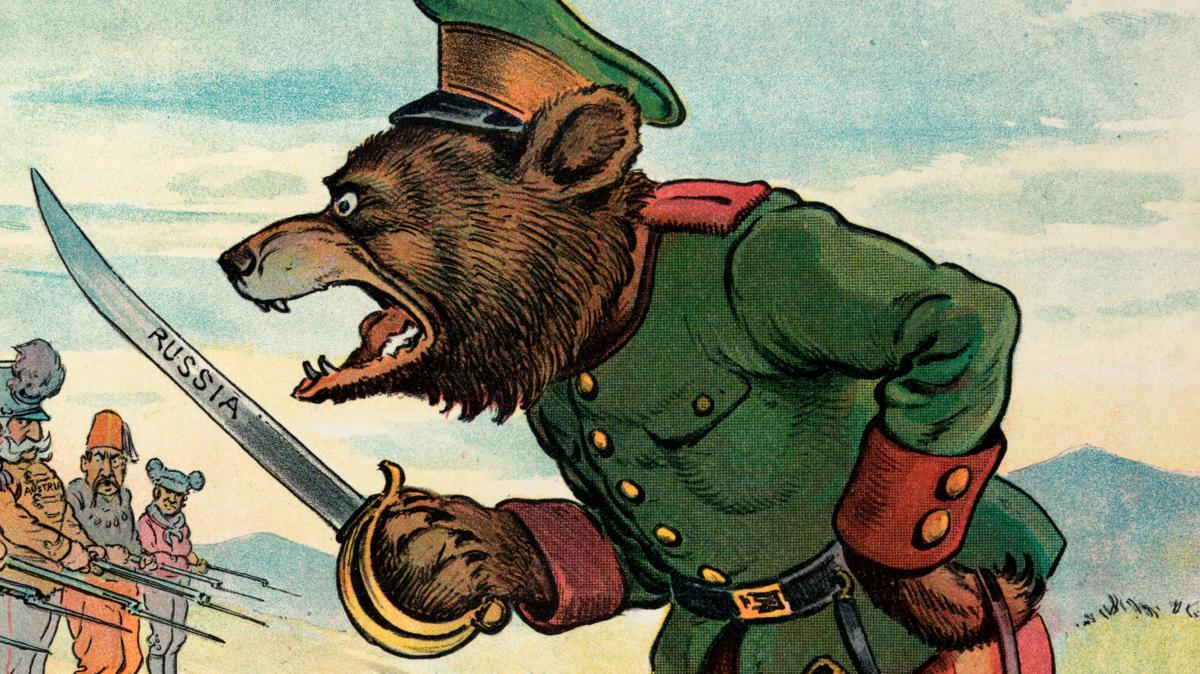
1901 Political Cartoon

In his interview with Noam Chomsky in Truthout dated March 1st , C.J. Polychroniou asks, with reference to Article 2(4) of the UN Charter, which prohibits the threat or use of force against the territorial integrity of another state, “Can you comment on Putin’s legal justifications for the invasion of Ukraine and on the status of international law in the post-Cold War era?” Chomsky says, “There is nothing to say about Putin’s attempt to offer legal justification for his aggression. Its merit is zero.. Chomsky ranks the Russian invasion of Ukraine as “a major war crime, ranking alongside the U.S. invasion of Iraq and the Hitler-Stalin invasion of Poland in September 1939.”

In essence, there is no enforceable legality and certainly, no universal sense of right, on the geopolitical scale. There are only actions and consequences. Chomsky sums up the very narrow range of accepable geopoltical outcomes that remain, now that the threatened invasion has occurred, “The options that remain after the invasion are grim. The least bad is support for the diplomatic options that still exist, in the hope of reaching an outcome not too far from what was very likely achievable a few days ago: Austrian-style neutralization of Ukraine, some version of Minsk II federalism within. Much harder to reach now. And — necessarily — with an escape hatch for Putin or outcomes will be still more dire for Ukraine and everyone else, perhaps almost unimaginably so.’

I worry that Western leaders are unanimously displaying a lack of understanding in the matter of this ‘escape hatch’. They are either intentionally provoking Putin into a quagmire that they believe will be his demise and/or they do not understand the consequences of ‘driving the bear into a corner’ in the way that Chomsky does.

Image https://www.thetimes.co.uk/article/the-russia-anxiety-by-mark-b-smith-review-should-we-fear-the-russian-bear-rjv76qzft

https://truthout.org/articles/noam-chomsky-us-military-escalation-against-russia-would-have-no-victors/

https://www.poetryfoundation.org/poems/56966/speech-all-the-worlds-a-stage

Ukraine: Forgotten Ancestors

 Soviet film director Sergei Parajanov‘s masterful first feature, Shadows Of Our Forgotten Ancestors (1965), has been described as a Ukrainian masterpiece. It is an adaptation of Mikhaylo Kotsyubinsky’s 1912 novel of the same name. Kotsiubynsky was a Ukrainian modernist who developed a sophisticated form of ethnographic realism. In this film, Parajanov poetically portrays the traditional life of the Hutsul people and the natural environment of the Carpathian Mountains in Western Ukraine.

Ivan falls in love with Marichka, who is the daughter of the man who killed his father. While Ivan is away from their village, Marichka drowns trying to rescue a lost lamb. Ivan is inconsolable over the loss but eventually meets Palahna whom he marries. Ivan remains obsessed with Marichka and the marriage fails. Palahna is unfaithful with a local molfar (magician) named Yurko,. Yurko mortally wounds Ivan in a fight. Ivan goes out into the forest, sees the spirit of Marichka, dies, and finally, he is given a traditional Hutsul burial.

https://parajanov.com/shadows/

https://en.wikipedia.org/wiki/Mykhailo_Kotsiubynsky

https://en.wikipedia.org/wiki/Shadows_of_Forgotten_Ancestors

Ukraine: The Realist View (15th Feb 2021)

This interview with John Mearsheimer was recorded on Tuesday 15th February at Kings College, Cambridge University, online forum, just before Russia invaded Ukraine on the 24th of February. Mearsheimer is a renowned American political scientist and international relations scholar, of the realist school of thought. He presents a view that contradicts what we have been presented with by the mainstream, with regard to the underlying causes of the crisis (presented by Mearsheimer in a lecture from 2015), and goes on to define just what has he believes has precipitated the crisis that has so tragically and rapidly unfolded.

His central argument is that since the advent of the Trump administration, the USA and its allies have accelerated the arming and training of the Ukraine military, with a view to turning Ukraine into a de facto NATO. state. He stresses that, from his realist perspective, this must be unequivocally unacceptable to Russia. Further, he points to recent provocations to Russia carried out by way of territorial incursions made by the British and the Americans. Mearsheimer concludes this talk by saying that the crisis would go on for a long time. It seems that even though he is clear that the Russians had reached their ‘boiling point’, does not anticipate an imminent Russian invasion. In the course of answering the last question, which was about the deterrent effect of nuclear weapons in this crisis, he even says, “I don’t think they are going to invade.”

Ukraine: Chomsky’s view

In an interview recorded on 10 Jan 2022, Chomsky unpacks the crisis that has sinse led to the Russian invasion of Ukraine. He echoes John Mearsheimer’s vie wanout the necessary neutrality of Ukraine with regard to NATO-Russian relations. He decribes the decision by the USA in 2008, taken against the wishes of France and Germany, to invite Ukraine to enter NATO as being utterely unacceptable to any Russian leader (ie this is not a question of Putin’s megalomania). Like Mearsheimer, Chomsky implicates the expansion of NATO contrary to gurantees given to the Soviet Union at the time of the unification of Germany as an significant cause of the present crisis.

He also suggests that the implementation of the Minsk 2 agreement (2015) which would establish the neutrality of Ukraine, as a possible way forward. However, as Duncan Allan notes, “Minsk-2 supports mutually exclusive views of sovereignty: either Ukraine is sovereign (Ukraine’s interpretation), or it is not (Russia’s interpretation)” he calls this “the Minsk conundrum”.

https://www.chathamhouse.org/2020/05/minsk-conundrum-western-policy-and-russias-war-eastern-ukraine-0/minsk-2-agreement

Ukraine: Dovzhenko’s Earth

Alexander Dovzhenko’s last silent film Earth (Zelmya) 1930 (third part of his Ukraine Trilogy which includes  Zvenyhora, 1928, and Arsenal, 1929) is a tragic and violent narrative of the Soviet collectivization is set within a lyrical Ukrainian landscape. The film features images of the cultivated Mammoth Sunflower which produces a single golden flower that grows up to 10″ across and is filled with edible seeds.

I bring up this imagery from nearly a century ago in response to the video making the rounds on social media and raising to the mainstream, that of a Ukranian woman confronting a Russian soldier in the early days of the invasion, symbolically offering him sunflower seeds so that flowers would grow where he died on Ukrainian soil, ‘Take these seeds and put them in your pockets” she seems to say, “so at least sunflowers will grow when you all lie down here.’

This powerful image raises, for me the difference I have with Andrei Tarkovsky’s premise that image can be separated from its symbols – Ukraine > Sunflower> Seeds > Death > Life > Ukraine.

https://www.thedigitalfix.com/film/dvd_review/the-dovzhenko-war-trilogy-zvenigora-arsenal-earth/

https://www.theguardian.com/world/video/2022/feb/25/ukrainian-woman-sunflower-seeds-russian-soldiers-video

Ukraine: What is actually goin down?

Watch Freddy Sayers of Unherd and Konstantin Kisin, a well-known Russian-British comedian, podcaster, writer and social commentator, break down the coverage in the Western media, both mainstream and alternate, and
offer some soundbites of their own. Kisin outlines Putin’s imperial aims as set out in his signal claim that large swathes of Ukraine are, historically and ethnically speaking, Russian territories. He goes on to criticize the Western
media’s failure to understand what was being announced.. He discounts the theory that it is NATO’s sustained expansionism (ala Mearsheimer whose analysis is left unreferenced) that has provoked the Russian aggression and calls for an assertion of Western power in the face of a new Cold War II. This is of course very much a NATO perspective (There is nothing cold about the invasion from a Ukrainian perspective). Kisin does acknowledge the West’s broken promise to the former Soviet Union (Russia) not to expand NATO, and points to a reciprocal promise to protect Ukraine from Russian aggression, made in return for giving up nuclear weapons. 

I must say that, while I am generally enamoured of Freddy’s objectivity and interlocutive rigour, and while there is much food for thought in this discussion, it is at this point that the conversation reveals a striking lack of depth. I feel that Freddy might have pushed Kisin to elaborate on the dialectic of NATO expansionism and Putinesque imperialism, and or on the symetry of Western duplicity. Indeed, what follows their heavyweight opening is much less substantial. Kisin’s declares that his wife is Ukrainian and displays some a domestic repurcussions of the geopolitical crisis. He touches on the potential refugee crisis and its consequences for Britain, not very generously at that., one might  He then  deigns to speculate on the decline of Western leadership and declares that Freddie and he are ‘metropolitian liberals’ … Hear Hear!!

Ultimately, this conversation is a  striking example of a new genre of podcast intertainment (yes I think I have just coined that one!) – a kind of hyperbolic (despite Freddie’s signature restraint) intellectual soundbite … comedy? The irony of our times is that comedians are becoming better sources of facts, analysis and objectivity than the mainstream talking heads … it seems the make better natioinal leaders too!

Ukraine: A prescient analysis from 2015

Given the derth of intellect and integrity in the mainstream media here in Canada, I thought I would share a prescient analysis on the crisis (the 2014 crises) in the Ukraine by John Mearsheimer, who is an American political scientist and international relations scholar. There is no doubt that there are those in North American establishment who are, today, in the position to say to their political leaders, “I told you so!”

Have we reached that disastrous point of rupture – the balkanization of Ukraine, that Mearsheimer was hoping would be avoided?