Early Internet Art in Malaysia 8

I had begun my practice as an artist in the late 1980’s with a series of paintings and had moved onto a more self-consciously critical performance/ installation practice when, in 1995, I found the World Wide Web, with its capacities for instantaneous connectivity, hypertextual linking and multimedia convergence. I then transferred my practice to this new medium and between 1996 and 1998 made two web works and La Folie de la Peinture (1998), is the second of these. It is archived in fragments on the Wayback Machine.

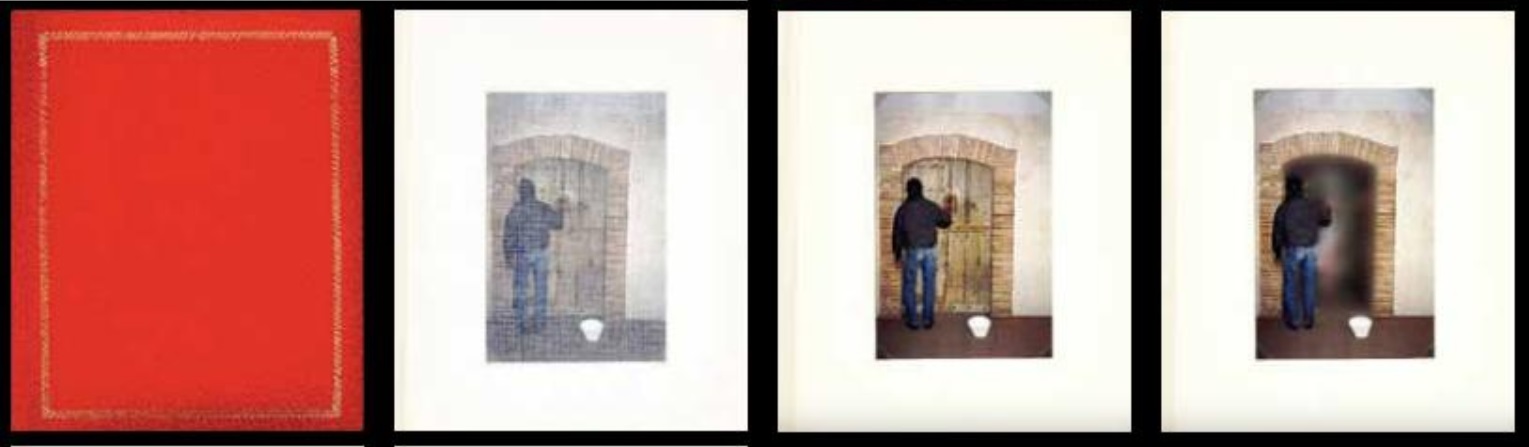
At the center of this work was a remediation of a set of installation photographs, linked in such a manner as to represent movement through the space, with the experience of each ‘work’ recast as a multimedia experience (WAV, GIF, MOV and VRML files). The text (hypertext) was an integral part of this web work and in it, I set out some contextualizing ideas. These ideas were also presented within a wider theoretical framework in a paper titled Toward a Universal Theory of Convergence: Transcending the Technocentric View of the Multimedia Revolution presented at INET 1998 in Geneva. These points originally made in 1998 are presented below –

* With the emergence of abstract colour-field painting, the placement of works on the gallery wall became integral to the presentation and, in the light of this transient ‘installation’ aspect of the presentation, photographic documentation began to take on a new significance.

* While the ‘installation shot’ confirms the uniqueness of the ‘site’ of the installation, this photographic documentation leaves its own mass (mechanical reproduction) condition unindexed and has, quite surreptitiously, become the ‘extended’ medium, of installation art.

* As bandwidth increases and multimedia technology goes online, fluidly articulating the remote experience of image, moving image, text and sound in an interactive ‘virtual reality’, it will become increasingly difficult to differentiate between an actual place, person or thing from its image or representation.

* As the representations contained on the multitude of servers on the Internet exist in virtual proximity, ‘here’ and ‘there’ have been brought together in the ‘now’ of fiber optic connectivity. The instantaneous connectivity of computer mediated communication, appears to have eliminated geographical distance and the modern/ postmodern distinction of ‘site’ and ‘non-site’ is no longer be meaningful.

https://web.archive.org/web/19990826231718/http://www.kunstseiten.de/installation/

https://web.archive.org/web/20160103142357/https://www.isoc.org/inet98/proceedings/7c/7c_1.htm
Early Internet Art in Malaysia 5

When the INET (annual Internet Society conference) came to Malaysia in 1997, I presented a paper titled “Art After the Internet: The Impact of the World Wide Web on Global Culture.” In this paper I analyzed how the Internet. was being shaped by various national and transnational forces and how esoteric postmodern theories were turning into everyday sensibilities. I presented examples of how artists were mapping the aesthetic, social, and political contours of the emerging electronic “terrain” as they made critical use of the World Wide Web to construct new arenas for their work.

This paper also set out the framework of Ideas that contextualized my web art work The Failure of Marcel Duchamp/Japanese Fetish Even! which had just launched in 1996. At the heart of this work was the new capacity to mix live (so to speak) images from servers that were geographically dispersed. I explained this extension of the modernist collage into the postmodern medium of jpegs, HTML, hotspots and servers as follows, “One of the artistic consequences of the mass circulation of printed images was the invention of collage. The artist no longer had to hand make an image but could now “cut out” two pre-existing images and combine them to generate another. The production of meaning was achieved by appropriating and recontextualizing found or ready-made material. Far from its esoteric origins as a mode of criticism, recontextualizing has now become the normal way of generating new content. In the popular music industry, the appropriated track or sample has been widely used for a long time and “mixing,” be it live or in the studio, is elevated to a form of art. With the availability of digital image manipulation and high resolution scanning, this approach now prevails even in the most commercial areas of the visual arts. With the development of technology acting as “frames,” the online textual, visual, multimedia “mix” is already happening”. Of note is the fact that Netscape had introduced ‘frames’, which involved the screen being divided into independent, scrollable areas in 1995.

This paper is archived on its entirety on the Wayback Machine.

https://html.com/frames/

https://web.archive.org/web/19970729041144/http://www.isoc.org/inet97/proceedings/G3/G3_1.HTM

https://www.w3.org/People/Raggett/book4/ch02.html

14 Post-Tradition

Keling Maya: Post-traditional Media, Malaysian Cyberspace and Me, presented at the Aliran Semasa Symposium, 2013, at the National Art Gallery, Kuala Lumpur.

In a paper titled Beyond Art History* presented at the Singapore Art Museum in 1995, I called for an approach to contemporary art in Southeast Asia that went beyond the historical approaches of chronology, stylistics and teleology. Given the persistence of traditional and sacred art forms, in the face of the disruptions and displacements of colonialism, I suggested that the study of contemporary art in the region should emphasize metaphysical and social approaches over conventional art history. Then, in Vancouver, I convened the New Forms Festival conferences of 2004 and 2005 which addressed,the relationship between culture and technology in local and global contexts. These conferences were premised on a post-traditional media theory which is represented in the diagram diagram above and outlined in the text that follows.

As the 19th Century became the 20th, it seemed that the pre-modern or traditional world was being erased and replaced by the modernity. The birth and passage of this modernist view are represented in the timeline above as the Modern Worldview. Then, there was the arrival of the Postmodern Worldview, in which modernism was deconstructed, decentered and retrospectively devalued. This moment is marked, after architectural historian Charles Jencks, by the demolition of the Pruitt-Igoe complex in 1972. Postmodern fragmentation and reorientation was accelerated by the arrival of the ubiquitous and instantaneous communications of the World Wide Web.

The sociologist Anthony Giddens challenges the view that postmodernism constitutes a break from the modernism in his assertion that is is simply a tertiary development of modernism. He suggests that ‘postmodern’ is a misnomer for ‘late modern’ and posits that both categories are properly subsumed in his Post-traditional Worldview (1). While I concur with Giddens’ conflation of the postmodern and the modern, I reject his truppeting of the ‘end of tradition.’ I also oppose his characterization of tradition as being merely superstition and irrationality, something that modern society is fortunate to be released from. In my own Post-traditional Worldview (2), there is a more nuanced understanding of the ‘modern moment.’ For me, it the start of an era in which it is no longer possible to hold an insular and self-satisfied view of one’s own tradition. My ‘post-tradition’ indexes a plurality of traditions that are cognisant of each other.

I suggest that this new self-aware and relativistic sense of tradition emerged due to the sudden acceleration in the exposure of traditional peoples to the material cultures of others around the turn of the century. This heightened awareness of others occurred in the context of the integrative communication flows of colonial economies, as well as the emerging representational technology of the Cinematographie. This new post-traditional condition was first hidden behind the edifice of the modernism/ postmodernism complex. I argue that it took the startling events of 9/11 to reveal this reality, retrospectively, and the present theory is presented as part of the effort to share this vision. The destruction of the Twin Towers at the dawning of the 21st Century, marks the convulsive realization that the hubris of modernism had been just that, a Western imperialist gloss on a vibrant, even violent, post-traditional world. Indeed, a plurality of traditions have survived modernism and have re-surfaced, rhizome-like, as an array of neo-traditionalisms and fundamentalisms, reducing the once transcendent modernism to being just another tradition in the mix.

This post-traditional theory was first presented in an unpublished paper presented at the New Forms Festival conference in 2004. A summary appears in the Convener’s introduction** to the conference programme. It offers a transhistorical or ahistorical framework within which to integrate traditional, particularly sacred, paradigms with the contemporary discourses around representational and communications technologies.

* Niranjan Rajah, “Towards a Southeast Asian Paradigm: From Distinct National Modernisms to an Integrated Regional Arena for Art,” 36 Ideas from Asia: Contemporary South-East Asian Art. (Singapore: ASEAN COCI [Singapore Art Museum], 2002), 26–37.

**Niranjan Rajah, “Convener’s Passe-Partout: Developing Discursive Protocols for Media Arts in Post-Traditional Scenario” (Vancouver: New Forms Media Society, 2004), 22.


0 Performance
1 Keling Maya
2 Cyberspace
3 Model
4 Heterotopia
5 Rajinikanth
6 Heroes
7 Telinga Keling
8 Keling Babi
9 Duchamp
10 MGG Pillai
12 Praxis
13 Dochakuka
15 Philosophia Perennis