Stateless Indians Clock 2

=100clock

On day 1 of the new Pakatan Harapan government, I noted that within the wide promise made to the most powerless section of our society, there was an actionable kernel  – to set in place the laws, administrative procedures and outreach that might make it possible to begin addressing the problem of statelessness among Malaysian Indians.  Instead of reporting, as I had hoped, on the state of development of the requisite policy/administrative instruments, this new government has offered relief to that portion of the stateless Indian community that has the least to benefit and whose citizenship has the least consequences for the Malaysian polity. 3,407 Indians above 60 years of age will be given citizenship on the basis of their meeting the requirements for permanent residents to become citizens. The new Prime Minister is reported to have said “We promised this in our manifesto. It took us some time, but we will stick to our promise and issue them a blue IC and they will be regarded as a citizen.” I am sorry to say it, but this is mere eyewash, bunkum even! … and a sign, that for the wretched of our earth, it seems to be Malaysian business as usual Barisan = Harapan … dosen matter bah!

Lawyers for Liberty (LFL) advisor N Surendran is reported in Malaysiakini to have countered that what we need, instead of this expediency, is a review of procedures for granting citizenship. I present the report on his words in numbered points for clarity and efficacious communication –

  1. “The policies, operating procedures and methodologies must be thoroughly reviewed and restructured by the new government.
  2. It is the inflexible and unnecessary demands for non-existent documents, evidence and witnesses insisted upon by the ministry and NRD (National Registration Department) which are responsible for both creating and perpetuating the problem of statelessness in Malaysia.
  3. We must reach out to the thousands of stateless persons who have difficulty dealing with the bureaucracy and stringent procedures of the NRD.
  4. Most stateless persons are those who already qualify to be citizens by ‘operation of law’ under Article 14 of the Federal Constitution, but are denied citizenship because they have either inadequate or no documents, are abandoned or adopted children, or their parents’ marriage was not registered.
  5. The problem is generational. Parents and grandparents have no identification documents at all or only red ICs, although born and residing in Malaysia and entitled to citizenship”.

Regardless of how far down this road of reform the new Home Ministry has gone or failed to go, these are the honest and pertinent terms in which the 100 day reckoning of the ‘STATELESS INDIANS PROMISE’ should have been couched.  And you know what my dear Pakatan Harapan? … you can still come clean! In fact you must!

Image: https://boingboing.net/2015/12/02/theres-a-100-hour-rule-n.html

http://www.thesundaily.my/news/2018/08/14/citizenship-stateless-over-60-mahathir-updated
https://www.malaysiakini.com/news/438983

Malaca Malaca 3

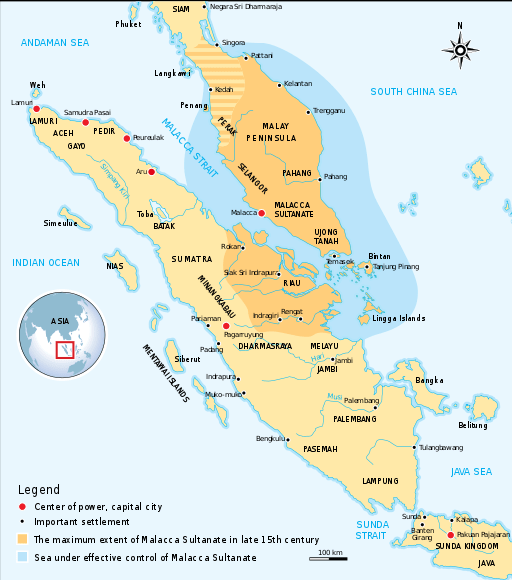
melaka reign map.pngSo what is the significance of Malaca (Portuguese), or Malacca (English) or, indeed, Melaka (Bahasa Melayu)? Founded around the 1400 by Raja Parameswara, later known as Raja Iskandar Shah, the Melaka Sultanate rose to the height of its power towards the end of the 15th Century.  At this time, the Melaka suzerainty extended over most of the Malay Peninsula, the Riau Islands and parts of the Eastern coast of Sumatra. The port of Melaka, strategically located, as it is, at the mid-point of the Straits of Melaka, became one of the most important trading ports in the world. Melaka’s place in the geo-political paradigm of the day was exemplified in the oft-cited line by Portuguese explorer and apothecary Tomé Pires, “Whoever is lord of Malacca has his hand on the throat of Venice” – Venice being Europe’s centre of global trade.
While the Portuguese attained this prize in 1511, they killed the golden goose, so to speak! Other trading centers like Acheh, Banten, Bandjarmasin and Brunei arose in the Malay Archipelago and displaced the now Portuguese-controlled Melaka which was unenterprising and decidedly antagonistic to Muslim traders. Melaka never regained its place as the port of choice in the Straits of Melaka during the Colonial era. The British chose to develop Penang and Singapore and given Singapore’s astronomical ascendancy in the post-colonial era (Singapore was according to 2017 statistics the 2nd busiest port in the world), as well as Malaysia’s own development of Ports in Kelang, Johor, Tanjung Pelepas, Kuantan, Penang, Bintulu and Kemaman; Melaka has had to accept its status as a glorious historical relic of the past.

Image: https://en.wikipedia.org/wiki/Malacca_Sultanate

http://www.academia.edu/789550/European_Perceptions_of_Malacca

https://books.google.ca/books?id=QKgraWbb7yoC&pg=PA1516&lpg=PA1516&dq=acheh+brunei+after+fall+melaka&source=bl&ots=3YrVJcc8TU&sig=e3wPz5sPdxlOQhz4WZFWojLVxFo&hl=en&sa=X&ved=2ahUKEwi3tPu7rfLcAhWBFzQIHU9HD6UQ6AEwDnoECAYQAQ#v=onepage&q=acheh%20brunei%20after%20fall%20melaka&f=false

https://en.wikipedia.org/wiki/List_of_busiest_container_ports

http://www.mot.gov.my/en/maritime/ports-in-malaysia

Malaca Malaca 2

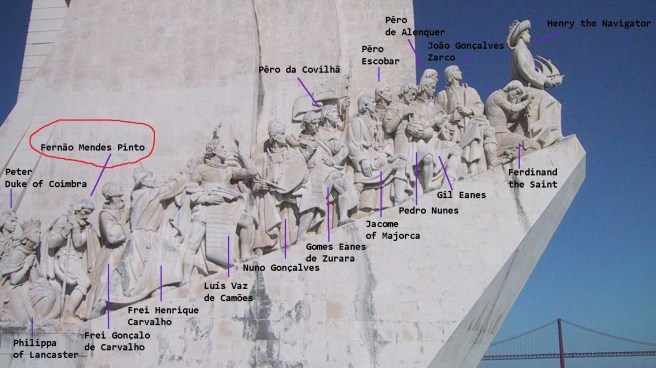
pinto.jpgIn Fernão Mendes Pinto’s Peregrinação (Pilgrimage) which was published in 1614 we find, as Rebecca  Catz notes, a highly colorful yet critical work for its time. Pinto’s work, is severely critical, albeit indirectly, of the Portuguese adventure of ‘discovery’. As Catz notes, the Portuguese “mission to conquer and convert all non-Christian peoples … was viewed, in the fiction of the work, as a false and corrupt ideal”. It is quite likely that it is for this highly advanced and reflexive critique, as much as for his conflation of autobiography with fiction, that Pinto was rewarded with the nickname Fernão, mentes? minto! (“Fernão, are you lying? I am!”). Nevertheless, Pinto’s place within the Portuguese maritime hagiography is memorialized in the gargantuan Discoveries Monument in Belem. A Koboi performance took place at this monument on the 9th of July 2018, highlighting the historical bond between Belem, the port from which the Portuguese adventurers set sail, and Malacca, their prized possession for 130 years (1511–1641) . For details please visit https://koboibalikkampung.wixsite.com/nuntengporta

Image: https://en.wikipedia.org/wiki/Padr%C3%A3o_dos_Descobrimentos

Malaca Malaca 1

‘Malaca Malaca’ is the exclamation that opens the chorus of Fuasto’s ‘A Guerra é a Guerra’ which is a part of his wonderful 1982 album Por Este Rio Acima (Up this River). Fausto took as his source and point of departure for this work, the hyperbolic yet highly philosophical and critical autobiography of ” Fernão Mendes Pinto titled Peregrinação (Pilgrimage) of 1614. Pinto was a Portuguese explorer and adventurer who was stationed in Malacca in the 1530’s.

Malaca Malaca
A guerra é a guerra
No céu e na terra
Nos dentes a faca
Avanço e avanço
A guerra é a guerra
No céu e na terra
Balanço, balanço

Malacca Malacca
War is war
In heaven and on earth
Knife in teeth
On and on I go
War is war
In heaven and on earth
Swaying on and on

As part of my Koboi performances in Belem, Lisbon, I played an audio clip from this track on a megaphone. For more information please visit  https://koboibalikkampung.wixsite.com/nuntengporta/description

https://translate.google.ca/translate?hl=en&sl=pt&tl=en&u=http%3A%2F%2Ffausto-bordalodias.blogspot.com%2F2009%2F12%2Fo-barco-vai-de-saida-1982.html&anno=2

https://www.jstor.org/stable/344173?seq=1#page_scan_tab_contents


Silting-up the Settlement 3

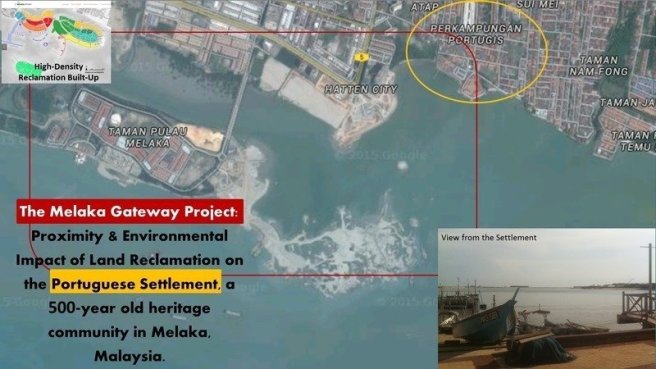
gatewayAccording to FMT Dr Mahathir Mohamad has in the past described the Melaka Gateway port project as a sign that Najib’s former government was ceding sovereignty to China for short-term political gains. In an interview with South China Morning Post (SCMP) in March 2017, Mahathir is reported to have said, “We already have enough ports and the necessary infrastructure to attract tourists. This [Melaka Gateway] is unnecessary.” Indeed, while the economics of the port is questionable, there is no doubt of the strategic importance of the Malacca Straits to China.

As he questions Beijing’s true motive for this 10 Billion Dollar investment, which includes a deep-sea port,  Thomas Maresca writes in USA Today, “Neighboring Singapore has long had a close defense relationship with the United States, which has deployed naval combat ships there since 2013. Analysts see China’s closer economic ties with Malaysia as an opportunity to strengthen its own maritime footprint in a crucial region”. Maresca cites Johan Saravanamuthu of the S. Rajaratnam School of International Studies at Nanyang Technological University, “There’s the argument that China is not getting favorable treatment from Singapore, so why not try Malaysia? …. With the Malacca Strait on one side and the South China Sea on the other, Malaysia is quite crucial.”

Given that the work on the Gateway Project had already caused severe silting in the Melaka Portuguese Settlement and that the demise of this community goes against all logic in the context of heritage and tourism, I hope the new State and Federal governments hear the people’s protestations. Now that Mahathir has successfully displaced Najib, and is seated as Malaysia’s Prime Minister once again, will he follow through with actions that show us that he was not speaking simply to undermine Najib?

Image: http://www.eurasianbusinessbriefing.com/malaysia-looks-strait-malacca-slice-silk-route-action/melaka-gateway/

http://www.freemalaysiatoday.com/category/nation/2017/04/16/chinas-port-project-in-malacca-under-scrutiny/

https://www.usatoday.com/story/news/world/2017/07/05/melaka-malaysia-china-project/423027001/


Silting-up the Settlement 2

spillover

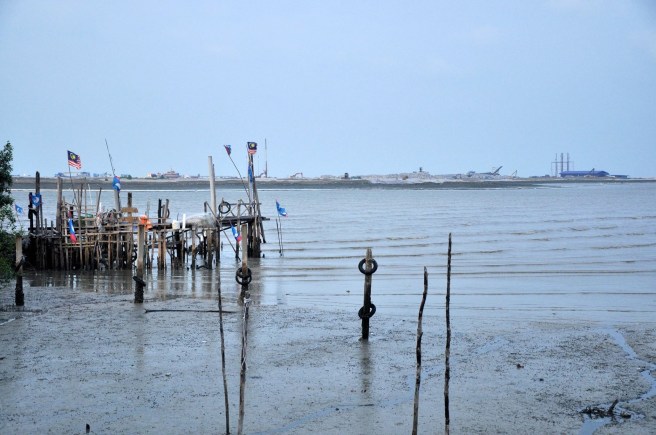
Photographs on Sabine’s Happy Trails   show how the Melaka Gateway project is causing silting in the Portuguese Settlement in Ujong Pasir, Melaka. Sabine notes that this reclamation and development of man-made islands by KAJ Development Sdn Bhd, has violated expert advice from both the EIA (Environmental Impact Assessment) and the SIA (Social Impact Assessment). According to Michael Singho, President of the Malacca Portuguese-Eurasian Association (MPEA), the distance of the reclamation is supposed to be kept at a minimum of 750 meters from the settlement shoreline. Sabine notes that it now appears to be less than 500 meters.

Image: https://www.facebook.com/SabinesHappyTrails/photos/a.1834215383303824.1073741859.1544639105594788/1834219763303386/?type=3&theater

https://www.facebook.com/pg/SabinesHappyTrails/photos/?tab=album&album_id=1834215383303824&ref=page_internal

https://www.change.org/p/unesco-the-federal-government-of-malaysia-the-state-government-of-melaka-please-step-in-to-protect-and-sustain-the-well-being-the-environment-and-the-heritage-culture-of-the-portuguese-settlement-at-ujong-pasir-in-the-state-of-melaka-malaysia-as-i/u/20206610

Portugues Antigo

The late Papa Joe Lazaroo and the late Uncle Noel Felix, elders of the Malacca Portuguese Settlement explaining the contiguity of Papiah Kristang and modern Portuguese language, and most interestingly, how Kristang is a misnomer for their language – which is best termed Portugues Antigo (Ancient Portuguese).

Portuguese Melaka

This video was directed, scripted and researched by Sudirman Hj. Rosli for Muzium Negara Malaysia in 2007. It tells the story of the Fall of Melaka, the 100 year triangular wars between the Acheh Sultanate, the Johore Riau Empire and Portuguese Melaka, and the ultimate fall of Portuguese Melaka to the combined forces of the Dutch and the Johore Riau Empire.


Silting Up the Settlement 1

silt

In 2016, President of the Malacca Portuguese-Eurasian Association, Micheal Singho, described the fate of his community in the face of the ongoing Gateway development.

Here is what he wrote in the New Straits Times on October 2, 2016 –

“RECENTLY, there have been reports on China’s RM30 billion boost to the Melaka Gateway project with a signing of a memorandum of understanding.

The approval of the project will snuff the life out of the Portuguese Settlement by depriving it of its life, spirit and culture-sustaining sea.

The Melaka Gateway development will rob the settlement of the open sea and replace it with a waterway that will turn it into a silt-filled, polluted, stinky and dead swamp if the design contours are not altered to studied specifications in the 1997 macro-Environmental Impact Assessment (EIA) report.

Is this morally right and responsible?

Even the basic 750m distance is not adhered to, with portions of the design coming as close as 250m to the settlement.

The project, coupled with the Pulau Melaka project, increases the level of siltation as it does not allow adequate flushing, and impedes vital current flows and tidal movements.

Even the channel between the two man-made islands is narrow and ineffective.

The project is still without a Social Impact Assessment report. Fishermen, whose income are affected, have not been compensated. These violations resulted in a stop-work order issued by the Department of Environment in March last year.

At the last meeting with government agencies and the developer, representatives of the Portuguese-Eurasian community forwarded a proposal that adhered to the tenets of the 1997 macro-EIA report and called for the channel to be a functional waterway free of pollution.

They are still waiting for a response.

MCA president Datuk Seri Liow Tiong Lai, who is also transport minister, has voiced his support and interest in the project.

But, will this come at the cost of a living, profound and contributing legacy falling victim to development?

Liow must recall how the Chinese fought for the preservation of Bukit Cina, a place that provided sanctuary for their dead.

The sea is our Bukit Cina, but with a little difference, as it sustains the living.

Nothing should be allowed to rob whatever is left of the sea and the seafront of the Portuguese Settlement. There are other options that will spare the settlement.”

Image: https://www.change.org/p/unesco-the-federal-government-of-malaysia-the-state-government-of-melaka-please-step-in-to-protect-and-sustain-the-well-being-the-environment-and-the-heritage-culture-of-the-portuguese-settlement-at-ujong-pasir-in-the-state-of-melaka-malaysia-as-i

https://www.nst.com.my/news/2016/10/177480/protect-portuguese-settlement

Kristang Protest

coffin

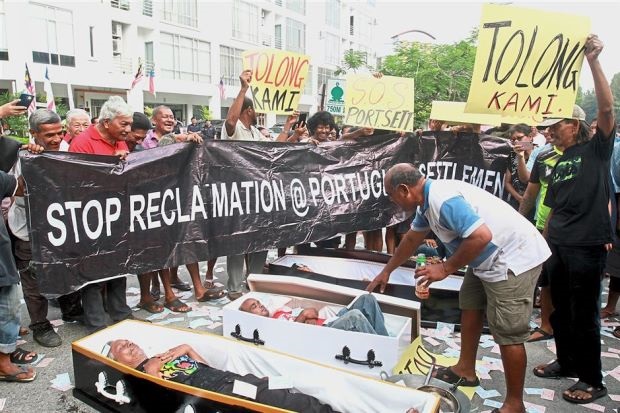
The Melaka Portuguese community staged a coffin protest at the Melaka Gateway site office on the 17th May 2018. Melaka Gateway is a gargantuan land reclamation and development project that is a part of China’s One Belt One Road initiative. It will include a deep-sea port that is being built by Chinese companies in a joint venture with Malaysia’s own KAJ Development Sdn Bhd’s (KAJD). According to a report in the STAR newspaper, the Chairperson of the Portuguese Village Community Management Council, Jacinta Lazaroo, alleged that the developer failed to comply with the macro EIA (Environmental Impact Assessment) report of 1998. This non-compliance seems to have resulted in severe silting which has affected the livelihoods of the members of this largely fishing community. The STAR also reported that according to Melaka Gateway’s developer, Hasbullah Zakaria, KAJD Maning Director, the company had not received any memorandum of protest nor any demand for compensation from the community.

Image: https://www.thestar.com.my/news/nation/2018/07/18/coffin-protest-by-melaka-portuguese-community-was-a-desperate-survival-call/