Ukraine: Yanis Varoufakis’ View

In a stirring conversation with Russell Brand, Yannis Varoufakis offers the most heart I have come across in the ubiquitous commentary on the Ukraine crisis, and some sound mind too! He notes,

1. When there is an invasion we must always take the side of people who are facing troops with direct orders to destroy the circumstances of their lives.

2. We must support all defenders of neighborhoods and homes across the world without prejudice without making a distinction between fashionable victims (Ukraine) and unfashionable victims (eg Palestine, Yemen).

3. The only question is how to stop the carnage and how do we get the Russians to withdraw.

4. There is a serious moral problem in supporting the Ukrainian fighters as we know that Russia is unstoppable, that Putin is ruthless (eg Grozny), and that NATO will never intervene directly (for fear of starting World War III).

5. While we cant ask the resistance to stop resisting, we, from the comfort of our homes, have a moral obligation to find a solution.

6. Such a solution might involve the US and Russia arriving at a quid pro quo somewhat like the following-
I. Russia withdraws from Ukraine
II. there is a demilitarization of Donbas and border regions
III. there could be bargaining about specific areas like Crimea
IV. the US and Russia guarantee the neutrality of Ukraine.

7. The alternative is carnage, a prolonged occupation, the permanent division of Ukraine, and the toxification of politics both in Ukraine and Russia.

Ukraine: Show me the Money!

Eric Draitser presents an alternative analysis of the situation in Ukraine, that gives the lie to both Russian and NATO narratives. He reveals a polity dominated by amoral oligarchs who, regardless of their purported ideological leanings and ethnolinguistic allegiances, are in it for money and power. Whether the picture is accurate or not, it reads like an X-ray, and reveals how government (and politics) masks the true workings of power. Draitse, who is an independent political analyst and host of CounterPunch Radio, offers a nose to the ground perspective that complements John Mearsheimer‘s realist big-power geopoliotical overview.

https://www.counterpunch.org/category/counterpunch-radio-podcasts/

i

Ukraine: Stop the War!

Stop the War in Ukraine. Russian Troops Out. No to NATO expansion.

The coalition CODEPINK, No to NATO and Stop the War, was initiated by the Campaign for Nuclear Disarmament, 120 cities participated in their Global Day of Action on March 6. CODEPINK, No to NATO and Stop the War is calling for demonstrations against the war.and a massive, unified response by peace-loving people around the world saying No to War in Ukraine; Yes to Negotiations and Peace!

Image: https://twitter.com/LynneSachs1/status/1501136610699714560

https://www.peaceinukraine.org/

Ukraine: The MI6 View

Former MI6 chief offers his perspective on the Ukraine crisis at the Oxford Union on 1st March 2022. He seems very objective, but note –

  1. He sits on the board of BP
  2. Suggests that Putin may have lost his balance.
  3. Overlooks organized neo-nazi militia in Ukraine.
  4. Ignores the Ukrainian civil war.
  5. Avoids NATO expansionism and the recent militarization of Ukraine
  6. Reveals that what the West envisages valiant resistance followed by the fall of Ukrainian and a debilitating insurgency against the Russians.
  7. He offers the image of Putin as a cornered rat!

Very cool, very British, very James Bond!

Ukraine: Dziga (Vertov) Means Top in Ukrainian

Cinema pioneer Denis Kaufman’s family was Jewish and hailed from Bialystok in what was once Russia, but is today a part of Poland. Kaufman is known to us by his pseudonym, Dziga Vertov, which he seems to have started using as early as the year 1915. According to an entry in momoscope, “Vertov” is a neologism extrapolated from the Russian verb vertit’sia, to spin, and Dziga is the Ukrainian word for a top, This new name carried connotations of the dynamism of the age. Another aspect of this name change is that it was typical of Russophilic Jewish youth of the revolutionary period.

In the light of today’s crisis and conflict on Ukraine, it is significant that being Russophile does not preclude the pairing of Russian and Ukrainian words in the coining of a pseudonym. In fact, much of Vertov’s seminal ‘Man with a Movie.’ Camera was shot in Ukraine. Here is how this seminal work of modernist filmmaking is described in the Telescope International film database, “A man wanders around Moscow, Kharkov, Kiev, and Odessa with a camera slung over his shoulder, documenting urban life with dazzling invention. There are few films that better enable the viewer to feel and understand the power of editing than this towering achievement in cinema.”

https://monoskop.org/Dziga_Vertov

https://telescopefilm.com/film/9035-man-movie-camera

Ukraine: You wont see this on TV!

This perspicacious conversation, which took place on 3rd March, was hosted by the Committee for the Republic, which is a non-partisan, nonprofit American organization that sponsors regular conversations on the challenges faced by the American Republic. This conversation features John Mearsheimer and Ray McGovern giving their views on the ongoing crisis in Eastern Europe. As I have previously shared Mearsheimer’s views (from 2015 and from days before the invasion) on the crisis, I will start the video at McGovern’s segment and outline his key argument here.

Ray McGovern is a long-time Russian specialist. After serving as an Army combat intelligence officer, he was a CIA analyst focused on the Sino-Soviet conflict and then chief of the Soviet Foreign Policy Branch. In encapsularing his position, McGovern offers the analogy of being bullied at the hands of bigger bigger guys as a kid, “When I get big I’m never going to let anybody do that to me …. Putin just got big, he got big last year, he got big when the Chinese decided to throw their lot in with him,” McGovern’s proposition is that the shift in the balance of power brought by an emerging Russia-China alignment helps explain Putin’s apparently irrational invasion of Ukraine, an invasion that McGovern himself had failed to anticipate.

Ukraine: The Avant-garde – Malevich

Black Square 1915

Kazimir Malevich is known in art history as a pioneer of modernist abstraction. Malevich was born in Kyiv to an ethnic Polish family. While he began his art studies in Ukraine, he did his most important work after he moved to Moscow in 1904 and is considered to be a leading artist of the Russian avant-garde. His seminal Black Square (1915) has become an emblem of the abstract tendency that culminated in the post-painterly tendencies identified as color field painting and hard-edge abstraction. Malevich returned to Kyiv to teach at the Kyiv State Art Institute (now the National Academy of Visual Arts and Architecture) between 1927 and 1929. Along with Alexander Archipenko, Vladimir Tatlin, Sonia Delaunay, and others, Malevich is claimed by Ukrainian art history for the Ukrainian avant-garde.

https://en.wikipedia.org/wiki/Kazimir_Malevich

https://www.stedelijk.nl/en/exhibitions/kazimir-malevich-and-the-russian-avant-garde

https://prabook.com/web/kazimir.malevich/3742740

http://www.encyclopediaofukraine.com/display.as

Ukraine: The Poetry of Arseny Tarkovsky

Arseny Tarkovsky is one of the leading Russian poets to emerge from the Soviet era. His son film auteur Andrei Tarkovsky used his poetry to profound effect in his 1975 feature film Mirror (Zrekalo).

According to Joseph Nakpil, Arseny Aleksandrovich Tarkovsky was born on June 25th, 1907 in what is now Kirovohrad, in Central Ukraine. His father, Aleksandr Karlovich, was a Ukrainian nationalist of Polish origins who was sentenced to five years in East Siberia. As a young writer, Arseny had himself had been involved in Ukrainian nationalism. He was in a group of writers who published a satirical acrostic against Lenin and was sentenced to be executed, but, somehow, he escaped.

One of the poems in Zerkalo is First Dates. The subtitles in the Youtube video above are from a translation by Tatiana Kameneva.

First Dates

Each moment of our dates, not many,

We celebrated as an Epiphany.

Alone in the whole world.

More daring and lighter than a bird

Down the stairs, like a dizzy apparition,

You came to take me on your road,

Through rain-soaked lilacs,

To your own possession,

To the looking glass world.

As night descended

I was blessed with grace,

The altar gate opened up,

And in the darkness shining

And slowly reclining

Was your body naked.

On waking up I said:

God bless you!

Although I knew how daring and undue

My blessing was: You were fast asleep,

Your closed eyelids with the universal blue

The lilac on the table so strained to sweep.

Touched by the blue, your lids

Were quite serene, your hand was warm.

And rivers pulsed in crystal slits,

Mountains smoked, and oceans swarmed.

You held a sphere in your palm,

Of crystal; on your throne you were sleeping calm.

And, oh my God! –

Belonging only to me,

You woke and at once transformed

The language humans speak and think.

Speech rushed up sonorously formed,

With the word “you” so much reformed

As to evolve a new sense meaning king.

And suddenly all changed, like in a trance,

Even trivial things, so often used and tried,

When standing ‘tween us, guarding us,

Was water, solid, stratified.

It carried us I don’t know where.

Retreating before us, like some mirage,

Were cities, miraculously fair.

Under our feet the mint grass spread,

The birds were following our tread,

The fishes came to a river bend,

And to our eyes the sky was open.

Behind us our fate was groping,

Like an insane man with a razor in his hand.

– Arseny Tarkovsky

https://honors.libraries.psu.edu/files/final_submissions/3174

https://kabiraftab.wordpress.com/2018/12/13/first-dates-by-arseny-tarkovsky/

Ukraine: Chomsky’s view 2

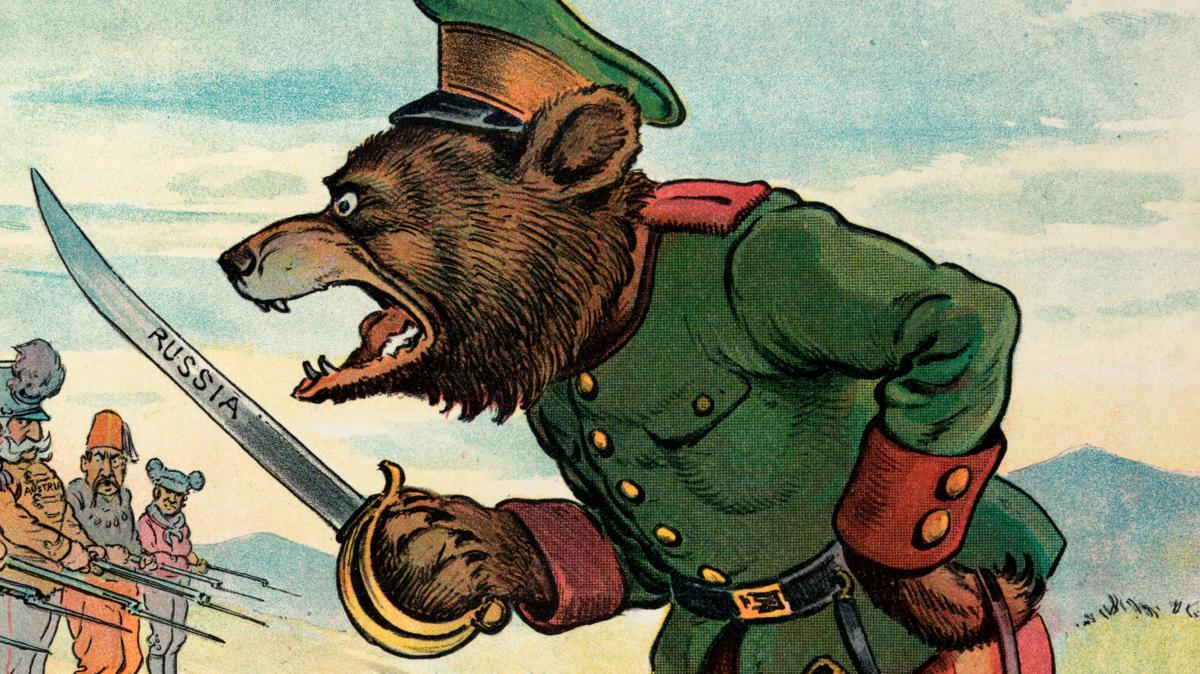
1901 Political Cartoon

In his interview with Noam Chomsky in Truthout dated March 1st , C.J. Polychroniou asks, with reference to Article 2(4) of the UN Charter, which prohibits the threat or use of force against the territorial integrity of another state, “Can you comment on Putin’s legal justifications for the invasion of Ukraine and on the status of international law in the post-Cold War era?” Chomsky says, “There is nothing to say about Putin’s attempt to offer legal justification for his aggression. Its merit is zero.. Chomsky ranks the Russian invasion of Ukraine as “a major war crime, ranking alongside the U.S. invasion of Iraq and the Hitler-Stalin invasion of Poland in September 1939.”

In essence, there is no enforceable legality and certainly, no universal sense of right, on the geopolitical scale. There are only actions and consequences. Chomsky sums up the very narrow range of accepable geopoltical outcomes that remain, now that the threatened invasion has occurred, “The options that remain after the invasion are grim. The least bad is support for the diplomatic options that still exist, in the hope of reaching an outcome not too far from what was very likely achievable a few days ago: Austrian-style neutralization of Ukraine, some version of Minsk II federalism within. Much harder to reach now. And — necessarily — with an escape hatch for Putin or outcomes will be still more dire for Ukraine and everyone else, perhaps almost unimaginably so.’

I worry that Western leaders are unanimously displaying a lack of understanding in the matter of this ‘escape hatch’. They are either intentionally provoking Putin into a quagmire that they believe will be his demise and/or they do not understand the consequences of ‘driving the bear into a corner’ in the way that Chomsky does.

Image https://www.thetimes.co.uk/article/the-russia-anxiety-by-mark-b-smith-review-should-we-fear-the-russian-bear-rjv76qzft

https://truthout.org/articles/noam-chomsky-us-military-escalation-against-russia-would-have-no-victors/

https://www.poetryfoundation.org/poems/56966/speech-all-the-worlds-a-stage