Ukraine: Oliver Stone’s View

In this important overview of the historical divisions in Ukraine that have evolved into the present invasion by Russia. Oliver Stone explores and explains Ukraine’s legacy of nazism – the Organization of Ukrainian Nationalists (OUN), Stephan Bandera, Mykola Lebed, Dmytro Dontsov, and the imbrication of the neo-nazi movement in contemporary Ukrainian politics. This fascist tendency in Ukraine is represented by figures and organizations like Oleg Tyagnibok, Svaboda, Dimitry Yarosh, Trizub, The Right Sector, Andriy Parubiy, and the Social-National Party (SNPU).

Particularly revealing is Stone’s explication of the USA’s involvement in fostering and instrumentalizing these far-right nationalist forces in their war against the Soviet Union during the cold war and, even after perestroika, against Russia. Stone presents abundant evidence of these machinations, during the Euromaidan revolution, including the infamous phone call between the US Assistant Secretary of State for Europe, Victoria Nuland, and the US ambassador.to Ukraine.- ‘Fuck the EU’! Another important revelation in this documentary is the nature and extent of rupture between Ukraine and and its Russian citizens in the East and the South.. There is, it seems, a civil war taking place, one that has been downplayed by the mainstream Western media.

Ukraine on Fire is the first of two documentaries directed by Igor Lopatonok and produced by Oliver Stone on the emerging situation in Ukraine.

Ukraine: George F. Kennan’s View

According to Davis Stockman, In 1998, at a time when NATO was extending into the former Warsaw Pact nations, New York Times columnist Tom Friedman asked George F. Kennan for his views. It is important to note that Kennan had been the US ambassador to Russia during the Stalinist era. He is known for having been influential in shaping the US policy of Soviet “containment” and in the creation of NATO. Here is some of what Kennan said 24 years ago concerning the US Senate debate on admitting Poland, Hungary, and the Czech Republic to NATO,

“I was particularly bothered by the references to Russia as a country dying to attack Western Europe. Don’t people understand? Our differences in the cold war were with the Soviet Communist regime. And now we are turning our backs on the very people who mounted the greatest bloodless revolution in history to remove that Soviet regime.”

. “It shows so little understanding of Russian history and Soviet history. Of course, there is going to be a bad reaction from Russia, and then [the NATO expanders] will say that we always told you that is how the Russians are – but this is just wrong.”

Image: https://www.newyorker.com/magazine/2011/11/14/getting-real

https://original.antiwar.com/david_stockman/2022/02/23/george-kennan-warned-nato-expansion-would-lead-to-this/

Ukraine: Kissinger’s View

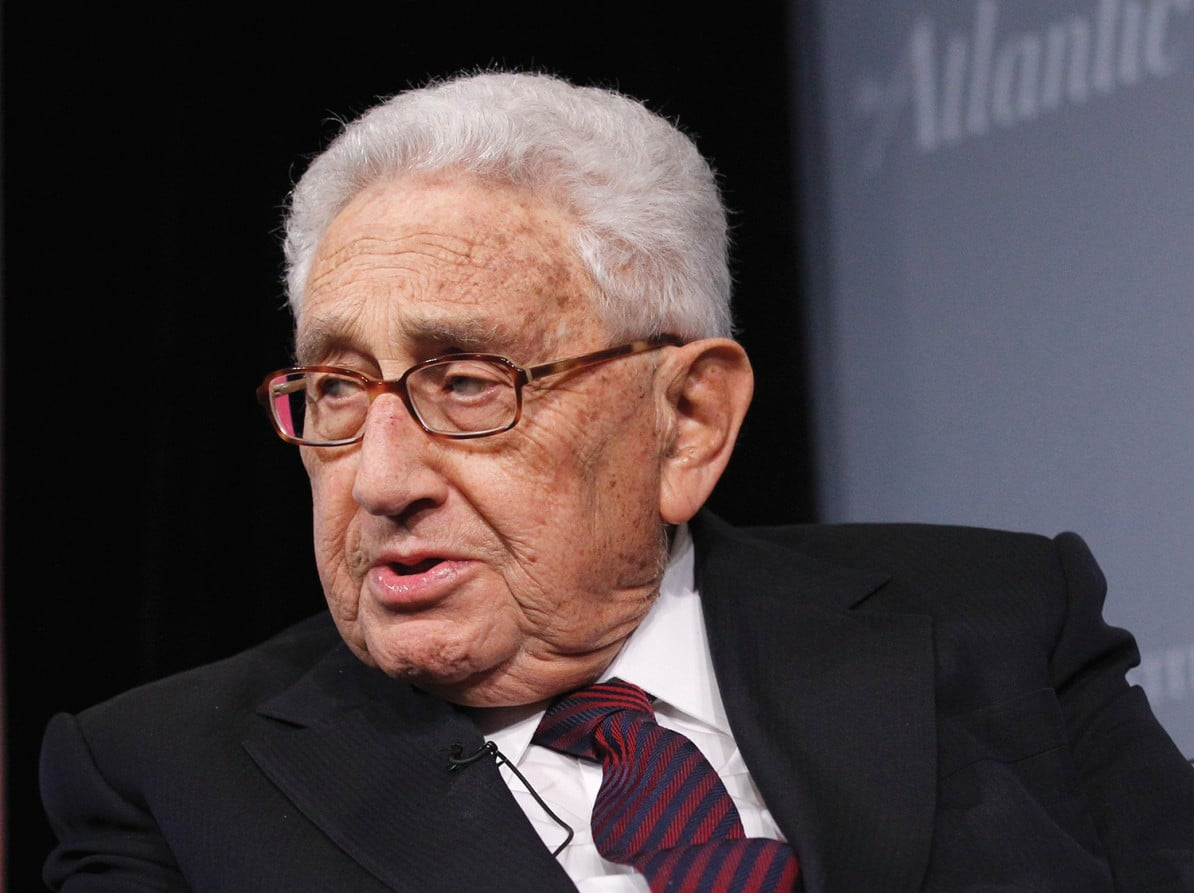
Writing in the Washington Post in 2014, Henry A. Kissinger who was US secretary of state from 1973 to 1977, noted,

“The West must understand that, to Russia, Ukraine can never be just a foreign country. Russian history began in what was called Kievan-Rus. The Russian religion spread from there. Ukraine has been part of Russia for centuries, and their histories were intertwined before then. Some of the most important battles for Russian freedom, starting with the Battle of Poltava in 1709, were fought on Ukrainian soil. The Black Sea Fleet — Russia’s means of projecting power in the Mediterranean — is based by long-term lease in Sevastopol, in Crimea. Even such famed dissidents as Aleksandr Solzhenitsyn and Joseph Brodsky insisted that Ukraine was an integral part of Russian history and, indeed, of Russia.”

He proposes four principles for geopolitical stability in the region –

“1. Ukraine should have the right to choose freely its economic and political associations, including with Europe.

2. Ukraine should not join NATO, a position I took seven years ago, when it last came up.

3. Ukraine should be free to create any government compatible with the expressed will of its people. Wise Ukrainian leaders would then opt for a policy of reconciliation between the various parts of their country. Internationally, they should pursue a posture comparable to that of Finland. That nation leaves no doubt about its fierce independence and cooperates with the West in most fields but carefully avoids institutional hostility toward Russia.

4. It is incompatible with the rules of the existing world order for Russia to annex Crimea. But it should be possible to put Crimea’s relationship to Ukraine on a less fraught basis. To that end, Russia would recognize Ukraine’s sovereignty over Crimea. Ukraine should reinforce Crimea’s autonomy in elections held in the presence of international observers. The process would include removing any ambiguities about the status of the Black Sea Fleet at Sevastopol.”

Sadly, just like John Mearsheimer, Kissinger is in the position to say, I told you so!

https://www.slow-journalism.com/from-the-archive/dg-interview-henry-kissingerImag: https://www.slow-journalism.com/from-the-archive/dg-interview-henry-kissinger

https://www.washingtonpost.com/opinions/henry-kissinger-to-settle-the-ukraine-crisis-start-at-the-end/2014/03/05/46dad868-a496-11e3-8466-d34c451760b9_story.html

Ukraine: The West Should Get Real and Honest!

As early as Feb 28, Major General G. D. Bakshi had set out the basic truths about this tragic conflict. While his military analysis may or may not be astute, it is the moral picture that he paints that is of the greatest significance. He salutes the bravery of Ukrainians but points out that it is immoral to press on with an unequal fight in which there will only be destruction. His most damming indictment is of the USA and the West who, for their own strategic ends, are inciting the Ukrainian to fight to the last man, while they themselves will not come into the fight directly.

Ukraine: Russia’s Military Objectives

Major General G. D. Bakshi, is a retired Indian army officer of great distinction and a prolific military analyst. In a 4th March interview he suggests that, despite Western media cheerleading of the Ukrainian resistance, Putin is steadily achieving his stated objective of demilitarising Ukraine and that, most likely, he has no intention of capturing and holding much territory in Western Ukraine. He suggests that the main objectives are Eastern and Southern Ukrainian nuclear plants (Chernobyl, Zaporizhzhia, etc.), Southern Ukrainian seaports (Mariupol, Odesa, etc.), and Eastern land that will give Russia a land corridor to the Crimean Peninsula. He even speculates that the assault on Kyiv might even be a deception operation, a distraction that has enabled them to make swift progress on their true objectives. He believes, however, that they will devastate Kyiv in due course.

https://military-history.fandom.com/wiki/G._D._Bakshi

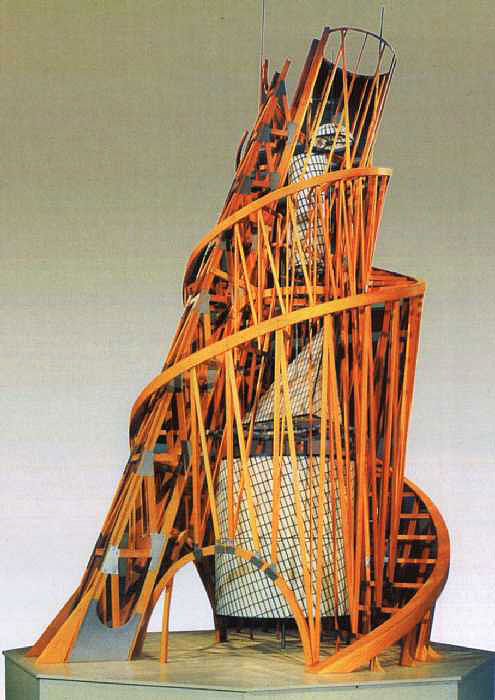
Ukraine: Tatlin’s Constructivist Tower

Soviet Constructivism was on the avant-garde of the Bolshevik Revolution that burst upon Russia in 1917. At the heart of this movement, was the question of the imbrication of art as a part of proletariat life. Constructivism eschewed the elitist concerns of the academy and the museum, in order to embrace the technologies and the process of the Industry.

In 1920 Vladimir Tatlin presented the exemplary Constructivist work, A Monument to the Third International, or, as it is best known today, Tatlin’s Tower. This hybrid of art, architecture and communication design, was meant to be used as a propaganda platform that would drive the spread of the Communist revolution across the world. Although it was never built, this design had a profound impact on the revolutionary art of the Soviet Union and on the international modern art that followed.

Although Vladimir Tatlin was born in Moscow, he grew up in Kharkiv. He studied art at the Kharkov Arts School and then become a merchant sea cadet at Odessa.  Having established himself as a leader of the Moscow avant-garde, Tatlin moved to Kyiv in 1925, to become chair of the theater, film, and photography department of the Kyiv State Art Institute. During this time he established connections with Mykhailo Semenko and the Nova Generatsiia futurist group in Kharkiv.

Image: https://humphries346.wordpress.com/2015/02/16/soviet-constructivism/

https://en.wikipedia.org/wiki/Vladimir_Tatlin

http://www.encyclopediaofukraine.com/display.asp?linkpath=pages%5CT%5CA%5CTatlinVladimir.htm

Ukraine: Yanis Varoufakis’ View

In a stirring conversation with Russell Brand, Yannis Varoufakis offers the most heart I have come across in the ubiquitous commentary on the Ukraine crisis, and some sound mind too! He notes,

1. When there is an invasion we must always take the side of people who are facing troops with direct orders to destroy the circumstances of their lives.

2. We must support all defenders of neighborhoods and homes across the world without prejudice without making a distinction between fashionable victims (Ukraine) and unfashionable victims (eg Palestine, Yemen).

3. The only question is how to stop the carnage and how do we get the Russians to withdraw.

4. There is a serious moral problem in supporting the Ukrainian fighters as we know that Russia is unstoppable, that Putin is ruthless (eg Grozny), and that NATO will never intervene directly (for fear of starting World War III).

5. While we cant ask the resistance to stop resisting, we, from the comfort of our homes, have a moral obligation to find a solution.

6. Such a solution might involve the US and Russia arriving at a quid pro quo somewhat like the following-
I. Russia withdraws from Ukraine
II. there is a demilitarization of Donbas and border regions
III. there could be bargaining about specific areas like Crimea
IV. the US and Russia guarantee the neutrality of Ukraine.

7. The alternative is carnage, a prolonged occupation, the permanent division of Ukraine, and the toxification of politics both in Ukraine and Russia.

Ukraine: Show me the Money!

Eric Draitser presents an alternative analysis of the situation in Ukraine, that gives the lie to both Russian and NATO narratives. He reveals a polity dominated by amoral oligarchs who, regardless of their purported ideological leanings and ethnolinguistic allegiances, are in it for money and power. Whether the picture is accurate or not, it reads like an X-ray, and reveals how government (and politics) masks the true workings of power. Draitse, who is an independent political analyst and host of CounterPunch Radio, offers a nose to the ground perspective that complements John Mearsheimer‘s realist big-power geopoliotical overview.

https://www.counterpunch.org/category/counterpunch-radio-podcasts/

i

Ukraine: Stop the War!

Stop the War in Ukraine. Russian Troops Out. No to NATO expansion.

The coalition CODEPINK, No to NATO and Stop the War, was initiated by the Campaign for Nuclear Disarmament, 120 cities participated in their Global Day of Action on March 6. CODEPINK, No to NATO and Stop the War is calling for demonstrations against the war.and a massive, unified response by peace-loving people around the world saying No to War in Ukraine; Yes to Negotiations and Peace!

Image: https://twitter.com/LynneSachs1/status/1501136610699714560

https://www.peaceinukraine.org/

Ukraine: The MI6 View

Former MI6 chief offers his perspective on the Ukraine crisis at the Oxford Union on 1st March 2022. He seems very objective, but note –

  1. He sits on the board of BP
  2. Suggests that Putin may have lost his balance.
  3. Overlooks organized neo-nazi militia in Ukraine.
  4. Ignores the Ukrainian civil war.
  5. Avoids NATO expansionism and the recent militarization of Ukraine
  6. Reveals that what the West envisages valiant resistance followed by the fall of Ukrainian and a debilitating insurgency against the Russians.
  7. He offers the image of Putin as a cornered rat!

Very cool, very British, very James Bond!