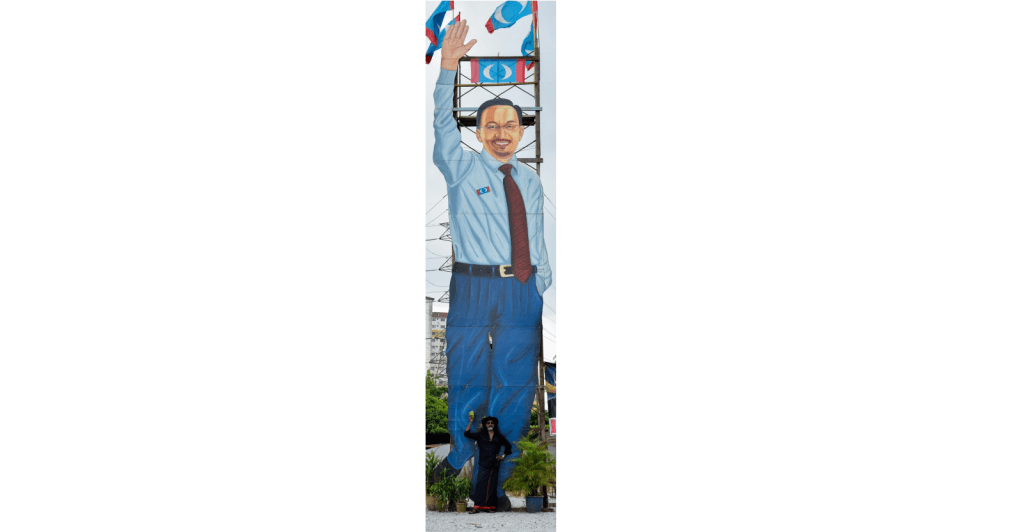
The Dari Pusat Tasek exhibition will run at Percha Artspace till 19 JAN 2020. As part of this event a performance was held at the Lumut Waterfront on the 25th December 2019. The Naan Anaiyttalflag was raised on a portable flag stand, accompanied by a performance based on a Perak Malay cleansing ritual. The flag presents the Koboi standing before a 12.2 m hoarding of the once jailed politician who is now Malaysia’s prime minister in waiting, Anwar Ibrahim. This image was shot in Kampung Indian Settlement, Batu Caves, in the wake of Malaysia’s 14th General Elections. Photographs of the Lumut performance will go towards making the 13th series of the Koboi Project tentatively titled Badan Aku Tubuh Negara. The draft of this work can be viewed at https://koboibalikkampung.wixsite.com/sialjambalang
The Dari Pusat Tasek, exhibition at Percha Art Space runs till 19 JAN 2020.
The enormous tree at the centre the ‘Pusat Tasek’. is an known as the Pokok Pauh Janggi. While I have been insisting that this is a mango tree, I have to acknowledge that the more commonly held view is that it is a coco de mer palm. Still, pauh is the Malay word for ‘mango’ and as Paul Kekai Manansala suggests janggi, probably, derives from the Toroja word ‘djjandji’ which, like the Malay ‘buah’, means ‘fruit’.
The Toraja are a people from the Sulawesi island, to the Southeast of Borneo, whose ancestral myths seem to claim origins from an island somewhere to the north where there is a powerful current, which could possibly be the Pusat Tasek. In the Taroja language taripa djandji means ‘mango tree,’ where or taripa means ‘mango’ and djandji , derived from djampu means ‘fruit’. In suggesting that the Toraja taripa djandji is the more original form of Pauh Janggi , Manansala points out that among the Bare’e people, also from Sulawesi, taripa djandji is the common way of saying ‘mango tree.’
Manasala also notes that Antonio Pigafetta, a mariner on Ferdinand Magellan’s pioneering voyage of ‘discovery’ (1518-1522), mentions local tales of an island surrounded by whirlpools, somewhere north or south of Java Major (Borneo), called Puzathaer (Pusat air?) on which there was a very large tree in whose branches perch enormous birds called Garuda. The fruit of this tree was said to be ‘larger than a cucumber.’ This size comparison, which must surely be with the in terms of the chayote cucumber from the Americas, suggests that the tree concerned was, indeed, a mango tree. The nut of the coco de mer is very much larger.
In Malay, of course, Pokok Pauh Janggi refers only to the mythical tree. A quotidian Mango tree would be pokok pauh and the coco de mer is referred as kelapa laut. While none of this is conclusive, in my understanding of language and of myth, the fact that, even when the signifier ‘Pauh Janggi‘, is understood as an index for the signified ‘coco de mer‘, the fact that it is indexed via the word ‘pauh‘, confirms that the root of chain of signifieds or similes is, indeed, the ‘mango’.
So where is the mythical Pusat Tasek Pauh Janggi located? I have found two possible locations so far; one from Pigafetta’s notes, is somewhere north or south the island of Borneo and the other, from the Perak establishment (pertabalan) myth of the Perak Sultanate, somewhere off the mouth of the Perak River. Now from that masterful, yet woefully ‘ortentalist’ (in Edward Said’s meaning of ‘Orientalism’ ), storyteller Rudyard Kipling’s, Just So Stories, I have found that there is also a way to conceive of a congruence or conflation of these locations.
In his tale of how the crab came to have pincers and live in holes in the sand titled The Crab That Played With The Sea he tells also of the cause of the tides and the currents and their primordial connection with the Pusat Tasik Pauh Janggi. While this tale is most interesting for its domestication and massification of colonial ethnography in the public discourse of Empire, I find its placement of the Tusat Tasek its greatest draw in the context of my present Dari Pusat Tasek project.
As the Elder Magician, the Son of Adam and his young daughter go in search of Pau Amma, the giant crab –
“they pushed out on the Perak river. Then the sea began to run back and back, and the canoe was sucked out of the mouth of the Perak river, past Selangor, past Malacca, past Singapore, out and out to the Island of Bingtang, as though it had been pulled by a string … So he took the paddle; but there was no need to paddle, for the water flowed steadily past all the islands till they came to the place called Pusat Tasek—the Heart of the Sea—where the great hollow is that leads down to the heart of the world, and in that hollow grows the Wonderful Tree, Pauh Janggi ..“
So it seems that in the space and time of mythology, and, in fact, of voyages in general, movement on a given course implies no necessary limit on the distance travelled, such that “off the mouth of the Perak River” can mean “North or South of Borneo Island”, of course!
The Dari Pusat Tasek exhibition will run at Percha Artspace, Lumut Waterfront till 19 Jan 2020. The performance for this event arises from the myth of the ‘navel of the seas’ or the Pusat Tasik Pauh Janggi. It is held in Malay folklore that somewhere in the proximity of the island of Borneo, or alternatively, somewhere off the mouth of the Perak river, there is a massive whirlpool that swirls down to the depths, draining the waters into the earth. At this nexus, rooted on the ocean floor, is the fabulous Pokok Pauh Janggi that reaches up to the heavens. At the base of this tree, at the bottom of the swirl of the ‘pusat tasek’, there is said to sit a giant crab, blocking the opening of the drain of the waters. It is the daily movements of this crab, that cause the oceans to rise and fall cyclically, giving us both the currents and the tides.
In connection with my show at Percha Artspace titled Dari Pusat Tasek, which runs till 5 Jan 2020, I ask the obvious question – where is the Pusat Tasek Pauh Janggi (Navel of the Seas)? The performance carried out on the Lumut Waterfront was based on a Perak Malay cleansing ritual that purports to wash all the sial jambalang (ill luck and malevolent spirits) away to the Navel of the Seas.. Many sources on the location of the Pusat Tasek place it somewhere in the South China Sea or Southwest thereof. According to Antonio Pigafetta, a mariner on Ferdinand Magellan’s pioneering voyage of ‘discovery’ (1518-1522), there were local tales of an island surrounded by whirlpools, somewhere north or south of Java Major (Borneo), called Puzathaer(Pusat air?) . The location of this Pusat Tasek varies, however, with the source of the myth. According to a Perak legend associated with the installation of its first Sultan, Mudzaffar Shah I, the Pusat Tasek is located somewhere off the mouth of the Perak river, beyond the extensive sandbanks there. This area, named Beting Beras Basah or Beras Basah Sandbank, is known as a deeply magical place – one filled with all manner of makhluk ghaib (supernatural beings).
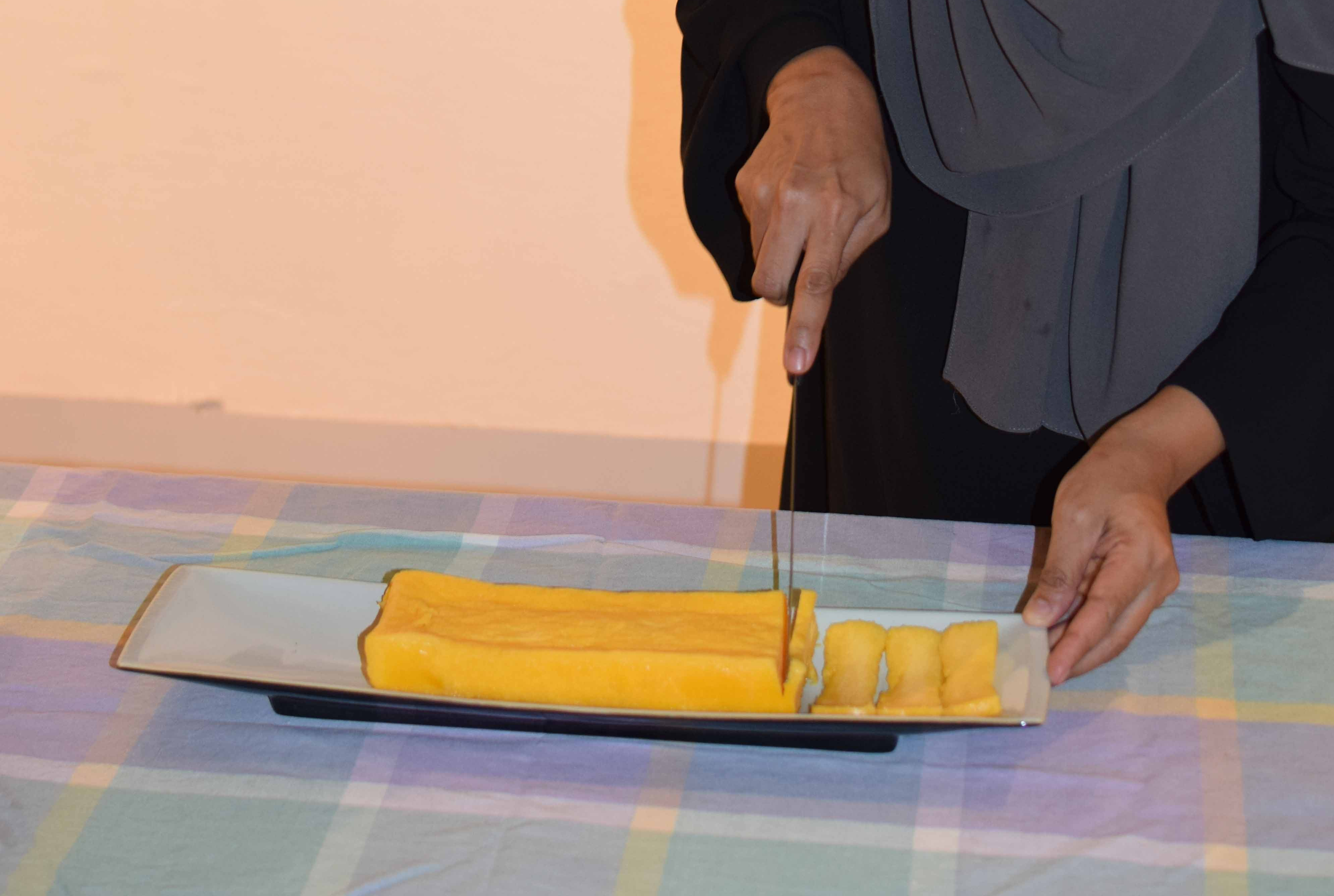
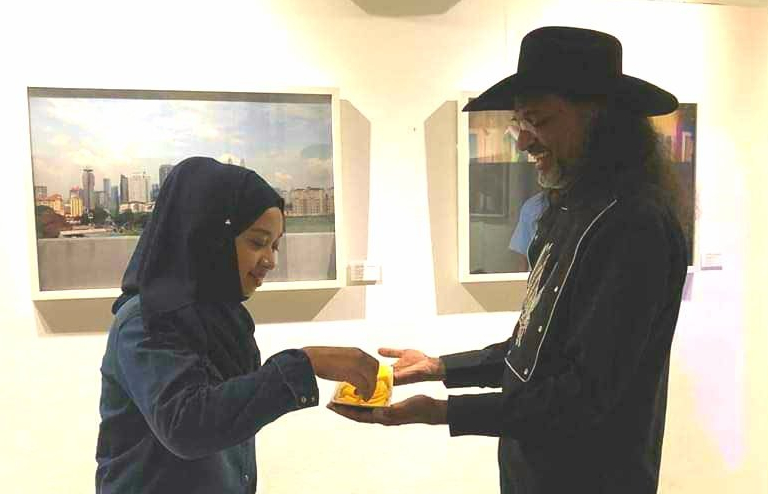
Pipinya bagai pauh dilayang …. During the opening reception of the Dari Pusat Tasek exhibition at Percha Artspace, Lumut Waterfront on 25 Dec 2019, I had the privilege of serving kueh pauh dilayang to my dear friend Nur Hanim Khairuddin. Hanim is Co-director of the Malaysian Art Archive and Research Support, General Manager for PORT (a Perak state creative agency) and Artistic Director of the Ipoh International Arts Festival 2019. I have known Hanim, since the late 1990’s when she was working for the Pekan Seni Ipoh and we were reunited more recently, when she presented the Koboi Project as part of the Malaysia section of the Singapore Biennale 2016.
‘Bersama Abang’ (tak kisah lah siapa lebih tua!) R Viriya pengelola Imej besar Datuk Seri Anwar Ibrahim di Kampung Indian Settlement, Batu Caves 2008/2018
Happy to meet with R Viriya the sponsor of the giant Anwar Ibrahim hoarding at Kampung Indian Settlement Batu Caves. This hoarding is the subject of my Naan Aanaiyittal flag for the Dari Pusat Tasek exhibition at Percha Art Space which continues till 5 January 2020 (EXTENDED TILL 19 JAN 2020). The 12.2m hoarding was first erected in front of Wisma Keringat with council approval in 2008. The hoarding, which had been sponsored through community fundraising, met with accusations of wastage and idolatry from UMNO and PAS politicians. It was taken down at the end of the permit period and kept in storage to be erected again near the Dewan Orang Ramai, Kg Indian Settlement in 2018 for the GE14. According to Viriya the image was painted by a visiting Indian cinema hoarding painter and it certainly conveys the aura of an Indian media SUPERSTAR! I took my koboi photo in 2018 after the surprise Harapan win in GE14.
UPDATE: This flag was presented again at the Pokok Pauh Janggi exhibition at the Kapallorek Artspace in Bandar Seri Iskandar, Perak. Pokok Pauh Janggi runs from 5th Aug – 30th Sept 2023..





 The Koboi Project
You must be logged in to post a comment.