
7,028 people killed by air strikes in the Gaza Strip. 26.10.2023
The Koboi Project is a photo-performative instantiation of identity across the discontinuities of a multi-generational diasporic experience.
7,028 people killed by air strikes in the Gaza Strip. 26.10.2023
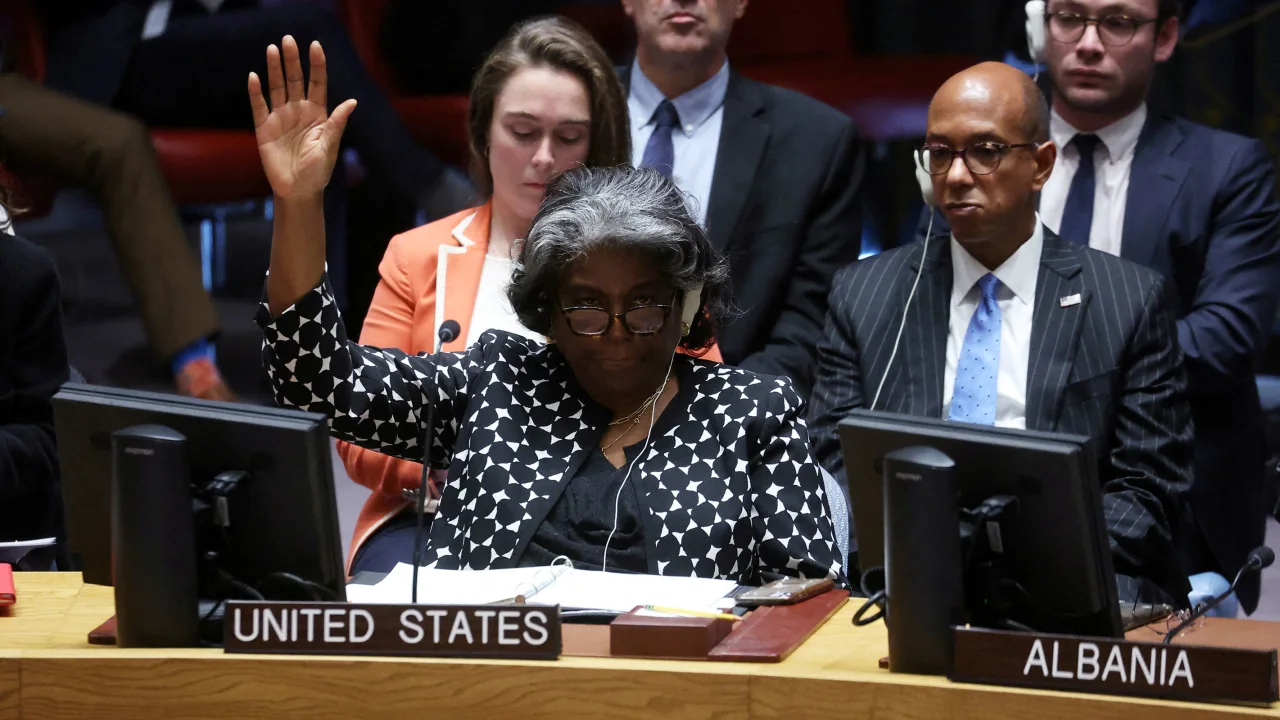
The United States was the only member of the Security Council to veto a draft resolution put forward by Brazil at the UN Security Council calling for a humanitarian pause in the assault on Gaza. This vote, which took place on 18 Oct 2023 followed an earlier resolution that was voted against by France, Japan, the United Kingdom, and the United States, for failing to condemn the HAMAS attack on Israel. Blocking this second, amended, call for a cessation of hostilities, which in fact specifically condemned “the heinous terrorist attacks by Hamas,” enables, Israel to continue its slaughter of innocent Palestinians without the legal restraint of UN censure. CNN reports that the US ambassador to the UN Linda Thomas-Greenfield criticized the resolution for failing to mention Israel’s right to self-defense, thereby perpetuating the Israeli conflation of the semantics of ‘attack’ and ‘defense.’ She also explained that the US wanted more time to let its on-the-ground diplomacy “play out.” It seems that the United States is enabling, even promoting, what Raz Segal has called a textbook case of genocide. Shame!
26. 10 2003 update: 7,028 people killed by air strikes in the Gaza Strip.
Image https://www.cnn.com/2023/10/18/europe/us-veto-security-council-israel-gaza-war-intl/index.html
https://www.middleeasteye.net/news/israel-palestine-death-toll-names-killed-released-biden-questions
In a moving and stunningly clarifying interview with Chris Hedges, Middle East scholar, Norman Finkelstein gives a historical and personal lesson about the morality of oppression. He locates the meaning of terrorism and the targeting of civilians within the context of genocide and ethnic cleansing, he refers to the Slave Revolts of Nat Turner and John Brown, as well as his own parent’s experiences of the Warsaw Ghetto Uprising and of Nazi concentration camps.
He contextualizes the acts of terror committed against civilians by HAMAS in terms of the traumatic spiritual and psychological conditions, the despondency and rage, of living in occupied Gaza. He cites Fredric Douglas and W. E, B. Du Bois (on John Brown’s killing of civilians) and, particularly, William Lloyd Garrison (on the killing of innocents in the Nat Turner Rebellion), all three of whom refused to condemn the brutal rebellions against the humiliations, degradations, and physical assaults of slavery. He also quotes his mother, whom he holds to be a deeply moral person, about her thoughts about the millions of German civilians who died in the Allied terror bombings of World War II. She said, “Our feeling was if we’re going to die, we’re going to take some of them with us.”
Describing Gaza as a “Concentration Camp” Finkelstein declares, “You want me to apply moral categories, condemn? … I’ll describe my reaction. I will acknowledge by a dictionary definition that it constituted a very large atrocity. That’s a dictionary definition, and it’s accurate. However, when you want me to apply a moral category to what happened, you lose me … I won’t do it!”
26. 10 2003 update: 7,028 people killed by air strikes in the Gaza Strip.
https://www.middleeasteye.net/news/israel-palestine-death-toll-names-killed-released-biden-questions

“A textbook case of genocide. Israel has been explicit about what it is carrying out in Gaza. Why isn’t the world listening?” Asks Raz Segal who is an Israeli historian, and an endowed professor in the study of modern genocide at Stockton University. He explains that according to the U.N. Convention on the Prevention and Punishment of the Crime of Genocide (1948) requires ‘special intent’ as a technical requirement for the determination of a ‘genocidal act.’ The aim of destroying a racial, ethnic, religious, or national group (collectively), is just such an intent, and this very intent is evident in recent statements of Israeli politicians and army officers. He points out that Israel’s Defense Minister Yoav Gallant has declared a “complete siege” on Gaza, cutting off water, food, and fuel. In this contect, Gallant has stated that Israel is fighting “human animals” and will react accordingly. Segal states, “If this is not special intent to commit genocide, I really don’t know what is.”
9,061 people killed in the Gaza Strip (3,760 children, 2,326 women) Nov 2, 1:45pm local time (10:45 GMT):Update
https://www.middleeasteye.net/news/israel-palestine-death-toll-names-killed-released-biden-questions
https://www.aljazeera.com/news/longform/2023/10/9/israel-hamas-war-in-maps-and-charts-live-tracker
On 7th October HAMAS fighters broke out of the blockaded Gaza strip the executed a devastating military operation deep within Israel. They captured 11 military bases and inflicted indiscriminate acts of terror on Israeli settlements, killing over 1,200 people, including women and children.
Exiled Israeli historian Ilan Pape gives his views on the impending Israeli response to this devastating HAMAS incursion. He characterizes the ongoing siege and impending invasion of Gaza as being based on an impulse for revenge set within an ongoing policy of genocide involving settler colonialism, occupation, and ethnic cleansing. He suggests that the objective of this invasion can be conceived of in terms of two possible models:
1) The moderate Beirut 1982 model, wherein Israel forced the PLO out of Lebanon – which he characterizes as expulsion and interprets as the permanent ejection of HAMAS from Gaza and
2) The extreme Afghanistan 2003 model wherein the USA invaded to eradicate the Taliban – which he extrapolates as the mass killing of all those whom Israel believes are associated with HAMAS.
Whichever model prevails, Pape believes that Israel will succeed militarily but that it may lose politically, particularly if HAMAS’ strategy triggers such a massive response from Israel as to provoke an attack from Hezbollah in Lebanon and an uprising in the West Bank, amounting to a third Intifada.
https://www.timesofisrael.com/liveblog-october-7-2023/
https://www.jta.org/2023/10/11/israel/death-toll-in-israel-attack-soars-past-1200-as-catalog-of-hamas-horrors-is-revealed
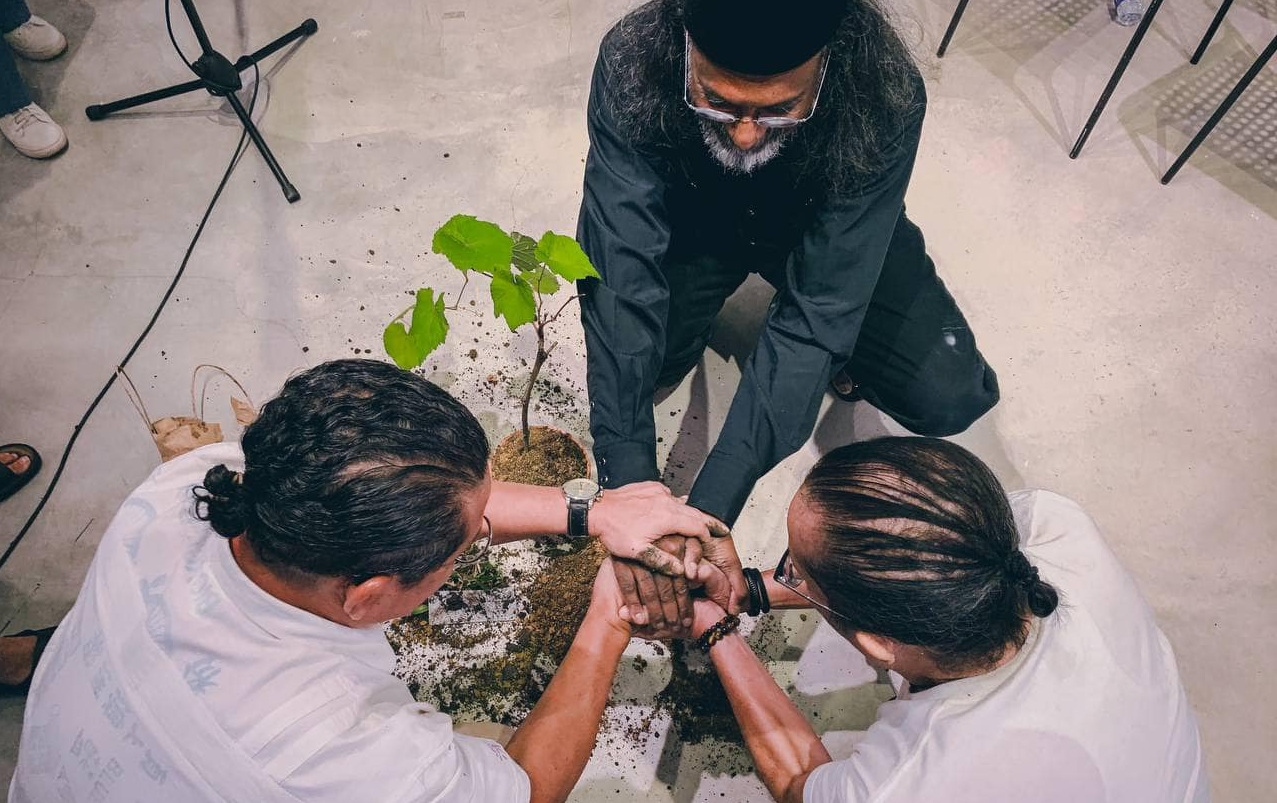
The Pokok Pauh Janggi exhibition at Kapallorek Artspace was officiated by my dear friend and important contemporary artist, Azizan Paiman. This is expecially significant as Paiman is featured in the photographs of the Koboi Balik Lagi series of the Koboi Project. He is someone with whom I have had a long relationship, first as a curator (Tenungan Curator), and then as a brother (Saudara Baru), and now as a fellow artist with a shared vision of the mdalities and meanings of art making in Malaysia. As part of the opening event of the exhibition, Paiman presided over the ritual transfer of a vine, nurtured in his garden, to the care of the Kapallorek Artspace.
In this ceremony another brother, the renown contemporary artist and teacher, Hasnul Jamal Saidon, Paiman, and I jointly transferred the plant into a pot, and handed it over to the care of Fadly Sabran, the founder/director of Kapllorek Artspace. This extension of the arboreal symbolism of the Pokok Pauh Janggi exhibition marked the deeply personal bonds of our respective relationships, while also suggesting a nexus and a line of development in contemporary Malaysian art. I was particularly moved by how Paiman’s ceremony got Hasnul and myself acting in unison once again, as we had done so effectively and so effortlessly in the days of the 1st Electronic Show and E-Art ASEAN.
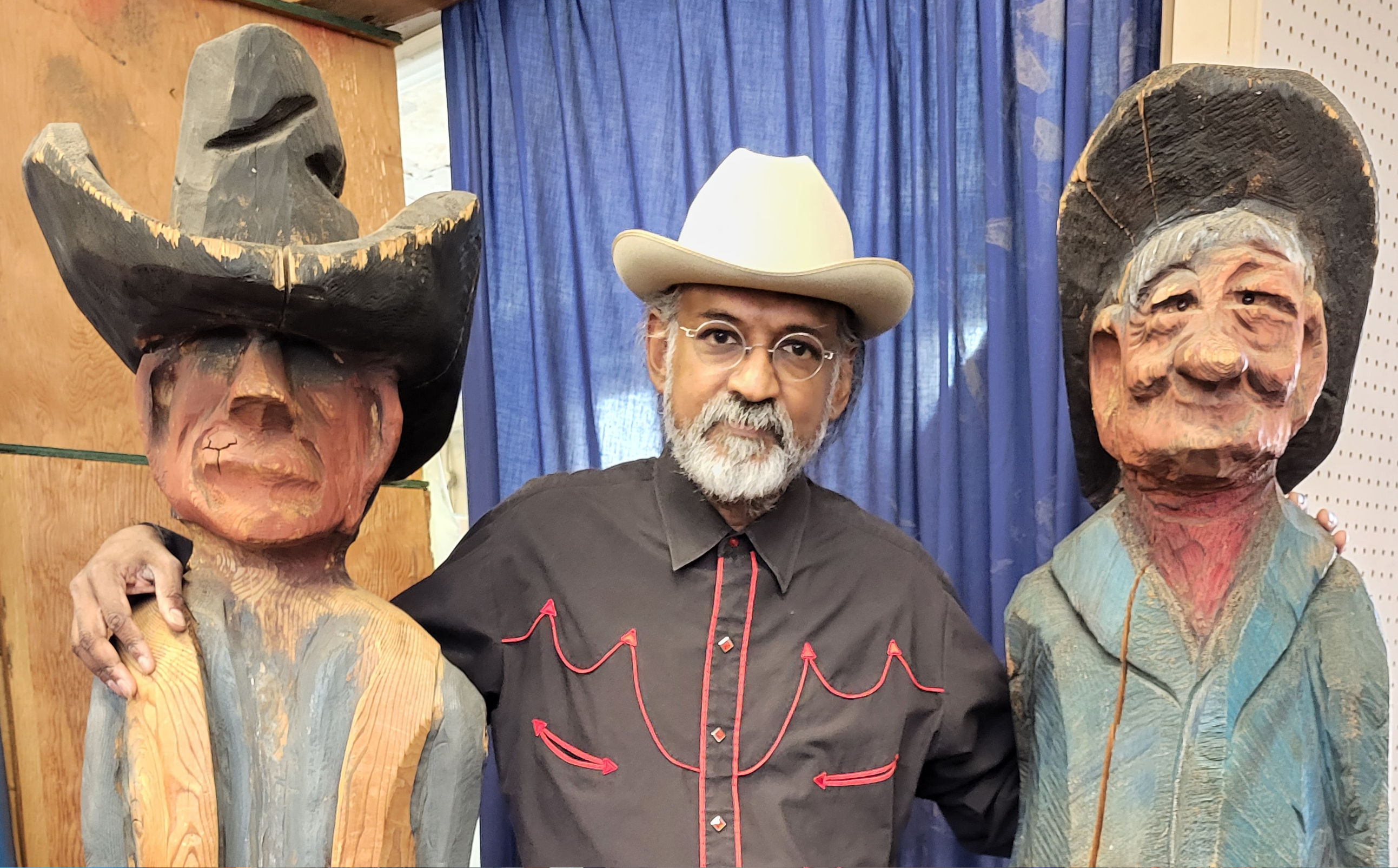
Hangin with some old cowpokes at the famous Portland Outdoor Store in July 2023, just before travelling to Malaysia to work with some other cowboys on the Pokok Pauh Janggi exhibition at Kapallorek Artspace, Bandar Seri Iskandar, Perak. The show runs till 10th October 2023.
Eyo Hock Seng is a Kelantanese Wayang Kulit Dalang who has been practicing his craft for over 40 years. Today he is one of eight or nine wayang kulit Dalangs who are performing today. Not only is he a Chinese master of this Malay
art form, but he might also even be credited for keeping the form alive in Kelantan for 30 years during which the PAS State government had banned Wayang Kulit in Kelantan. He tells of how he was one of eighteen Dalangs in the State
when they all called to a meeting with the late Tok Guru Nik Aziz (Menteri Besar of Kelantan from 1990 to 2013 and Spiritual Leader of PAS until his death in 2015) in 1999. As Hock Seng recalls, when they were asked to perform
for Tok Guru, they did so with all the traditional ritual accouterments, including spells and glutinous rice offerings. The result of which is that Wayang Kuilt was banned, due to its unIslamic elements (Animist, Hindu/Buddhist).
In fact the Kelantan state government officially banned cultural performances like Mak Yong and Wayang Kulit under
the Entertainment\ and Entertainment Premises Enactment 1998. The Dalangs had to migrate to other states in order to continue their art and many gave up altogether. Eyo Hock Seng was the only one permitted to continue the practice as he was not a Muslim but he was restricted to presenting his Wayang in the Chinese and Siamese districts. During this time Eyo Hock Seng grew in stature as a performer and gained an international reputation. It was only in 2019 that the ban was lifted, with the proviso that there were no unIslamic elements of worship in the performances. Hock Seng laments that there were not many of the old Dalangs left who could return to the practice after the passage
of twenty years, as many had given up altogether and had sold their puppets and musical instruments during the ban.
The following questions relating to this episode in the history of Kelantanese Wayang Kulit inform my own Pokok Pauh Janggi performance (see notes) –
1. To what extent can Malay culture be isolated from its pre-Islamic roots?
2. To what extent can the elements of pre-Islamic Malay culture be accepted within contemporary Malay Islam?
3. To what extent does contemporary Malay culture remain contigious with the wider spirit of the Archipelago?
4. To what extent can a contemporary citizen of Malay lands be assimilated to Malayness without being a Muslim?
5. Can only non-Malay/Non-Muslims perform and preserve Malay traditions that are presently considered unIslamic?
The first three questions pertain to the essence of Malay culture. The fourth and fifth question reflect on the significance of non-Malay/ non-Muslims performing, identifying with and preserving Malay cultural forms, Thes last questions index the prospect of an integrative, integral even, Malaysian identity.
The audio played on the megaphone during the flag raising in the Pokok Pauh Janggi performance (see notes) is Gerimis Mengundang is a Malaysian chart topping single from the band Slam. It was released in 1996 and it permeated the airways and the hearts of the nation. I had just returned to Malaysia to take up a position at the Universiti Malaysia Sarawak and this song resonates within me still, just as it does, I suggest, with the saga that underpins the present state of our national polity, with a particular poignance if interpreted in terms of the Anwar Ibrahim saga! It is worthy of mention that it began to drizzle (gerimis) over the performance area in the course of the event. Later we learnt from observers that it had only rained in the Kapallorek Artspace area and not the surrounding area.
Kusangkakan panas berpanjangan
Rupanya gerimis rupanya gerimis
Mengundang ah ha ha ha
Dalam tak sedar ku kebasahan
Music and lyrics by Saari Amri © Universal Music Publishing Group

The main component of the Pokok Pauh Janggi installation is the Kobol Balik Lagi series of photographs (Duratrans). This 3rd series of the Koboi Project is based on photography done during the Seni Di Kota Symposium and Exhibition curated by Zanita Anuar at the National Art Gallery, Kuala Lumpur in December, 2015. In the original Koboi Balik Kampung series, I presented the Koboi within the vast panorama of the Malaysian culture, politics and life, photographed in and around Kuala Lumpur over a time span of three weeks. In the Koboi Balik Lagi series, I take on the challenge of finding and presenting the same significations, metonymically, within the reduced narrative time and pictorial space of one morning at the National Art Gallery. Koboi Balik Lagi is thus a more narrowly focused and self-reflexive Koboi narrative. The photography for this series was done by Zuraini Anuar who is the award winning art director and production designer in Malay cinema
 The Koboi Project
You must be logged in to post a comment.