Tarkovsky Monument

tarkovsky moumentA monument to Andrei Tarkovsky was opened on the 29th July 2017 in Suzdal, where his own monumental contribution to Russia cinema, Andrei Rublev, was shot in 1965 … well over half a century ago. Andrei Tarkovsky was in my view the most important artist of the 20 century in any medium. Yes, that is a sweeping statement! … but I have just watched his films in the cinema – Solaris 3 times and Stalker twice in the course of the last week, and feel this claim is justified. I shall do my best to contextualize my hyperbole … and if I fail to convince you … perhaps, you might at the very least, understand where I am coming from (my perspective or paradigm)!

In a deathbed conversation with Krzysztof Zanussi, he said to his friend and esteemed colleague,  “If I happen to die, please whenever you talk about me, remind people I want to be remembered as a sinner, as somebody who committed many sins …. “ Andrei Tarkovsky was Christian and I believe he was expressing, in this request, his subscription to the doctrine of original sin, which although different in orientation and nuance, is in essence similar to the Islamic fitrah (original purity) or the Buddhist dhukka  (universal suffering). In all his work Tarkovsky struggled to express this sacred, understanding of the human condition in historical and psychological terms.

In his hands, film, the quintessential 20th Century representational medium, becomes both a medicine and a sacrament – an interface for healing and a window on salvation. He set this ameliorative and soteriological vehicle into motion in what Ingmar Bergman, no less, has described as “a new language, true to the nature of film, as it captures life as a reflection, life as a dream”.  Tarkovsky is the exemplary post-traditionalist, utterly contemporary in his engagement with social history and psychology … timeless in his grasp of the sacred. He articulated this timelessness in his films, his 7 technically and aesthetically masterful ‘sculptures of time‘!

Image : http://wellnews.us/articles/the-firstever

https://www.youtube.com/watch?v=mHnUhowBYkI

https://people.ucalgary.ca/~tstronds/nostalghia.com/TheTopics/IB_On_AT.html

https://en.wikipedia.org/wiki/Sculpting_in_Time

PETRONAS Connection 2

12524006_1520298238271641_2821739112345251707_nAs I shift my attention from the now aborted PETRONAS investment on Lelu Island to the underlying and ongoing PETRONAS engagement with British Columbia’s LNG sector, I feel it necessary to reiterate my own history with Malaysia’s exemplary crown corporation. Indeed, while I have my doubts about the benefit of LNG extraction in the long duree, I also have a history with PETRONAS that I feel it is necessary to declare. I have  worked for PETRONAS in the capacity of a guest curator in 2001-2002.  Then director of the Galeri PETRONAS, Zainol Abidin Sharif (ZABAS) , kindly gave me a great opportunity  to curate the first retrospective of the important Malaysian artist Sulaiman Esa. This project gave me the ability to  develop my interpretative frame for the contemporary art of Southeast Asia. I had previously argued that to do justice to contemporary artistic practice and meaning, we must combine the study of Sacred Forms as developed by the likes of Nasr, Burkhardt and Coomaraswamy, this with the study of social history, and that, ultimately, we should look ‘Beyond Art History” for our interpretative approaches. Mainstream art history with its chronologies and detailed stylistic differentiation is not so relevant to us. Indeed it seems almost uninteresting given the depth of the alternative traditional aesthetic imperatives at play.

The exhibition I curated and wrote for at the Galeri Petronas was titled Insyirah: lukisan Sulaiman Esa dari 1980 hingga 2000. I am proud of this work, and am grateful to PETRONAS for supporting it and for all their contributions to Malaysian art. PETRONAS is a government corporation, so unlike Shell or Exxon, it has a natural obligation owed towards the nation as well as a natural loyalty owed in return by Malaysians. I feel that debt and I am proud of PETRONAS’ achievements in the corporate world. Generally, as a Malaysian I want to see them succeeded in all their ventures. However, as a person who makes his home and is bringing his children up in British Columbia, my concerns are more complex. This blog will continue to explore this particular nexus of interests, in the face of the events that are unfolding around me.

Image – Sulaiman Esa, “Doa / Supplication” (1999), Mixed-media, 114x66cm (Collection of Petronas Art Gallery) http://hasnulsaidon.blogspot.ca/2016/01/inter-connectivity-and-single-unified.html

Progress Energy

petronas progreess
While the Pacific Northwest LNG logo belies its PETRONAS connections, the more established Progress Energy logo proudly wears the PETRONAS green.  In his announcement on the termination of the Lelu Island development, Datuk Anuar Taib
who is Executive Vice-President & Chief Executive Officer of Upstream PETRONAS, Chairman of Pacific NorthWest LNG and Chairman of Progress Energy made it clear how deeply established in and committed to Canadian natural resource development this Malaysian crown corporation really is – “Over the years, Progress Energy and its North Montney joint venture partners have developed a reserves and contingent resource of around 52 trillion cubic feet of natural gas reserves and resource in the North Montney assets. … we are positioning Progress Energy to be one of the top natural gas exporters in North America. That’s why we are moving our Unconventional Centre of Excellence from Kuala Lumpur to Calgary. The centre, which will house a network of technical experts with similar expertise, responsibilities and interests, will deliver operational innovations for PETRONAS worldwide unconventional gas plays with its core in Calgary.” Once again I find myself swelling with Malaysian Pride and, at the same time, shrinking fearfully at the realization that what we are talking about a monumental fracking operation in Canadian earth!

FRACKING HELL!!

fracking hell BC

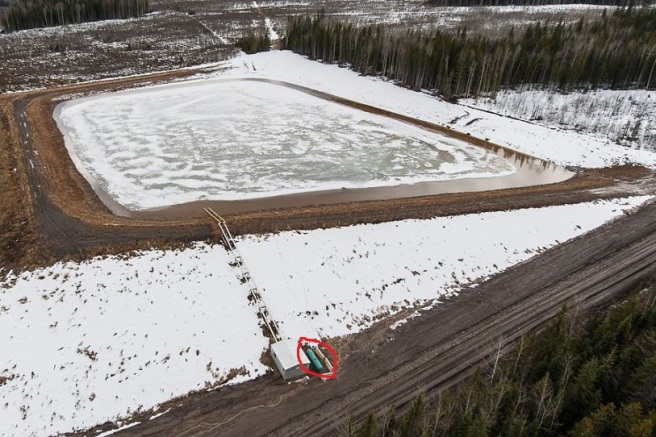
It is reported in the Tyee that Progress Energy, a subsidiary of PETRONAS has built 16 unauthorized earth dams in the Montney basin, Northeastern British Columbia that, for whatever reason, have not been vetted by the provincial Environmental Assessment Office (EAO) . These dams trap water for large-scale fracking activities which involve injecting a pressurized mix of water, chemicals, gases and sand into the ground – a process that has allegedly triggered significant earthquakes in the region. Progress Energy seems to have built these dams between 2012 and 2014 on Treaty 8 land north of Fort St John. Treaty No. 8 land cover 840,000 square kilometres and is home to 23 Alberta First Nations, 3 Saskatchewan First Nations, 6 Northwestern Territories First Nations and 8 British Columbia First Nations. Treaty rights give members of party Nations, shared territorial rights to hunt, fish, pursue cultural activities and build burial grounds; in other words to collectively live their traditional way of life.

In 2013 the government of British Columbia announced a multi-billion dollar LNG investment by Malaysia’s PETRONAS Group of Companies. The proposal was to build an LNG export terminal on Lelu Island. This investment would have made Malaysia the largest foreign investor or, in liberal terms the greatest economic benefactor to our province. Meanwhile, the racial, religious, financial and political funk of Malaysia has been steadily rising in the wake of the the tightly contested 13th general elections of 2013 as well as the ongoing 1MDB scandal.

In BC the promised investment began driving the inherent tribal, territorial, economic and environmental contestations towards an inexorable crisis. This congruence of contexts that I call mine – Malaysia and British Columbia, gave rise to an awakening  in me of a transpacific identity and to many, many questions – Does the populace of BC have a perspective on Malaysia and on PETRONAS’ imbrication in the finances of  that nation? Are Malaysians aware of economic, environmental and territorial perspectives in BC? … These were some of the stirrings behind this Koboi Kembara Lagi (The Koboi Rides Again) Blog which I initiated in 2015.

Just 2 days ago (July 2017) it was  announced that the PETRONAS LNG Project on Lelu Island would not proceed for financial reasons. While this decision is good news for the fish, for environmentalists and for some natives, others, including many native communities feel that this withdrawal will hurt the economy and consequently the social fabric of society. For the present at least, it seems that the Skeena river and Lelu island are safe from environmental degradation by PETRONAS developments in the context of BC’s resource economy. This relief is however very local, to Lelu island. In the bigger a provincial picture we find that this powerful Malaysian crown corporation is already well entrenched in our LNG economy and, as expressed in the Tyee atticle, involved in environmental controversies that are poorly reported by BC’s mainstream news media.

The Lelu island project was, for PETRONAS, part of a downstreaming exercise designed to maximize profits from PETRONAS’ own primary resource assets that have been developed more discreetly in British Columbia over a much longer period of time. Indeed, the Lelu terminal was intended to bring mainly PETRONAS’ LNG to PETRONAS’ markets in China. The terminal is now not happening but the fracking and its consequences continue. This blog will now follow these activities more closely in search of answers to the abiding question – Can information flows follow global capital and create truly transnational networks and communities of contestation and accord or does the new communications medium create solipsistic circuits of ‘social’ media?  As the Koboi continues his wanderings and his art this Koboi Kembara Lagi blog will go on exploring the implications of Malaysian investments in British Columbia.

Image https://thetyee.ca/News/2017/05/03/Petronas-Unauthorized-Dams-Fracking/

https://thetyee.ca/News/2017/05/03/Petronas-Unauthorized-Dams-Fracking/

http://treaty8.bc.ca/treaty-8-accord/

http://www.bbc.com/news/world-asia-33447456


LNG Bluff 6: The Artist

the fish is fine 2

Image – Koboi Kembara Lagi: Berhijrah, 8 The Fish if Fine, copyright by Niranjan Rajah. Preparatory sketch for photographic work. Image source Vancouver Sun

I am moved to hear that the PETRONAS LNG Project on Lelu Island will not be going forward. My latest email conversation on 13 July 2017 with Donnie Wesley, Simoyget (hereditary chief) Yahaan, who has lead the opposition to the project valiantly, reflects the pressure his movement has been under of late. Here is an extract from the the Chief’s last email to me, ” … many thanks for expressing the views of many. My court dates are encroaching and feel the need to scream as the misery of my people is real … “.

And for the record, here is what I had written to him that prompted his reply, “…. I feel many people do not understand what is at stake … even native people seem to be polarized between an ideal Turtle Island where the settlers and immigrants are gone and some kind of unreflective engagement with the Canadian  State… ie. some are happy with the trickle down of benefits from the state  …   My own position as an immigrant is that I am here and I am here to stay but I want Canada to move towards a meaningful recognition of First Nation rights and claims to their remaining assets and authority … The key to Native reclamation is the insistence on proper consultation before anything else. This is what you are doing and I hope the Federal Court sees justice through“.

In all honesty, I must say my own feelings are very mixed with regard to this great victory for the Chief. I am so happy for him and his people. I am happy for the environment and the fish. I am happy for my children who will is some way inherit the environment that the present generation of deciders and actors leaves behind on this beautiful coastal land. I am however somewhat disappointed as a Malaysian that this momentous transpacific engagement will not take place and, as an artist, I feel that, suddenly, I have lost my muse!


Burning Man

17968712_1009651002503236_1558151456_o.jpgThe Koboi Project will be at Burning Man 2017 in the Nevada dessert.  In keeping with the burning Man theme of Radical Ritual this work will exemplify how, even traditional rituals are constantly being revivified and radicalized. Earlier this year the proposal for Cowboys and Indians: Special Burning Man Edition was presented at RECHARGE which is an event organized by The Greater Vancouver Interactive Arts Society (GVIAS). What seemed to strike the brightest chord with burners, was the gifting of mangoes on the playa. The understanding of art as a gift and its presentation as the occasion for conviviality are central to my art. These values are also at the heart of Burning Man. The Cowboys and Indians project will articulate a rapprochement of tradition and its other, in a manner that is germane to the present post-traditional moment.

LNG Bluff 5: Greens

greensYesterday, the left leaning NDP officially formed the new government of British Columbia thereby ending of 16 years of conservative Liberal Party rule in our Province. The NDP had no majority on their own but with the support of the BC Green party they just pushed past the Liberals by one seat. I have addressed the duality of the NDP position regarding the Lelu Island  LNG development in a previous post and now I want to address the position of their new allies the BC Greens. Andrew Weaver, the leader of the Greens, had denounced LNG as a “pipe dream” upon first taking office as an MLA in 2013. He as the lone Green MLA, voted against the special tax regime that both the Liberals and New Democrats approved for LNG development in 2014. Further, in the runup to the recent elections which saw a record 3 Green MLAs in the BC legislature, he promised to repeal the BC government”s agreement with Pacific NorthWest/ PETRONAS to develop their LNG terminal on Lelu Island. Weaver has however, in the wake if the elections agreed to support the NDP in governing BC, giving this new alliance a tenuous majority of 1 in the provincial parliament.  In fact, the NDP appointed speaker  would have to break with convention and cast his vote with the government for this alliance to sucessfully pass any legislation. How can Weaver hold his position on Lelu LNG if the NDP fall in behind the Feds, the Liberals and their own powerful patrons, the alliance of BC Building Trade unions, in supporting the project.

http://vancouversun.com/opinion/columnists/vaughn-palmer-weaver-offers-dramatic-alternative-to-ndp-and-liberals

Image : http://commonsensecanadian.ca/rafe-elizabeth-may-greens-double-bc/

What is Consultation?

chiefsThere are presently 3 applications for judicial review brought by Gitwilgyoots Tribe, Gitanyow Tribe and by and SkeenaWild Conservation Trust in connection with the PETRONAS/ Northern Gateway investment proposal on Lelu Island. In considering the reasonableness and good faith of the government’s decision to proceed with this development, it seems clear from the Federal Appeal’s court decision on the matter of the Northern Gateway Pipeline Project that the Crown is obliged to consult with First Nations on whose territories economic developments take place before proceeding with any decision making.  There are two specific issues that need to be resolved: –

1. Who should be consulted which boils down to whose authority the Court recognizes over the lands occupied by the Gitwilgyoots and the Gitanyow tribes. In this matter  the Lax Kw’alaams Band Council has launched a legal challenge to the tribal authority of hereditary chief Simogyet Yahaan.

2. What does meaningful consultation amount to – As David P. Ball notes in a Metro Vancouver article, when asked what ‘meaningful consultation’ would look like Chief Malii of the Gitanyow replied: “It means you have to really listen to the aboriginal group, take into account what they’re saying, and you have a discussion … It’s not just having a meeting or writing a letter; it’s an actual exchange.”

The first point goes to the heart of First Nations autonomy as Band Council’s are appointed under the auspices of Canadian legislation, while hereditary leadership in inherent to the native order and relationship with this land. The second point, which is the subject of this post, goes to the heart of the matter of any possible reconciliation with the First peoples on our common abode. It seems to be a matter of good faith and common sense, that recognition of the First Nations should involve some semblance of respect for their jurisdiction.  Faith and sense which the details of the Tribes’ applications for judicial review indicate the Crown may not have displayed!

http://www.metronews.ca/news/vancouver/2016/10/27/no-meaningful-consultation-on-pacific-northwest-lng.html

Image: http://theecoreport.com/legal-challenges-petronas-lng-project

Band vs Tribe

LeluDecSigning_610px
Simogyet Malii, the chief negotiator for the Gitanyow Hereditary Chiefs, makes a powerful assertion that the recent cultural appropriation debate belies a deeper arrogation. First Peoples cultural forms are expressions of their relationship to their lands and waters and are inseparable from their traditional laws. He draws our attention to the fact that the significant  ‘appropriation’ “isn’t happening in art galleries or on the pages of high-minded magazines. This is happening on our lands and in the courts and legislatures, and it has to stop.”

A case in point is how the Lax Kw’alaams Band Council is seeking to deny or, to extend the analogy,  ‘appropriate’ the ancestral authority of hereditary chief Simogyet Yahaan, of the Gitwilgyoots in connection with and PETRONAS/ Pacific NorthWest LNG project on Lelu island. The Band Council has launched a legal challenge to Yahaan’s locus standi to repersent his tribe and protect its territory. Simogyet Malii notes that this assertion by the Council is unprecedented and that, “It challenges the respect for aboriginal law and authority, and undermines any possible reconciliation between Canada and aboriginal peoples.”

There is clear  preceedant, in Federal Court of Appeal decions, that the Crown is obliged to properly consult First Nations in connection development projects on uceded lands under their jurisdiction and the technical question at stake here is quite simply, who should the Crown rightly consult – ancestral hereditary chiefs or the Band Council that derives its authority from  colonial legislation. The Gitwilgyoots and the Gitanyow who believe they too have a right to be consulted do to impacts of this project on the Salmon ecology and consequently on their economy has brought a request for  Jucial review in this matter to the Federal Court in Vancouver . Yahaan has said , “The … council deemed they could go out and take tribal territory and use it at their own discretion for oil and gas. Their only jurisdiction is on reserves. Outside that jurisdiction belongs to the tribes.”

The Band Council’s apolication to the courts to have  Yahaan declared persona non grata  in this manner is, rightly or wrongly, an attempt to  circumvent this important questoin of jurisdiction and right adewuate consultation. Simogyet Malii’s explication of the depths of ‘cultural’ apprioriation seems briliant to me but it must be an obvious fact to the First Peoples with whom reconciliation is acknowledged in the formalities of state, but  the continued aporopriation and exoloitation of whose sacred and material possesions is ongoing.


https://www.theglobeandmail.com/opinion/beyond-appropriation-of-our-culture-the-most-important-fight-is-for-our-land/article35406652/

Image: https://thetyee.ca/Opinion/2016/01/25/Lelu-Declaration/