The main component of the Pokok Pauh Janggi installation is the Kobol Balik Lagi series of photographs (Duratrans). This 3rd series of the Koboi Project is based on photography done during the Seni Di Kota Symposium and Exhibition curated by Zanita Anuar at the National Art Gallery, Kuala Lumpur in December, 2015. In the original Koboi Balik Kampung series, I presented the Koboi within the vast panorama of the Malaysian culture, politics and life, photographed in and around Kuala Lumpur over a time span of three weeks. In the Koboi Balik Lagi series, I take on the challenge of finding and presenting the same significations, metonymically, within the reduced narrative time and pictorial space of one morning at the National Art Gallery. Koboi Balik Lagi is thus a more narrowly focused and self-reflexive Koboi narrative. The photography for this series was done by Zuraini Anuar who is the award winning art director and production designer in Malay cinema
This work is what I call a ‘deep readymade’, by which I mean there is a gesture or configuration by another actor being interpreted or articulated in the work. A deep readymade is thus differentiated from a simple readymade, in that there is a juxtaposition of components done by someone other than the artist. The primary component of this work is a carved wooden Ganesha which was once in my late mother’s possession. When my mother was alive, this Ganesha used to sit on the wall, above her prayer altar and would receive flowers in the course of her daily worship. It is an item she and my father brought back from one of their trips to India and Sri Lanka. While my father was born in Seremban, Malaysia, my mother, myself, and my sister Shyamala were born in Jaffna, Sri Lanka. We are Jaffna Tamils and Sri Lanka is in some sense our homeland.
The second component of this deep readymade, is the white stone, a large, well-worn pebble that was picked up on a Sri Lankan beach by the renowned Malaysian artist Reza Piyadasa on his first trip (date uncertain but a book that I believe was presented at the same time is autographed and dated 1995) to Sri Lanka (his own ancestral homeland) and brought back for my mother. The late Reza Piyadasa was a Sinhalese Malaysian and the stone was a deeply meaningful exchange of a piece of Sri Lankan earth (bumi) between two Malaysians, one Sinhalese, the other a Tamil – two people whose communities were at war in their homeland. As Malaysians, however, these two people were at peace with each other, falling together in the shared category of ‘Malaysian Indian’. My mother placed this stone, which was so lovingly brought for her by Piyadasa, at the feet of Lord Ganesha and it has remained there ever since. Beyond this complex image of the interplay of race and nationality in human relations, there is, embodied in this readymade, the personal relationship between Piyadasa and my mother. Piya had lost his own parents relatively early in life and, somehow, he formed a close attachment to my parents. They were his guests when he received the prestigious Prince Claus Award in 1998, and later, in 2007, he called them to his hospital bedside when he was close to the moment of his passing.
In titling this piece ‘The Appearance of a Fact ataupun Batu Kasih Piyadasa’, I pay a tribute to the striking conceptualism of Pia’s early output, while offering a way through its solipsistic reflexivity. In a piece titled ‘A Fact Has No Appearance’, 1977, Pia created an ouroboros-like liaison between form and concept. The piece consisted of a box, part painted, part bare wood, a painted ovoid form, probably made of plaster, and the stenciled text A FACT HAS NO APPEARANCE. It is indeed true that a fact is immaterial and, as such, has no appearance; even while an appearance, which is material, is, indubitably, a fact! In my readymade, we have a material configuration that presents, in its appearance, a simple fact – the fact of love.
The Appearence of a Fact ataupun Batu Kasih Piyadasa, circa 2007 is on display in the Pokok Pauh Janggi exhibitionwhich runs from 5th Aug – 30th Sept 2023 at the Kapallorek Artspace in Bandar Seri Iskandar, Perak
The opening image of this navigational work was a direct flatbed scan of a bottle of Cuvée Tradition French wine that we had recently consumed. The two hyperlinked hotspots on the image that took the user through to the rest of the work were a ‘black square’ and the word ‘ZIP‘, references to the endgame in American hard-edged abstraction. Black square took the user through to a set of photographic images, remediated documentation, of an installation made at the Tower House Studios, Goldsmith’s college, London in 1991. These images were linked in such a manner as to enable a simulation of the navigation of the space and the experience of each ‘work’ in the new web ‘space’ as a reinterpretation in multimedia for online viewing. This part of the web work was augmented with physical objects from the original installation and a new desktop VR interface, when La Folie de la Peinture was presented at the Substation, Singapore in 2001 in a two-person show with Joe Lewis titled, Layers … Reality … Memory.
Keling Maya: Post-traditional Media, Malaysian Cyberspace and Me, presented at the Aliran Semasa Symposium, 2013, at the National Art Gallery, Kuala Lumpur.
Telinga Keling, Silver Halide Print, Niranjan Rajah, 1999. Permanent Collection of the National Visual Art Gallery, Kuala Lumpur
Updated on March 29th 2021:
With reference to the recurrent controversies around the use of the term ‘keling’, and with particular reference to the recent Dewan Bahasa dan Pustaka (DBP) inclusion of the word “keling” in its definition of “tambi,“ there is no need for hysterical reaction from Indians about the presence of the word Keling in the Malay lexicon and publications in the Malay Language. After all if Indians think about it carefully, ‘thambi’ itself is problematic, as it can reflect status, class and cast when used to refer to adults. In fact it is far more troubling that we use the word ‘pariah‘ as a put-down in English as well as in Malay with scant criticism. However, it reveals an extremely poor standard of scholarship and professionalism on the part of the DBP that they have used the term ‘keling’ as an index for ‘Indian’ in the contemporary setting. Yes, this failure to recognize that the main contemporary usage of of the term is to put Indians down, might even reflect a systemic (unconscious) racism in the esteemed authority in whose care we have put the future of the Malay Language.
Telinga Keling (1999) is in the collection of the National Visual Art Gallery in KL. It is currently (oct 15 2019) on display again in a selection from the collection. ‘Keling’ is a today taken as a derogatory term for ‘Indian’ although, from its etymology, it is clear that this was not always so. The items obscuring my ears in the image are Malay sweets which are colloquially referred to as ‘Telinga Keling’ (Indian Ears). More formally and publicly, given our multi-racial Malaysian society, these cakes are referred to as ‘penyaram’ or ‘denderam’. Ironically, this Telinga Keling sweet is quite likely to be of Indian origin. My mother used to make something that tastes exactly the same that we call it ‘athirasam’
The idea of the piece is that I can engage the Malay viewers regarding this juncture of ‘sweetness’ and ‘derision’ while excluding the others, who would likely be unfamiliar with the cake’s colloquial name. Of course, there’ll be some Indians who know, particularly those from Kelantan where the sweet is prevalent, but empirically speaking, during the opening of its inaugural exhibition in Kuala Lumpur, the Indians had no idea and kept asking, ‘Why did you insult yourself in this work? ’, The Malays, however, smiled at me in and nodded in awkward acknowledgement.
It is the morning of the 31st of August 2019 and I am posting this image from my home in Vancouver (16 hrs behind in seeing the Sun), thinking of Malaysia and Malaysians on this day of our Independence ! This image is part of the Dendang Koboi Gelap series (https://koboibalikkampung.wixsite.com/koboigelap ) of the Koboi Project which was shot in December 2015 in Kuala Lumpur, and Vancouver as well as at the National Gallery of Singapore which had just opened in November 2015 and Vancouver . The photography is by Tan Sei Hon, Durga Rajah and various stewards and visitors at the National Gallery of Singapore. It is a set of 12 Archival Silver-Halide Dye Prints issued in an Edition of 9 and 1 Artist’s Proof. The series consists of 9 landscape images at 20″ X 30″ and 3 portrait images at 13.33″ X 20″.
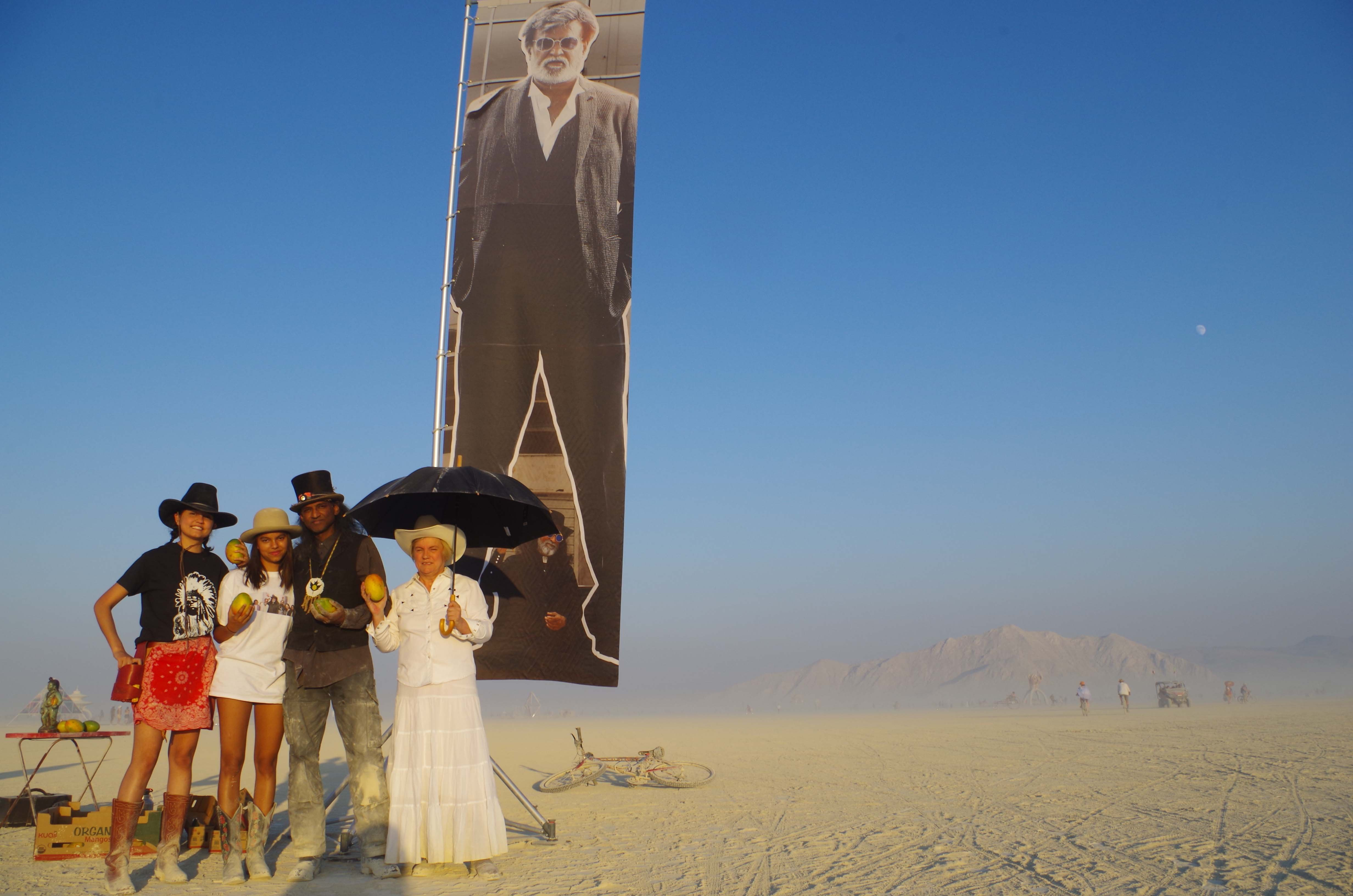
Cowboys and Indians: Tokyo Edition, to be presented at Courtyard Hiroo Gallery on 11th May 2018, is the sencond installation/ performance of ‘Cowboys and Indians’, the 6th series of the Koboi Project. The first edition was presented at the Burning Man Festival in the Nevada Desert in 2017. The overarching Koboi Project is photo-conceptual work involving installations, traditional icons, story telling and performance elements. It is a transnational epic, presented as the adventures of my persona – the ‘Black Hat’ Cowboy, through whom I present my life as my art, as I explore my identity as a Malaysian, as an Indian, as a British Columbian and as a citizen of the world.


 The Koboi Project
You must be logged in to post a comment.