Who or what is the Cakravartin? (Spiritual Authority and Temporal Power in the Indian Theory of Government)

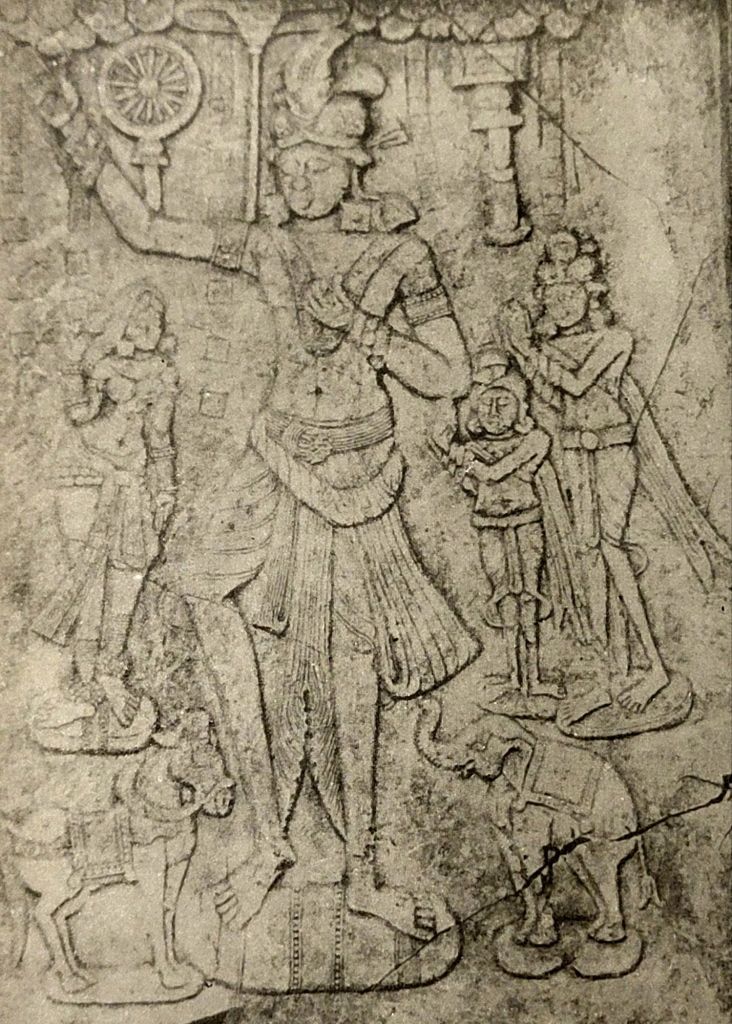
Fig 1. The Circulation of the Shower of Wealth: a Caktavartin with the umbrella of Dominion and the Seven Treasures. Jagayyapeta, 2nd century B.C. (After Coomaraswamy)

I have been slow to begin my series on Ananda Kentish Coomaraswamy’s Spiritual Authority and Temporal Power in the Indian Theory of Government,1 but here is the first installment. It is, arguably, the most complex and integrative of Coomaraswamy’s three most profound texts, the other two being Hinduism and Buddhism and Time and Eternity. I have been reading and rereading Time and Eternity slowly for the best part of 25 years but have only recently begun studying Hinduism and Buddhism and Spiritual Authority and Temporal Power in the Indian Theory of Government. It has not been easy work without proficiency in Sanskrit, Latin and a host of other languages that would render a comprehension of Coomaraswamy’s uncompromising work more complete. Nevertheless, I have taken it upon myself to attempt this task, and share my reflections on this text, as limited as they might be. I am particularly interested in understanding contemporary governance in its light.

I will begin with six  contextualizing themes: 1) Post traditionalism, 2) the relationship of Traditionalism with Fascism, 3) the precedence of Rene Guenon’s Spiritual Authority and Temporal Power,2 4) the implied validation of varna or the caste system, 5) the implied gender hierarchy, and 6) the image of the Cakravartin. In this, the first post in the series, I will deal with the image of the Cakravartin, which, as the frontispiece, is quite literally, the opening of the book. This image is captioned, “The Circulation of the Shower of Wealth: a Cakravartin with the umbrella of Dominion and the Seven Treasures. Jagayyapeta, 2nd century B.C.”

The Cakravartin expresses the Indic ideal of the Universal Monarch and was developed as an icon in the Andhra region during the Buddhist era. The concept was defined and perpetuated in the Brahmanical Kautilya Arthasastra. As John M. Rosenfield notes in The Dynastic Arts of the Kushans, “In the relief carvings of Amaravati and Nagarjunikonda the Cakravartin is usually shown surrounded by the seven emblems of his supremacy: the great discus of unimpeded conquest [cakra], the state elephant on which the king can ride to the very ends of the earth and back in one day, his equally remarkable charger, the octagonal gem which is so luminous that it can light the path of his army by night, the all-wise finance minister, the beautiful consort who is the very embodiment of his prosperity, and his prime minister (or the crown prince). These seven attributes of his dignity, the sapta ratna, come supernaturally to the king when he has attained a requisite degree of virtue.”3 The number and variety of the “jewels” or ratnas varies, sometimes including householder, general, and chariot, with the source being referred to, but there are usually seven and the symbolism is consistent.

As Coomaraswamy notes, according to traditional doctrine, not just Indian but universal doctrine, the life and fertility of the realm depends upon the King.4 If the King fails to fulfil his duty, by way of ritual and metaphysical sacrifice, the wealth and bounty that falls from the sky as rain will cease. This is what the Cakravartin icon symbolizes. The image ties the actions of the King to the fate of the land in a perpetual circulation of gifts – the Gods confer their bounty and the King presents his sacrifice. Coomaraswamy translates and interprets verses from the Satapatha Brahmana on the relationship between the Shower of Wealth and the Cakravartin thus, “its [the Shower of Wealth] self or body (atman) is the sky, the cloud its udder, lightning its teat, the shower the shower (the rain); from the sky it comes to the cow (i.e. from the Sky as archetypal cow to the earthly cow … ), its self or body is the cow … its shower the shower (of milk); and from the cow it comes to the Sacrificer. He [the Cakravartin] (in turn) is the self or the body, his arm its udder, the offering ladle its teat, the shower the shower (of ghi). From the Sacrificer to the Gods: from the Gods to the Cow; from the cow to the Sacrificer; thus circulates this perpetual neverending food of the Gods.” 5

Coomaraswamy specifically addresses the Cakravartin as represented in sculptural reliefs. in Amaravati (similar to the frontispiece which is from Jagayyapeta) He explains that the image shows the Cakravartin raising his right hand up to the clouds (signifying his sacrifice), and that from the sky, a shower of coins is falling (signifying the bounty).6 The image, as a whole, signifies the circulation of wealth, produced and perpetuated by the ritual (outward) and metaphysical (inward) righteousness of the Universal Monarch – the Cakravartin.

  1. Ananda K. Coomaraswamy, Spiritual Authority and Temporal Power in the Indian Theory of Government  (Munshiram Manoharlal Publishers, 1978),
  2. Rene Guenon, Spiritual Authority and Temporal Power (Sophia Perennis, 2001).
  3. John M. Rosenfield, The Dynastic Arts of the Kushans (University of California Press, 1967), 175.
  4. Ananda K. Coomaraswamy, Spiritual Authority, 68.
  5. Ananda K. Coomaraswamy, Spiritual Authority, 68.
  6. Ananda K. Coomaraswamy, Spiritual Authority, 69.
Happy New Year from the Koboi Project

I have not made any new posts since 25 December 2023, having become despondent over the ever-deepening genocide in Palestine. Nevertheless, this blog has had a doubling in viewership in 2024 due to the success of one post – ‘The Poppy is the Flower of Palestine.’

The Koboi Project Blog will be active again, addreessing the same questions of power and justice, but in a more metaphysical manner, beginning with a series of posts on Ananda Coomaraswamy’s ‘Spiritual Authority And Temporal Power In The Indian Theory Of Government’.

Early Internet Art in Malaysia 4

In the introduction to his profound work on the cinematic image, Signatures of the Visible, Fredric Jameson writes, “The visual is essentially pornographic, which is to say that it has its end in rapt, mindless fascination.” Explicit pornography is thus the acknowledgement of the true nature of the filmic image, a “potentiation” of its call to “stare at the world as though it were a naked body.” There is no doubt in my mind that, from the perspective of the Traditional School (with Coomaraswamy and Guenon as exemplars), that the visual abjection that Jameson attributes to cinema is simply the culmination of what one might refer to as the ‘ocularization’ of human civilization in the course of Humanism, the Enlightenment and Modernism.

Exemplified by the entrenchment of single-point perspective as the representation of reality (indeed as reality itself!) in art of the European Renaissance, this ocularity has permeated all aspects of social, cultural and political life in the mainstream of our civilization. Jameson orients his critique towards the centrality of images in consumerist society, wherein our very sense of being in the world is first and foremost visual. He says, “our society has begun to offer us the world … as … a body, that you can possess visually, and collect the images of.” It is this very photographic and pornographic ontology that Marcel Duchamp had earlier articulated and developed through his oeuvre. In all his work, be it his readymades, the Large Glass and most profoundly, in Etant Donnes, this obscenity, inherent in the image is both indexed and exploited.

This critique of visuality and the nature of the image is the impetus for my own The Failure of Marcel Duchamp/ Japanese Fetish Even! (1996). According to Tyrus Miller, underlying the various senses of Duchamp’s use of the word ‘delay’ in connection of the work The Bride Stripped Bare by her Bachelors, Even is that the glass of the so called ‘ Large Glass’ is a medium in which and through which ‘delay’ is realized and manifested, “by virtue of its material properties of transparency, reflectiveness, and refraction of light, and hence, by implication, the splitting of a present act of seeing into temporally different streams, ranging from maximum to minimum delay in the passage of light.” Indeed, I saw the slow download speeds of the early WWW as a vivification of Duchampian ‘delay.’

Further, like Jameson, I saw that the fight about power and desire had to be brought to that place “between the mastery of the gaze and the illimitable richness of the visual object.” In making The Failure of Marcel Duchamp/ Japanese Fetish Even!, I took my own object to the site of Duchamp’s notorious diorama, Étant Donnés, and made an intervention and a photograph. My image was later digitally composited with a pornographic one appropriated from the internet and offered as an online presentation which was inaccessible without the conscious intention of the viewer. If the viewer chose ‘to proceed,’ this gave rise a slow download of the new image, delayed by the bandwidth of the Internet of the day! The first commercial modem, was introduced in 1962 by AT&T and had a download speed of 300 bits per second. By 1994 speeds had reached at 28.8 kilobits per second and in then 1996 the 56K modem was invented. Very slow in comparison to speeds we are familiar with today. For instance, my provider in Vancouver offers fiberoptic data plans with 75mega bits per second (MBPS), 940mbps and 1500mbps download rates.

Also of note is the fact that in January of 1996, 5 years after Tim Berners-Lee published the first ever website and also the year in which The Failure of Marcel Duchamp/ Japanese Fetish Even! premiered at ISEA, there were, according to one source, only 100,000 websites (unique hostnames) on the World Wide Web (an alternative figure for that year is 257,601 websites). Today (as of August 2021), there are well over 1.5 billion websites. Of these annual numbers, 75% are believed to be inactive sites or parked domains.

https://thecharnelhouse.org/wp-content/uploads/2017/09/Fredric-Jameson-Signatures-of-the-Visible-1992.pdf

https://modernistreviewcouk.wordpress.com/2020/07/03/a-delay-in-glass-marcel-duchamp-the-possible-and-the-aversion-to-deja-vu/

https://whirlpool.net.au/wiki/d_u_m_h

https://www.pingdom.com/blog/the-web-in-1996-1997/

https://www.internetlivestats.com/total-number-of-websites/

Potentiality and Prediction 2

In his exposition on Fate, Foresight, and Free-will, Ananda Coomaraswamy states that “No event can be thought of as taking place apart from a logically antecedent and actually imminent possibility of its taking place.”[3] He distinguishes this anticipatory view from a retrospective one thus, “whatever does not happen was not really a possibility, but only ignorantly conceived to have been so.” Coomaraswamy shows how both the potential and the uncertainty of an event, exist or appear to exist only up to the point of its occurrence, at which moment the potential is extinguished and all the alternative possibilities are all shown to have been impossible all along.

The passage above is an extract from my essay Towards A Post-Traditional Gnoseology of Potentiality and Prediction: Preliminaries‘ is published in Oliver Hockenhull’s marvelous A House Made of Dawn: The Sublime Horizon of the Digital Arts as the Concluding Formation of the Information Civilization (2021),’ which “marries science fiction stories with non-fiction essays and with video interventions regarding developments in digital art, computer, communication and network technologies.”

The Image that graces my essay is taken from Y. B Yeats’ ‘Michael Robartes and the Dancer‘.

15 Philosophia Perennis

Keling Maya: Post-traditional Media, Malaysian Cyberspace and Me, presented at the Aliran Semasa Symposium, 2013, at the National Art Gallery, Kuala Lumpur.

O Performance
1 Keling Maya
2 Cyberspace
3 Model
4 Heterotopia
5 Rajinikanth
6 Heroes
7 Telinga Keling
8 Keling Babi
9 Duchamp
10 MGG Pillai
11 Pantun
12 Praxis
13 Dochakuka
14 Post-tradition