RIP Jeganathan Ramachandran 3

Although we have communicated over the Internet quite recently, the last time I saw Jega in person was about 20 years ago! I remember visiting his place with my wife, Jane. We had a great conversation about art, religion and culture. Jega told us about his time in India, inspiring stories about learning from masters of traditional arts and sciences as well as demoralizing tales about Indian attitudes and customs around caste. We spoke on the metaphysical understanding of the world from an Indian perspective and also of the social conditions and the position of Indians in Malaysia.

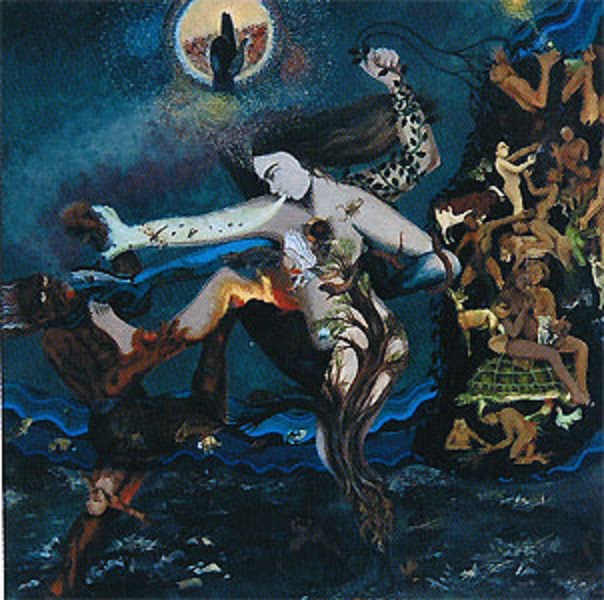
We spoke of the extrinsic oppressions experienced by Indians in the Malaysian political equation and of the detriments that are inherent within the community. It is in this light that I want to highlight the work pictured above titled ‘The House Slave’ (2001) that was included in Bara Hati Bahang Jiwa. This image was painted in response to the suffering experienced by an Indian woman, a friend of Jega’s, who was caught in an abusive domestic situation. It serves as a symbolic reflection on the plight of women caught in the patriarchal failings of Malaysian Indian society. Many Malaysian Indian women suffer a threefold oppression – those of race, class (or caste) and gender. It is as revealing of Jega’s broad and polyvalent practice, as it is of the sacred ontology that, while he operated within the sacred Shiva/ Shakti tradition, his art was most progressive in its representations of gender in secular society.

On a more mystical or uncanny note, I recall how he quietly did reading of Jane’s face (Samudrigham) during our visit, and then, suddenly came out with a statement that she was a very healing person. There was some literal truth in this observation as, while it had been a long time before, Jane had worked as a nurse but we did not take this to be what he meant. As I had felt before, when I received the portrait of me he had made using the same interpretive technique, I felt uncomfortable. While I live within deeply metaphysical sense of reality, and while I am critical of the narrow-minded scientism that dominates the contemporary scientific world-view, I look at all sacred, magical and mystical knowledge as interpretations of signs and symbols patent or latent in creation. I rarely take such propositions as “Jane is a healer” to be intrinsically or literally true. Still, as the years have gone by since our last meeting, and as I have continued to live my life with Jane, I can not deny that there was truth in Jega’s vision. Indeed, I no longer question the reality of what he saw and read at that moment!.

Rest in Peace Jega. Long may your spirit resonate!

Image: https://www.afkcollection.com/gallery/artist/jeganathan-ramachandram
RIP Jeganathan Ramachandran 2

In reflecting on my engagement with the art of Jeganathan Ramachandran, I clearly recall including his paintings in the exhibition I curated for the Balai Seni Lukis Negara in 2002 titled Bara Hati Bahang Jiwa. The exhibition was premised on the need to reconsider the established narrative on Expressionism in Malaysian art from the perspective of a post-colonial recovery. Skirting the pitfalls of essentialism and nationalism, I pitched the reconfiguration in terms of ethnic, ethnographic, regional and national considerations. I identified the underpinnings of a Malay approach to ‘expressionism’ and presented the representative artists this within a boarder national overview, placing the dominant Malay idiom within the wider pool of contemporary Malaysian expressions.

While my thesis was couched in the aesthetic and emotional proclivities of the Malays, I included Chinese and Indians artists even though they disrupted my neat Nusantara schematization which emphasized indigenous psychology and culture (amok, latah, adat and adab). I decided that I would try negotiate the essentially Malay aesthetics of my curatorial theme with the overarching multiethnic realities of the nation. The Indian and Chinese artists did not fit in neatly within my theme and, In this regard, I must acknowledge that, as a whole, Bara Hati Bahang Jiwa was somewhat unresolved, perhaps it was unresolvable by definition … as unresolvable as the idea of the Malaysian nation itself!

Given that I was going to include an Indian artist in the mix, regardless of the goodness of fit, I needed to identify an artist whose work exemplified and encapsulated contemporary Malaysian Indian expression on its own terms … Who would it be? ….. Jeganathan Ramachandran had been making his presence felt in the contemporary scene since the mid 1990’s, with his powerful figurative paintings. Having studied sculpture, woodcarving and painting from a traditional perspective, Jeganathan had been developing a direct and personal mode of expression that was nevertheless steeped in traditional Indian philosophy, psychology and science. I saw in his work the complete Malaysian Indian expression – religious, spiritual, mythical, metaphysical and, most importantly, social.

In a note sent to me in the course of our communication after the ASEAN Art Awards 1996 Jega had said, “I have always believed that art is not just a decorative medium but a powerful tool of expression and the deeper I looked within the Indian art context I saw the vast symbolic expressions that exist within the ‘rigid style’… Then I started painting in a narrative form much like the old times. Nearly every painting of mine had a story and every symbol I applied, new and old, further enhanced the story. During this time my involvement in spiritualism introduced me to many wondrous expressions and their visual impressions upon my mind took on new shapes and I started depicting them in my paintings.” Just as the Malay artists I had selected seemed to carry their particular traditions and psyche into the contemporary idiom of ‘Expressionism, Jega brought forth a deeply Indian expressiveness.

I included 4 of Jega’s works in Bara Hati Bahang Jiwa – ‘Invocation’ (2001) and ‘1 Tree = 40 Life Forms’ (2001) reflect this quest for a spiritual expression, with different degrees of reference to aspects of lived experience. ‘The House Slave’ (2001) is a response to the suffering of a friend in an abusive situation and a reflection on the plight of women caught within Indian social norms. Pictured above is the most expansive of the 4 works, both in scale and in thematic. It is titled ‘Fallout in the Garden of Life’ (1998). The artist has said “Kali is nature and she is fighting everything unnatural which has created imbalance on earth and all the people in the boat- like thing, that Noah’s Ark (my version). My belief is that nature will always protect those who are natural and the five hands represent the five elements (pancha butham). And notice the tree, that’s where it all starts.”

Rest in Peace Jega – Kali Kali Mahakali!

The above is a modified extract from my essay ‘Expression and Expressionism in Contemporary Malaysian Art’ published in 2002.

Reference:
Rajah, Bara Hati Bahang Jiwa: Expression and Expressionism in Contemporary Malaysian Art, Kuala Lumpur: Balai Seni Lukis Negara, 2002.

Image: http://www.sgm.org.my/en/?cur=page/page&id=154&title=Why_Art?_A_Public_Lecture_by_Zanita_Anuar

Pity the Stateless Children

I make this post in the wake of the recent policy reversal by the Malaysian government that requires adopted stateless children to the present of a passport in order to register for schooling. The specific issue of adopted children, cogent though it is in itself, brings forth the more general and much more important question of the state’s moral obligation to provide education to all children, stateless or otherwise, who live within its borders.

I ask the following questions, as an Indian and as a Malaysian –

First I ask, in the context if the statelessness of many Indians in our country, how can any person of Indian identity, holding Malaysian citizenship, fight for equality for themselves, without first embracing the fundamental struggle of our fellows who were brought to British Malaya as indentured laborers in the colonial political economy and then abandoned as the nation achieved independence? Do Indian Malaysians not have to fight for a parity of citizenship amongst out own people before we have the moral standing to question the injustices purportedly meted out to us in a Malaysia dominated by Malays who have, no doubt set their own postcolonial colonial reclamations and interests above all else in the nation.

According to the current UNHCR website ” the Malaysian Indian Community has faced challenges related to identity documentation and confirmation of Malaysian citizenship for many years” and in the estimation of Malaysian NGO, the Development of Human Resources in Rural Areas (DHRRA), there were 12,400 established stateless persons residing in West Malaysia as of the end of December 2017. The UNHCR notes that the documentation problems faced by stateless communities that might best be addressed by the Malaysian government at a policy level. (As an aside, the Pakatan Harapan GE 14 election campaign seems to have been hollow and hypocritical, if not downright dishonest in this its claims and promises on this matter)

Secondly, acknowledging that by no measure is the Indian community the only one facing the curse of statelessness, I ask, can any Malaysian meaningfully strive for anything else of moral worth in our nation, while accepting this denial of access to education to innocent children who are caught within its boarders, trapped in the administrative limbo of statelessness? Shame on Malaysian Indians when we cry louder about a lost Thaipusam holiday! Shame on all of us Malaysians who accept this situation!

Image: https://www.unhcr.org/ending-statelessness-in-malaysia.html

https://malaysia.news.yahoo.com/stateless-children-still-denied-access-015100401.html

https://www.freemalaysiatoday.com/category/nation/2021/01/21/mic-puts-heat-on-kedah-mb-over-cancelled-thaipusam-holiday/

Politik Ketuanan (1948 – 2020)

After Cartoon in Majlis, 6 September 1947 re-presented in Hartal: The Untold Story by Dinesweri Puspanadan

1948, the Malayan Union was replaced by the Federation of Malaya.

The original cartoon addresses, amongst other issues, the PUTERA vs UMNO conflict prior to Federation in 1948. The DR is, of course, Dr. Burhanuddin Helmi.

Source Image: https://www.slideshare.net/ComChe/hartaltheuntoldstory

Koboi Balik Kampung 2

1 MUDIK PULANG Koboi Balik Kampung Series, 12 Chromogenic Printed in a Limited Edition of 9, Niranjan Rajah, 2015

​I will be presenting my Koboi Balik Kampung series of the Koboi Project at Percha Art Space in Lumut over the Christmas and New Year period. The show, titled Dari Pusat Tasek, will open on 25th Dec and run for 2 weeks. Koboi Balik Kampung presents a very personal perspective on the complexities of contemporary Malaysian art and society. It explores the notion of returning home from the diaspora, but also interrogates this idea in terms of the complex relationship between nationality and ethnicity. It was conceived in the course of my visit to Malaysia for Aliran Semasa {RearView Forward}, a series of events curated by Roopesh Sitharan in June and July, 2013. The images were gleaned from my activities in Kuala Lumpur and its surroundings. The titles delve deep into the Malay idioms and expressions. The series was mainly shot by my daughter Durga Rajah who was my constant companion on this trip.

Koboi Balik Kampung (2013)

Koboi Balik Kampung, Readymade Rockmount Western Shirt, 2013. Permanent Collection of the National Visual Art Gallery, Kuala Lumpur. (The image above is from an installation and performance at the National Visual Art Gallery in 2018).

The Koboi Balik Kampung (2013) Readymade from the permanent collection of the National Visual Art Gallery in KL is currently on display at the gallery. This item was a residual artifact from a performance at the Aliran Semasa symposium held at the gallery in 2013. This performance marked my Malaysian homecoming after ten years away in Western Canada.

I appeared at the event wearing a brand-new Rockmount Western shirt with tags intact. As the symposium began, my mother the late Sathiavathy Deva Rajah was invited on stage, to give me a traditional Indian/ Hindu blessing by placing chanthanam (sandalwood paste) and kunggumum (red turmeric powder) on my forehead. Then, facing the audience, I remove the shirt, draped it on a pre-installed hanger at the back of the stage and my mother consecrated it with the same chanthanam and kunggumum. The shirt was left hanging for the duration of the symposium and then presented to the gallery.

A version of the Performance was repeated in an intervention when the item was on show for the first time as a selection from the collection of the National Visual Art Gallery in 2018. My Mother and I were stopped from renewing the markings on the shirt by a curator and a conservator from the gallery. We debated notions of completion of an art work, ownership of an artwork, the artist’s rights to modify an artwork, the extensive conservational bureaucracy that encompases a work of art in a National collection and the effects of all of these on the state of an art work (is it active or is it inert, alive or dead!). Mother and I proceed with the portion of our ritual that did not interfere with what is now the property of the gallery. The image above was captured by my daughter Durga Rajah during this performance.

Telinga Keling (1999)

Telinga Keling, Silver Halide Print, Niranjan Rajah, 1999. Permanent Collection of the National Visual Art Gallery, Kuala Lumpur

Updated on March 29th 2021:

With reference to the recurrent controversies around the use of the term ‘keling’, and with particular reference to the recent Dewan Bahasa dan Pustaka (DBP) inclusion of the word “keling” in its definition of “tambi,  there is no need for hysterical reaction from Indians about the presence of the word Keling in the Malay lexicon and publications in the Malay Language. After all if Indians think about it carefully, ‘thambi’ itself is problematic, as it can reflect status, class and cast when used to refer to adults. In fact it is far more troubling that we use the word ‘pariah‘ as a put-down in English as well as in Malay with scant criticism. However, it reveals an extremely poor standard of scholarship and professionalism on the part of the DBP that they have used the term ‘keling’ as an index for ‘Indian’ in the contemporary setting. Yes, this failure to recognize that the main contemporary usage of of the term is to put Indians down, might even reflect a systemic (unconscious) racism in the esteemed authority in whose care we have put the future of the Malay Language.

Telinga Keling (1999) is in the collection of the National Visual Art Gallery in KL. It is currently (oct 15 2019) on display again in a selection from the collection. ‘Keling’ is a today taken as a derogatory term for ‘Indian’ although, from its etymology, it is clear that this was not always so. The items obscuring my ears in the image are Malay sweets which are colloquially referred to as ‘Telinga Keling’ (Indian Ears). More formally and publicly, given our multi-racial Malaysian society, these cakes are referred to as ‘penyaram’ or ‘denderam’. Ironically, this Telinga Keling sweet is quite likely to be of Indian origin. My mother used to make something that tastes exactly the same that we call it ‘athirasam’

The idea of the piece is that I can engage the Malay viewers regarding this juncture of ‘sweetness’ and ‘derision’ while excluding the others, who would likely be unfamiliar with the cake’s colloquial name. Of course, there’ll be some Indians who know, particularly those from Kelantan where the sweet is prevalent, but empirically speaking, during the opening of its inaugural exhibition in Kuala Lumpur, the Indians had no idea and kept asking, ‘Why did you insult yourself in this work? ’, The Malays, however, smiled at me in and nodded in awkward acknowledgement.

https://malaysia.news.yahoo.com/ramasamy-tells-dbp-remove-racist-020100995.html