Forms of Government 2

2. Ethnocracy: A form of government based on communalism. It is more widespread than you might think. Sometimes it is an explicit premise, at other times, it is just an unstated reality. Wherever the communal organization is stated explicitly in law, we find the formal ethnocracy that we call apartheid.

Here are three instances of legislated ethnocracy –
1) Canada, the quintessential settler-colonial ethnocracy, based on the Indian Act, status identity cards, and native reservations, upon which South African apartheid was based.
2) Malaysia, where there is a constitutionally enshrined ‘special position’ for the indigenous Malays by which they assert their supremacy over immigrant Indians and Chinese who settled under the auspices of colonial rule.
3) Israel, where there is an ongoing occupation of Palestinian lands effected through an apartheid system that involves limiting the Palestinian’s right to movement, denying them the right to vote, and subjecting them to a separate legal system. The seal was set on this ethnocracy, when Israel passed a law in 2018, symbolically affirming that it was the nation-state of the Jewish people.


Teka Teki: Malaysia, Canada, Israel; Apa Persamaannya?
Jawapan: Semuanya mengamalkan Ethnocracy!

UPDATED 13.11.2023

https://en.everybodywiki.com/Apartheid_in_Malaysia

https://troymedia.com/politicslaw/indigenous-apartheid-system-canada/

https://www.vox.com/23924319/israel-palestine-apartheid-meaning-history-debate
https://www.vox.com/world/2018/7/31/17623978/israel-jewish-nation-state-law-bill-explained-apartheid-netanyahu-democracy

Ke Mana Malaysia Kita? 18

An Indian in the Cabinet! Just one!

Sivakumar Varatharaju Naidu is the Minister of Human Resources and the only Indian in Anwar Ibrahim’s cabinet. Gone are the glory days of the Pakatan Harapan government that followed GE 14 when there were 4 Indian ministers in a cabinet of 25 ministerial portfolios. Waytha Moorthy Ponnusamy was Minister in the Prime Minister’s Department responsible for National Unity and Social Well-being, Xavier Jayakumar Arulanandam was Minister of Water, Land, and Natural Resources, Kulasegaran Murugeson was Minister of Human Resources and Gobind Singh Deo was Minister of Communication and Multimedia. Today, in Anwar’s Unity Government there is only 1 Indian minister from a cabinet of 28 portfolios. Indeed, the ratio has gone down dramatically, and there is a lot of discussion in the media, about the implications for the place of Malaysian Indians in the political paradigm of Malaysia.

Malaysia is a nation founded in the wake of colonial immigration and postcolonial communalism. Race and religion are determinants of status and rights in our constitution and the majority of the political parties in our constitutional democracy are defined in terms of ethnic and religious interests. As East Malaysian parties figure more prominently in the political leadership of our nation (as they should in the cause of strengthening the Federation) the space for Indians in the leadership of the nation will naturally diminish in time.

In any event, while some Indians have risen to power based on communalist politics, Samy Vellu being the exemplar, this order has not really served the Indian community very well in the post Independent period. So, while I acknowledge the communal nature of the Indian Malaysian stake in the nation, I believe the time has come to pursue our community interests less directly, by perpetuating general principles of justice and citizenship for all. As the power dynamic shifts in Malaysian politics, Indians need to assert their needs and rights as citizens, rather than as a members of a community. They need to entrench themselves within the multiethnic political parties and contribute to the deepening of trans-communal ethos that may be emerging, in the Malaysian political landscape, albeit, with difficulty.

Our community is clearly on the way to losing its 3rd place in the triumvirate of Malaysian races – Malay/Chinese/XXX, we need to be at the forefront of the effort to transcend communalism in Malaysian life. This might be a losing battle in the face of the rising wave of Malay ethnoreligious sentiments, but I believe it is still the only way forward, and the best chance for Indians to have a say in a future Malaysia. We should stop worrying about the number of Indians in the Cabinet, and focus on deepening our role and influence at the back end of governance. Indian Malaysians have everything to gain from thinking and acting as Malaysians per se, and much to lose by being entrenched in the Indianness of our national identity. I believe that Indians can best serve our community by striving to raise the living conditions and opportunities for all Malaysians who have been left behind in the post-independence period.

Image: https://www.msn.com/en-my/news/national/sivakumar-the-speaker-under-the-rain-tree-now-a-minister/ar-AA14SznE

https://en.wikipedia.org/wiki/Seventh_Mahathir_cabinet

https://en.wikipedia.org/wiki/Anwar_Ibrahim_cabinet#cite_note-3

https://www.malaysiakini.com/columns/646797

Keling Pariah

This is a super exposition on the Keling word on A Daview Originals. Although there are errors, for example, according to the Malay Concordance Project, in the 1963 edition of Cherita Jenaka, orang Keling  was changed to orang India and not, as the presenter claims, the other way around. Sorry lah it is in Tamil!

https://www.youtube.com/c/DaViewProduction/videos

http://mcp.anu.edu.au/N/CJen_bib.html

A Keling Lexicon Q – Z

Telinga Keling, Silver Halide Print, Niranjan Rajah, 1999. Permanent Collection of the National Visual Art Gallery, Kuala Lumpur

A Keling Lexicon A – J
A Keling Lexicon K – P

Q
R
Raja Keling
Rakyat Keling
Rama Keling
Rojak Keling
Roti Keling
Rendang Keling
S
Sembah Keling
Sembang Keling
Sireh Keling
(Kayu) Sono Keling
Subang Keling
Sungai Keling
T
Tanah Keling
Tanjung Keling
Taubat Keling
Telinga Keling
Temberang Keling
Terup Keling
U
Ubi Keling
Ugut Keling
Usada (Pengubatan) Keling
V
W

Wayang Keling
X
Y
Z

Addendum: Keling words with no Indian reference (happy to be corrected)
Keling Gawai
Paku Keling
Pasang Keling


A Keling Lexicon K – P

Telinga Keling, Silver Halide Print, Niranjan Rajah, 1999. Permanent Collection of the National Visual Art Gallery, Kuala Lumpur

A Keling Lexicon A – J
A Keling Lexicon Q – Z

K
Kacang Keling
Kain Keling
Kampung Keling
Kapal Keling
Kapitan Keling
Keling Karam
Kecamatan Keling
Keling Kelate
Kemudi Keling
(Jika Perak) Kerani Keling
(Ikan) Kerapu Keling
Keris (Sempana) Keling
Kesumba Keling
Ketuk Keling (Dulu)
(Darah) Keturunan Keling
Koboi Keling
Kote Keling
Kuli Keling
L
Lidah Keling
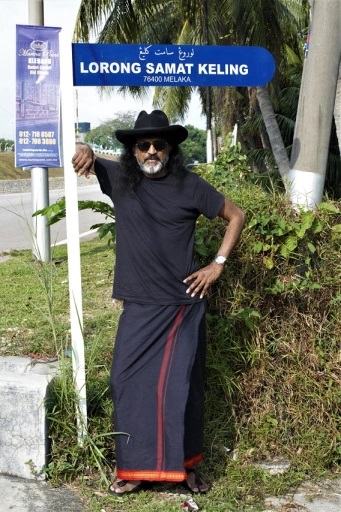
Lorong (Samat) Keling
M
Keling Mabuk (Todi)
Mamu Keling
Keling Maya
Keling Mabuk (Todi)
Melayu Keling
Mengkuang Keling
N
Negeri Keling
O

P
Pacar Keling (Surabaya)
Pahlawan Keling
Pandai Keling
(Corak) Parang Keling
Peguam Keling
Pendekar Keling
Penulis Keling
Keling Pariah
Keling Pelikat
Penulis Keling
Pisang (Abu) Keling
Pisang (Kelat) Keling
Pukul Keling (Dulu)
Pusing Keling
Putar Keling

A Keling Lexicon A – J

Telinga Keling, Silver Halide Print, Niranjan Rajah, 1999. Permanent Collection of the National Visual Art Gallery, Kuala Lumpur

A Keling Lexicon K – P
A Keling Lexicon Q – Z

A
Akal Keling
Anak Keling (Bermain Api)
Auta Keling
Ayam Keling
B
Babi Keling
Keling Balik (India)
Keling Bang (Azan)
Bawang (Merah) Keling
Belanga Keling
Benua Keling
Beras Keling
(Sang) Bhramana Keling
Keling Bodoh
(Anak-putu) Bono Keling
Keling Botol
Bukit Keling (Johor)
Bunuh Keling
Butuh Keling
C
Cempaka Keling
Cakap (Macam) Keling
Cucak Keling
D
Doktor Keling
E
F
G
(Ikan) Gelama Keling
Gelung Keling
Gempar Keling
Gendang Keling
Gertak Keling
Gerantang Keling
(Kerja) Golok Keling
Gulai Keling
(Tari) Keling Gunojoyo
Gunting (Rambut) Keling
H
Hulubalang Keling
Keling Hindu
I
Keling Islam
J
Jambu Keling
Janji Keling
Keling (Teater) Jikey

Towards A Keling Lexicon

Telinga Keling, Silver Halide Print, Niranjan Rajah, 1999. Permanent Collection of the National Visual Art Gallery, Kuala Lumpur

KELING dan MELAYU tak dapat dipisahkan,
Sejarah dan keturunanpun ada kesinambungan.
Persuratan mulia Makkal tak rasa,
Kerana memaki namanya sudahpun berleluasa.

RIP Jeganathan Ramachandran 2

In reflecting on my engagement with the art of Jeganathan Ramachandran, I clearly recall including his paintings in the exhibition I curated for the Balai Seni Lukis Negara in 2002 titled Bara Hati Bahang Jiwa. The exhibition was premised on the need to reconsider the established narrative on Expressionism in Malaysian art from the perspective of a post-colonial recovery. Skirting the pitfalls of essentialism and nationalism, I pitched the reconfiguration in terms of ethnic, ethnographic, regional and national considerations. I identified the underpinnings of a Malay approach to ‘expressionism’ and presented the representative artists this within a boarder national overview, placing the dominant Malay idiom within the wider pool of contemporary Malaysian expressions.

While my thesis was couched in the aesthetic and emotional proclivities of the Malays, I included Chinese and Indians artists even though they disrupted my neat Nusantara schematization which emphasized indigenous psychology and culture (amok, latah, adat and adab). I decided that I would try negotiate the essentially Malay aesthetics of my curatorial theme with the overarching multiethnic realities of the nation. The Indian and Chinese artists did not fit in neatly within my theme and, In this regard, I must acknowledge that, as a whole, Bara Hati Bahang Jiwa was somewhat unresolved, perhaps it was unresolvable by definition … as unresolvable as the idea of the Malaysian nation itself!

Given that I was going to include an Indian artist in the mix, regardless of the goodness of fit, I needed to identify an artist whose work exemplified and encapsulated contemporary Malaysian Indian expression on its own terms … Who would it be? ….. Jeganathan Ramachandran had been making his presence felt in the contemporary scene since the mid 1990’s, with his powerful figurative paintings. Having studied sculpture, woodcarving and painting from a traditional perspective, Jeganathan had been developing a direct and personal mode of expression that was nevertheless steeped in traditional Indian philosophy, psychology and science. I saw in his work the complete Malaysian Indian expression – religious, spiritual, mythical, metaphysical and, most importantly, social.

In a note sent to me in the course of our communication after the ASEAN Art Awards 1996 Jega had said, “I have always believed that art is not just a decorative medium but a powerful tool of expression and the deeper I looked within the Indian art context I saw the vast symbolic expressions that exist within the ‘rigid style’… Then I started painting in a narrative form much like the old times. Nearly every painting of mine had a story and every symbol I applied, new and old, further enhanced the story. During this time my involvement in spiritualism introduced me to many wondrous expressions and their visual impressions upon my mind took on new shapes and I started depicting them in my paintings.” Just as the Malay artists I had selected seemed to carry their particular traditions and psyche into the contemporary idiom of ‘Expressionism, Jega brought forth a deeply Indian expressiveness.

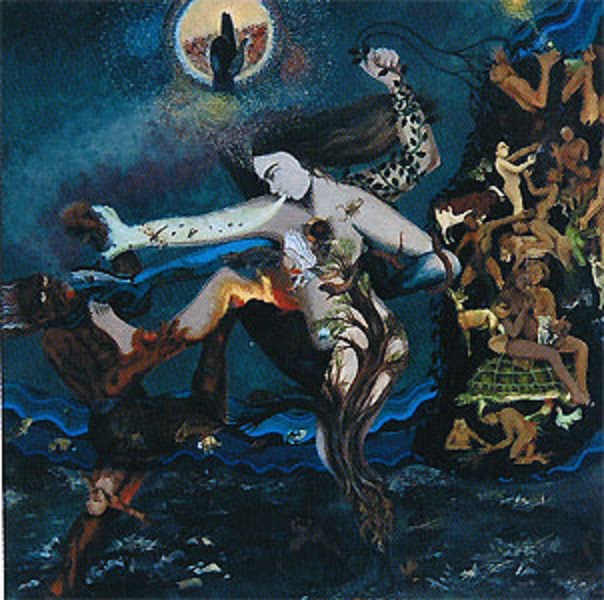
I included 4 of Jega’s works in Bara Hati Bahang Jiwa – ‘Invocation’ (2001) and ‘1 Tree = 40 Life Forms’ (2001) reflect this quest for a spiritual expression, with different degrees of reference to aspects of lived experience. ‘The House Slave’ (2001) is a response to the suffering of a friend in an abusive situation and a reflection on the plight of women caught within Indian social norms. Pictured above is the most expansive of the 4 works, both in scale and in thematic. It is titled ‘Fallout in the Garden of Life’ (1998). The artist has said “Kali is nature and she is fighting everything unnatural which has created imbalance on earth and all the people in the boat- like thing, that Noah’s Ark (my version). My belief is that nature will always protect those who are natural and the five hands represent the five elements (pancha butham). And notice the tree, that’s where it all starts.”

Rest in Peace Jega – Kali Kali Mahakali!

The above is a modified extract from my essay ‘Expression and Expressionism in Contemporary Malaysian Art’ published in 2002.

Reference:
Rajah, Bara Hati Bahang Jiwa: Expression and Expressionism in Contemporary Malaysian Art, Kuala Lumpur: Balai Seni Lukis Negara, 2002.

Image: http://www.sgm.org.my/en/?cur=page/page&id=154&title=Why_Art?_A_Public_Lecture_by_Zanita_Anuar

Politik Ketuanan (1948 – 2020)

After Cartoon in Majlis, 6 September 1947 re-presented in Hartal: The Untold Story by Dinesweri Puspanadan

1948, the Malayan Union was replaced by the Federation of Malaya.

The original cartoon addresses, amongst other issues, the PUTERA vs UMNO conflict prior to Federation in 1948. The DR is, of course, Dr. Burhanuddin Helmi.

Source Image: https://www.slideshare.net/ComChe/hartaltheuntoldstory