On Being Malaysian Tamil 8

According to a report in FMT, on 18 January 2020, hundreds of people rallied to call for the release 12 Malaysian Tamils detained under the draconian Security Offences (Special Measures) Act (SOSMA) for alleged links to the Liberation Tigers of Tamil Eelam (LTTE). This gathering commemorated 100 days of detention for the 12 men who were arrested under the, commonly called Sosma.

The article also claims that the gathering called on Prime Minister Dr Mahathir Mohamad, Home Minister Muhyiddin Yassin and the Pakatan Harapan Cabinet to release the men and abolish Sosma in keeping with their manifesto promise. I would like to note that, while Harapan promised to abolish some laws SOSMA was not one of these. Indeed, the widely held notion that Harapan promised to abolish SOSMA is incorrect. Here is what Promise 27 of the Harapan Manifesto said on the matter –

…. The Pakatan Harapan Government will also abolish draconian provisions in the following Acts:
• Penal Code 1997 especially on peaceful assembly and activities
harmful to democracy
• Communications and Multimedia Act 1998
• Security Offences (special measures) Act 2012 (SOSMA)
Peaceful Assembly Act 2012
• Prevention of Terrorism Act (POTA) 2015″

So what exactly the people can hold the Harapan government to, depends on an interpretation of the phrase ‘draconian measures.’ In this regard, the manifesto itself states that a Harapan government would “ensure an effective check and balance” by revoking “all clauses that prevent the Court from reviewing decisions of the Government or the laws introduced by the Government.” I suggest that the provisions of SOSMA that allow for police detention without bail before trial are just such ‘draconian measures’, as they grant licence to the agents of the executive to incarce suspects outside of the ambit of judicial review.

In fact, as reported in Bernama, on Nov 29, the High Court ruled that this portion of SOSMA is unconstitutional “because it divests from the courts the judicial discretionary power to evaluate whether or not to grant or refuse bail.” These are the provisions that can be misused, and will be seen to be misused even when they are used with good intent. In the interest of all accused persons and for the good name of the Malaysian judicial process, these provisions must be revoked immediately.

As I have suggested before, the 12 Malaysian Tamils are being held on the basis of charges that, at best, seem to defy logic. As they sit out their 100th day in prison, and while their appeals for bail to work slowly through the courts system, there is, as yet, no credible sign that the LTTE exists. At worst, these charges are based on guile and malice. As Suaram executive director Sevan Doraisamy, is reported to have said on behalf of his organization, “We feel that these arrests are politically motivated.” Please see On Being Malaysian Tamil 7

https://www.freemalaysiatoday.com/category/nation/2020/01/18/hundreds-at-rally-to-mark-100-days-of-ltte-detention/

http://kempen.s3.amazonaws.com/manifesto/Manifesto_text/Manifesto_PH_EN.pdfhttp://kempen.s3.amazonaws.com/manifesto/Manifesto_text/Manifesto_PH_EN.pdf


http://www.bernama.com/en/news.php?id=1799295

PETRONAS’ Pipeline Interest 2

According to a post on the UNIST’OT’EN website Wet’suwet’en Hereditary Chiefs have submitted a formal request to the United Nations to monitor RCMP (police), government and Coastal GasLink (CGL) actions on their traditional, unceded territory. This request follows the directive from the UN Committee on Racial Discrimination (CERD) requiring Canada to halt the pipeline project and withdraw RCMP from our territory in order to avoid further violations of Wet’suwet’en, constitutional, and international law. This submission reveals the Chiefs’ perception of the imminent threat posed by the RCMP and security forces currently surrounding Wet’suwet’en villages and lands.

As I have noted before Malaysia’s PETRONAS crown corporation holds a 25% stake in LNG Canada’s Kitimat development which is totally dependant on this CGL pipeline. This pipeline is intended to transport natural gas from Dawson Creek to Kitimat and much of this gas will come from PETRONAS’ own North Montney fields. As noted in the Globe and Mail, the UN Committee for the Elimination of Racial Discrimination says that it is imperative that all affected First Nations give free, prior and informed consent before the pipeline proceeds. So once again, the interests of the exemplary Malaysian bumiputra (indigenous) led enterprise is contrary to the those of a group of indigenous people from British Columbia.

https://unistoten.camp/unintervention/

https://www.theglobeandmail.com/canada/british-columbia/article-wetsuweten-coastal-gaslink-pipeline-rcmp-explainer/

Dari Pusat Tasek 24

Anwar Saji Lagu Tamil

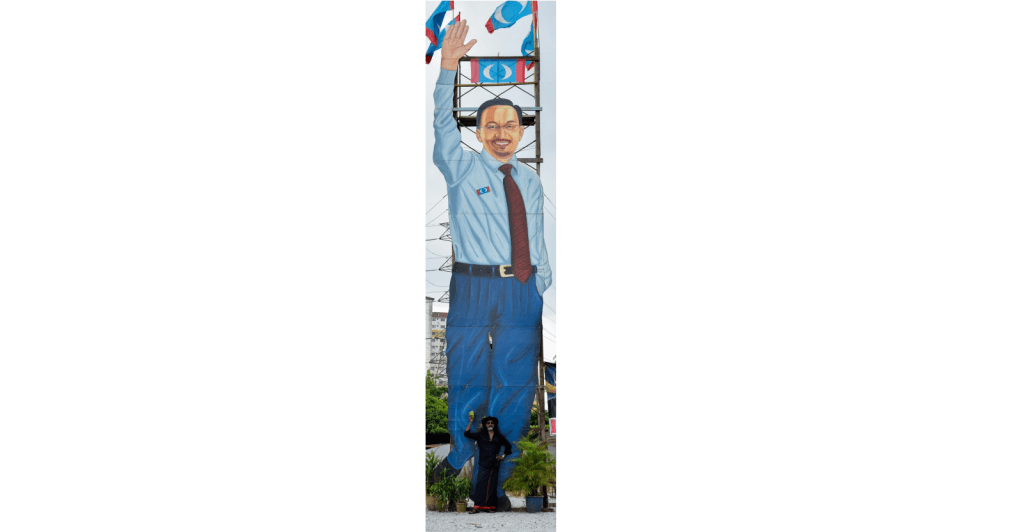
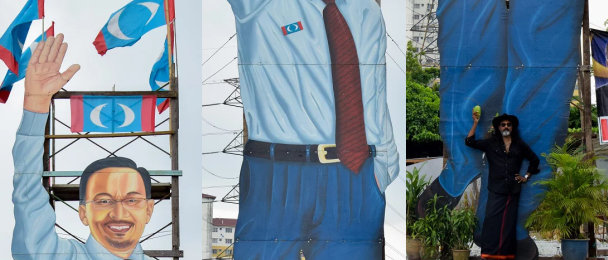
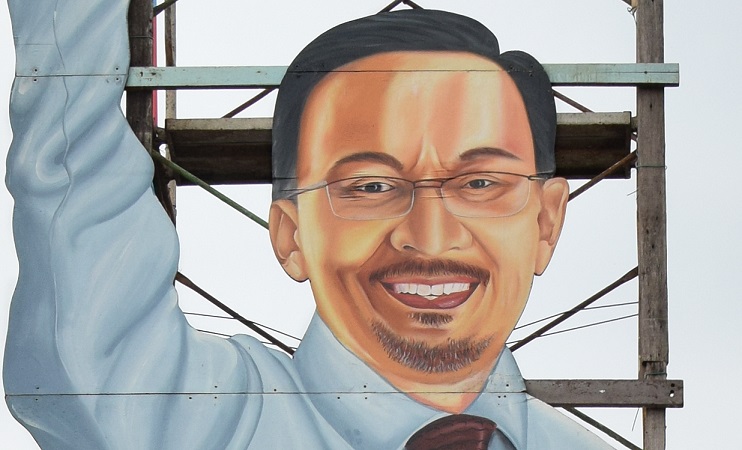
The 12th series in the Koboi Project, ‘Dari Pusat Tasek”, consists of a pair of photographs titled Naan Anaiyttal and Rockin Cowboy taken in Kampung Indian Settlement, Batu Caves and on West Broadway, Mount Pleasant, Vancouver, respectively. Naan Anaiyttal presents the Koboi standing before a hoarding of 12 meter cutout of formerly jailed Deputy Prime Minister and Parti Keadilan leader, Anwar Ibrahim. The Koboi stands gesturing forwards and upwards with a green skinned mango in his right hand. The cutout was initially erected around the 2008 election but taken down in the context of political controversy and  fears that the structure would be vulnerable to weather conditions. It was put up again for the 14th general election which took place in May 2018. The Koboi photograph was taken in 2018.  Naan Anaiyttal is title of a song from M G Rmachandran’s hit film Enga Veettu Pillai (1965). MGR was of course to become the Chief Minister of Tamil Nadu and the song has populist and egalitarian theme. Anwar Ibrahim, in turn is, however tenuously, in line to be the next Prime Minister of Malaysia.

Naan Anaiyittal
Athu Nadanthuvittal
Ingu Ezhaigal vedanai padamatta
Uyirullavari oru thunbamillai
Avar kanneer kadalile vizhamattar

If I were to rule
and if it comes to pass
The poor will not suffer
As Long as they live they will feel no pain
They will not fall into the sea of tears

or in Anwar Ibrahim’s summation

​Kalau aku diberi kuasa
Tidak ada lagi yang derita
Tidak ada lagi yang miskin mengalir air mata

Dari Pusat Tasek 20

The Dari Pusat Tasek exhibition will run at Percha Artspace till 19 JAN 2020, ‘Dari Pusat Tasek” is the title of the 12th series in the Koboi Project, which includes a photograph titled  Naan Anaiyttal  taken in Kampung Indian Settlement, Batu Caves. It presents the Koboi standing before a 12 meter cutout of formerly jailed Deputy Prime Minister and Parti Keadilan leader Anwar Ibrahim. The Koboi stands gesturing forwards and upwards with a green skinned mango in his right hand. The cutout was initially erected around the 2008 election but taken down in the midst of a political/religious controversy about wastage/idolatry and fears that the structure would be a danger to the public in unfavourable weather conditions. It was put up again for the the 14th general election which took place in May 2018. 

The Koboi photograph was taken in 2018. Naan Anaiyttal is title of a song from M G Rmachandran’s hit film Enga Veettu Pillai (1965). MGR was of course to become the Chief Minister of Tamil Nadu and the song has populist and egalitarian theme. Anwar Ibrahim, in turn, is in line, however tenuously, to become the next Prime Minister of Malaysia next Prime Minister. Here are the lyrics of the song in Tamil, English, Malay and finally in Anwar Ibrahim’s own elegant translation –

Naan Anaiyttal
Athu Nadanthuvittal
Ingu Ezhaigal vedanai padamatta
Uyirullavari oru thunbamillai
Avar kanneer kadalile vizhamattar

If I were to rule
If that comes to pass
The poor will not suffer
As Long as they live they will feel no pain
They will not fall into the sea of tears

Kalau saya diperintah
Kalau ia menjadi kebenaran
Kaum miskin tidak akan menderita
Sepanjang hidupnya tanpa kecewa
dan tidak terjatuh ke lautan air mata

Kalau aku diberi kuasa
Tidak ada lagi yang derita
Tidak ada lagi yang miskin mengalir air mata

Naan Anaiyttal
Lyrics by Vaali

Dari Pusat Tasek 19

The Dari Pusat Tasek exhibition will run at Percha Artspace till 19 JAN 2020. As part of this event a performance was held at the Lumut Waterfront on the 25th December 2019. The Naan Anaiyttal flag was raised on a portable flag stand, accompanied by a performance based on a Perak Malay cleansing ritual. The flag presents the Koboi standing before a 12.2 m hoarding of the once jailed politician who is now Malaysia’s prime minister in waiting, Anwar Ibrahim. This image was shot in Kampung Indian Settlement, Batu Caves, in the wake of Malaysia’s 14th General Elections. Photographs of the Lumut performance will go towards making the 13th series of the Koboi Project tentatively titled Badan Aku Tubuh Negara. The draft of this work can be viewed at https://koboibalikkampung.wixsite.com/sialjambalang

Dari Pusat Tasek 6

The Dari Pusat Tasek performance (View my draft for the 13th Koboi series ) was held at the Lumut Waterfront, under the auspices of Percha Art Space at 5pm on the 25th December 2019. The exhibition will run till 5 Jan 2020 (EXTENDED TILL 19 JAN 2020) . The Naan Anaiyttal flag presents an image that was shot in Kampung Indian Settlement, Batu Caves, in the wake of Malaysia’s 14th General Elections. The Koboi stands before a 12.2 m hoarding of the once jailed politician who is now Malaysia’s prime minister in waiting, Anwar Ibrahim. This flag was raised on a portable flag stand, accompanied by a performance based on a Perak Malay cleansing ritual performed with cut lime.

After my body was ritually rubbed with lime, I faced the East and spit seven times. I then threw the remains of the limes in the Westerly direction  saying, Pergi-lah semua sial jambalang dari badan aku, dan dari pada tubuh negara; pergi lah ke Pusat Pasek Paujangi, (‘Misfortune and spirits of evil begone from my body, and from the corpus of the nation, begone to the whirlpool of the of the Pusat Pasek Paujangi!) Water was then poured over me to complete the cleansing. All the waters of the world are ultimately received at the Pusat Tasek, bringing to its swirl all of the flotsam, jetsam and refuse of the world. The Pusat Tasek of myth seems to coincide with the contemporary swirl of the North Pacific Gyre – a place at which the worst of our contemporary sial jambalang reside.

http://www.gutenberg.org/files/47873/47873-h/47873-h.htm

On Being Malaysian Tamil 5

12 Indian detainees wait for trial in Malaysian prisons on LTTE related charges under the ambit of SOSMA with draconian restrictions of their rights to a fair and open trial. Terrorism is a matter of legal definition and that the LTTE was not designated as a terrorist organization in Malaysia until 2014. Until this time, most Tamils in Malaysia as in the wider diaspora would have seen the LTTE as a violent separatist movement born of the exhaustion of peaceful and democratic negotiations with the majority Sinhalese. Velupillai Prabhakaran was doubtless identified as a ruthless leader but admired for his incomparable courage, determination and military prowess.

This admiration is a very different matter from believing that he and his Tigers were right in their methods and even their goals. I for one have always been against a violent struggle for Elam. I have feared that the goal of a Tamil nation on the island of Lanka, while being historically justified, may just be a vanity project for the diasporic community. An edifice that can only be built out of the blood and tears of those left behind. Even if the men and women of the armed movement of liberation may have been cognisant and willing, it is the civilians would have been unwittingly and unknowingly been made to pay. Further, the middle classes were the best equipped to exit the situation as expatriates and refugees, while the working classes and the poor did not have that choice. Offering material support form the safety of the international diaspora would, in my view, have meant foisting blood and sorrow upon those who had no agency. Ultimately, I could not see Elam a sustainable geopolitical entity. Even with all of Prabhakaran’s prowess, he could only deliver Elam as a temporary domain, as a stage in a South Asian game of thrones in which the real players were bigger than the Tamils and the Sinhalese – India, the US and China!

Although I have never supported the LTTE , I do see them as having taken up a valid stance among the options available to the Tamils in their time. Towards the end of the Elam war in 2009, with Tigers and civilians trapped on the beach at Mullivaikkal, I stood with a small crowd of Tamils outside the CBC offices in Vancouver trying to impress upon that estemend news agency, that they were obliged to report on the plight of Tamil civilians caught between the ruthless Tigers who were using them as a shield and the merciless SLA who seemed about to attack with genocidal abandon. News of his situation was, it seemed, being systematically suppressed. Amongst those with whom I stood in solidarity that day, as a member of the Tamil diaspora, were flag waving supporters of the LTTE. It was at that moment impossible for me to extricate the furtherment of the cause of Tamils from that of the Tigers.

For all intents and purposes the LTTE ceased to exist with the Mullivaikkal massacre by the victorious SLA. It can not be denied that to Tamils across the world, even to those who find the their methods despicable and their project erroneous, the Tigers and their leader are champions of the Tamil race. They are the latest signifiers in an ancient stream of heroes and conquerors that flows through the heart of the Tamil identity. While they will not be forgotten as myth they are gone as an organization, and so, even though I make no assumption about the guilt or innocence of the 12 Malaysian Indians, I must note that in charging them with possessing printed literature and propagating the LTTE on social media, the onus is on the state to show that these men were furthering the organizational agenda of the LTTE rather than celebrating the myth . Further the state is obliged to prove that the organization still exists and/or that these men were involved in actually trying to revive an entity that is contiguous with the LTTE that was extinguished in 2009. … More in On Being a Malaysian Tamil 6

On Being Malaysian Tamil 1

I am a Malaysian of Jaffna Tamil extraction. My late father was a Seremban born Malaysian but my Mother, also now deceased, was a Jaffna girl. Just as the Malays of the peninsular index the notion of a homeland with the term Tanah Melayu, the Tamils of Jaffna use the term Elam. Unlike the Indians and Chinese populations of Malaysia, the majority of whom came under the auspices of the British, the Tamils of Sri Lanka are the descendants of the subjects of ancient Tamil Kingdoms. As such, they have a sense of attachment and entitlement to the land commonly found in those who have occupied and ruled for centuries. Neither the majority Sinhalese nor the minority Tamils are beholden to any compromise or ‘social contract’ the one that binds Malays and non-Malays in Malaysia. This sense of entitlement lead to irresolvable conflict and I have observed this violent Elam struggle from afar. I have experienced it vicariously through news of grandparents and aunties caught in the crossfire between the LTTE (Liberation Tigers of Tamil Elam)and the IPKF (Indian Peace Keeping Force), cousins in being sent away to India and Canada as they reached their teenage years for fear of being killed by the SLA (Sri Lankan Army) or Forcibly recruited by the Tigers …. and there are many other such family situations that I have experienced vicariously, scenarios whose trauma I have felt through my own mother’s emotional responses.

My father was a pragmatist and a dove, “Minority Tamils need to compromise with the Sinhala majority! Given the demographics of post-colonial Sri Lanka, armed struggle is futile ,” I can imagine him encapsulating his position. My mother however, was a Tigress at heart! Metaphorically speaking,that is! “They have taken away our language and now they will push us into to the sea!” She could not stand the injustices, indignities and the cruelties experienced by the Tamils and once the war had begun she was emotionally behind “our boys and girls” fighting with the LTTE! You have to recall that the LTTE was not designated as a terrorist organization in Malaysia at the time of this war of independence. (It is much later in 2014 that the designation was given, long after the war had been lost and the LTTE decimated in 2009). And my mother’s openly emotional allegiance meant serious arguments with my father. Although, I was more interested in questions of race, nationality and justice in my own Malaysian milieu, I absorbed all the contrasting positions and sentiments … more in On Being a Malaysian Tamil 2

Telinga Keling (1999)

Telinga Keling, Silver Halide Print, Niranjan Rajah, 1999. Permanent Collection of the National Visual Art Gallery, Kuala Lumpur

Updated on March 29th 2021:

With reference to the recurrent controversies around the use of the term ‘keling’, and with particular reference to the recent Dewan Bahasa dan Pustaka (DBP) inclusion of the word “keling” in its definition of “tambi,  there is no need for hysterical reaction from Indians about the presence of the word Keling in the Malay lexicon and publications in the Malay Language. After all if Indians think about it carefully, ‘thambi’ itself is problematic, as it can reflect status, class and cast when used to refer to adults. In fact it is far more troubling that we use the word ‘pariah‘ as a put-down in English as well as in Malay with scant criticism. However, it reveals an extremely poor standard of scholarship and professionalism on the part of the DBP that they have used the term ‘keling’ as an index for ‘Indian’ in the contemporary setting. Yes, this failure to recognize that the main contemporary usage of of the term is to put Indians down, might even reflect a systemic (unconscious) racism in the esteemed authority in whose care we have put the future of the Malay Language.

Telinga Keling (1999) is in the collection of the National Visual Art Gallery in KL. It is currently (oct 15 2019) on display again in a selection from the collection. ‘Keling’ is a today taken as a derogatory term for ‘Indian’ although, from its etymology, it is clear that this was not always so. The items obscuring my ears in the image are Malay sweets which are colloquially referred to as ‘Telinga Keling’ (Indian Ears). More formally and publicly, given our multi-racial Malaysian society, these cakes are referred to as ‘penyaram’ or ‘denderam’. Ironically, this Telinga Keling sweet is quite likely to be of Indian origin. My mother used to make something that tastes exactly the same that we call it ‘athirasam’

The idea of the piece is that I can engage the Malay viewers regarding this juncture of ‘sweetness’ and ‘derision’ while excluding the others, who would likely be unfamiliar with the cake’s colloquial name. Of course, there’ll be some Indians who know, particularly those from Kelantan where the sweet is prevalent, but empirically speaking, during the opening of its inaugural exhibition in Kuala Lumpur, the Indians had no idea and kept asking, ‘Why did you insult yourself in this work? ’, The Malays, however, smiled at me in and nodded in awkward acknowledgement.

https://malaysia.news.yahoo.com/ramasamy-tells-dbp-remove-racist-020100995.html

My Country

8 My Country, Dendang Koboi Gelap Series, 2016

It is the morning of the 31st of August 2019 and I am posting this image from my home in Vancouver (16 hrs behind in seeing the Sun), thinking of Malaysia and Malaysians on this day of our Independence ! This image is part of the Dendang Koboi Gelap series (https://koboibalikkampung.wixsite.com/koboigelap ) of the Koboi Project which was shot in December 2015 in Kuala Lumpur, and Vancouver as well as at the National Gallery of Singapore which had just opened in November 2015 and Vancouver . The photography is by Tan Sei Hon, Durga Rajah and various stewards and visitors at the National Gallery of Singapore. It is a set of 12 Archival Silver-Halide Dye Prints issued in an Edition of 9 and 1 Artist’s Proof. The series consists of 9 landscape images at 20″ X 30″ and 3 portrait images at 13.33″ X 20″.