My First Rodeo 2

The Koboi Project centres on the question of identity and its relationship to authenticity. I dress as a cowboy, both in performance situations and in my private life. Indeed, I am very comfortable with this eccentricity of mine, so much so that, in some ways, I feel that I am a cowboy, albeit an urban cowboy who has never ridden a horse and has very little to do with cows. As a vegetarian, I do not even eat them. In my daily life, you could say it is my style. When I perform in Southeast Asia it stands for my return from the West. But what happens to the authenticity of my persona when I venture into real cowboy country.

Recently, at the Cloverdale Rodeo, I gained some insight into the nature of my Koboi persona and even the nature of cowboy persona itself. At the heart of the rodeo is the image of the pesky, spunky cowboy prevailing over the ornery Bronco, kicking and bucking to get him off its back. In my observation at Cloverdale, however, there seemed to be a little bit of a disconnect. Indeed, the horses buck violently, and the Cowboys hang on valiantly and skillfully, but are the horses bucking to get the cowboys off or are they bucking for some other reason? There is, in this context, a debate about the use of spurs and the application of pressure around the horse’s belly with what is called a flank strap. Some say the strap brings pain that causes the bucking and others that it merely gives form to the buck.

The BC SPCA says that the flank strap “applies pressure on their sensitive underbelly, causing discomfort. The rider also uses … spurs, to cause discomfort which leads to more bucking. While bucking is a natural behaviour of these animals, in rodeo it is a behaviour rooted in discomfort, not in play.” In other words, it is not as it appears, that the horse is bucking to get the rider off, but as a response to the discomfort caused by the flank strap. The cowboy’s art of hanging on is incidental or secondary to the main action. Proponents of rodeo however, counter with the argument that the horse bucks because it is in its nature and breeding to do so, and that the “flank strap alters the bucking action of the horse by encouraging him to kick out straighter and higher with his hind legs, thus making himself harder to ride. The flank strap stacks the odds in favor of the horse. It cannot make him buck.” With regard to the spurs, they insist that they are required to be blunt and spinning and that they also put the odds in favor of the horse, as the forward position of the feet required to spur the horse in the shoulders makes it much harder for the cowboy to stay on.

Even within the proponents’ terms, it can not be denied that there is a sense that the bucking is being induced and conditioned independently of the horse’s impulse to get the rider off its back. The horse is just bucking independantly and the rider holds in an illusion of relationship. The question of cruelty aside, the rodeo cowboy’s ride is a performance, and not unlike my own Koboi performance, an artifice or fiction of sorts.

https://spca.bc.ca/ways-to-help/take-action/farm-animals/rodeo

https://www.cowboyway.com/BroncRiding.htm

About the Koboi Project

The Koboi Project is an expression of my search for an integral identity, across the gaps of an inter-generational diasporic experience, within the context of the contemporary crisis of globalization. The Koboi Project integrates its own abiding tropes – the ‘black hat cowboy and the ‘SUPERSTAR’ with the idioms, myths, and contemporary issues of each place of performance or presentation. An important aspect of the work is the circulation of its messages via a range of media, beginning with the megaphone and the banner as primordial transmitters of word and image. The Koboi Project is realized and disseminated by way of photographic prints, performances, installations, and online images/ social media. Among the imperatives of this autobiographical photo-performative project is the development of a deep engagement with place and people. This involves an immersion in the social history, popular culture, language, and religion of the places involved.

The most recent Koboi Project presentation is the Pokok Pauh Janggi exhibition at the Kapallorek Artspace, Bandar Seri Iskandar, Perak in Aug/Oct 2023.

Early Internet Art in Malaysia 11

Between 1997 and 1998 Dr. Raman Srinivasan of Chennai and I collaborated to build, theorize and install a virtual temple on the Internet. The Temple was built in VRML in Chennai and located on a server in Sarawak. It was presented to the international interactive arts community in a paper titled Sacred Art in a Digital Era: Or the Internet and the Immanent Place in the Heart at the 2nd Consciousness Reframed conference at the University of Wales College in Newport (not available online).

The VRML temple was based on sketches of the Hridayaleeswarar temple, an existing physical structure in Thirunindravur about 20 miles from Chennai. According to the Sthala Purana or founding legend of the temple, it was in fact erected by the great King Kadavaraja based on the proportions of what was initially a virtual temple built in devotional meditation by the sage Poosalar. Some years after our project ended and the website was taken down, I returned to the VRML model to make a 3D print of its central Icon, Lord Shiva Nadaraja. This image was sent to Chennai from Vancouver where it was consecrated by Srinivasan’s father and used in domestic worship.

At the heart of this project was the integration of the traditional and the technological relationships of the real to the virtual. There was first, in the sthala purana, a movement from myth to physical architecture and then, in our VRLM/Internet project, from the actual architecture to the virtual model and, finally moving from the VRML model to the physical 3D print. This work was grounded in the belief that as the World Wide Web makes the Internet globally accessible, it must become a medium for the living sacred traditions of the world.

I went on to develop a framework for the rapprochement of digital technology and sacred tradition in papers like the following –


http://www.immersence.com/publications/1999/1999-NRajah-full.html

https://web.archive.org/web/20030106042915/http://www.uoc.edu/artnodes/eng/art/rianan0302/rianan0302.html

.

Abhimanyu Sir

The magnificent Rajini Sir seems unable to avoid being the embodiment of mythology. Recently, he has been equated to the Trojan Horse from the Odyssey, suggesting that his appealing Dravidian cinematic persona may be packed with a BJP / Arya Samaj political intent, waiting to be let in past the Dravidian gates of Tamil Nadu governance. Now, with his own Mahabaratha reference in the context of the Modi government’s move to revoke Article 370, he has been equated to Abhimanyu the warrior son of Arjuna. In an open letter to Rajinikanth Arun Ram, Resident Editor, of the The Times of India, Tamil Nadu, writes, ” I am happy that you have found your Krishna and Arjuna in Amit Shah and Narendra Modi, though you are not sure who is who. That’s fine, as long you realise that you are the Abhimanyu the BJP badly needs in Tamil Nadu.”

Abhimanyu is the son of Pandava champion Arjuna and nephew of the Lord Krishna himself. At the tender age of 16 he was the most powerful, and perhaps vainglorious, of warriors. But despite wreaking havoc on the Kauravas in the battlefield he is killed and his role in the plot of the Mahabaratha seems to be much more as a catalyst of victory than as a victor. You see, his father Arjuna is ambivalent about using his powers to destroy the enemy. The Kauravas are after all the cousins of the Pandavas! With the killing of his beloved son, however, Arjuna is personally afflicted and is open to the martial wiles of the masterful Lord Krshna.

Abhimanyu was a dispensable element in the plot of the Mahabharata. I hope Rajini Sir will avoid the pitfalls of personifying such figures from Indo Aryan mythology as the dissembling Trojan Horse and the tragic Abhimanyu, on the political battlefield of Dravida Nadu.

Image: https://timesofindia.indiatimes.com/blogs/chennaitalkies/letter-to-rajinikanth-please-be-bjps-abhimanyu/

https://www.mahabharataonline.com/stories/mahabharata_character.php?id=78

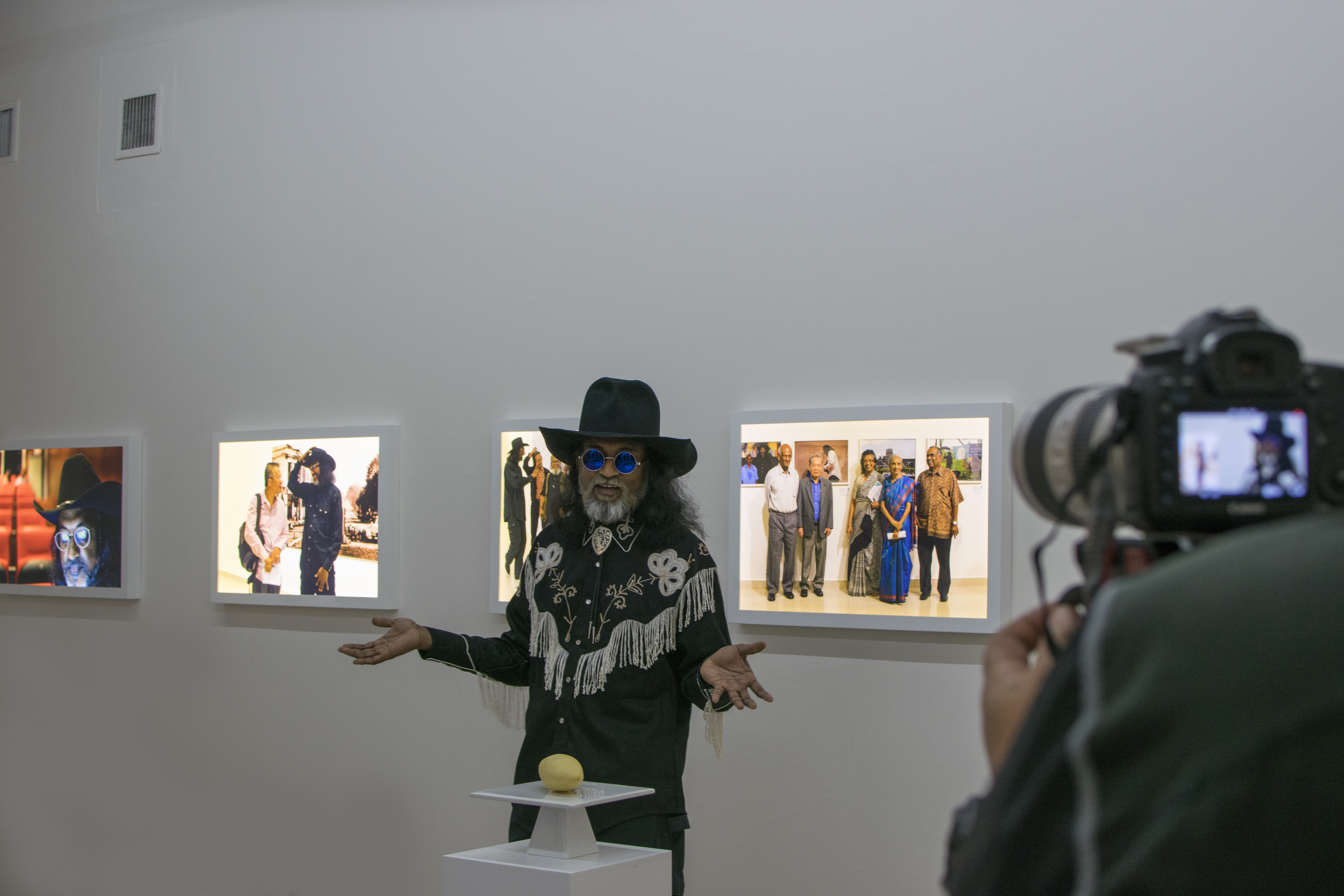
Mango Performance

mango-performanceIt was a happy return for the Koboi, when on the 28th October 2016, I presented my Koboi Balik Lagi performance as a Biennale artist at the Singapore Art Museum. This is where I had cut my teeth as a Southeast Asian theorist and as a curator in the 1990s. Compared to my previous appearances at this venue, my mango myth presentation was a bit more of an enactment and less of an exposition. Still, for me, there is little difference between the two modes of performance. In fact, in the oral, tradition all speech acts are performative. In the mindful recounting  of myth, the diegesis is inherently mimetic. The world is enacted  in the telling and within this enactment, stirs the moment of its its very creation. Such are the workings of the oral tradition … the universal sacred tradition. Indeed, as Ananda Coomaraswamy has explained, ‘a myth is always true’.