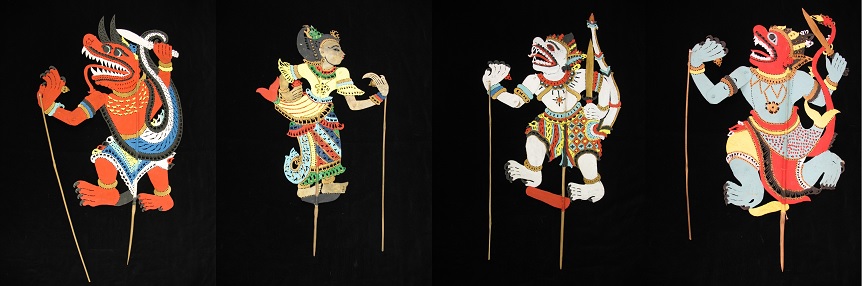
Nenek Sepit Pentala Naga | Tuan Puteri Ikan Selar Banum | Hanuman Kera Putih | Hanuman Ikan
In the Mak Yong Endeng Tajali, when the Great Raja dies, his sons the Elder Raja, the Middle Raja and the Young Raja fight for the throne. The Elder Raja is victorious and Middle Raja flees to the forest to became a Jin Gergasi haunting the land, while the Young Raja goes to the Laut Buih Gelombang Tujuh to become the Nenek Sepit Pentala Naga. At the centre of this lautan is, of course, the Pusat Tasek Pauh Janggi.
In the Kelantan Wayang Kulit at the bottom of, presumably, the same Pusat Tasek, there also lives a Nenek Sepit Pentala Naga. He is the Raja of the Negeri Lautan Buih. He has a beautiful daughter, the Tuan Puteri Ikan Selar Banum who marries the great warrior, Hanuman Kera Putih and has a child named Hanuman Ikan.
The Dari Pusat Tasek, exhibition at Percha Art Space runs till 19 JAN 2020.
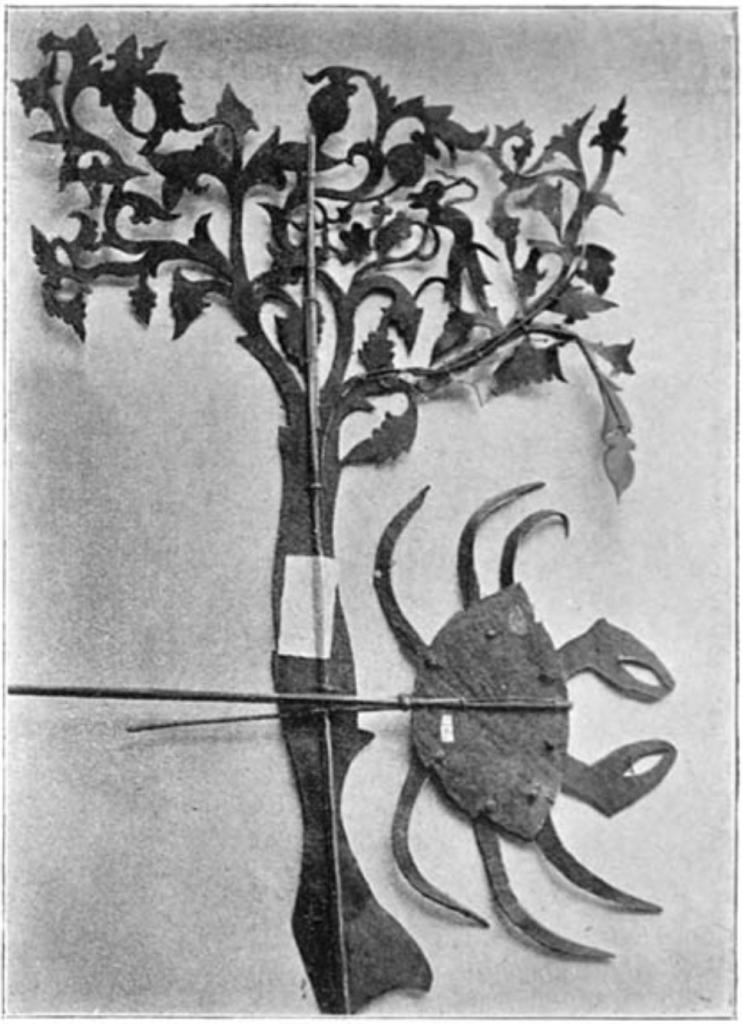
The enormous tree at the centre the ‘Pusat Tasek’. is an known as the Pokok Pauh Janggi. While I have been insisting that this is a mango tree, I have to acknowledge that the more commonly held view is that it is a coco de mer palm. Still, pauh is the Malay word for ‘mango’ and as Paul Kekai Manansala suggests janggi, probably, derives from the Toroja word ‘djjandji’ which, like the Malay ‘buah’, means ‘fruit’.
The Toraja are a people from the Sulawesi island, to the Southeast of Borneo, whose ancestral myths seem to claim origins from an island somewhere to the north where there is a powerful current, which could possibly be the Pusat Tasek. In the Taroja language taripa djandji means ‘mango tree,’ where or taripa means ‘mango’ and djandji , derived from djampu means ‘fruit’. In suggesting that the Toraja taripa djandji is the more original form of Pauh Janggi , Manansala points out that among the Bare’e people, also from Sulawesi, taripa djandji is the common way of saying ‘mango tree.’
Manasala also notes that Antonio Pigafetta, a mariner on Ferdinand Magellan’s pioneering voyage of ‘discovery’ (1518-1522), mentions local tales of an island surrounded by whirlpools, somewhere north or south of Java Major (Borneo), called Puzathaer (Pusat air?) on which there was a very large tree in whose branches perch enormous birds called Garuda. The fruit of this tree was said to be ‘larger than a cucumber.’ This size comparison, which must surely be with the in terms of the chayote cucumber from the Americas, suggests that the tree concerned was, indeed, a mango tree. The nut of the coco de mer is very much larger.
In Malay, of course, Pokok Pauh Janggi refers only to the mythical tree. A quotidian Mango tree would be pokok pauh and the coco de mer is referred as kelapa laut. While none of this is conclusive, in my understanding of language and of myth, the fact that, even when the signifier ‘Pauh Janggi‘, is understood as an index for the signified ‘coco de mer‘, the fact that it is indexed via the word ‘pauh‘, confirms that the root of chain of signifieds or similes is, indeed, the ‘mango’.
So where is the mythical Pusat Tasek Pauh Janggi located? I have found two possible locations so far; one from Pigafetta’s notes, is somewhere north or south the island of Borneo and the other, from the Perak establishment (pertabalan) myth of the Perak Sultanate, somewhere off the mouth of the Perak River. Now from that masterful, yet woefully ‘ortentalist’ (in Edward Said’s meaning of ‘Orientalism’ ), storyteller Rudyard Kipling’s, Just So Stories, I have found that there is also a way to conceive of a congruence or conflation of these locations.
In his tale of how the crab came to have pincers and live in holes in the sand titled The Crab That Played With The Sea he tells also of the cause of the tides and the currents and their primordial connection with the Pusat Tasik Pauh Janggi. While this tale is most interesting for its domestication and massification of colonial ethnography in the public discourse of Empire, I find its placement of the Tusat Tasek its greatest draw in the context of my present Dari Pusat Tasek project.
As the Elder Magician, the Son of Adam and his young daughter go in search of Pau Amma, the giant crab –
“they pushed out on the Perak river. Then the sea began to run back and back, and the canoe was sucked out of the mouth of the Perak river, past Selangor, past Malacca, past Singapore, out and out to the Island of Bingtang, as though it had been pulled by a string … So he took the paddle; but there was no need to paddle, for the water flowed steadily past all the islands till they came to the place called Pusat Tasek—the Heart of the Sea—where the great hollow is that leads down to the heart of the world, and in that hollow grows the Wonderful Tree, Pauh Janggi ..“
So it seems that in the space and time of mythology, and, in fact, of voyages in general, movement on a given course implies no necessary limit on the distance travelled, such that “off the mouth of the Perak River” can mean “North or South of Borneo Island”, of course!
The Dari Pusat Tasek exhibition will run at Percha Artspace, Lumut Waterfront till 19 Jan 2020. The performance for this event arises from the myth of the ‘navel of the seas’ or the Pusat Tasik Pauh Janggi. It is held in Malay folklore that somewhere in the proximity of the island of Borneo, or alternatively, somewhere off the mouth of the Perak river, there is a massive whirlpool that swirls down to the depths, draining the waters into the earth. At this nexus, rooted on the ocean floor, is the fabulous Pokok Pauh Janggi that reaches up to the heavens. At the base of this tree, at the bottom of the swirl of the ‘pusat tasek’, there is said to sit a giant crab, blocking the opening of the drain of the waters. It is the daily movements of this crab, that cause the oceans to rise and fall cyclically, giving us both the currents and the tides.
In connection with my show at Percha Artspace titled Dari Pusat Tasek, which runs till 5 Jan 2020, I ask the obvious question – where is the Pusat Tasek Pauh Janggi (Navel of the Seas)? The performance carried out on the Lumut Waterfront was based on a Perak Malay cleansing ritual that purports to wash all the sial jambalang (ill luck and malevolent spirits) away to the Navel of the Seas.. Many sources on the location of the Pusat Tasek place it somewhere in the South China Sea or Southwest thereof. According to Antonio Pigafetta, a mariner on Ferdinand Magellan’s pioneering voyage of ‘discovery’ (1518-1522), there were local tales of an island surrounded by whirlpools, somewhere north or south of Java Major (Borneo), called Puzathaer(Pusat air?) . The location of this Pusat Tasek varies, however, with the source of the myth. According to a Perak legend associated with the installation of its first Sultan, Mudzaffar Shah I, the Pusat Tasek is located somewhere off the mouth of the Perak river, beyond the extensive sandbanks there. This area, named Beting Beras Basah or Beras Basah Sandbank, is known as a deeply magical place – one filled with all manner of makhluk ghaib (supernatural beings).
Wayang Kulit puppets – Pokok Pauh Janggi and Ketam Gergasi
The Dari Pusat Tasek exhibition and performance will open at the Percha Art Space in Lumut on 25th Dec 2019. This performance for this event arises from the mythic realities of the ‘navel of the seas’ or the Pusat Tasik Pauh Janggi. Far out in in the deep ocean somewhere in the proximity of the island of Borneo, or even in the mouth of the Perak river, depending on which account one follows, there is said to be a momentus whirlpool that swirls down to the depths, draining the waters into the earth. Also at this nexus, rooted on the ocean floor, is the fabulous Pokok Pauh Janggi that reaches up to the heavens. At the base of this tree, at the bottom of the ‘pusat tasek’, there is said to sit a giant crab, blocking the opening of the drain of the waters. It is the daily movements of this crab, that cause the oceans to rise and fall cyclically, giving us both the currents and the tides. The oceanic currents are sometimes personified as a regular visitor, the Mambang Tali Harus, a type of spirit who is said to go back and forth from the navel of the seas (bĕrulang ka pusat tasek). Rooted at this centre of tidal activity, this Pusat Tasik, is the fabulous Pokok Pauh Janggi that reaches up to the heavens.
In the Selangor Malay tale of Haji Batu, a man, journeying to perform the Haj, had to cross the fearsome Navel of the Seas, known to be a dangerous and fiendish place (Siapa terjatuh atau tergelincir, tersuruplah ia ke dalam pusar. Tempat menanti segala mara bahaya. Tempat duduk menantinya Nenek Sepit Pentala Naga di Laut Buih Gelombang Tujuh. Kalau si lemah yang sampai, maka hilang ghaiblah ia di mulut Raja Naga yang maha bisa). As Haji Batu’s ship went down, he clung to the Pokok Pauh Janggi, and following instructions he had received in a dream, drew himself up on 7 nails that he drove into the tree. When he reached the top, he found the nest of the mythical Burong Roc (Garuda) that lived there. He waited therein and when the Roc returned, he attached himself to the bird and flew Westward on his Journey to Mecca.
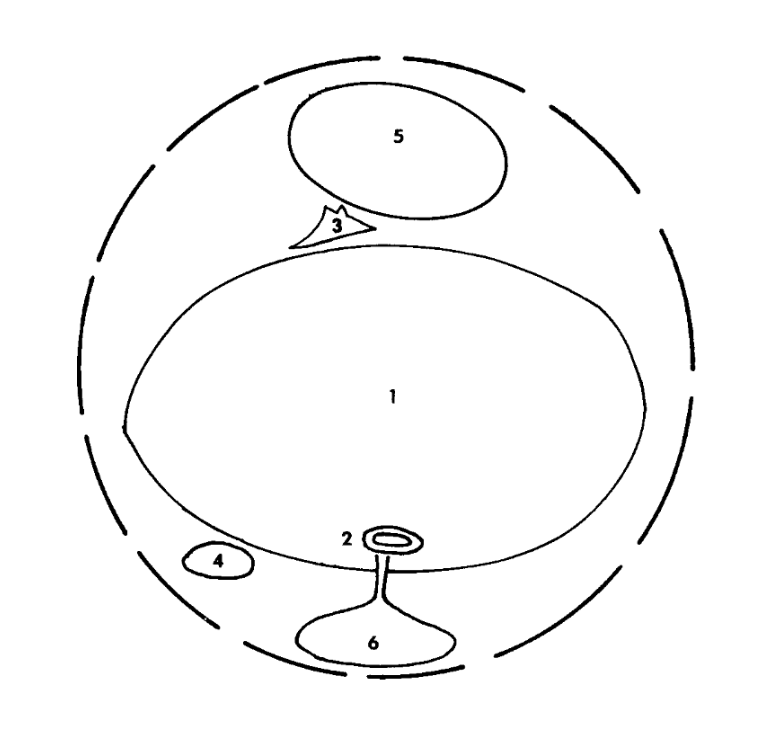
1. Dunia; 2. Pusat Tasik Pauh Janggi; 3. Padang Jauh dan Puncak Gunung; 4. Pulau Buah; 5. Kayangan; 6. Dasar Laut. Diagram by Md. Salleh Yaspar in Malaysian world-view by Taib Osman
The Koboi Project exhibition and performance titled Dari Pusat Tasek will open at the Percha Art Space in Lumut on 25th Dec 2019. There will be an impromptu street performance, carried out as part of this exhibition, based on the malay myth of the ‘navel of the seas’ or the pusat tasik pauh janggi. The combined downward spiral of the Pusat Tasek and the upward thrust of the enormous Pokok Pauh Janggi combine to create an axis of the world, one that analogous with the Tiang Seri of the traditional Malay House. In the Malay Ontology or cosmos – 1. Dunia is inhabited by Man, animals, plants, objects, spirits; 2. Pusat Tasik Pauh Janggi is inhabited by Nagas, Jins, Garudas; 3. Padang Jauh dan Puncak Gunung is inhabited by Giants, jins; 4. Pulau Buah is inhabited by Ancestral spirits; 5. Kayangan is inhabited by Dewa, Perman; 6. Dasar Laut is inhabited by Raja Lebis.
The Pusat Tasik Pauh Janggi appears to exemplify more general Southeast Asian structural and relational principles in which – 1. The Navel of the Seas drains the waters of the world; 2. A submarine tree or world pillar at the navel links the human realm to both the underworld and the skyworld; 3. There are mythic creatures dwelling at the navel of the seas at the base of the tree or pillar; 4. The ebb and flow of tides are due to the movements of the creature blocking the drain at the navel; 5; The ocean currents are due to water flowing in and out of the drain at the navel; 6. Earthquakes are caused by creature at navel of the sea shaking the world pillar; 7. There are relationship between these flows to the movement of the Sun and Moon and events like eclipses; 8. Rising sea levels and flooding are associated with the navel of the sea.



 The Koboi Project
You must be logged in to post a comment.