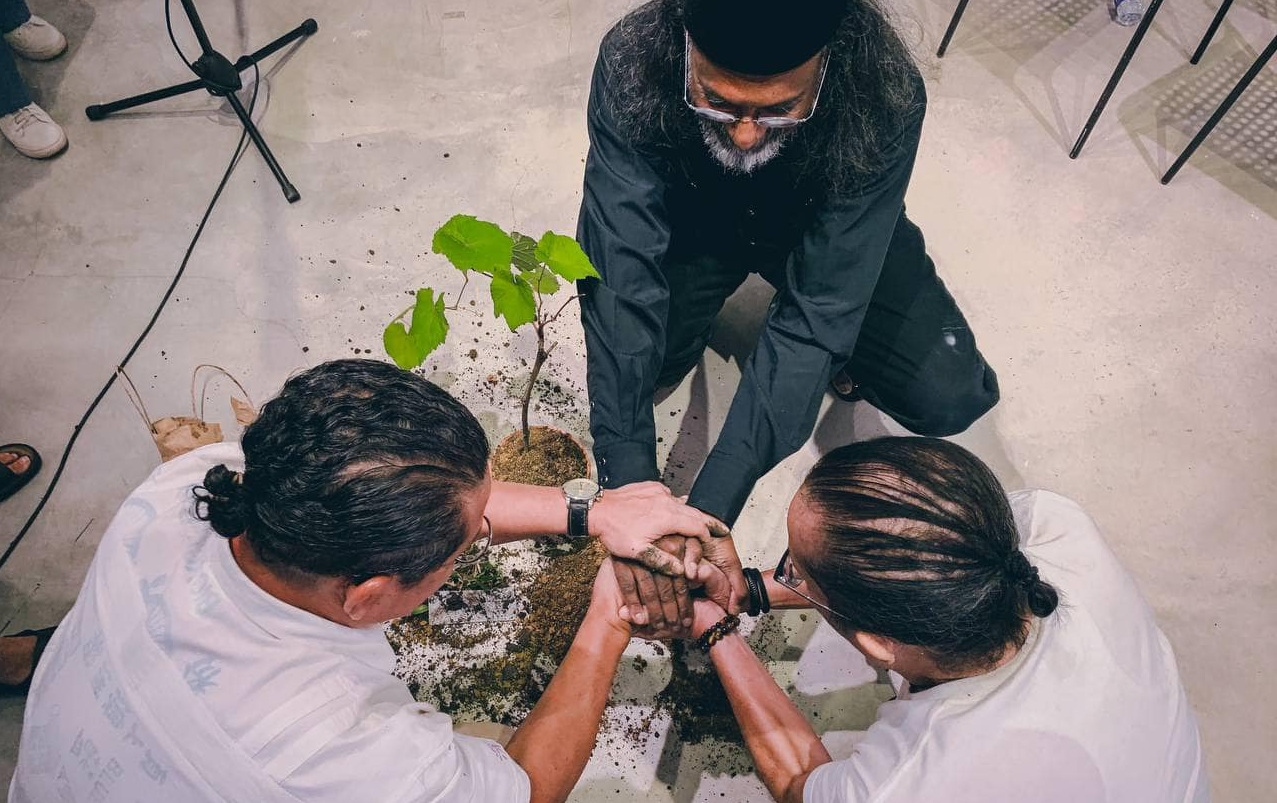
The Pokok Pauh Janggi exhibition at Kapallorek Artspace was officiated by my dear friend and important contemporary artist, Azizan Paiman. This is expecially significant as Paiman is featured in the photographs of the Koboi Balik Lagi series of the Koboi Project. He is someone with whom I have had a long relationship, first as a curator (Tenungan Curator), and then as a brother (Saudara Baru), and now as a fellow artist with a shared vision of the mdalities and meanings of art making in Malaysia. As part of the opening event of the exhibition, Paiman presided over the ritual transfer of a vine, nurtured in his garden, to the care of the Kapallorek Artspace.
In this ceremony another brother, the renown contemporary artist and teacher, Hasnul Jamal Saidon, Paiman, and I jointly transferred the plant into a pot, and handed it over to the care of Fadly Sabran, the founder/director of Kapllorek Artspace. This extension of the arboreal symbolism of the Pokok Pauh Janggi exhibition marked the deeply personal bonds of our respective relationships, while also suggesting a nexus and a line of development in contemporary Malaysian art. I was particularly moved by how Paiman’s ceremony got Hasnul and myself acting in unison once again, as we had done so effectively and so effortlessly in the days of the 1st Electronic Show and E-Art ASEAN.
The main component of the Pokok Pauh Janggi installation is the Kobol Balik Lagi series of photographs (Duratrans). This 3rd series of the Koboi Project is based on photography done during the Seni Di Kota Symposium and Exhibition curated by Zanita Anuar at the National Art Gallery, Kuala Lumpur in December, 2015. In the original Koboi Balik Kampung series, I presented the Koboi within the vast panorama of the Malaysian culture, politics and life, photographed in and around Kuala Lumpur over a time span of three weeks. In the Koboi Balik Lagi series, I take on the challenge of finding and presenting the same significations, metonymically, within the reduced narrative time and pictorial space of one morning at the National Art Gallery. Koboi Balik Lagi is thus a more narrowly focused and self-reflexive Koboi narrative. The photography for this series was done by Zuraini Anuar who is the award winning art director and production designer in Malay cinema
The first propitiation of this performance (see notes) was to the spirits of the earth (jintanah, also called hantu tanah, hulubalang or jambalang tanah), specifically the land (bumi) where the performance takes place. Soil from the ground below was gathered and placed in a woven basket and brought up to the roof of the Kapallorek Artspace, where the performance took place. A lighted candle was placed in this basket of soil while the following was uttered,
Aku minta’ ampun kapada kramat yang memegang tanah disini! I beg forgiveness from the sacred spirits that hold this land!
This appeasement of spirits was performed wholeheartedly (dengan bersungguh sungguh) as magic (in terms of its metaphysical or spirtiual dimension), but not without an awareness some socio-political implications. The propitiation sets up a hierarchy of asspciation with the land – first there are the spirits (kramat) of the land, then the people who recognize and propitiate these spirits, and only then the others. In other words, first kramat yang memegang tanah disini!, then the orang Pribumi yang mengakui keunggulan Kramat tanah, and only after, the non-indegenous (orang barudatang or pendatang) who do not know (mengenali) the kramat .
An interesting implication of this model of primacy is that, as the Malays lose their connection with the Semangat of their land in the course of modernization (due to both Islamic modernism and secular modernity), they too get alienated from the land and lose their place in the hierarchy. Conversely, the pendatang who becomes attuned to this Semangat might, arguably, rise up. I belioeve that this aspect of the performance discretely problematizes the notion of the bumiputera that informs the Malaysian social contract.
1 Set up in Gallery *Plain Black Cowboy Shirt on hanger on the back wall of a niche. *Platform for batang Pisang, nails on either side of niche for tukelan. *Place 7 nails on the ground before the platform.
2 Set-up on Roof *Flag elements in place – weights frame, post, strut. *Panggung in place – mat (tikar anyaman), 2 cushions, bananana stem (batang pisang), brick supports, 2 bamboo verticals. *Arena setup- 2 plastic mats for audience, one row lights above audience, a few plastic chairs. *Large basket to the rear of the panggung – contents: songkok, cowboy hat, capal, flag folded and hooks in place. *mp3 player/megaphone, Kemenyan set (Benzoin incense)- holder with hot coal, kemenyan, lighter, 3 medium size red candles – all set up to front-left of panggung. *Woven container filled with local earth (bekas mengandungi tanah Bota), the badi (remnants of dear hide wrapped in muslin cloth), daun pisang, brass bowl containing water and flowers, – all set up to front-right of panggung.
3 Memasang Tukelan *The performance begins on the roof *Koboi ties string (tukelan) across posts, strings coins (Uang Kepeng). *Sang Nabil Utama lights coal at the back of the arena. *Koboi and Sang Nabil Utama go to start positions.
4 Entrance *Koboi Brings in Artcase containing cloth wrapped Pak Dogol (yellow cloth) and Wak Long, Pokok Pauh Janggi, Ketam Gergasi (black cloth) and places it to the right of the tikar. *Simultaneously Nabil bring a tray (dulang) with food offering on a ceramic plate : pulut kuning, telur rebus, 7 helai. daun sireh and places it to the rear between cushions.
5 Flag Raising *Sang Nabil Utama turns on music on mp3 player/megaphone – Gerimis Mengundang by Slam. *Set up frame, secure fame, insert post, string flag, secure flag, raise flag.
6 Memanggil Jin Tanah *Pasang lilin satu batang, serta berkata :- Aku minta’ ampun kapada kramat yang memegang tanah disini! *Letakkan lilin di dalam bekas yang mengandungi tanah Bota.
7 Memanggil Hantu Tinggi *Lepas itu pasang lilin lagi satu batang, Jalan ke tempat mural bota dan berkata :- Aku minta’ ampun kapada sagala Hantu Tinggi! *letak lilin di kaki bendera. 8 Memanggil Jambalang Wayang *Nyalakan lilin ketiga dan berkata:- Aku minta’ ampun juga kapada sagala Jambalang Wayang! *letak lilin dalam piring nasi pulut.
9 Koboi Mengubah Wajah *Koboi takes off socks/boots and cowboy hat. *Nabil get songkok from basket. *Koboi puts on songkok. *Koboi and Sang Nabil Utama walk over to mat. *Nabil turns off music.
10 Membuka Panggung *Koboi dan Sang Nabil Utama bersila. *Sang Nabil Utama starts Kemeyan . *Naikkan piring dan berkata :- Hei Jin Tanah,Hantu Tinggi, Hoi Jembalang Wayang ! Dato’ jangan membisakan, Aku tahu asal ‘kau jadi : Dato jangan membe’ngkakkan : Bintang Timor asal ‘kau mula jadi. Biar sagala makhluk suka permainan kita, Berkat Dato’ Batara Guru, Menyaksikannya! *Letakkan piring atas tikar di antara Koboi dan Sang Nabil Utama di tengah panggung.
11 Membuang Badi Rusa *Koboi Buka kain kuning, keluarkan Pak Dogol cucuk dalam batang pisang ke sebelah kanan, pandang ke kiri. *Koboi Buka kain hitam, bagi Wak Long pada, Sang Nabil Utama cucuk dalam batang pisang di sebelah kiri, pandang ke kanan. *Koboi Ambil Pokok … angkat menunjukkan bahagian kulit rusa kepada penonton and then Koboi letak patung ke bawah. *Koboi Angkat ketam menunjukkangahagian kulit rusa kepada penonton and then Koboi letak patung ke bawah. *Sang Nabil Utama tutup muka dengan kain semutar. *Koboi Kebaskan tiga kali ka bawah, ia itu ke arah patung dengan kain hitam (OMITED IN PERFORMANCE). *put black cloth on head, serta berkata :- O Si Lanang, Si Lambaun, Si Ketor, Si Becheh, orang yang berampat, Ambil kembali bahagian-kau! *Koboi buka kain puteh dan mengambil isyarat bahagian rusa – Mata, telinga, mulut, hidong,kaki, tangan, bulu, hati, jantong, limpa dan tandok, *masukkan di daun, pulangkan ke tanah, merenjis air dan bunga, serta berkata : — O Mentala Guru Asa sabulan, dua sabulan, Tiga sabulan, ampat sabulan, Lima sabulan, anam sabulan, Tujoh sabulan, malam di-angkau, Siang di-aku. Sa’ekor aku bawa balik, Sa’ekor aku tinggalkan!
12 Membangkunkan Jambalang Pokok Pauh Janggi *Koboi angkat patong Pokok Pauh Janggi, waving tree about, showing only back, serta berkata :- Hei Toh Mambang Puteh, Toh Mambang Hitam Yang diam di bulan dan matahari Melempahkan sakalian ‘alam asal-nya pawang, Menyampeikan sakalian hajat-ku, Melakukan sagala kahandak-ku, Hidulaplah Pokok Pauh Janggi! *Turn tree around to show colour, cucuk in batang pisang.
13 Membangkunkan Jambalang Ketam Gergasi *Koboi angkat semula patong Ketam dan bagi kepada Sang Nabil Utama . *NaSang Nabil Utama menunjukkan blank side to audience (OMITED IN PERFORMANCE), moving the legs. *Koboi berkata :- Al-salam ‘aleikum ! Hei sahabat-ku Mambang Tali Harus, Yang berulang ka pusat tasek Pauh Janggi, Sampeikan-lah pesan-ku ini, Bangunkan Jambalang Ketam Gergasi! *Sang Nabil Utama turns crab around to show colour and cucuk in batang pisang, Manipulate limbs
14 Nabil Mengubah Wajah *Sang Nabil Utama turns on Wayang audio. *Both get up slowly. *Koboi takes out and puts capal. *Koboi gives Sang Nabil Utama Cowboy hat. *Sang Nabil Utama puts on Cowboy hat.
15 Bersalam- salaman *Both face audience for count of 5 seconds. *Turn face each other. *bersalam-salaman.
16 Membuka Tukelan *With wayang audio running ….. pause, be at ease viewing the scene for a while. *Koboi unties the tukelan and removea the uang kepeng . *Koboi removes Ketam from batang pisang and hands to Sang Nabil Utama. *Koboi removes Pokok and stands up. *Koboi andSang Nabil Utama lead the procession from the roof down to the gallery.
17 Paparan Penghabisan *Koboi and Sang Nabil Utama, stand to the left and right in front of the niche, holding forth their puppets. *Batang Pisang is brought down and placed on platform. *Koboi and Sang Nabil Utama insert their puppets into the Batang Pisang and step back allowing others to view. *Nabil pierces the 7 nails into the Batang Pisang. *Sang Nabil Utama helps Koboi change shirts and places the eagle bib shirt on the wall and buttons it up. *Koboi ties tukelan across niche, strings coins (Uang Kepeng). *Koboi places tahi pelangi in front of the paparan as a pendinding. *Koboi and Sang Nabil Utama acknowlege audience, Koboi mintak ampun dari para penonton
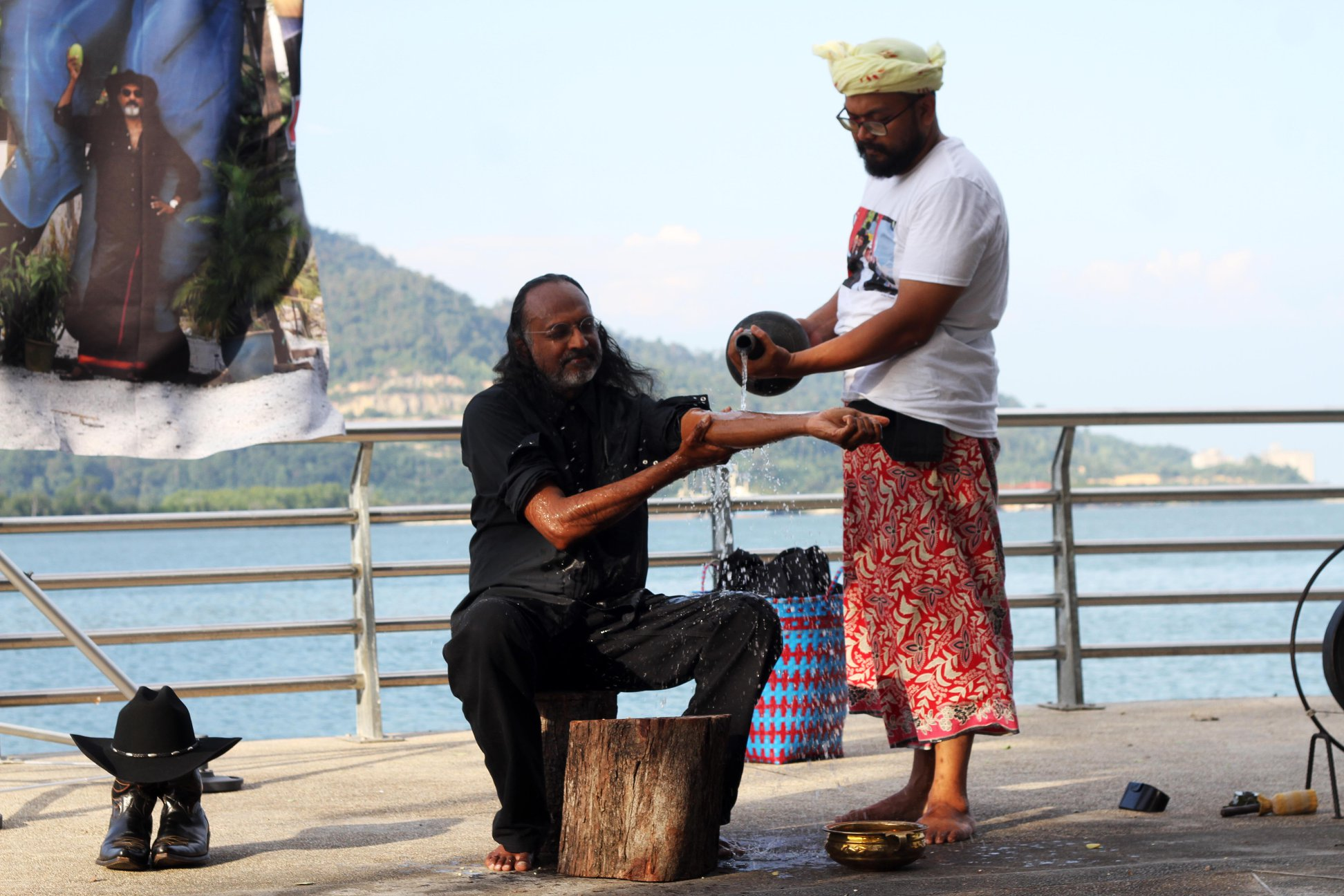
In December 2019, The Koboi Projectpresented Dari Pusat Tasek at the Percha Artspace, Lumut, Perak. This presentation was realized as an installation in the gallery accompanied by a performance in the public space of the Lumut waterfront. Dari Pusat Tasek addressed salient themes of contemporary Malaysian society while also engaging with the forms and meanings of traditional Malay ritual and folklore. Documentary images of this earlier Percha Artspace performance forms the content of the Panji Pauh Ulungphotographic series of the Koboi Project. The Koboi now returns to Malaysia again, to present Pokok Pauh Janggi, a related performance and exhibition at Kapallorek Artspace, Bandar Iskandar, Bota, Perak. The exhibition features the Koboi Balik Lagi series of photographs and runs from 5th Aug – 30th Sept 2023. OPENING EVENTS on 5TH AUG: Performance 6pm, Reception 8pm, Artist Talk 9pm.
About the Koboi Project … a search for integral identity, across an inter-generational diasporic experience … The Koboi Returns 2023 – …Anwar Ibrahim has become the 10th Prime Minister of the nation …
The Koboi Project centres on the question of identity and its relationship to authenticity. I dress as a cowboy, both in performance situations and in my private life. Indeed, I am very comfortable with this eccentricity of mine, so much so that, in some ways, I feel that I am a cowboy, albeit an urban cowboy who has never ridden a horse and has very little to do with cows. As a vegetarian, I do not even eat them. In my daily life, you could say it is my style. When I perform in Southeast Asia it stands for my return from the West. But what happens to the authenticity of my persona when I venture into real cowboy country.
Recently, at the Cloverdale Rodeo, I gained some insight into the nature of my Koboi persona and even the nature of cowboy persona itself. At the heart of the rodeo is the image of the pesky, spunky cowboy prevailing over the ornery Bronco, kicking and bucking to get him off its back. In my observation at Cloverdale, however, there seemed to be a little bit of a disconnect. Indeed, the horses buck violently, and the Cowboys hang on valiantly and skillfully, but are the horses bucking to get the cowboys off or are they bucking for some other reason? There is, in this context, a debate about the use of spurs and the application of pressure around the horse’s belly with what is called a flank strap. Some say the strap brings pain that causes the bucking and others that it merely gives form to the buck.
The BC SPCA says that the flank strap “applies pressure on their sensitive underbelly, causing discomfort. The rider also uses … spurs, to cause discomfort which leads to more bucking. While bucking is a natural behaviour of these animals, in rodeo it is a behaviour rooted in discomfort, not in play.” In other words, it is not as it appears, that the horse is bucking to get the rider off, but as a response to the discomfort caused by the flank strap. The cowboy’s art of hanging on is incidental or secondary to the main action. Proponents of rodeo however, counter with the argument that the horse bucks because it is in its nature and breeding to do so, and that the “flank strap alters the bucking action of the horse by encouraging him to kick out straighter and higher with his hind legs, thus making himself harder to ride. The flank strap stacks the odds in favor of the horse. It cannot make him buck.” With regard to the spurs, they insist that they are required to be blunt and spinning and that they also put the odds in favor of the horse, as the forward position of the feet required to spur the horse in the shoulders makes it much harder for the cowboy to stay on.
Even within the proponents’ terms, it can not be denied that there is a sense that the bucking is being induced and conditioned independently of the horse’s impulse to get the rider off its back. The horse is just bucking independantly and the rider holds in an illusion of relationship. The question of cruelty aside, the rodeo cowboy’s ride is a performance, and not unlike my own Koboi performance, an artifice or fiction of sorts.
According to Md. Salleh Yaspat (in Malaysian World View edited by Mohd Taib Osman. Mohd Taib Osman) the Traditional Malay Cosmology can be visualized as in the above diagram, whose key is is as follows: 1. Dunia: inhabited by Man, animals, plants, objects, spirits; 2. Pusat Tasik Pauh Janggi: inhabited by Nagas, Jins, Garudas; 3. Padang Jauh dan Puncak Gunung: inhabited by Giants, jins; 4. Pulau Buah: inhabited by Ancestral spirits; 5. Kayangan: inhabited by Dewa, Perman; 6. Dasar Laut: inhabited by Raja Lebis.
In December 2019, I did a Koboi Performance for Percha Art Space in Lumut after which I left for Vancouver. I will now return to Malaysia in August this year (2023) and, to mark my return, I am working towards another Koboi Performance, the details of which will be announced shortly.
In December 2019, I did a Koboi Performance for Percha Art Space in Lumut, in which I raised a new SUPERSTAR banner depicting a giant hoarding of Anwar Ibrahim. I performed a cleansing ritual on the Lumut waterfront and left for Vancouver soon after. I will return to Malaysia in August this year (2023).
Since my performance, and after a long struggle, Anwar Ibrahim has become the 10th Prime Minister of the nation and holds on to this seat by the skin of his teeth. Anwar incredible return to power, after a quarter-century perjuangan, is an exemplary Hero’s journey – a striking display determination, endurance and a sense of destiny. To mark my own much less momentous return, I am working towards another Koboi Performance the details of which will be announced shortly.
I had begun my practice as an artist in the late 1980’s with a series of paintings and had moved onto a more self-consciously critical performance/ installation practice when, in 1995, I found the World Wide Web, with its capacities for instantaneous connectivity, hypertextual linking and multimedia convergence. I then transferred my practice to this new medium and between 1996 and 1998 made two web works and La Folie de la Peinture (1998), is the second of these. It is archived in fragments on the Wayback Machine.
At the center of this work was a remediation of a set of installation photographs, linked in such a manner as to represent movement through the space, with the experience of each ‘work’ recast as a multimedia experience (WAV, GIF, MOV and VRML files). The text (hypertext) was an integral part of this web work and in it, I set out some contextualizing ideas. These ideas were also presented within a wider theoretical framework in a paper titled Toward a Universal Theory of Convergence: Transcending the Technocentric View of the Multimedia Revolution presented at INET 1998 in Geneva. These points originally made in 1998 are presented below –
* With the emergence of abstract colour-field painting, the placement of works on the gallery wall became integral to the presentation and, in the light of this transient ‘installation’ aspect of the presentation, photographic documentation began to take on a new significance.
* While the ‘installation shot’ confirms the uniqueness of the ‘site’ of the installation, this photographic documentation leaves its own mass (mechanical reproduction) condition unindexed and has, quite surreptitiously, become the ‘extended’ medium, of installation art.
* As bandwidth increases and multimedia technology goes online, fluidly articulating the remote experience of image, moving image, text and sound in an interactive ‘virtual reality’, it will become increasingly difficult to differentiate between an actual place, person or thing from its image or representation.
* As the representations contained on the multitude of servers on the Internet exist in virtual proximity, ‘here’ and ‘there’ have been brought together in the ‘now’ of fiber optic connectivity. The instantaneous connectivity of computer mediated communication, appears to have eliminated geographical distance and the modern/ postmodern distinction of ‘site’ and ‘non-site’ is no longer be meaningful.




 The Koboi Project
You must be logged in to post a comment.