The Dari Pusat Tasek exhibition will run at Percha Artspace, Lumut Waterfront till 19 JAN 2020. Hanging in the Percha gallery is a t-shirt bearing an image titled Rockin Cowboy. This is the t-shirt was worn by Sang Nabil Utama during the performance at the Lumut Waterfront on 25 Dec 2019. The image was shot outside the Rockin Cowboy Western store at 106 East Broadway, Vancouver. This is where I got my cattleman hat, my roper boots and spurs and my Rockmount Classic Sawtooth Western shirts for the first Koboi performance at the National Art Gallery, Kuala Lumpur in 2013. One of these shirts is now in the collection of the National Art Gallery.
Since that first Koboi Balik Kampung performance, I have passed many a Western hour at the Rockin’ Cowboy with Dave Lawr (Cowboy Dave) and Danny Kresnyak (Rock n Roll is in the House!). The store used to be a mere city block away from my apartment at Quebec and 7th, Vancouver but it has now moved further West to new premises at 118 West Broadway, just a few blocks from the original location.
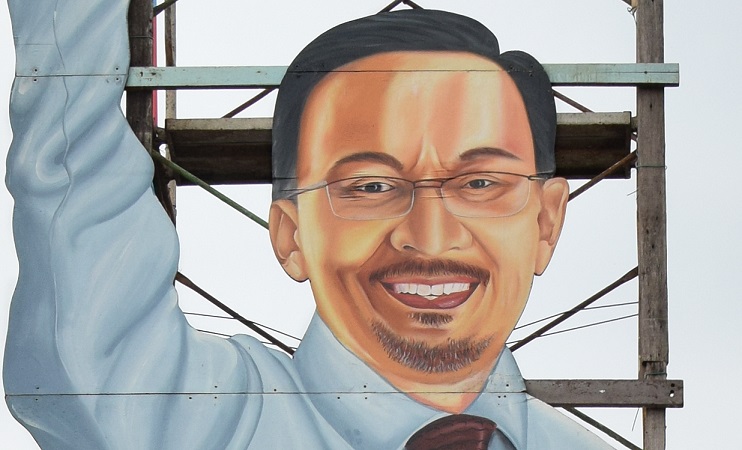
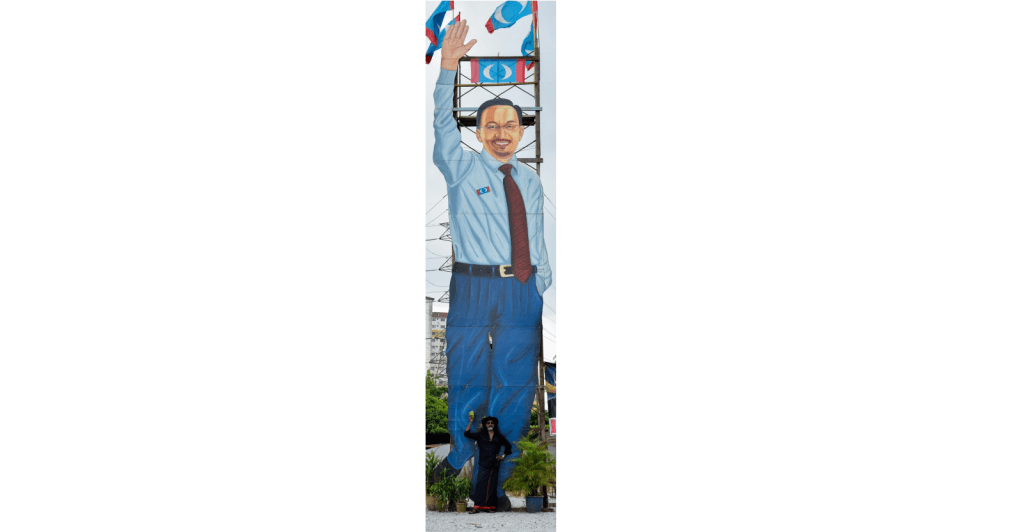
The 12th series in the Koboi Project, ‘Dari Pusat Tasek”, consists of a pair of photographs titled Naan Anaiyttal and Rockin Cowboy taken in Kampung Indian Settlement, Batu Caves and on West Broadway, Mount Pleasant, Vancouver, respectively. Naan Anaiyttal presents the Koboi standing before a hoarding of 12 meter cutout of formerly jailed Deputy Prime Minister and Parti Keadilan leader, Anwar Ibrahim. The Koboi stands gesturing forwards and upwards with a green skinned mango in his right hand. The cutout was initially erected around the 2008 election but taken down in the context of political controversy and fears that the structure would be vulnerable to weather conditions. It was put up again for the 14th general election which took place in May 2018. The Koboi photograph was taken in 2018. Naan Anaiyttal is title of a song from M G Rmachandran’s hit film Enga Veettu Pillai (1965). MGR was of course to become the Chief Minister of Tamil Nadu and the song has populist and egalitarian theme. Anwar Ibrahim, in turn is, however tenuously, in line to be the next Prime Minister of Malaysia.
If I were to rule and if it comes to pass The poor will not suffer As Long as they live they will feel no pain They will not fall into the sea of tears
or in Anwar Ibrahim’s summation –
Kalau aku diberi kuasa Tidak ada lagi yang derita Tidak ada lagi yang miskin mengalir air mata
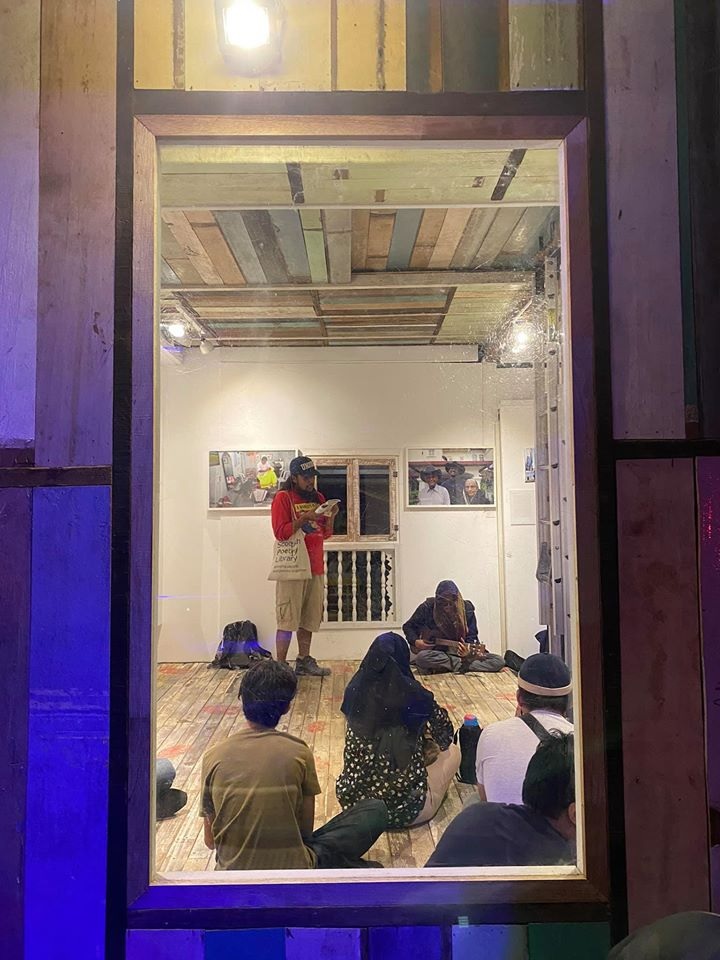
Hamzah Yazd and Zai Kuning performed an impromptu ‘Gazal Pauh di bibir laut’ at the Dari Pusat Tasek opening, Percha Artspace, 25 Dec 2019. Hamzah read Balada Terbunuhnya Beringin Tua di Pinggir Sebuah Bandaraya and Benarkah Ketam Mengajar Anaknya Berjalan Betul? by Usman Awang as well as Di Bibir Air and Sajak-sajak Tengah Malam by Latiff Mohidin. Here is the conclusion of sajak-sajak tengah malam –
v tujuh lautan satu gelombang di pusar perutmu berpusing denyutan purba memanggil namaku kuturuni bukit kutinggalkan padang luas
aku merangkak kembali ke lubuk kelammu
And in Hamzah’s own words, here is how the night went down – Siuman tengah malam Sajak sajak redam Koboi balik kampung Menghiris pauh ulung
1. Dunia is inhabited by Man, animals, plants, objects, spirits; 2. Pusat Tasik Pauh Janggi is inhabited by Nagas, Jins, Garudas; 3. Padang Jauh dan Puncak Gunung is inhabited by Giants, jins; 4. Pulau Buah is inhabited by Ancestral spirits; 5. Kayangan is inhabited by Dewa, Perman; 6. Dasar Laut is inhabited by Raja Lebis. Modified from a diagram by Md. Salleh Yaspar.
The combined downward spiral of the Pusat Tasek and the upward thrust of the enormous Pokok Pauh Janggi combine to create an axis of Malay Ontology or cosmos. Anker Rentse explains, from ethnographic notes that seem to have been made in Ulu Kelantan“Shurga, Heaven, is on the top of Pauh Janggi, and Nuraka, Hell, is down below its roots. A gigantic hole between the roots causes the ocean water to disappear into hell’s big boiling-pot, kawah nufaka , whence the whirl-pool. Underneath the pot burns everlasting fire. A dragon guards the hole, the gate to hell ( pintu nuraka) with its body in order to prevent the ocean from running dry. In Pusat Tasek an account is kept of the good and the bad deeds of every human being in the world. The accountant in Heaven is Ka’ Tebir, and in Hell, Kiraman. The last one is said to be so busy on occasions, that he gets angry, throws his pen on the floor and declares, Ini sekarang sudah chukup!”
The Dari Pusat Tasek exhibition will run at Percha Artspace, Lumut Waterfront, till 19 JAN 2020 Photographs of the Lumut performance will go towards making the 13th series of the Koboi Project tentatively titled Badan Aku Tubuh Negara. The draft of this work can be viewed at https://koboibalikkampung.wixsite.com/sialjambalang
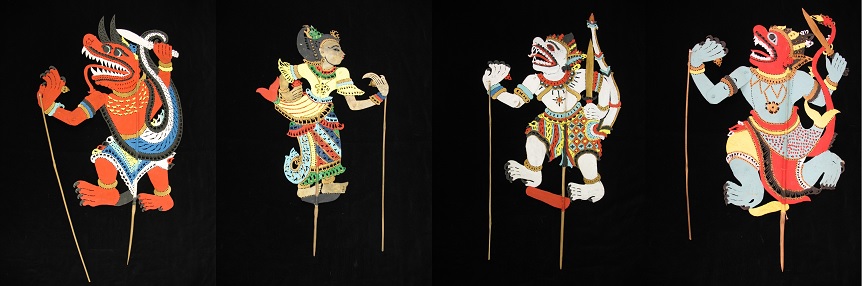
Nenek Sepit Pentala Naga | Tuan Puteri Ikan Selar Banum | Hanuman Kera Putih | Hanuman Ikan
In the Mak Yong Endeng Tajali, when the Great Raja dies, his sons the Elder Raja, the Middle Raja and the Young Raja fight for the throne. The Elder Raja is victorious and Middle Raja flees to the forest to became a Jin Gergasi haunting the land, while the Young Raja goes to the Laut Buih Gelombang Tujuh to become the Nenek Sepit Pentala Naga. At the centre of this lautan is, of course, the Pusat Tasek Pauh Janggi.
In the Kelantan Wayang Kulit at the bottom of, presumably, the same Pusat Tasek, there also lives a Nenek Sepit Pentala Naga. He is the Raja of the Negeri Lautan Buih. He has a beautiful daughter, the Tuan Puteri Ikan Selar Banum who marries the great warrior, Hanuman Kera Putih and has a child named Hanuman Ikan.
The Dari Pusat Tasek exhibition will run at Percha Artspace till 19 JAN 2020, ‘Dari Pusat Tasek” is the title of the 12th series in the Koboi Project, which includes a photograph titled Naan Anaiyttal taken in Kampung Indian Settlement, Batu Caves. It presents the Koboi standing before a 12 meter cutout of formerly jailed Deputy Prime Minister and Parti Keadilan leader Anwar Ibrahim. The Koboi stands gesturing forwards and upwards with a green skinned mango in his right hand. The cutout was initially erected around the 2008 election but taken down in the midst of a political/religious controversy about wastage/idolatry and fears that the structure would be a danger to the public in unfavourable weather conditions. It was put up again for the the 14th general election which took place in May 2018.
The Koboi photograph was taken in 2018. Naan Anaiyttalis title of a song from M G Rmachandran’s hit film Enga Veettu Pillai (1965). MGR was of course to become the Chief Minister of Tamil Nadu and the song has populist and egalitarian theme. Anwar Ibrahim, in turn, is in line, however tenuously, to become the next Prime Minister of Malaysia next Prime Minister. Here are the lyrics of the song in Tamil, English, Malay and finally in Anwar Ibrahim’s own elegant translation –
If I were to rule If that comes to pass The poor will not suffer As Long as they live they will feel no pain They will not fall into the sea of tears
Kalau saya diperintah Kalau ia menjadi kebenaran Kaum miskin tidak akan menderita Sepanjang hidupnya tanpa kecewa dan tidak terjatuh ke lautan air mata
Kalau aku diberi kuasa Tidak ada lagi yang derita Tidak ada lagi yang miskin mengalir air mata
The Dari Pusat Tasek exhibition will run at Percha Artspace till 19 JAN 2020. As part of this event a performance was held at the Lumut Waterfront on the 25th December 2019. The Naan Anaiyttalflag was raised on a portable flag stand, accompanied by a performance based on a Perak Malay cleansing ritual. The flag presents the Koboi standing before a 12.2 m hoarding of the once jailed politician who is now Malaysia’s prime minister in waiting, Anwar Ibrahim. This image was shot in Kampung Indian Settlement, Batu Caves, in the wake of Malaysia’s 14th General Elections. Photographs of the Lumut performance will go towards making the 13th series of the Koboi Project tentatively titled Badan Aku Tubuh Negara. The draft of this work can be viewed at https://koboibalikkampung.wixsite.com/sialjambalang
The Dari Pusat Tasek, exhibition at Percha Art Space runs till 19 JAN 2020.
The enormous tree at the centre the ‘Pusat Tasek’. is an known as the Pokok Pauh Janggi. While I have been insisting that this is a mango tree, I have to acknowledge that the more commonly held view is that it is a coco de mer palm. Still, pauh is the Malay word for ‘mango’ and as Paul Kekai Manansala suggests janggi, probably, derives from the Toroja word ‘djjandji’ which, like the Malay ‘buah’, means ‘fruit’.
The Toraja are a people from the Sulawesi island, to the Southeast of Borneo, whose ancestral myths seem to claim origins from an island somewhere to the north where there is a powerful current, which could possibly be the Pusat Tasek. In the Taroja language taripa djandji means ‘mango tree,’ where or taripa means ‘mango’ and djandji , derived from djampu means ‘fruit’. In suggesting that the Toraja taripa djandji is the more original form of Pauh Janggi , Manansala points out that among the Bare’e people, also from Sulawesi, taripa djandji is the common way of saying ‘mango tree.’
Manasala also notes that Antonio Pigafetta, a mariner on Ferdinand Magellan’s pioneering voyage of ‘discovery’ (1518-1522), mentions local tales of an island surrounded by whirlpools, somewhere north or south of Java Major (Borneo), called Puzathaer (Pusat air?) on which there was a very large tree in whose branches perch enormous birds called Garuda. The fruit of this tree was said to be ‘larger than a cucumber.’ This size comparison, which must surely be with the in terms of the chayote cucumber from the Americas, suggests that the tree concerned was, indeed, a mango tree. The nut of the coco de mer is very much larger.
In Malay, of course, Pokok Pauh Janggi refers only to the mythical tree. A quotidian Mango tree would be pokok pauh and the coco de mer is referred as kelapa laut. While none of this is conclusive, in my understanding of language and of myth, the fact that, even when the signifier ‘Pauh Janggi‘, is understood as an index for the signified ‘coco de mer‘, the fact that it is indexed via the word ‘pauh‘, confirms that the root of chain of signifieds or similes is, indeed, the ‘mango’.




 The Koboi Project
You must be logged in to post a comment.