Mango Performance

At the heart of the Koboi Performances at Singapore Biennale 2016,  was the offering of a mango to Lords Murugan and Ganesha while reciting a prayer addressed metonymically to Lord Murugan’s Vel (spear) –

HEROIC  VEL,
RADIANT VEL,
VALIANT VEL THAT SET FREE IMPRISONED CELESTIAL BEINGS,
VIRTUOUS VEL,
VEL OF THE SACRED HAND,
VEL THAT PLUNGED THE OCEANS DEEP,
REGAL VEL,
VEL THAT PIERCED SURAN’S BREAST AND HILL,
THE SOLE REFUGE.

veera vel
thaarai vel
vinnohr siraimeetta theera vel
sev vel
thirukkai vel
vaari kullittha vel
kottravel
soor marpum kunrum thullaittha vel
onreh thunai

வீர   வேல்
தாரை   வேல்
விண்ணோர்   சிறைமீட்ட   தீர   வேல்
செவ்   வேல்
திருக்கை  வேல்
வாரி குளித்த  வேல்
கொற்ரவேல்
சூர்   மார்பும்   குண்றும்   துளைத்த  வேல்
ஒன்றே  துணை

The mango was then offered to the image of Thalaivar Rajinikanth and a small portion was served to one member of the audience.


Light on the Playa

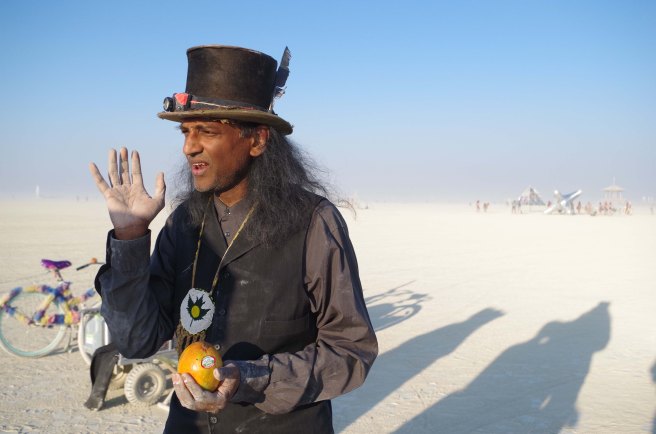
truthOnce upon a time, an eternity ago, in their heavenly abode on Mount Kailash, Lord Shiva, Mother Parvathy and their children Ganesha and Muruga were all together in a moment of family bliss. The Sage Naradha, who is notorious in Hindu mythology, for creating dissension among the Gods, paid them a visit. Holding a mango in his hand, Naradha addressed the boys, “Lord Ganesha, Lord Muruga, this is the mango of knowledge or enlightenment (nyanam) . It is sweeter than amirtham or the divine nectar, elixir of immortality. It must not, however, be shared or divided. It must be consumed whole, by one person of course!” Shiva and Parvathy were perturbed by this divisiveness, but nevertheless Lord Shiva set the boys a challenge, “This mango, this Nyana Pazaham (fruit of enlightenment), goes to the person who is the fastest in circumnavigating the world.”​

Knowing he must win, Muruga bestrode his glorious vahanam (mount), the peacock, and flew swiftly round the world. The ungainly Ganesha, God of Wisdom, thought for a moment before setting off. Ganesha pondered on his own gait and girth, and on his modest vahanam – the homely mouse, and asked his parents a question, “AmmaAppa, is it not true that the parents are the world for a child?” “Yes”, the puzzled but glowing parents replied. Ganesha continued, “Is it not true that the whole universe is but a reflection or manifestation of your Lordly selves?” “Well, yes of course, it is!” It was the only possible reply. Ganesha simply circumambulated Shiva and Parvathy, his father and mother, his whole world – the whole world!

Sure enough Ganesha won the mango. When Muruga came flying back expecting to win, he saw Ganesha with the prize. Feeling cheated by his parents, he flew into a rage and pierced Ganesha in the belly with his vel (spear) a symbolic attribute of the Lord Murugan (This unusual variation of the myth comes via my mother and grandmother). Disenchanted, he abandoned his family and discarded all his jewels and princely clothes. He left his abode in Heaven and went south to stand on Mount Palani in his loin cloth. To this day he stands there as a youth, as Palani Aandi or the Mendicant of Palani, a form of the Lord, dear to the hearts of the Shaivites of South India and the diaspora.
Truth on the Playa

mango of truthThe mango also appears in an episode in the Oriya  poet Sarala’s rendition of the Mahabaratha where, the now mature and more worldly, Lord Krishna performs a miracle with the fruit. He materializes a ripe mango from a seed, while the fruit is out of season and then, turns it to ashes, thereby revealing both the illusory nature of reality (maya) and the complexities that underlie the idea of truth (satyam) itself.
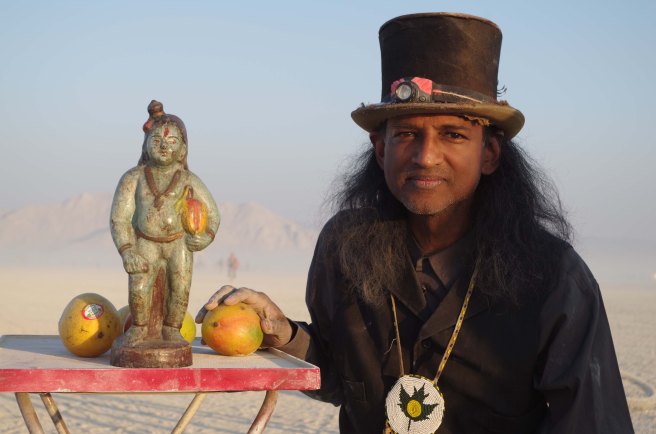
As it is written in the Mahabaratha … Nine years pass after the Pandavas go into the forest having lost their kingdom in a game of dice. Duryodhana the leader of the Kauravas sends Gouramukha to locate  the Pandavas. Gouramukha would find them by posing as a sage and asking for the gift of a ripe mango out of season. Only the Pandavas, aided by their ally Lord Krishna, could produce such a miraculous mango. When Yudhisthir, the lead Pandava, came upon Gouramukha in the forest disguised as a sage, he asked with great humility what food he would accept as an offering. The false sage said he would accept only a ripe mango. As expected, the  needy Yudistihira asked Krishna for help. Krishna was, of course, able to oblige but an out of season mango was a ‘mango of truth’ and that it could only be produced if each of the Pandava brothers and their common wife Draupadi spoke their innermost truth.

Krishna called for a dry mango seed and breathed the potential of life into it. One after another the Pandavas each spoke their truth – Yudhisthira said he was a man of integrity and that he intended to fight to get back his kingdom … a shoot emerged from the seed; Bhima said he was a man of greed and he would kill anyone who insulted his mace … the plant grew into a tree; Arjuna said that he was brave and pure and that he was unbeatable in battle as long as he held his divine bow … the tree blossomed gloriously; Nakula said he was a man of conscience and that he was loyal to Yudhisthira  … small unripe fruits appeared;  Sahadeva said that he had the knowledge of the past, the present and the future but that he would not volunteer unsolicited advice to anyone … the mangoes grew to full size. Finally it was Draupadi ’s turn and she said that although the five Pandavas equal as her husbands, she had the greatest affection for Arjuna. The other brothers were hurt and angered but the mangoes were ripened by this truth.

Gauramukha swiftly departed to give Duryodhana the news that the Pandavas were indeed alive in the forest but Krishna intervened disguised as a Brahmin. Pretending to be surprised at the sight of a ripe mango in autumn, he suggests that it can not be ‘a real mango’ as a mango ripening in autumn was an anathema to the nature of things. ‘Truth’ could not produce such a mango. When Gouramukha protested, Krishna said that he would like to utter some truths as a test of this mango of truth. He said he had seen that a stone was floating on water, and a lotus was blooming on a mountaintop. The moon rose in the day and the sun arose at night. He continued in this manner and in no time the mango was burnt to ashes.

By Krishna’s ‘lies’ the falsehood of the ‘mango of truth’ ripened out of season was revealed and it was destroyed. Krishna symbolically destroys the very possibility of absolute truths in the relativistic flux of maya (our everyday reality), which is sustained by ambiguity. All things that one takes to be true are mere illusion – false mangoes of truth that reveal their falsehood beside Krishna’s apparent lies, which are at a deeper level, Krishna’s truths.

http://saralamahabharat.blogspot.ca/2008/06/story-of-mango-of-truth.html

Love on the Playa

fruitseller​In the myth of Krishna and the fruit seller, an old hawker woman selflessly satisfies the god child’s desire for her ripe and aromatic produce, even though he seems to offer her practically nothing in return. In folk representations of this allegory of desire (kama) and devotion (bakthi), such as the terracotta icon described above, the sublime mango often stands, metonymically, for the cornucopia of fruit in the old woman’s basket, which in turn represents the desires and delectations of the material life.
This kama is redolent, or indeed ripe, with soteriological promise in that it can be transmuted into the bakthi of a selfless offering to the Lord. To return to the story … One day a fruit seller came to Vrindavan, the village that is young Krishna’s abode. She was a simple woman, old and poor. Little Krishna heard her call and he ran out to her with a handful of grains to trade for his favorite mango. As he was running, the grains fell out between his little fingers and as he made his offer to the fruit seller, there were hardly any left in his hands.

The poor old lady was, however, so charmed by Krishna’s  beauty that she freely gave him all the fruits he desired. On the way home she noticed the basket was heavy and when she arrived she found that the lord had filled it up with celestial jewels. Thus it is shown how love (bakthi) of the greater self (Brahman), recognized metonymically in the more tangible beauty of the young Lord Krishna has great soteriological effect. It is this salvation by selfless giving  that is both the theme and the message of the myth of Krishna and the fruit seller.

http://radhanathswamiyatras.com/articles/vrindavan-articles/radhanath-swami-on-krishnas-mercy-to-fruit-vendor

Indians on the Playa

playa

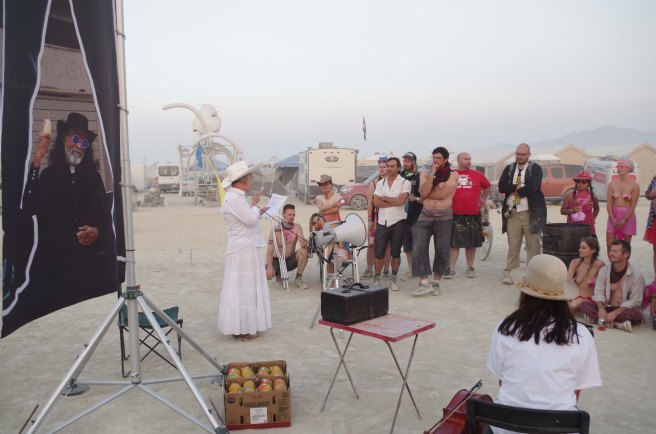
So we did it! My fellows at The Camp With No Name, my family and I – we realized the image I had visualized for Cowboys and Indians at Burning Man. We did one performance on the evening of the 31st August at camp where I presented the Krishna icon, the Thalaivar banner, and the Indian Cowboy image and 40 perfectly ripe mangoes. I told Krishna stories of love and truth to the gathering. Tara played an improvisation on the melody of Joe Ely’s Indian Cowboy on the Cello and Jane read her Poems on the Megaphone. Durga took photographs for future editions of the Koboi Project. The next day on the 1st September, Jane, Tara, Durga, Lucas, Guy, Saren and I took Cowboys and Indians onto the playa. This time we distributed 80 mangoes and interacted with burners as they came by on the their vehicles, their bikes and on foot. We shared love and truth … and mangoes till the sun went down on the Playa.

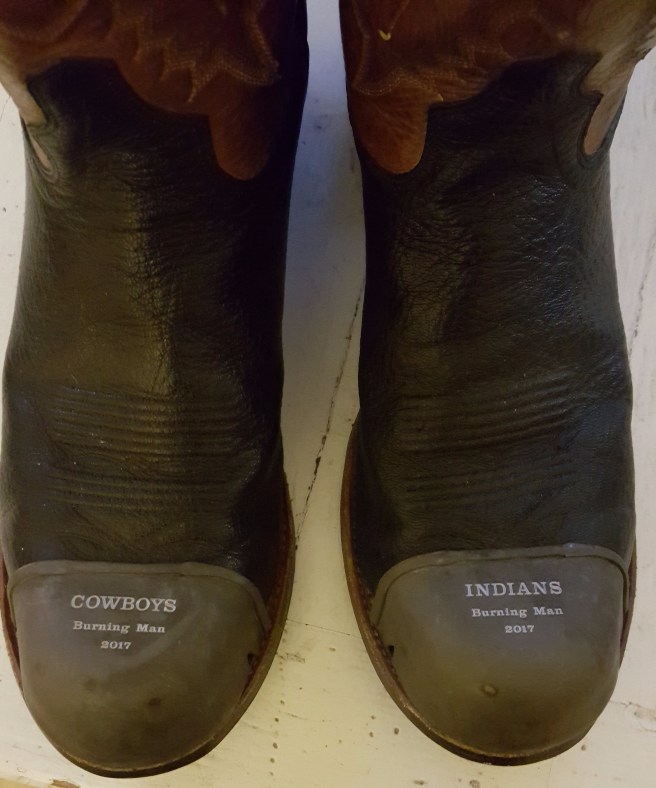
Burning Man Boots

20170505_205746-1.jpg

Going in to Burning Man equipped with my ‘Cowboys and Indians’ boots. One of the unspoken ironies of living in the Americas for Indians of the great subcontinental diaspora is the coincidence of signifieds for the generalizing signifier ‘Indian’. I remember arriving in Vancouver to find that I was referred to as an ‘East’ Indian. I wondered if it was a reference to the historical East India Company that managed that far end of the British empire while this end was being run by the Hudson Bay Company. Yes … its always been a corporate universe … but that is another story! No quite simple I believe that I am ‘East’ Indian in ‘North ‘America’ to to distinguish me from the other Indian – the ‘native Indian’ or as I know them from a childhood of \Cowboys and Indians’ play, the Red Indian’. Indeed, living in the Americas is living with both the nominal and significant consequences of the original hubris and error of Columbus and his ilk.

The Mango Icon

20161214_144809.jpg

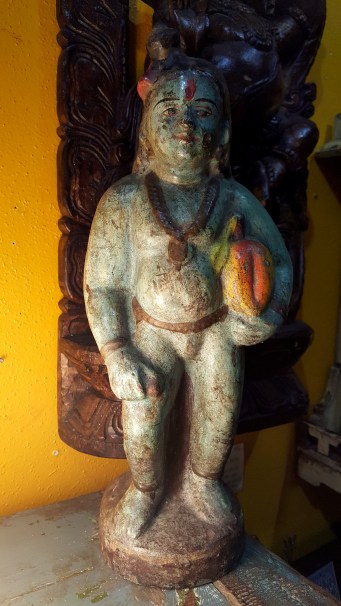
For the Cowboys and Indians performance at burning Man I shall present an antique terracotta icon of the infant Krishna. The icon was is a ritual object that would in its time have been used in domestic worship. It presents the infant Krishna bearing fruits. In his right hand, he bears a small purple fruit, perhaps a navel pazham or jambul fruit (Syzygium cumini) which is linked metaphorically to the Lord’s dark skin. In the crook of his left arm he holds a large ripe mango. This terracotta indexes the metaphoric equivalence of the Mango and the Jambul as attributes or representations or indeed flavors of the Lord Krishna.

In the myth of Krishna and the fruit seller, an old hawker woman selflessly satisfies the god’s desire for her ripe produce, even though he seems to offer her practically nothing in return. In folk representations of this allegory of desire (kama) and devotion (bakthi), as exemplified in the terracotta icon described above, the sublime mango often stands, metonymically, for the cornucopia of fruit in the old woman’s basket, which in turn represents the desires and delectations of the material life. This kama is redolent, or indeed ripe, with soteriological promise in that it can be transmuted into the bakthi of a selfless offering to the Lord.
The mango also appears in some versions of the Mahabaratha where, the now mature and more worldly, Lord Krishna miraculously materializes a ripe mango from a seed, while the fruit is out of season and then, turns it to ashes, thereby revealing both the illusory nature of reality (maya) and the complexities that underlie the idea of truth (satyam) itself. There are also variations of this mango of truth narrative in which, the mango is replaced by the jambul fruit (Syzygium cumini). A case in point is the Jambul-Upakhyan which is a contemporary expression of the Marathi folk tradition developed by the renowned folk story-teller and performer Shahir Vitthal Umap.  Here the jambul which stains the tongue demonstrates the ubiquity of outward falsifications of inner truths.

http://radhanathswamiyatras.com/articles/vrindavan-articles/radhanath-swami-on-krishnas-mercy-to-fruit-vendor/

http://saralamahabharat.blogspot.ca/2008/06/story-of-mango-of-truth.html​

http://devdutt.com/articles/modern-mythmaking/stains-of-the-jambul.html

The Mango of Truth

17237086_977803845687952_343943901_o

The Mango of Truth Performance will be carried out twice during the Burning Man event, once at camp and once on the playa.  At the heart of this performance is the presentation of an antique terracotta icon for Lord Krishna and the gifting of mangos at the end of each performance. The performance will take place beneath the Pazham Neeyappa (You art the Fruit) banner of SUPERSTAR Rajinikanth. The Krishna icon will be shown to the audience along with a ripe mango. The Koboi will narrate the meaning of the mango within Hindu worldview, in terms of the Hindu concept of knowledge, and in terms of ideas of love and truth. The narrative will be centered on the exploits of Lord Krishna. These ideas and allegories will lead to a reflections on the ‘image’ (Superstars, cowboy, etc.) and on the nature ’truth’ (false news, post-truth, etc.) in our contemporary reality. Jane Frankish will read poems from her Jane And The Library Monkeys Blog on a Megaphone. Tara Rajah will play short improvisations of Joe Ely’s Indian Cowboy on the cello and Durga Rajah will photograph the performances for future Koboi Project editions.

PETRONAS Payments

anwar-mahathir-najib-4-620x348

Reuters reports that PETRONAS profits have  quadrupled (from RM 1.68 billion to 7.06 billion) because of higher oil prices and improved margins and as a result the amount paid to the Malaysian Government will rise from the previously committed RM 13 billion to 16 billion. The announcement of increased payments is timely for the Malaysian Government they have announced massive infrastructure projects in the run-up to the general election that must be called by mid-2018. PETRONAS recently cancelled its massive investment plans in British Columbian LNG industry and Reuters quotes PETRONAS CEO as saying that the corporation is “finalizing our strategy on how to monetize our North American gas assets. All options are being looked at.” It is of note that PETRONAS has absorbed other major losses in its world-wide LNG investments for instance the Australian Gladstone LNG Project For those involved with PETRONAS and its subsidiaries in Canada, it is surely of significance that this fortune 500 company is in fact a Crown corporation, potentially subject as much to global market forces as to domestic political imperatives.

https://www.reuters.com/article/us-petronas-results-idUSKCN1B50GK

Image: http://www.malaysia-chronicle.com/najibs-cash-cow-hit-govt-of-thieves-run-dry-petronas-suffers-additional-us2-9-bil-loss-in-overpriced-aussie-project/