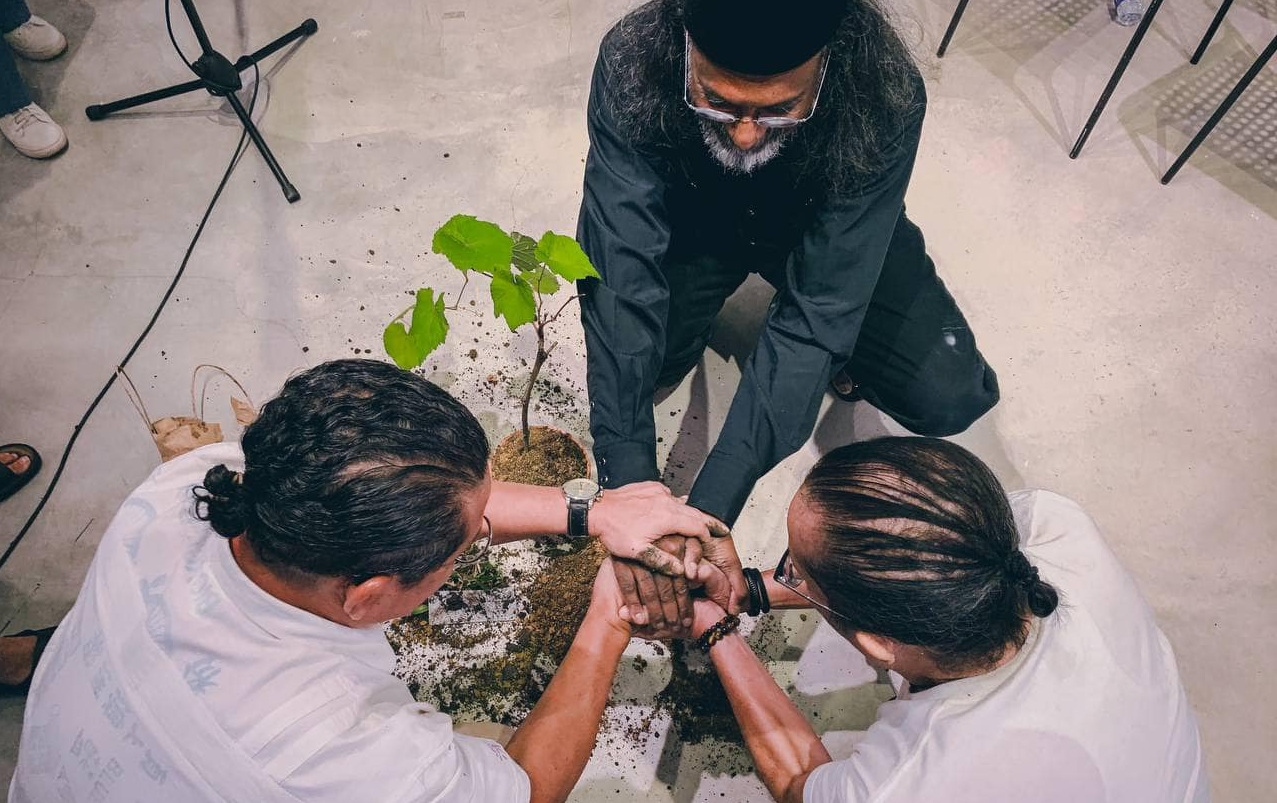
The Pokok Pauh Janggi exhibition at Kapallorek Artspace was officiated by my dear friend and important contemporary artist, Azizan Paiman. This is expecially significant as Paiman is featured in the photographs of the Koboi Balik Lagi series of the Koboi Project. He is someone with whom I have had a long relationship, first as a curator (Tenungan Curator), and then as a brother (Saudara Baru), and now as a fellow artist with a shared vision of the mdalities and meanings of art making in Malaysia. As part of the opening event of the exhibition, Paiman presided over the ritual transfer of a vine, nurtured in his garden, to the care of the Kapallorek Artspace.
In this ceremony another brother, the renown contemporary artist and teacher, Hasnul Jamal Saidon, Paiman, and I jointly transferred the plant into a pot, and handed it over to the care of Fadly Sabran, the founder/director of Kapllorek Artspace. This extension of the arboreal symbolism of the Pokok Pauh Janggi exhibition marked the deeply personal bonds of our respective relationships, while also suggesting a nexus and a line of development in contemporary Malaysian art. I was particularly moved by how Paiman’s ceremony got Hasnul and myself acting in unison once again, as we had done so effectively and so effortlessly in the days of the 1st Electronic Show and E-Art ASEAN.
This work is what I call a ‘deep readymade’, by which I mean there is a gesture or configuration by another actor being interpreted or articulated in the work. A deep readymade is thus differentiated from a simple readymade, in that there is a juxtaposition of components done by someone other than the artist. The primary component of this work is a carved wooden Ganesha which was once in my late mother’s possession. When my mother was alive, this Ganesha used to sit on the wall, above her prayer altar and would receive flowers in the course of her daily worship. It is an item she and my father brought back from one of their trips to India and Sri Lanka. While my father was born in Seremban, Malaysia, my mother, myself, and my sister Shyamala were born in Jaffna, Sri Lanka. We are Jaffna Tamils and Sri Lanka is in some sense our homeland.
The second component of this deep readymade, is the white stone, a large, well-worn pebble that was picked up on a Sri Lankan beach by the renowned Malaysian artist Reza Piyadasa on his first trip (date uncertain but a book that I believe was presented at the same time is autographed and dated 1995) to Sri Lanka (his own ancestral homeland) and brought back for my mother. The late Reza Piyadasa was a Sinhalese Malaysian and the stone was a deeply meaningful exchange of a piece of Sri Lankan earth (bumi) between two Malaysians, one Sinhalese, the other a Tamil – two people whose communities were at war in their homeland. As Malaysians, however, these two people were at peace with each other, falling together in the shared category of ‘Malaysian Indian’. My mother placed this stone, which was so lovingly brought for her by Piyadasa, at the feet of Lord Ganesha and it has remained there ever since. Beyond this complex image of the interplay of race and nationality in human relations, there is, embodied in this readymade, the personal relationship between Piyadasa and my mother. Piya had lost his own parents relatively early in life and, somehow, he formed a close attachment to my parents. They were his guests when he received the prestigious Prince Claus Award in 1998, and later, in 2007, he called them to his hospital bedside when he was close to the moment of his passing.
In titling this piece ‘The Appearance of a Fact ataupun Batu Kasih Piyadasa’, I pay a tribute to the striking conceptualism of Pia’s early output, while offering a way through its solipsistic reflexivity. In a piece titled ‘A Fact Has No Appearance’, 1977, Pia created an ouroboros-like liaison between form and concept. The piece consisted of a box, part painted, part bare wood, a painted ovoid form, probably made of plaster, and the stenciled text A FACT HAS NO APPEARANCE. It is indeed true that a fact is immaterial and, as such, has no appearance; even while an appearance, which is material, is, indubitably, a fact! In my readymade, we have a material configuration that presents, in its appearance, a simple fact – the fact of love.
The Appearence of a Fact ataupun Batu Kasih Piyadasa, circa 2007 is on display in the Pokok Pauh Janggi exhibitionwhich runs from 5th Aug – 30th Sept 2023 at the Kapallorek Artspace in Bandar Seri Iskandar, Perak
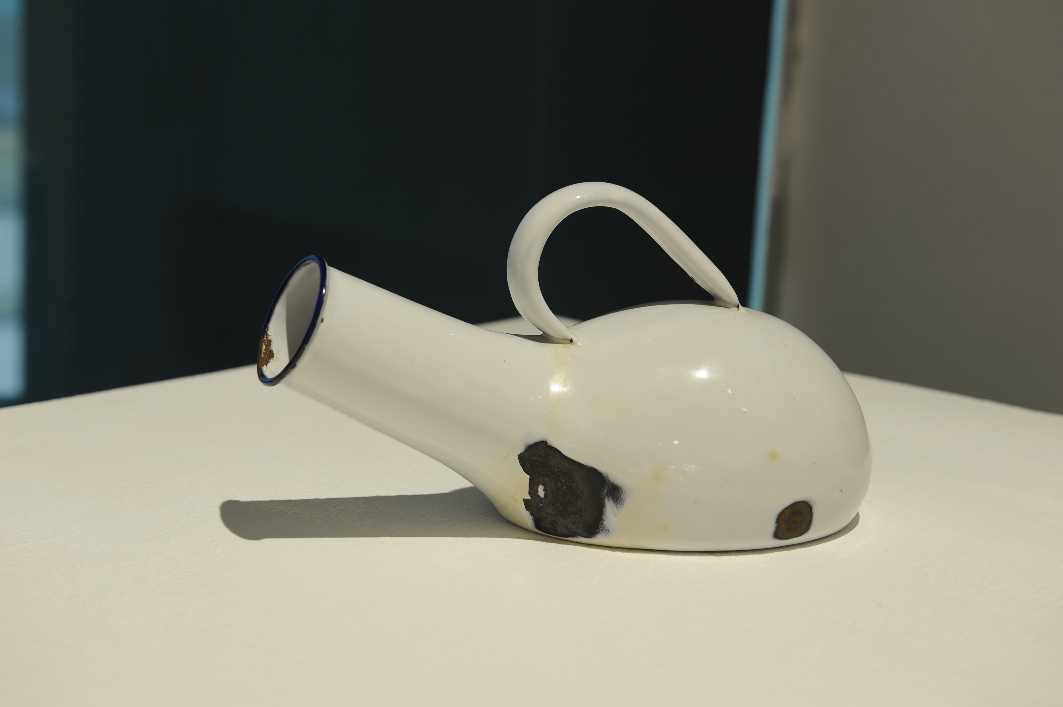
This readymade or found object alludes to that infamous incident at the Dewan Bahasa dan Pustaka in 1974, when Reza Piyadasa and Sulaiman Esa’s seminal Mystical Reality exhibition received a drenching (literally ) criticism from the enfant terrible of the Kuala Lumpur literary scene, Salleh ben Joned. While Salleh himself writes of the “simple act of unzipping my trousers and zipping up my mouth” he was undoubtedly itching (to use another bodily metaphor) to explain his position. In an open letter titled “Kencing dan kesenian: surat dari Salleh Ben Joned untuk Piyadasa,” published in 1975 in the Dewan Sastra, he responded to Piyadasa’s challenge to give the rationale for his uncouth (kurang ajar) gesture of pissing on the Mystical Reality manifesto in the corner of the exhibition space during the opening.
At the heart (perhaps this is the wrong bodily metaphor) of Salleh Joned’s gesture there seems to have been a critique of what he saw as Mystical Reality’s confusion of the relationship between art and life. Here is what he says “Piya! Piya! You want art, but how confused you are about what art is. You want reality, but how innocent you are about reality. Reality? Just remember the rainbow arc of my piss, the fountain of life affirms and celebrates the unity of reality: the vulgar and the refined, the bawdy and the spiritual, the concrete and the transcendent, the stinking and the mystical, the profane and the sacred.” The intrepid and insightful art collector, Pakhruddin Sulaiman, has given us a record of Piyada’s own response to being on the receiving end of this savage lesson in the Zen of art. He writes, “Rupa-rupanya, menurut Piyadasa, wujud seorang “mahaguru” Zen yang telah berjaya “mengajar” mereka berdua (yang masih “greenhorn” dalam falsafah Zen pada waktu itu) secukup-cukupnya tentang apa itu Zen sehingga serangan “mahaguru” itu tidak terbantah oleh mereka.”
My own gesture of presenting this enamel urinal along with the title “Air Abang Salleh” pays homage to Salleh Joned’s masterful deconstruction of the salient pretension of Modern Art – the interchangeability of art and life. There is also, however, in the respectful honorific “Abang” of my title, a gentle critique, much more in keeping with Malay decorum (adab), of Salleh Joned’s own pretensions to radicality. He has after all, in spite of all his ill-mannered and uncouth anti-traditional posturings, which many of his contemporaries found most offensive, been lifted up, out of the 1970’s Kuala Lumpur underground, and assimilated into the canon of modern Malaysian culture.
Air Abang Salleh, circa 2013 is on display in the Pokok Pauh Janggi exhibition which runs from 5th Aug – 30th Sept 2023 at the Kapallorek Artspace in Bandar Seri Iskandar, Perak.
I was saddened to hear of the passing of my friend and fellow Malaysian Indian artist Kanniah Tangarajoo on Malaysia’s 66th National day, a few days before his own 66th birthday. I only got to know Raj well late in his career but had the honour of being asked to officiate his solo show, ‘The Pulse of Creation’ at the NSTP Gallery in January 2016. The above image is the prized gift he gave me to mark the occasion. While my own approach as an artist involves conceptualism and more indirect forms of expression, my early drawings and paintings were rooted in the same vitalism and mind-body connection that I saw in Raj’s work. I felt a deep empathy but, more significantly, I saw in the exhibition, the fruits of a lifelong commitment to developing a graphic expression of an inner impulse – an impulse so deeply set that the resultant drawings (the works were mainly rendered in line) seemed to visualize vast expanses of the cosmos and the inner workings of matter itself. I was deeply moved by his vision and extremely happy to deliver the opening address. Rest in Peace Thangarajoo.
‘Traces, Legacies, and Futures’ was a conversation on electronic art between Hasnul Jamal Saidon and myself, presented under the auspices o the Muzium dan Galeri Tuanku Fauziah, mediated by Ropesh Sitharan. It took place at 9pm (MYT) on 30 September 2020.
Synopsis: The practice of art is contextual in that it is responsive to, or critical of, the time in which it is performed. Especially a work of art that invites us to foresee the possibilities to come, akin to a message that tries to teach (some say warn) future generations. In this sense, an artist is not someone who mimics the ordinary for a palatable outreach, but who is ready and willing to use their talents to challenge norms and shift perceptions. This casual conversation with Hasnul and Niranjan probes such significant efforts of ‘shifting’ in their art practice – what we have come to refer to as ‘new media art’ today. It will address the diversity and the various trajectories in their practice that have substantially contributed to the ongoing conversations about art, culture and technology in our lives today. Indeed, it is hoped this conversation on past ideas, expressions and arguments by them will help preserve their legacy and launch critical inquiry into the future of electronic art in Malaysia as these ideas find their way to the relevant institutions.
One of the highlights of my days as an early Internet artist in Malaysia is being invited as a guest at Michael Heim’s (author of The Metaphysics of Virtual Reality) virtual world Cyberforum as a guest in 2000. Other speaker that year were leaders in the field – Cliff Joslyn, David Weinberger, Howard Bloom, Francis … Continue readingEarly Internet Art in Malaysia 12
Between 1997 and 1998 Dr. Raman Srinivasan of Chennai and I collaborated to build, theorize and install a virtual temple on the Internet. The Temple was built in VRML in Chennai and located on a server in Sarawak. It was presented to the international interactive arts community in a paper titled Sacred Art in a … Continue readingEarly Internet Art in Malaysia 11
In 1999 Hasnul Jamal Saidon and I founded the pioneering Eart ASEAN Online portal which, as the text on the homepage used to say, was an “interactive resource for electronic art in Southeast Asia. This site consists of a comprehensive Database of new media art including profiles of artists and samples of artworks, a Journal dealing with the historical … Continue readingEarly Internet Art in Malaysia 10
In 1999, I curated the first exhibition of online artworks in Malaysia for the ‘4th International Ipoh Arts Festival.’ The artists in the show were all students and faculty from the Faculti Seni Gunaan dan Kreatif (FSGK), Universiti Malaysia Sarawak (UNIMAS). Indeed, between 1995 and 2000 Hasnul Jamal Saidon and I had worked to established … Continue readingEarly Internet Art in Malaysia 9
I had begun my practice as an artist in the late 1980’s with a series of paintings and had moved onto a more self-consciously critical performance/ installation practice when, in 1995, I found the World Wide Web, with its capacities for instantaneous connectivity, hypertextual linking and multimedia convergence. I then transferred my practice to this … Continue readingEarly Internet Art in Malaysia 8
One of the themes of my work in the 1990’s was a reclamation of the international contemporary art discourse from a national perspective. If postmodernism had displaced the hegemony of international of modernism with a disruptive array of regional, national and marginal discourses. While my own work was clearly located within the ambit of this … Continue readingEarly Internet Art in Malaysia 7
In 1998, I made my 2nd web art work titled La Folie de la Peinture (The Madness of Painting), fragments of which are archived on the Wayback Machine site. This was a comprehensive, if condensed, articulation of my critique of the movement from modernist abstraction, via conceptualism, to the photographic ontology of postmodern installation and … Continue readingEarly Internet Art in Malaysia 6
When the INET (annual Internet Society conference) came to Malaysia in 1997, I presented a paper titled “Art After the Internet: The Impact of the World Wide Web on Global Culture.” In this paper I analyzed how the Internet. was being shaped by various national and transnational forces and how esoteric postmodern theories were turning … Continue readingEarly Internet Art in Malaysia 5
In the introduction to his profound work on the cinematic image, Signatures of the Visible, Fredric Jameson writes, “The visual is essentially pornographic, which is to say that it has its end in rapt, mindless fascination.” Explicit pornography is thus the acknowledgement of the true nature of the filmic image, a “potentiation” of its call … Continue readingEarly Internet Art in Malaysia 4
In 1993 I made my first trip to New York. My wife Jane and I were living in London and had bought a Hoover vacuum cleaner. As part of the infamously disastrous (for Hoover) promotion of the time we got two free tickets to New York. I had, as an artist from Malaysia practicing in …
In 1996 I made a web work titled The Failure of Marcel Duchamp/Japanese Fetish Even! which is the first Internet art work in Malaysia and, as far as I know, also in Southeast Asia. This work was both an admiring tribute and a harsh parody of Marcel Duchamp’s Étant donnés (Given: 1. The Waterfall, 2. The … Continue reading
In reflecting on my engagement with the art of Jeganathan Ramachandran, I clearly recall including his paintings in the exhibition I curated for the Balai Seni Lukis Negara in 2002 titled Bara Hati Bahang Jiwa. The exhibition was premised on the need to reconsider the established narrative on Expressionism in Malaysian art from the perspective of a post-colonial recovery. Skirting the pitfalls of essentialism and nationalism, I pitched the reconfiguration in terms of ethnic, ethnographic, regional and national considerations. I identified the underpinnings of a Malay approach to ‘expressionism’ and presented the representative artists this within a boarder national overview, placing the dominant Malay idiom within the wider pool of contemporary Malaysian expressions.
While my thesis was couched in the aesthetic and emotional proclivities of the Malays, I included Chinese and Indians artists even though they disrupted my neat Nusantara schematization which emphasized indigenous psychology and culture (amok, latah, adat and adab). I decided that I would try negotiate the essentially Malay aesthetics of my curatorial theme with the overarching multiethnic realities of the nation. The Indian and Chinese artists did not fit in neatly within my theme and, In this regard, I must acknowledge that, as a whole, Bara Hati Bahang Jiwa was somewhat unresolved, perhaps it was unresolvable by definition … as unresolvable as the idea of the Malaysian nation itself!
Given that I was going to include an Indian artist in the mix, regardless of the goodness of fit, I needed to identify an artist whose work exemplified and encapsulated contemporary Malaysian Indian expression on its own terms … Who would it be? ….. Jeganathan Ramachandran had been making his presence felt in the contemporary scene since the mid 1990’s, with his powerful figurative paintings. Having studied sculpture, woodcarving and painting from a traditional perspective, Jeganathan had been developing a direct and personal mode of expression that was nevertheless steeped in traditional Indian philosophy, psychology and science. I saw in his work the complete Malaysian Indian expression – religious, spiritual, mythical, metaphysical and, most importantly, social.
In a note sent to me in the course of our communication after the ASEAN Art Awards 1996 Jega had said, “I have always believed that art is not just a decorative medium but a powerful tool of expression and the deeper I looked within the Indian art context I saw the vast symbolic expressions that exist within the ‘rigid style’… Then I started painting in a narrative form much like the old times. Nearly every painting of mine had a story and every symbol I applied, new and old, further enhanced the story. During this time my involvement in spiritualism introduced me to many wondrous expressions and their visual impressions upon my mind took on new shapes and I started depicting them in my paintings.” Just as the Malay artists I had selected seemed to carry their particular traditions and psyche into the contemporary idiom of ‘Expressionism, Jega brought forth a deeply Indian expressiveness.
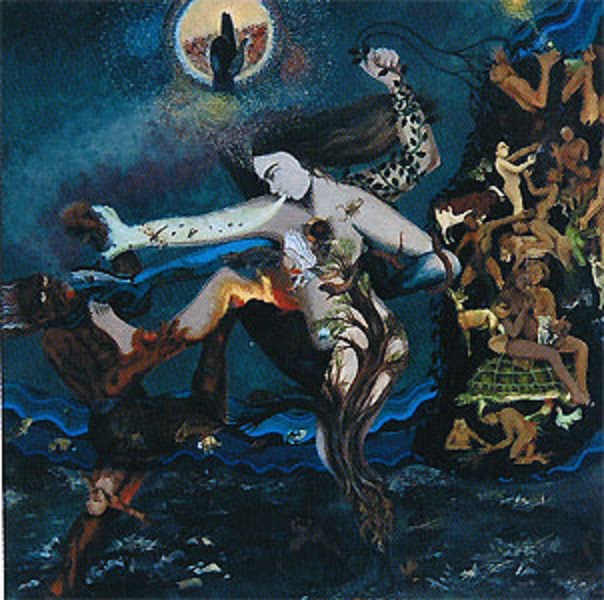
I included 4 of Jega’s works in Bara Hati Bahang Jiwa – ‘Invocation’ (2001) and ‘1 Tree = 40 Life Forms’ (2001) reflect this quest for a spiritual expression, with different degrees of reference to aspects of lived experience. ‘The House Slave’ (2001) is a response to the suffering of a friend in an abusive situation and a reflection on the plight of women caught within Indian social norms. Pictured above is the most expansive of the 4 works, both in scale and in thematic. It is titled ‘Fallout in the Garden of Life’ (1998). The artist has said “Kali is nature and she is fighting everything unnatural which has created imbalance on earth and all the people in the boat- like thing, that Noah’s Ark (my version). My belief is that nature will always protect those who are natural and the five hands represent the five elements (pancha butham). And notice the tree, that’s where it all starts.”
Rest in Peace Jega – Kali Kali Mahakali!
The above is a modified extract from my essay ‘Expression and Expressionism in Contemporary Malaysian Art’ published in 2002.
Reference: Rajah, Bara Hati Bahang Jiwa: Expression and Expressionism in Contemporary Malaysian Art, Kuala Lumpur: Balai Seni Lukis Negara, 2002.
With the sudden passing of Jagannathan Ramachandran Malaysians and Malaysian Indians in particular have lost a great practitioner of the arts, one who has bridged the traditions and techniques of his Indian legacy with the forms and formats of a modern Malaysian presentation. Jega’s life and work has embodied an exemplary post-traditional focus within the ever widening milieu of Malaysian contemporary art. I have known Jega since the beginning of his entry into the Malaysian mainstream and have written a little about the importance of understanding his approach properly.
In Malaysian modernism there is the official narrative of Islamic spirituality (see my essay “Insyirah Al Sadr: The art of Sulaiman Esa.) and then there are a whole host of other traditions that subsist and coexist, emerging and receding from prominence in the contemporary discourse. Following is an account of a personal encounter with Jega. One could say that, at this time Jega was an Indian artist, who determinedly been practicing Tantric methods of visualization on the periphery of the Malaysian mainstream. I met him after having been on a panel of judges that had selected his ‘Seeking an Answer: The Indian Migration’, 1996, for inclusion in the Phillip Morris Malaysia / ASEAN Art Awards exhibition 1996. We exchanged vanakams (greetings) and addresses, and some time later I received a package in the post containing examples of his work which I had asked for. I was surprised and disturbed by one of the works. It was an idealized portrait of myself in line and verse which seemed to have echoes of lord Shiva Nadaraja. I was embarrassed and considered writing back admonishing him for flattery and the cult of personality. Somehow, I did not write back but was left, nevertheless, pondering this image of myself. I felt there was some truth in the idealization but this made me even more upset as I felt, in contemplating this image, the expansion of my own ego.
Much later, it came my understanding that it was not the artist but the model who had responded inappropriately … I had taken the image personally! In this connection and as a kind of mitigation of my egocentricism, I must ask – which modern person would not have done so, it was after all ‘my’ portrait. I was wrong, of course! Jeganathan had received training in the arts of meditation and Samudrigham from a Himalayan master named Bootha Muni. Samudrigham or Samudrika Shastra is a descriptive art and part of a symbolic system based on the study of bodily features. Jeganathan explained that unlike in the West where physiognomy is defined as physical attributes which may index the individual’s personality, Tantra sees it as the link between man and the cosmic force. Every expression is brought through in the state of meditation and that which is formed in the moment of totalness, in pure slumber, can be nothing but creative impulse of the Maker … and by Maker, the great Maker of all!
Rest in Peace Jega – Om Nama Shivaya!
The above is a modified extract from my paper ‘Sacred Pictures Secular Frames’ published in 1998.
Reference : Rajah, N. ‘Sacred Pictures Secular Frames’ in Art Asia Pacific 17, 1998: 67-71. Rajah, N. “Insyirah Al Sadr: The art of Sulaiman Esa.” in N. Rajah, ed. Insyirah: The Art of Sulaiman Esa from 1980-2000. Kuala Lumpur: Petronas, pp. 31-64, 2001
The official opening of an exhibition of the hitherto unreleased drawings of Zulkifli Dahalan was held on the 17th of May at the National Art Gallery, Kuala Lumpur. This exhibition was curated by Nur Hanim Khairuddin who kindly included an essay by myself in the catalogue. After I had completed and submitted my essay to Hanim, I was alerted to Hasnul Jamal Saidon’s extended review of the then newly released film Arrival on his Jiwa Halus Blog. The review was titled THE LATE ARRIVAL OF NON-LINEARITY: A NON-OBJECTIVE REFLECTION ON THE MOVIE “ARRIVAL” and was written as a series of three letters to the films director. I was delighted to find that Hasnul had chosen to conclude PART 3 of this innovative series by citing my own application of Keith Critchlow’s ideas on geometry in my essay on Sulaiman Esa for his Petronas Gallery retrospective Insyrah. Indeed, in Islamic geometry, the extension from point to line to plane, and back again, carries the allegory of space into that of time. The non-spatiality of the point in geometry and the bindu in Tantra are indifferent from the intemporal consciousness of the Sufi Ibn al-wakt or ‘son of the moment’. Beyond my superficial delight in finding my name at the ‘point’ of closure of Hasnul’s marvellous serial letter, I was profoundly moved by the fact that after nearly two decades with only occasional contact, our inner rhythms seem to be in perfect synchronicity. You see, Hasnul had appraised Arrival in terms of abstraction, geometry and the Islamic ideas of Shirik (interdiction against life-like representations or concentrations), Tawhid (multivalent singularity) and Fitrah (the original state of man). And I, in my newly submitted catalogue essay, had attempted to interpret the figuration and humanism of Zulkifli Dahlan in exactly the very same terms.





 The official opening of an
  The Koboi Project
You must be logged in to post a comment.