Tok Dalang Cina

Eyo Hock Seng is a Kelantanese Wayang Kulit Dalang who has been practicing his craft for over 40 years. Today he is one of eight or nine wayang kulit Dalangs who are performing today. Not only is he a Chinese master of this Malay
art form, but he might also even be credited for keeping the form alive in Kelantan for 30 years during which the PAS State government had banned Wayang Kulit in Kelantan. He tells of how he was one of eighteen Dalangs in the State
when they all called to a meeting with the late Tok Guru Nik Aziz (Menteri Besar of Kelantan from 1990 to 2013 and Spiritual Leader of PAS until his death in 2015) in 1999. As Hock Seng recalls, when they were asked to perform
for Tok Guru, they did so with all the traditional ritual accouterments, including spells and glutinous rice offerings. The result of which is that Wayang Kuilt was banned, due to its unIslamic elements (Animist, Hindu/Buddhist).

In fact the Kelantan state government officially banned cultural performances like Mak Yong and Wayang Kulit under
the Entertainment\ and Entertainment Premises Enactment 1998. The Dalangs had to migrate to other states in order to continue their art and many gave up altogether. Eyo Hock Seng was the only one permitted to continue the practice as he was not a Muslim but he was restricted to presenting his Wayang in the Chinese and Siamese districts. During this time Eyo Hock Seng grew in stature as a performer and gained an international reputation. It was only in 2019 that the ban was lifted, with the proviso that there were no unIslamic elements of worship in the performances. Hock Seng laments that there were not many of the old Dalangs left who could return to the practice after the passage
of twenty years, as many had given up altogether and had sold their puppets and musical instruments during the ban.

The following questions relating to this episode in the history of Kelantanese Wayang Kulit inform my own Pokok Pauh Janggi performance (see notes)
1. To what extent can Malay culture be isolated from its pre-Islamic roots?
2. To what extent can the elements of pre-Islamic Malay culture be accepted within contemporary Malay Islam?
3. To what extent does contemporary Malay culture remain contigious with the wider spirit of the Archipelago?
4. To what extent can a contemporary citizen of Malay lands be assimilated to Malayness without being a Muslim?
5. Can only non-Malay/Non-Muslims perform and preserve Malay traditions that are presently considered unIslamic?

The first three questions pertain to the essence of Malay culture. The fourth and fifth question reflect on the significance of non-Malay/ non-Muslims performing, identifying with and preserving Malay cultural forms, Thes last questions index the prospect of an integrative, integral even, Malaysian identity.

https://worldofbuzz.com/un-official-wants-kelantan-to-lift-ban-against-traditional-art-like-mak-yong-wayang-kulit/

https://www.malaymail.com/news/malaysia/2019/09/25/kelantan-lifts-mak-yong-ban-after-two-decades-but-insists-performances-must/1794202

The Appearance of a Fact ataupun Batu Kasih Piyadasa, circa 2007

This work is what I call a ‘deep readymade’, by which I mean there is a gesture or configuration by another actor being interpreted or articulated in the work. A deep readymade is thus differentiated from a simple readymade, in that there is a juxtaposition of components done by someone other than the artist. The primary component of this work is a carved wooden Ganesha which was once in my late mother’s possession. When my mother was alive, this Ganesha used to sit on the wall, above her prayer altar and would receive flowers in the course of her daily worship. It is an item she and my father brought back from one of their trips to India and Sri Lanka. While my father was born in Seremban, Malaysia, my mother, myself, and my sister Shyamala were born in Jaffna, Sri Lanka. We are Jaffna Tamils and Sri Lanka is in some sense our homeland.

The second component of this deep readymade, is the white stone, a large, well-worn pebble that was picked up on a Sri Lankan beach by the renowned Malaysian artist Reza Piyadasa on his first trip (date uncertain but a book that I believe was presented at the same time is autographed and dated 1995) to Sri Lanka (his own ancestral homeland) and brought back for my mother. The late Reza Piyadasa was a Sinhalese Malaysian and the stone was a deeply meaningful exchange of a piece of Sri Lankan earth (bumi) between two Malaysians, one Sinhalese, the other a Tamil – two people whose communities were at war in their homeland. As Malaysians, however, these two people were at peace with each other, falling together in the shared category of ‘Malaysian Indian’. My mother placed this stone, which was so lovingly brought for her by Piyadasa, at the feet of Lord Ganesha and it has remained there ever since. Beyond this complex image of the interplay of race and nationality in human relations, there is, embodied in this readymade, the personal relationship between Piyadasa and my mother. Piya had lost his own parents relatively early in life and, somehow, he formed a close attachment to my parents. They were his guests when he received the prestigious Prince Claus Award in 1998, and later, in 2007, he called them to his hospital bedside when he was close to the moment of his passing.

In titling this piece ‘The Appearance of a Fact ataupun Batu Kasih Piyadasa’, I pay a tribute to the striking conceptualism of Pia’s early output, while offering a way through its solipsistic reflexivity. In a piece titled ‘A Fact Has No Appearance’, 1977, Pia created an ouroboros-like liaison between form and concept. The piece consisted of a box, part painted, part bare wood, a painted ovoid form, probably made of plaster, and the stenciled text A FACT HAS NO APPEARANCE. It is indeed true that a fact is immaterial and, as such, has no appearance; even while an appearance, which is material, is, indubitably, a fact! In my readymade, we have a material configuration that presents, in its appearance, a simple fact – the fact of love.

The Appearence of a Fact ataupun Batu Kasih Piyadasa, circa 2007 is on display in the Pokok Pauh Janggi exhibition which runs from 5th Aug – 30th Sept 2023 at the Kapallorek Artspace in Bandar Seri Iskandar, Perak

My First Rodeo 2

The Koboi Project centres on the question of identity and its relationship to authenticity. I dress as a cowboy, both in performance situations and in my private life. Indeed, I am very comfortable with this eccentricity of mine, so much so that, in some ways, I feel that I am a cowboy, albeit an urban cowboy who has never ridden a horse and has very little to do with cows. As a vegetarian, I do not even eat them. In my daily life, you could say it is my style. When I perform in Southeast Asia it stands for my return from the West. But what happens to the authenticity of my persona when I venture into real cowboy country.

Recently, at the Cloverdale Rodeo, I gained some insight into the nature of my Koboi persona and even the nature of cowboy persona itself. At the heart of the rodeo is the image of the pesky, spunky cowboy prevailing over the ornery Bronco, kicking and bucking to get him off its back. In my observation at Cloverdale, however, there seemed to be a little bit of a disconnect. Indeed, the horses buck violently, and the Cowboys hang on valiantly and skillfully, but are the horses bucking to get the cowboys off or are they bucking for some other reason? There is, in this context, a debate about the use of spurs and the application of pressure around the horse’s belly with what is called a flank strap. Some say the strap brings pain that causes the bucking and others that it merely gives form to the buck.

The BC SPCA says that the flank strap “applies pressure on their sensitive underbelly, causing discomfort. The rider also uses … spurs, to cause discomfort which leads to more bucking. While bucking is a natural behaviour of these animals, in rodeo it is a behaviour rooted in discomfort, not in play.” In other words, it is not as it appears, that the horse is bucking to get the rider off, but as a response to the discomfort caused by the flank strap. The cowboy’s art of hanging on is incidental or secondary to the main action. Proponents of rodeo however, counter with the argument that the horse bucks because it is in its nature and breeding to do so, and that the “flank strap alters the bucking action of the horse by encouraging him to kick out straighter and higher with his hind legs, thus making himself harder to ride. The flank strap stacks the odds in favor of the horse. It cannot make him buck.” With regard to the spurs, they insist that they are required to be blunt and spinning and that they also put the odds in favor of the horse, as the forward position of the feet required to spur the horse in the shoulders makes it much harder for the cowboy to stay on.

Even within the proponents’ terms, it can not be denied that there is a sense that the bucking is being induced and conditioned independently of the horse’s impulse to get the rider off its back. The horse is just bucking independantly and the rider holds in an illusion of relationship. The question of cruelty aside, the rodeo cowboy’s ride is a performance, and not unlike my own Koboi performance, an artifice or fiction of sorts.

https://spca.bc.ca/ways-to-help/take-action/farm-animals/rodeo

https://www.cowboyway.com/BroncRiding.htm

About the Koboi Project

The Koboi Project is an expression of my search for an integral identity, across the gaps of an inter-generational diasporic experience, within the context of the contemporary crisis of globalization. The Koboi Project integrates its own abiding tropes – the ‘black hat cowboy and the ‘SUPERSTAR’ with the idioms, myths, and contemporary issues of each place of performance or presentation. An important aspect of the work is the circulation of its messages via a range of media, beginning with the megaphone and the banner as primordial transmitters of word and image. The Koboi Project is realized and disseminated by way of photographic prints, performances, installations, and online images/ social media. Among the imperatives of this autobiographical photo-performative project is the development of a deep engagement with place and people. This involves an immersion in the social history, popular culture, language, and religion of the places involved.

The most recent Koboi Project presentation is the Pokok Pauh Janggi exhibition at the Kapallorek Artspace, Bandar Seri Iskandar, Perak in Aug/Oct 2023.

Malaysian Indian Artists 2

In his article on Malaysian Indian artists published in the Penang Monthly, Ooi Kok Chuen writes of J. Anu and myself both being of Sri Lankan Tamil descent. This observation, in the context of the question of Malaysian Indianness, raises two concerns pertaining to blood ties, one intimate and familial and the other, public and communal.

The first is a fact – I am proud to note that Anu and I are not only members of the same community, we are of the same family. Anu’s mother Gana, whom I call Acca, is my cousin, and this relationship is celebrated in an image of the Koboi Balik Lagi series of the Koboi Project.

4 Ikatan Pertiwi
4 Ikatan Pertiwi, Koboi Balik Lagi, https://koboibalikkampung.wixsite.com/baliklagi

The second is a question that underpins Ooi’s own pertinent question – ” WHY ARE THERE so few artists of Indian (including Singhalese) descent in Malaysia?.” It is this – Who is Indian in the Malaysian context? As I have noted in a previous post, Ceylonese Tamils in Malaysia have historically tried to preserve a distinct identity from Malaysian Indians. We have our own organization, the Malaysian Ceylonese Congress (MCC), that has been traditionally aligned to Barisan National. Although the MCC is not a registered political party, it had, until 1981, a senator in the Malaysian parliament’s upper house, the Dewan Negara. However, as Suhaini Aznan notes, Malaysians do not recognize the difference between Indians and Ceylonese and in the 2000 census many Ceylonese were counted as Indians. In this light, MIC seems to have invited the Ceylonese to join up with the Indians but, as Aznan notes the Ceylonese declined. He explains, after Datuk Dr N.K.S. Tharmaseelan, president of the MCC, “every race wanted its own identity to survive.”

It is my own opinion that Malaysian Tamils of Ceylonese origin should, to the extent that the Malaysian Indians will accept us, be absorbed into the category and identity of ‘Indian’. It is not a question of renouncing ones Ceylon Tamil background but, rather, of integrating it into the wider Malaysian Indian mosaic. Regardless of my own identification, however, the question remains, “are Ceylonese Tamils included in the category ‘Malaysian Indian’?” The question of Indianness does not stop here. It is clear from Ooi’s placing ‘including Singhalese’ within parenthesis in his question, that even he feels his placement of this other Ceylonese community within the Indian category is questionable. And then there is the question of the Mamak or Indian Muslims – it is unclear if they would all be equally happy with the highlighting of their belonging to the Indian category, as some might be in the process of transferring their identity into the ‘Malay’ category’.

Returning to the first concern, that of family, artist T. Selvaratnam is related to both Anu and myself, but that is a story for another blog post.

https://penangmonthly.com/article/20432/spotlight-on-indian-malaysian-artists?fbclid=IwAR3CB_s6jMPFH2A8P-4UcFwKXz6oUzjwBn7aRXijHkPNp35Aob8d9iE5Gto

https://en.wikipedia.org/wiki/Malaysian_Ceylonese_Congress

https://www.thestar.com.my/opinion/letters/2005/03/27/standing-up-for-the-ceylonese

12 Praxis

Keling Maya: Post-traditional Media, Malaysian Cyberspace and Me, presented at the Aliran Semasa Symposium, 2013, at the National Art Gallery, Kuala Lumpur.

0 Performance
1 Keling Maya
2 Cyberspace
3 Model
4 Heterotopia
5 Rajinikanth
6 Heroes
7 Telinga Keling
8 Keling Babi
9 Duchamp
10 MGG Pillai
11 Pantun
13 Dochakuka
14 Post-tradition
15 Philosophia Perennis

6 Heroes

Keling Maya: Post-traditional Media, Malaysian Cyberspace and Me, presented at the Aliran Semasa Symposium, 2013, at the National Art Gallery, Kuala Lumpur.

0 Performance
1 Keling Maya
2 Cyberspace
3 Model
4 Heterotopia
5 Rajinikanth
7 Telinga Keling
8 Keling Babi
9 Duchamp
10 MGG Pillai
11 Pantun
12 Praxis
13 Dochakuka
14 Post-tradition
15 Philosophia Perennis

Telinga Keling (1999)

Telinga Keling, Silver Halide Print, Niranjan Rajah, 1999. Permanent Collection of the National Visual Art Gallery, Kuala Lumpur

Updated on March 29th 2021:

With reference to the recurrent controversies around the use of the term ‘keling’, and with particular reference to the recent Dewan Bahasa dan Pustaka (DBP) inclusion of the word “keling” in its definition of “tambi,  there is no need for hysterical reaction from Indians about the presence of the word Keling in the Malay lexicon and publications in the Malay Language. After all if Indians think about it carefully, ‘thambi’ itself is problematic, as it can reflect status, class and cast when used to refer to adults. In fact it is far more troubling that we use the word ‘pariah‘ as a put-down in English as well as in Malay with scant criticism. However, it reveals an extremely poor standard of scholarship and professionalism on the part of the DBP that they have used the term ‘keling’ as an index for ‘Indian’ in the contemporary setting. Yes, this failure to recognize that the main contemporary usage of of the term is to put Indians down, might even reflect a systemic (unconscious) racism in the esteemed authority in whose care we have put the future of the Malay Language.

Telinga Keling (1999) is in the collection of the National Visual Art Gallery in KL. It is currently (oct 15 2019) on display again in a selection from the collection. ‘Keling’ is a today taken as a derogatory term for ‘Indian’ although, from its etymology, it is clear that this was not always so. The items obscuring my ears in the image are Malay sweets which are colloquially referred to as ‘Telinga Keling’ (Indian Ears). More formally and publicly, given our multi-racial Malaysian society, these cakes are referred to as ‘penyaram’ or ‘denderam’. Ironically, this Telinga Keling sweet is quite likely to be of Indian origin. My mother used to make something that tastes exactly the same that we call it ‘athirasam’

The idea of the piece is that I can engage the Malay viewers regarding this juncture of ‘sweetness’ and ‘derision’ while excluding the others, who would likely be unfamiliar with the cake’s colloquial name. Of course, there’ll be some Indians who know, particularly those from Kelantan where the sweet is prevalent, but empirically speaking, during the opening of its inaugural exhibition in Kuala Lumpur, the Indians had no idea and kept asking, ‘Why did you insult yourself in this work? ’, The Malays, however, smiled at me in and nodded in awkward acknowledgement.

https://malaysia.news.yahoo.com/ramasamy-tells-dbp-remove-racist-020100995.html

Cowboys & Indians:Tokyo 2

truth

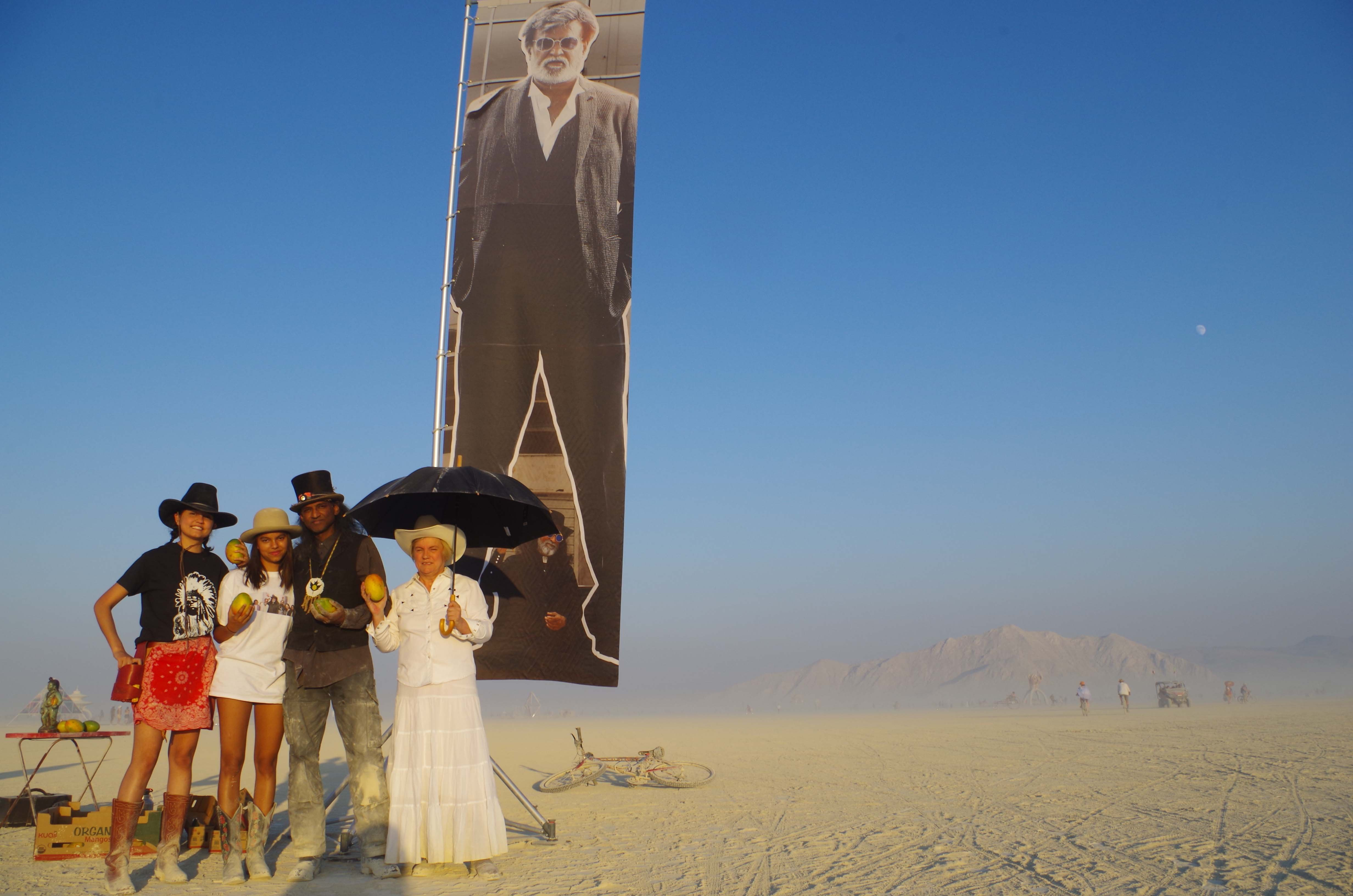
Cowboys and Indians: Tokyo Edition, to be presented at Courtyard Hiroo Gallery on 11th May 2018, is the sencond installation/ performance of ‘Cowboys and Indians’, the 6th series of the Koboi Project. The first edition was presented at the Burning Man Festival in the Nevada Desert in 2017. The overarching Koboi Project is photo-conceptual work involving installations, traditional icons, story telling and performance elements. It is a transnational epic, presented as the adventures of my persona – the ‘Black Hat’ Cowboy, through whom I present my life as my art, as I explore my identity as a Malaysian, as an Indian, as a British Columbian and as a citizen of the world.

https://koboibalikkampung.wixsite.com/momo/proposal

Kaala Karikaalan

kaala

As Rajinikanth fans anticipate the April 27th 2018 release of Kaala Karikaalan, the Koboi Project is glancing off the SUPERSTAR’s look for the movie. While as a fan, I relish the simple pleasure of ‘being’ the Thalaiva, as an artist,  I am cognizant of the aesthetic and critical connotations of my play.  Is this a pastiche or a parody, and if it is a parody – what is it a parody of? What is the measure of similitude, how much ‘looking like’ does it take to ‘look like’ or signify another person or persona? What is the threshold of sufficiency? Is such similitude founded on ethnic, even ethnocentric, notions of identity? What is the inner dimension of such a representation? Hoe does one actually form a meaningful image of another? When does homage become piracy? What, beyond context, is the difference between a popular and a fine art image in the contemporary taxonomy of the arts? Most poignantly and pertinently, Kaala may be the last of my easy and heartfelt appropriations of the SUPERSTAR’s image as, having launched his political party in Tamil Nadu, he is now on the cusp of announcing his manifesto. Along with Thalaiva’s long-time college in the Movie business, and now political co-aspirant, Kamal Haasan, I fear that Rajinikanth’s avowed ‘spiritual politics’ will take on the saffron hues of Hindutva.

Image: https://www.thenewsminute.com/article/kaala-team-miffed-leak-stunt-sequence-76315

https://www.ndtv.com/tamil-nadu-news/at-harvard-kamal-haasan-says-hope-rajinikanths-colour-isnt-saffron-1811209